
How to Read Gold Market Bias Before the New York Open - A Working Framework

I used to do almost no preparation before the US session. I would glance at the chart, see a candle forming, decide it looked like a setup, and enter.
Some trades were fine. Others were already bad before they started - spread elevated, a US release ten minutes out, price sitting directly into a level London had tested three times. At the time I blamed the signal. Looking back, the problem was simpler: I had no pre-session routine.
After enough of those, I started treating the 30 minutes before New York as non-negotiable prep time. Not because I found some methodology that removed uncertainty. Just because I kept losing in preventable ways.
This is the routine I use. It won't remove unexpected volatility. It won't fix a bad broker or a buggy EA. What it does is stop me from improvising a plan after price has already started moving.
One timing note upfront: there is no single universal "New York open" for spot gold. Broker server times and US daylight saving shifts affect everything. The times I mention here are relative to my own setup - convert them before using this as a checklist.
🌟 First: What Kind of Market Are You Actually In
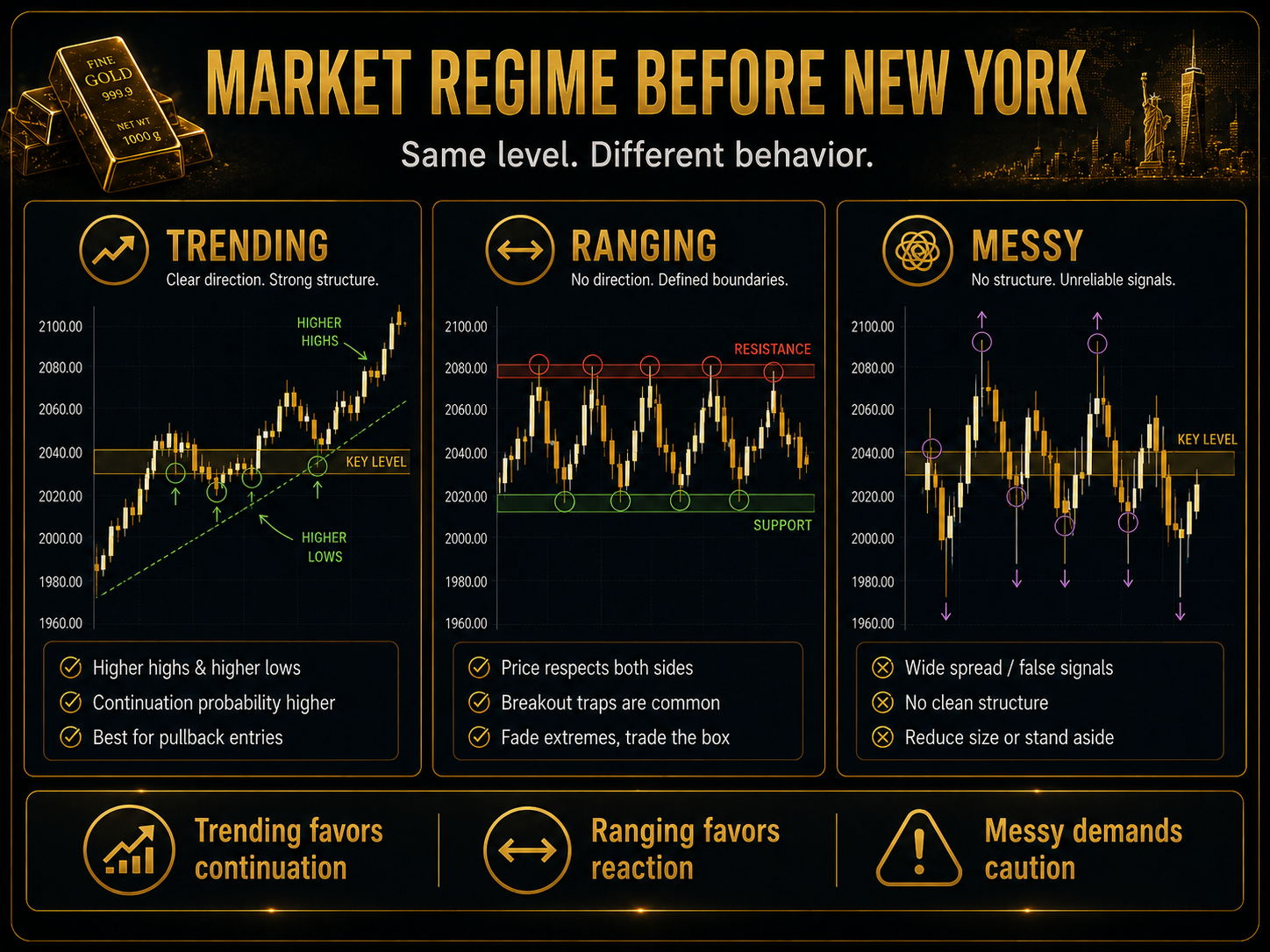
Before drawing anything, I need to know the regime. Not direction. Regime.
I keep the label simple: trending, ranging, or messy.
"Messy" is not a technical term, but it is useful. When I need more than a couple of minutes to convince myself the chart is trending, it usually isn't trending cleanly enough for the type of trade I want. That's a useful signal in itself.
In a directional market, mean-reversion entries get destroyed repeatedly. In a clean range, the first breakout is usually a trap. In a messy session - which tends to happen during news uncertainty or mid-week consolidation - spread is wide, fills are bad, and indicators fire false positives constantly.
Getting this wrong costs money in a specific way: you can run the same EA for two weeks, watch it blow up, restart it, and see it recover. Not because you fixed anything. Because the regime changed.
I use the Gold Bias Regime Filter for this check, but I still compare its output with the chart. If the tool and my own read disagree, I don't automatically assume the tool is right. I either wait or reduce size.
🌟 Where Is Price Relative to Structure
Once I know the regime, I need to know where price is sitting.
In gold, standard support and resistance levels break constantly. A level that held for three sessions can get eaten in 15 minutes when NY volume hits. What matters is not whether a line exists on the chart - it's whether that line has actual liquidity sitting near it.
Before 13:00 UTC, I check three things:
The Asian session range. Where did price consolidate overnight? Is London currently trading above, below, or still inside that range? London often sets the directional bias; NY either extends it or fades it hard.
Yesterday's daily close. I keep this line on every chart. When NY opens clearly above the prior close after a strong London push, continuation is more probable than reversal. Not a rule - an observation I've seen hold often enough to track.
The pre-session range from roughly 11:00–12:30 UTC. Was price forming a tight accumulation block with clean edges, or chopping across an 8-pip range with no structure? A well-defined pre-NY range gives you a cleaner invalidation level. It doesn't tell you which side breaks.
I stopped drawing these zones manually in 2023. Not because I'm lazy - because my manual reads got inconsistent between sessions depending on what I wanted to see. Gold Market Structure PRO MT5 handles the session high/low tracking and structural shifts automatically. I check its output, then decide if I agree.
🌟 The Macro Check Nobody Wants to Do
Open the economic calendar. Look at the next four hours. That's it.
If CPI, NFP, FOMC, or anything USD-moving is scheduled within an hour of your intended entry, your risk profile changes. Gold can move $30–60 per ounce on major releases. More importantly, most ECN brokers widen spreads significantly in the seconds around a release - sometimes to $0.50–0.80 on a pair that normally sits at $0.20.
I've had stops taken by spread expansion, not by price. Setup was valid, SL was reasonable, and the trade closed negative before price moved a single dollar against my position. Then price ran $40 in my direction over the next 20 minutes.
That combination - tight SL, wide spread, scheduled release - is a specific mistake I made multiple times before I started checking the calendar first. If there's a major event within 60 minutes of the session, I either widen the SL and accept worse R:R, or I sit the session out.
🌟 Execution Risk Is Not in Your Backtest
This is the check I used to skip because my Strategy Tester results looked fine.
MT5's variable spread model during backtesting is approximate at best. It does not accurately replicate how your specific broker behaves around 13:00–13:15 UTC on a high-volume day. The gap between backtest equity and live equity in short-term systems is often substantially explained by spread, slippage, and partial fills - not by a flaw in the signal logic.
Check what your broker's spread on XAUUSD actually does during the pre-NY and NY-open window. Log it for a week. If it doubles or triples for the first 10–15 minutes, your entry logic needs to account for that. If your system targets a $15 move but gives up $3.50 on entry costs alone, your edge is much thinner than the backtest shows.
VPS latency matters here too. During a fast NY move, a 200ms round-trip can mean filling materially worse than the price that triggered your entry. How much worse depends on liquidity and broker routing - I can't give you a fixed number because it varies.
My rule: no new entries in the first 5 minutes of the NY session. Wait for the initial spread compression and let the first volatility spike resolve. This costs some trades. It avoids more.
I track real-time spread with Gold Spread Monitor. Mainly it confirms whether conditions are normal or elevated before I commit.
🌟 The Bias Decision
After those four checks, I write down the bias. Usually one sentence.
Something like: Long only if price sweeps the Asian high, then holds above the prior daily close with spread below $0.30. No trade if price is inside the pre-NY chop zone.
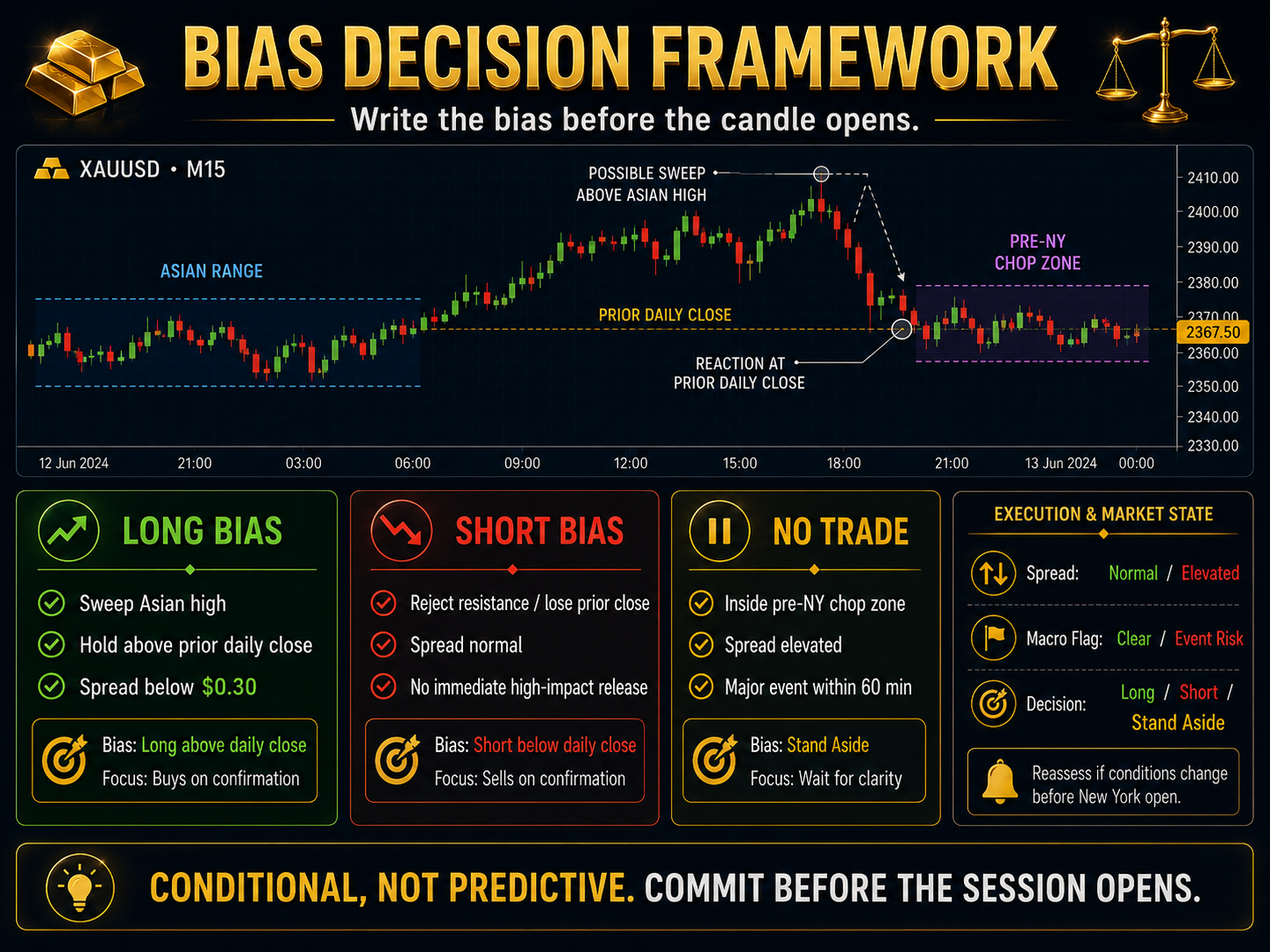
That's a conditional, not a prediction. It means: if X happens, I act. If Y happens, I act differently. If neither happens in the first 30 minutes, I close the chart and move on.
Skipping this step is how I end up chasing candles. A big move prints at 13:02, I don't know if it's with or against structure, FOMO kicks in, I enter, and I get caught in the institutional reversal that follows. Without a pre-committed bias, every session becomes reactive.
The Gold Decision Assistant is what I use to force the commitment. It takes regime, structure, macro flag, and spread state as inputs and produces a hard condition matrix - what has to be true for me to trade long, short, or not at all. The discipline is in doing it before the first candle opens, not after.
🌟 What This Routine Doesn't Fix
Worth being direct about this.
If your broker freezes during high volatility - and some do, I've had it happen on more than one provider - no pre-session prep matters. Your order sits in limbo and fills 25 pips away when liquidity returns.
If a geopolitical headline drops at 13:05, your structure is instantly irrelevant. The bias you formed at 12:45 is based on conditions that no longer exist.
If your EA has a bug that only triggers under a specific spread-plus-time-plus-volume combination - which happens more often than most developers admit - the checklist doesn't catch it. That's a testing problem, not a preparation problem.
The routine reduces bad decisions made from ignorance. It doesn't protect against bad luck, bad infrastructure, or broken code.
🌟 The Actual Checklist
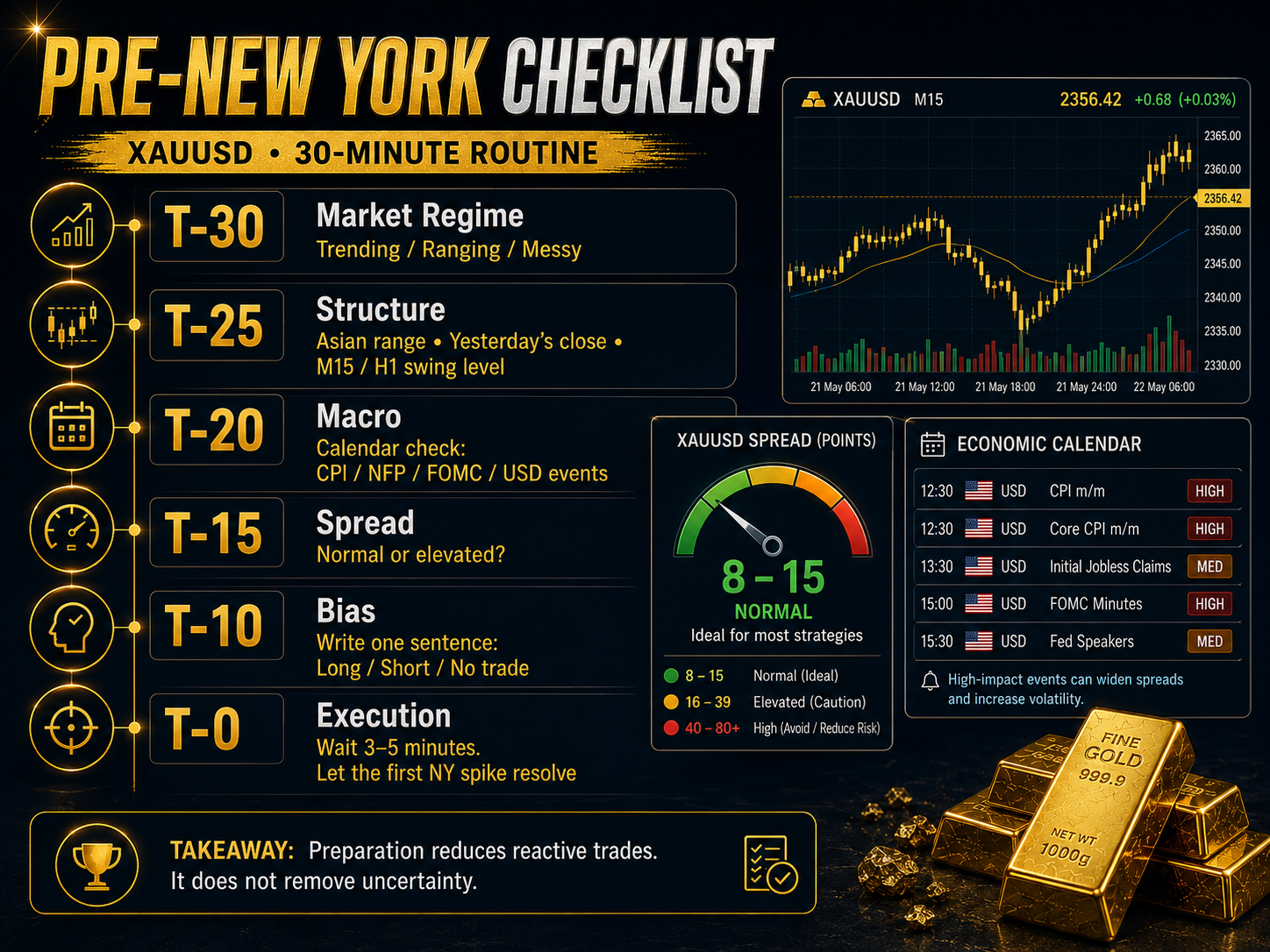
T-30 min: Check the regime. Trending, ranging, or messy? If messy, flag it and lower position size expectations before doing anything else.
T-25 min: Check structure on M15 and H1. Where is the nearest valid swing level? Where is price relative to yesterday's close and the Asian range?
T-20 min: Economic calendar. Anything scheduled in the next 3 hours?
T-15 min: Check current spread. Normal or elevated?
T-10 min: Write down the bias. One sentence. Commit to it before the session opens.
T-0: Don't touch anything for the first 3–5 minutes. Let the initial spike resolve. Execute only if your pre-committed condition triggers.
Some mornings the bias is obvious. Other mornings it isn't - the regime is ambiguous, structure is mixed, and the most honest answer is that I don't have a high-confidence read. Those sessions I either sit out or trade at reduced size. That's a normal outcome, not a failure.
🔥 Final Note
The traders I've seen hold up over multiple years don't have better instincts during the session. They have more structured thinking before the session. The decision isn't made when the candle opens - it's made before it does.
The tools in this workflow - Gold Bias Regime Filter, Gold Market Structure PRO MT5, Gold Spread Monitor and Gold Decision Assistant - are available in the Gold Algo Lab catalog at $39 each. No subscription. The routine can be performed manually; the tools mainly remove repetitive chart-checking and keep the checks consistent across sessions.
For more context on how broker execution affects gold EA performance: https://www.mql5.com/en/blogs/post/769009
🎁 New to Gold Algo Lab?
Start with the Gold Algo Lab Tool Map - a practical guide that organizes our MT5 tools into 6 connected stages: market context, setup selection, risk planning, trade execution, position management and account protection.
→ Gold Algo Lab Tool Map: Where to Actually Start With MT5 Tools for XAUUSD
https://www.mql5.com/en/blogs/post/771930
Do not choose a tool by its name alone. Start with the part of your trading process that needs the most control, then build your workflow one layer at a time.
Gold Algo Lab builds practical, risk-first MT5 tools for serious XAUUSD traders, shaped by 8 years of developing and trading real systems to help traders identify clearer setups, manage risk with greater confidence and execute with more discipline.