Multi-Factor FX Analysis in MT5: COT, CB Rates, Carry, and ESI in One Terminal

Professional FX analysis draws from several distinct data streams simultaneously: central bank policy trajectories, speculative positioning from CFTC reports, carry yield differentials, macroeconomic surprise momentum, options market skew, and cross-asset correlations. Each of these signals lives in a different place — rate derivatives platforms, government data portals, broker swap specifications, options desks.
The practical consequence for a systematic trader is a fragmented pre-session workflow: multiple browser tabs, manual data reconciliation, and the near-certainty that some signal will go stale or be missed entirely during a live session. The larger problem is not data access — most of this information is publicly available — but synthesis: bringing it into a single decision surface where relationships between signals are immediately legible.
This article presents the Global Investing FX Terminal, an Expert Advisor for MetaTrader 5 that addresses this problem. It consolidates thirteen analytical panels into a single dashboard rendered directly over the chart window, drawing from both the MT5 native data environment and an external pipeline that processes publicly available institutional datasets on a continuous basis. A companion web terminal at globalinvesting.github.io provides the same analytical framework in a browser, extending the workflow beyond the trading station.
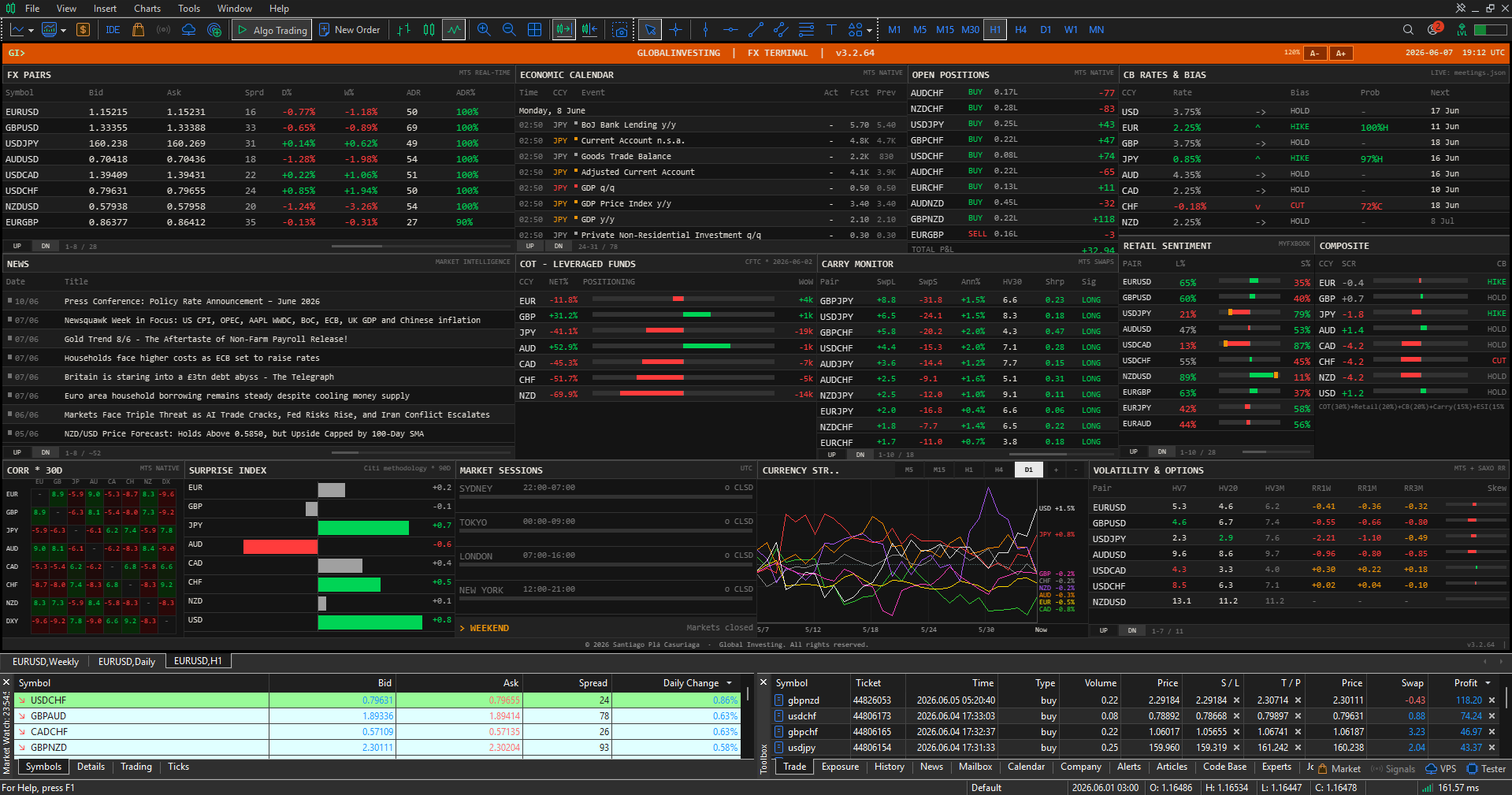
Figure 1. Global Investing FX Terminal — full dashboard overlay in MetaTrader 5.
Analytical Architecture: Thirteen Panels, One Dashboard
The terminal renders as a full-window dashboard — a single canvas-composited frame that eliminates the flicker and partial-refresh artifacts characteristic of object-based dashboard approaches in MT5. The layout adapts to any monitor resolution through a configurable scale multiplier accessible from the top bar (A+ / A−). All panels refresh on a user-defined cycle; the default is ten seconds.
The thirteen panels divide naturally into three analytical layers: market overview (live prices, calendar, open positions), macro-fundamental signals (CB rates, OIS expectations, COT positioning, ESI, composite score), and risk context (carry, volatility, correlations, retail sentiment). What follows is a description of each panel oriented toward analytical utility.
Market Overview
FX Pairs Table
Live bid/ask prices for all 28 major G10 pairs sourced from the MT5 symbol feed in real time, extended with NOK/SEK crosses — up to 36 pairs in total — whenever they're present in the broker's Market Watch. Each row displays spread in points, daily and weekly percentage change, absolute daily range in pips, and the current range as a percentage of the 14-day Average Daily Range (ADR%).
The ADR% column provides immediate session-timing context. A pair trading at 100% of its statistical daily range has consumed its typical directional extension and is unlikely to generate further meaningful movement without a catalyst. A pair at 30% ADR mid-session retains room for continuation. Row colors update tick-by-tick using the terminal's amber/dark palette, maintaining legibility under the high-contrast demands of a live trading environment.

Figure 2. FX Pairs Table — live bid/ask, spread, D%/W%, range in pips and ADR% across G10 pairs. Colors update tick-by-tick.
Pair Detail
Clicking any row in the FX Pairs Table opens a full analytical overlay for that pair. A centred popup renders a live candlestick chart with timeframe selector (M5 / M30 / H1 / H4 / D1 / W1) and chart-type toggle (Candles / Bars / Line), with price grid and time axis matching the MT5 native chart convention — oldest bar left, newest bar right. Below the chart, the popup surfaces the full analytical context for the pair in a single frame:
• Stats bar: ADR in pips, ADR% (colored when above 75% of daily range), 52-week High/Low, and HV30 with amber flag when realised volatility is elevated
• Composite & ESI: the six-factor composite score and economic surprise index reading per currency, colored using the same thresholds as their respective panels
• CB Rates: policy rate and directional bias (Hike / Hold / Cut) for both the base and quote currency
• 2Y Yield: each leg's 2-year government bond yield, colored relatively — the higher-yielding currency in green, the lower-yielding in red — as a carry/rate-differential read for the pair
• Swap rates: broker long and short swap values for the pair, color-coded by sign
• COT net positioning: leveraged fund net% for each currency; USD is estimated via a DXY-weighted synthetic of the seven G10 contracts and labeled accordingly
• Retail sentiment: long/short percentages colored using the same threshold rule as the Retail Sentiment panel (>55% green, <45% red)
• 25-delta Risk Reversal: the 1-month tenor for the pair, colored by sign
• AI Market Signal: the current signal for the pair with priority tag and generation timestamp
• Related News: headlines filtered to the base and quote currency, with publication date; clicking any headline opens an inline snippet popup to the side without closing the pair overlay

Figure 3. Pair Detail popup — EUR/USD, D1 view. Includes live candlestick chart (switchable M5—W1, Candles/Bars/Line), CB Rates, 2Y Yield, Swap, COT, Retail Sentiment, AI Market Signal, and Related News with inline article snippet.<
Economic Calendar
Upcoming high-impact economic events surfaced from the MT5 native calendar API — the same dataset underlying the MetaTrader 5 calendar tab, displayed inline within the analytical framework without requiring a context switch. Each row shows event name, currency, importance level, time to release, and previous/forecast/actual values once published. Events within 15 minutes of release are highlighted in amber as a pre-alert signal ahead of the MT5 push notification.
The analytical value is sequencing: knowing that three JPY data releases cluster at the Tokyo open, or that a BoC statement falls 20 minutes into the New York session, directly informs position sizing and timing decisions in ways that no price chart communicates on its own.

Figure 4. Economic Calendar — high and medium-impact events for the next 48 hours, with time to release, forecast, previous, and actual values as they print. Events within 15 minutes highlight in amber.
Clicking any calendar row opens a detail popup for that event: a release history chart plotting actual against forecast values over the trailing 24 prints, the upcoming release date and consensus forecast, and the event's data source.
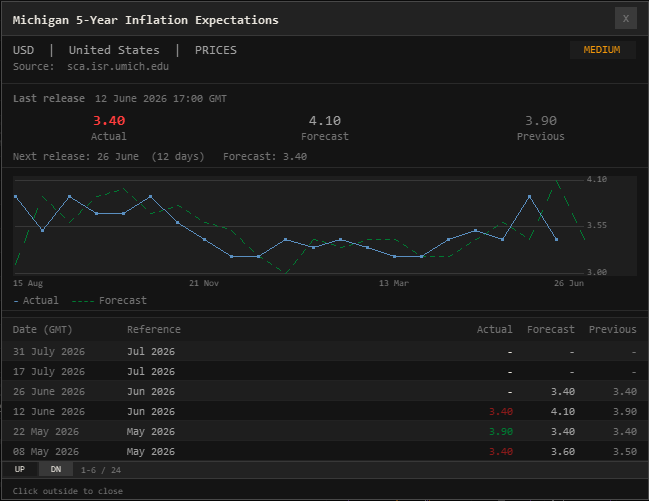
Figure 5. Calendar event detail — Actual vs Forecast history chart, next scheduled release with consensus forecast, and a 24-period release history table.
Open Positions
Live account exposure pulled directly from the MT5 terminal: symbol, direction, volume, open price, current P&L in account currency, and accrued swap. Updates on every refresh cycle. The analytical value is adjacency — a trader monitoring an open AUD/USD long can simultaneously view COT showing leveraged funds at near-extreme short positioning in AUD, the CB Rates panel showing RBA at 4.35% with a Hike signal, and carry showing positive annualised yield, all on a single screen without navigating away from the position view.

Figure 6. Open Positions — live account exposure with symbol, direction, volume, open price, P&L, and accrued swap.
Macro-Fundamental Signals
CB Rates & Bias
Policy rates for all eight G10 central banks (Fed, ECB, BoE, BoJ, RBA, BoC, SNB, RBNZ), plus Norges Bank (NOK) and Riksbank (SEK) whenever those currencies are present in the broker's Market Watch — ten central banks in total — alongside three forward-looking data points per bank: the current policy bias (Hike / Hold / Cut), the OIS market-implied probability of a move at the next meeting expressed as a percentage, and the next meeting date.
The bias signals are updated following each major central bank meeting and communication event. The probability column reflects live OIS market pricing of the next decision, displaying the dominant-direction probability that matches the current bias classification: a hike bias shows the probability of a hike (e.g. 100%^ for the ECB, or 97%^ for the BoJ ahead of a widely expected move off its current 0.85% rate); a hold bias shows no percentage (e.g. the Fed, GBP, AUD, and CAD, all displaying a dash — no move is priced); a cut bias shows the cut probability (e.g. 72%v for the CHF). This follows the Bloomberg WIRP convention of displaying the probability of the expected direction rather than a fixed cut or hike metric regardless of bias. For pair analysis, the divergence between two central banks' bias columns is often the most durable FX signal available: a Hike-biased ECB against a Hold Fed is a structural tailwind for EUR that tends to persist across multiple sessions.

Figure 7. Central Bank Rates & Bias — policy rate, directional bias, OIS-implied probability, and next meeting date per G10 central bank.
Clicking any row in the CB Rates & Bias panel opens a detail popup for that central bank. The popup displays the current policy rate, directional bias badge, OIS-implied probability of the next decision, and the next scheduled meeting date — sourced directly from the MT5 native calendar so the data is updated intraday rather than relying on a static schedule.
The primary content is a rate history chart rendered in the step-after convention standard for central bank policy rate visualisation: each rate level holds horizontally until the exact date of a new decision, then steps vertically. A 1Y / 2Y / 4Y / 10Y range selector in the upper area of the chart filters the displayed window; the full 10-year history is fetched from the MT5 native calendar at popup open, so switching ranges requires no additional data requests. The Y-axis labels float on the right margin; X-axis dates are anchored left, centre, and right at their respective tick positions rather than centred uniformly, matching the axis convention used in standard financial charting for irregular time series.
Below the chart, a scrollable decision history table lists every rate decision in the MT5 calendar record: date (GMT), rate level in percent, change in basis points colour-coded green for hikes and red for cuts, and the previous rate. The table opens scrolled to the most recent decision with actual data, bypassing future scheduled meetings that have no outcome yet — the same auto-scroll behaviour applies when switching range selectors.
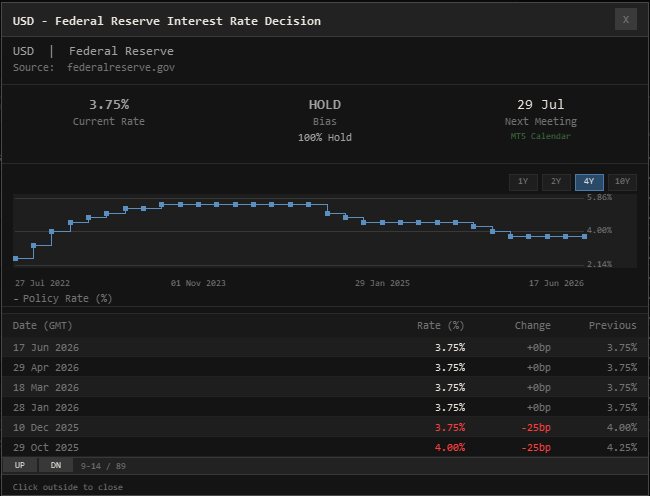
Figure 7b. CB Rates detail popup — USD / Federal Reserve, 4Y view. Step chart plots the full rate decision history from the MT5 native calendar; 1Y / 2Y / 4Y / 10Y range selector filters the window. The scrollable table below shows Date (GMT), Rate (%), Change in basis points (red for cuts, green for hikes), and Previous rate for every decision on record.
COT Positioning — Leveraged Funds
The CFTC Commitments of Traders report represents the most comprehensive public window into institutional speculative positioning across the G10 futures complex, published weekly. The panel displays net leveraged fund positioning for seven currency futures (EUR, GBP, JPY, AUD, CAD, CHF, NZD) in thousands of contracts, the week-over-week change, and a horizontal bar chart that makes direction and relative magnitude immediately visible. NOK and SEK are intentionally excluded from this panel, as neither has a liquid CFTC futures contract.
The panel header timestamp reflects the exact week-ending date of the current data, confirming freshness without requiring the trader to cross-reference the CFTC publication schedule.
The analytical edge of COT data is not directional prediction but positioning extreme detection. When leveraged funds hold a multi-year extreme short in JPY — as observed at -41.1% net open interest in the session shown — the asymmetric risk is a sharp squeeze on any catalyst that forces those positions to unwind. The week-over-week change column, showing -19K for JPY in the same report, flags when a crowded trade is beginning to move.

Figure 8. COT Leveraged Fund positioning across G10 currencies.
Surprise Index
A rolling economic surprise index showing how data releases for each of the nine covered currencies — the seven G10 currencies plus NOK and SEK — have come in versus consensus forecasts. Each currency receives a single bar: green for data consistently beating expectations, red for consistent misses. The methodology follows the Citi Economic Surprise Index approach — beat/miss/in-line scoring applied to the last N releases per currency, decay-weighted to give greater influence to recent events. High-impact releases (NFP, CPI, rate decisions) receive twice the weight of medium-impact releases, consistent with institutional weighting conventions; low-impact events are excluded from the index entirely.
In the captured session: JPY at +0.9, USD at +0.8, AUD at -0.6. Surprise momentum tends to lead currency direction by two to four weeks in low-volatility regimes, as systematic data beats build a revision cycle that eventually gets priced into rate expectations — the ESI flags this shift before it appears in the CB Rates or OIS panels.

Figure 9. Economic Surprise Index panel.
Composite Score
A single ranked score per currency derived from six weighted inputs: COT positioning 52-week z-score, Momentum, retail sentiment, CB bias signal, Sharpe-adjusted carry yield, and economic surprise index. The default weighting is shown in the panel footer: COT 25% / Momentum 15% / Retail 18% / CB 18% / Carry 12% / ESI 12%. Momentum is a 5-day-smoothed reading of the Currency Strength Index (see the Currency Strength panel below), z-scored against its own trailing 60-day distribution — a realized-price-trend measure kept deliberately separate from the leveraged-fund positioning captured by COT. For NOK and SEK, which have no COT input available, the 25% COT weight is redistributed pro-rata across the other five components rather than scored as neutral. Using the z-score rather than raw net-as-%-of-open-interest for the COT component, and Sharpe-adjusting the carry component (annualised carry ÷ 30-day HV), ensures the score reflects how extreme or well-compensated a position is in historical context, not just its current size. The output is a color-coded bar per currency reflecting net bullish or bearish signal confluence across all factors.
This panel is not a mechanical trading signal. It is a rapid-scan surface for identifying where multi-factor evidence is aligned versus conflicted. Currencies with strong unidirectional composite scores warrant further analysis; near-zero scores indicate genuine uncertainty across the factor set.
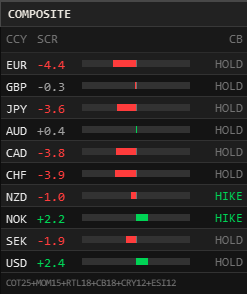
Figure 10. Composite Score panel — six-factor weighted confluence per currency.
Risk Context
Carry Monitor
All scrollable G10 pairs ranked by annualised carry yield, calculated from the live broker swap specifications available directly within MT5. No external data source is required — the panel reads swap rates from the broker's own symbol feed and converts them to an annualised comparable basis.
Each row shows: long swap (pips/day), short swap (pips/day), net carry annualised (%), 30-day historical volatility as denominator context, Sharpe-adjusted carry score, and the direction of the positive carry trade. The Sharpe column is the primary filter: high-carry pairs with high realised volatility carry a fundamentally different risk profile than moderate-carry pairs in suppressed-volatility regimes. The column renders on a four-zone color scale — green above 0.5 (carry well-compensated), muted green between 0 and 0.5, muted red between −0.5 and 0, and red below −0.5 (volatility regime historically unfavorable for carry) — with a background tint on the most extreme rows to make the top and bottom of the ranking immediately visible. CHF as the quote currency provides a zero-rate funding cost (SNB policy rate at 0.00%), pushing pairs like GBPCHF and USDCHF toward the top of the carry ranking — while crosses where both currencies carry low rates (CADCHF, EURCHF) cluster toward the lower end.
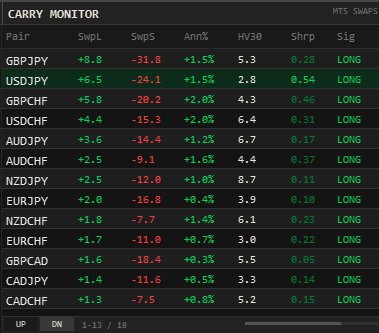
Figure 11. Carry Monitor — G10 pairs ranked by Sharpe-adjusted annualised carry yield.
Retail Sentiment
Long/short positioning ratios aggregated across up to 36 pairs — the 28 G10 pairs plus NOK/SEK crosses when available in the broker's Market Watch — displayed as a percentage bar with the current ratio labeled. Retail sentiment functions as a structural context layer rather than a timing instrument: when 88% of retail accounts hold short USD/CAD — net long CAD exposure — the directional crowding that results has historically preceded mean-reversion squeezes. Cross-referenced against CFTC Commitments of Traders data, leveraged funds simultaneously carried net short CAD futures of −45.3%, representing the opposite directional bias: institutional money positioned long USD/CAD against the retail crowd. This retail-versus-institutional divergence — where the two populations sit on opposite sides of the same trade — is the signal that neither dataset surfaces in isolation.

Figure 12. Retail Sentiment panel — long/short ratios across 28 G10 pairs.
Correlation Matrix
A rolling correlation matrix covering nine non-USD currencies — the seven G10 currencies plus NOK and SEK — against each other and against DXY, calculated from daily closes over a configurable lookback period (default: 30 days). High positive correlations render in green; strong negative correlations in red.
The primary use case is position overlap detection. Simultaneous longs in EUR/USD, AUD/USD, and GBP/USD in a 30-day window where all three show high positive correlation to each other is not three independent trades — it is effectively multiple units of DXY short exposure. The matrix makes this visible before entry rather than after a correlated drawdown.

Figure 13. Cross-Asset Correlation Matrix — 30-day rolling, G10 vs. DXY.
Currency Strength
A multi-timeframe momentum chart for all nine non-USD currencies — the seven G10 currencies plus NOK and SEK — with timeframe selector buttons (M5 / M15 / H1 / H4 / D1) rendered directly on the panel. The D1 view displays approximately four weeks of relative momentum as overlapping line series, with the current reading labeled per currency. In the captured session on the D1 view: JPY +0.8% and USD +0.8% leading, followed by NZD +0.7% and GBP +0.1% narrowly positive, while CHF, EUR, and AUD sit mildly negative and CAD trails the group at -1.3%.
When this panel's momentum alignment matches the CB Rates bias direction for the same currency, the two signals are reinforcing. When they diverge — a Hike-biased currency showing negative momentum — it flags either a temporary correction or a forthcoming bias revision. The D1 reading also feeds the Momentum input of the Composite Score above, smoothed over 5 days and z-scored against its own 60-day distribution.

Figure 14. Currency Strength Index — multi-timeframe momentum, D1 view.
Volatility & Options
Historical volatility at three lookbacks (7-day, 20-day, 3-month, all annualised from log returns) and risk reversal skew at three tenors (1-week, 1-month, 3-month) for nine major pairs. Risk reversals measure the implied volatility premium of out-of-the-money calls versus puts at equivalent delta. A negative 1-month risk reversal on EUR/USD (-0.41 in the captured session) indicates the options market is pricing more downside risk than upside. A sign flip — from negative to positive — triggers an alert in the terminal and is often a leading indicator of directional shift in the underlying.
USD/CHF showing a modestly positive +0.19 while EUR/USD shows -0.41 reflects the options market's relative conviction: more bearish on EUR than on CHF against the dollar at the current moment — a nuance not visible in the spot price alone.
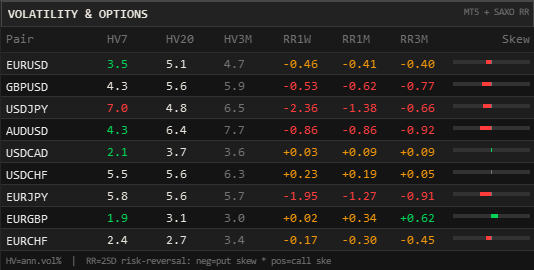
Figure 15. Volatility & Options Skew — historical volatility and risk reversal skew at three tenors.
Market Sessions
Sydney, Tokyo, London, and New York sessions with live open/closed status. Session times are displayed in broker server time, with the UTC offset shown in the panel header. Liquidity context modifies the interpretation of every other panel: a pair at 100% ADR during the Tokyo session in a typically London-driven market carries a different analytical weight than the same statistic at the London open.

Figure 16. Market Sessions — live open/closed status for Sydney, Tokyo, London, New York.
Alert System
The terminal monitors all data sources on each refresh cycle and fires MT5 alerts — with optional push notification to the MetaTrader 5 mobile app — when predefined thresholds are crossed:
• Central bank bias classification changes
• OIS-implied meeting probability shifts by more than a configurable threshold (default: 5 percentage points between refresh cycles)
• CFTC COT week-over-week change exceeds a threshold (default: 10,000 contracts), or a new weekly release is detected
• Broker swap rates change materially
• A high-impact calendar event enters the configurable pre-alert window (default: 15 minutes)
• Risk reversal sign flip on any monitored pair
• AI Market Signal update detected between refresh cycles — fires when new signals are published to the data pipeline
• Economic Surprise Index (ESI) reaching a configurable extreme reading
• COT positioning reaching a 52-week z-score extreme (crowded trade)
• Correlation breakdown between any two monitored pairs versus their long-run norm
• Risk reversal term structure inversion between the 1-month and 3-month tenors
• Composite Score entering or exiting a configurable strong bullish/bearish zone
• A pair entering or leaving the top-ranked carry trades
Each threshold crossing is logged with a full timestamp and event description. In the captured session, two distinct events fire independently: COT NZD extreme WoW at -14K contracts, and COT JPY extreme WoW at -19K contracts.
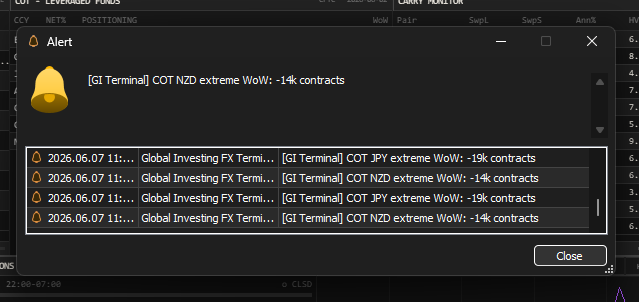
Figure 17. Alert system — COT extreme positioning signal, dual event firing.
The Web Terminal: Extended Research Depth
The companion web terminal at globalinvesting.github.io provides the same core analytical panels in a browser interface, with several additions that exploit the expanded display environment of a full-page layout.
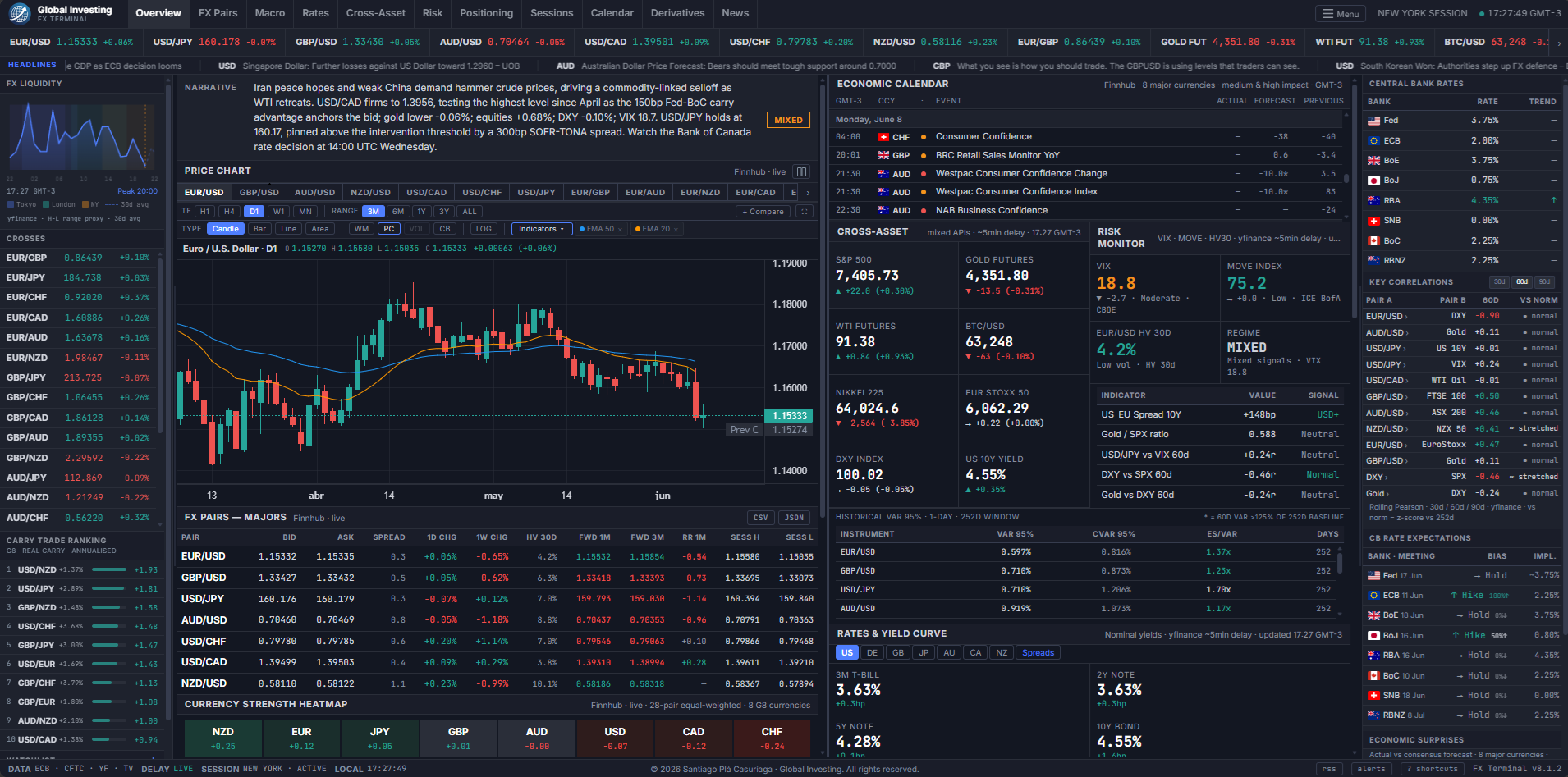
Figure 18. Global Investing web terminal — analytical dashboard overview.
AI Market Narrative
At each major session open — Tokyo, London, New York — the terminal reads COT positioning, OIS rate differentials, yield spreads, and cross-asset stress inputs to produce a single macro narrative in plain language: what the current environment looks like, which pairs the regime structurally favours, and what the dominant risk factor is for the session ahead. The narrative updates automatically; no manual interpretation is required. For a practitioner running multiple positions across currencies, this functions as a pre-session briefing that surfaces the most relevant macro context without requiring a review of every individual panel.

Figure 19. AI Market Narrative — automated macro briefing at each major session open.
Macro Risk Regime & Cross-Asset Monitor
The Macro Risk Regime classifies the current environment into one of four states — RISK-ON, MIXED, CAUTION, or RISK-OFF — derived from five cross-asset inputs: VIX (equity implied volatility), MOVE index (US rates implied volatility), DXY (dollar index), Gold, and S&P 500. The classification follows a stress-score methodology: each input is evaluated against its own threshold, and the aggregate score determines the regime. RISK-ON requires VIX below 18 with no additional stress factors active; RISK-OFF requires four or more factors simultaneously in stress territory.
The Cross-Asset Risk Monitor panel renders the five inputs in real time, updated every five minutes, so the inputs driving the regime read are always visible alongside the classification itself. The analytical value is specificity: a CAUTION regime driven by MOVE above 120 (rates stress) carries different implications for FX than a CAUTION regime driven by VIX above 25 (equity stress) — the former primarily affects JPY and CHF via rate uncertainty, the latter affects AUD and NZD via risk appetite. Both read as CAUTION; only the panel reveals which factor is driving it.
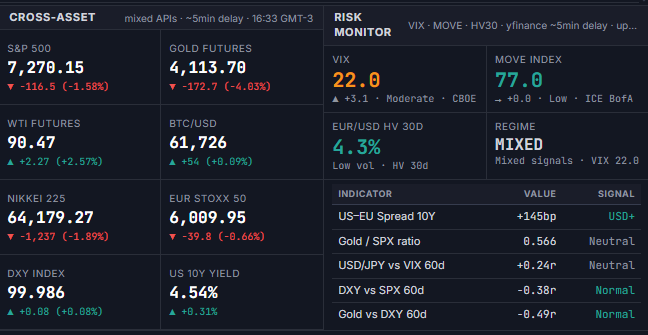
Figure 20. Macro Risk Regime & Cross-Asset Monitor — five-input stress classification with real-time factor visibility.
CB Rate Expectations & OIS Forwards
The web terminal extends the CB Rates panel from the EA with a full decision history modal per central bank: the current cycle's policy decisions plotted on the yield curve — 29 months and 6 decisions in the RBA example captured below — the OIS-implied forward rate at each upcoming meeting, and the market-priced probability of each outcome. Clicking any central bank flag opens the modal inline. The OIS sources follow institutional convention — SOFR for USD, €STR for EUR, SONIA for GBP, TONA for JPY, CORRA for CAD, SARON for CHF — the same overnight benchmarks used by prime brokers for CIP-covered carry calculations, not policy rates. When the OIS differential and the CB policy rate differential diverge, the OIS figure is authoritative for carry framing.
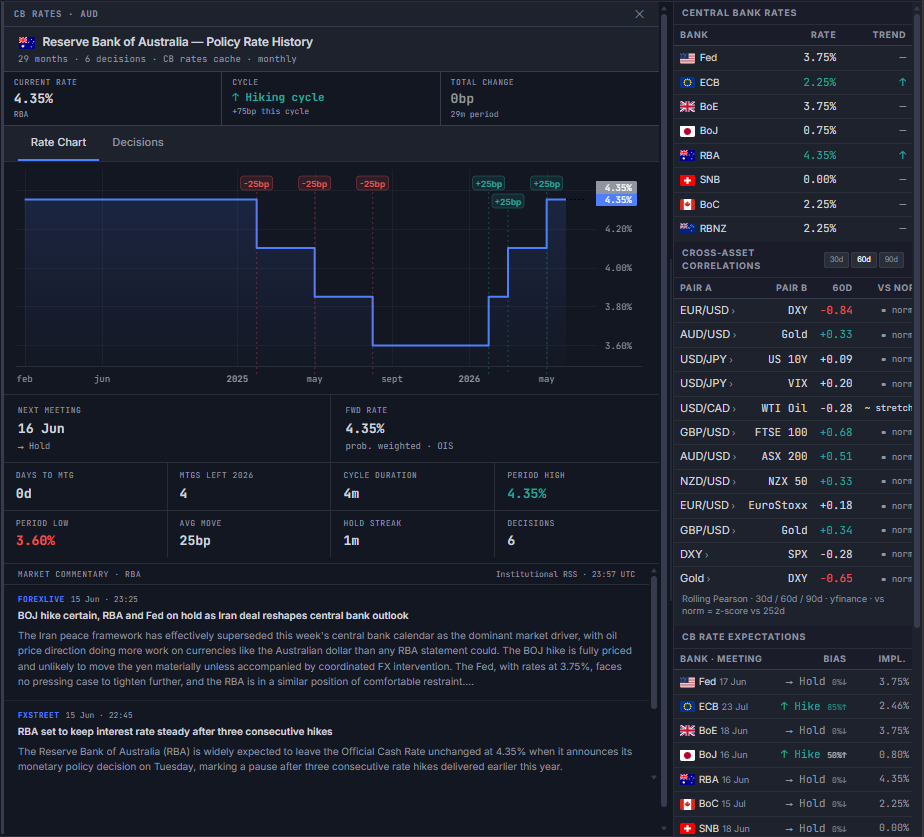
Figure 21. CB Rate Expectations & OIS Forwards — 29-month policy rate history, cycle analytics, and OIS probability-weighted forward rate per central bank (RBA example shown).
The Real Rate Carry Analysis module adjusts OIS benchmark rates for current inflation expectations sourced from market-implied breakevens and IMF/OECD proxies. The result is a real carry ranking — USD at +1.11% real, NZD at -0.83% real in the captured session — that reflects the purchasing-power-adjusted return of each carry position. A high nominal carry in an economy with accelerating inflation may produce negative real carry, fundamentally altering the trade thesis.

Figure 22. Real Rate Carry Analysis — net yield adjusted for inflation expectations.
The Yield Curve module renders full sovereign yield curves (US, DE, GB, JP, AU, CA, NZ) with today versus prior-close comparison and basis point changes per tenor. The US curve in the captured session — 3M at 3.63%, 2Y at 3.63%, 10Y at 4.53%, 30Y at 5.01%, labeled Steep — contextualises the rate environment. A steep 10Y-2Y spread of 90bp is a structurally different monetary environment than an inverted curve, with distinct implications for carry and risk appetite.

Figure 23. US Treasury Yield Curve — current vs. prior close, basis point changes per tenor.
The Economic Surprises module shows the full event-by-event history underlying the ESI index, with BEAT/MISS/IN LINE outcomes for the last 90 days, decay-weighted to give greater influence to recent releases. USD at +23.5 index with a 53% beat rate on 206 scored events reflects durable data momentum — not a single-event spike.

Figure 24. Economic Surprise Index — USD, 90-day rolling event history with BEAT/MISS/IN LINE scoring.
The COT Positioning Detail panel provides Z-score percentile rankings across a 52-week window and participant-category breakdowns separating Leveraged Funds from Asset Managers and Dealers — a distinction that matters because LF and AM positioning frequently diverge at turning points.

Figure 25. CFTC COT Positioning Detail — leveraged funds Z-score, percentile rank, and participant breakdown.
Alerts & Market Signals
The Alerts & Market Signals panel is the synthesis layer of the web terminal. Rather than presenting raw data for the analyst to reconcile manually, it generates a structured narrative per pair — integrating COT positioning, OIS-implied carry differentials, options skew, retail sentiment, and CB forward guidance into a single coherent read, timestamped and refreshed continuously.
Each signal carries a title identifying the dominant analytical theme (e.g. USD/JPY — Intervention Risk + Carry + Positioning), followed by a narrative that explains the confluence: why the data combination is significant, what the asymmetric risk is, and what event or threshold to monitor for resolution. Data traceability is built in — each signal row displays the source values it was derived from as inline evidence chips (pair price, carry differential in basis points, COT net position, next meeting pricing), making the reasoning independently verifiable without navigating to individual panels.
This is the operational output of the multi-factor framework. Where the COT, CB Rates, carry, and OIS panels each provide one dimension of analysis, the Alerts & Market Signals panel provides the cross-panel read — the signal that only becomes visible when all factors are considered simultaneously.

Figure 26. Alerts & Market Signals — AI-generated cross-panel synthesis with inline data evidence.
Derivatives — Forwards, Volatility Surface & OTC Flow
The Derivatives section consolidates four data streams that are typically distributed across separate institutional platforms. CIP Forwards — covered interest parity-implied 1-month to 1-year forward prices for major pairs, allowing direct comparison of forward market pricing against OIS-implied rate differentials and flagging deviations from no-arbitrage conditions. Risk Reversal Term Structure — 25-delta risk reversal skew across weekly, monthly, and 3-month tenors, updated daily from OTC broker data, providing the full options market view of directional conviction and tail risk by tenor rather than a single point-in-time reading. ECB Official Fixings — daily reference rates versus live spot, relevant for position valuation and cross-border transaction benchmarking. DTCC Global Trade Repository — actual OTC FX notional reported under Dodd-Frank regulatory disclosure, broken down by instrument type (swap, forward, NDF) per pair. The DTCC data is the closest publicly available proxy for real institutional transaction flow — not a survey, not a positioning report, but actual reported trade notional aggregated across reporting dealers.
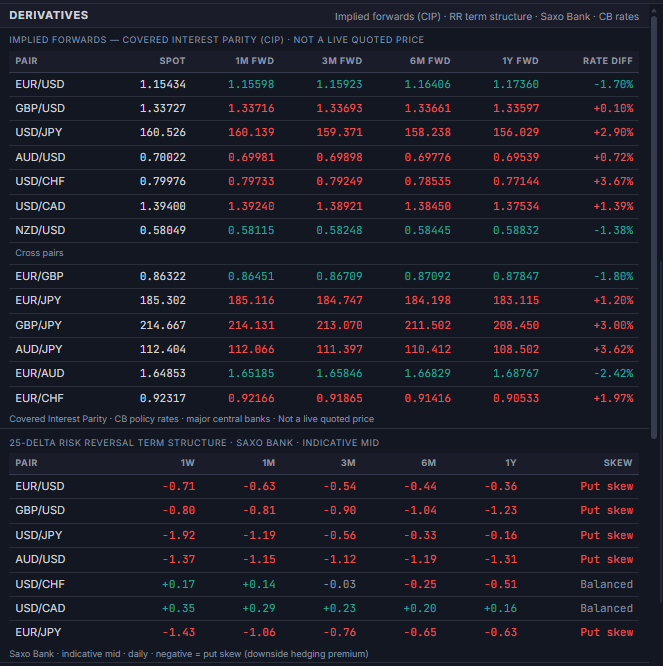
Figure 27. Derivatives — CIP forwards and 25-delta risk reversal term structure by instrument type.
The Integrated Workflow
Pre-session (web terminal): Review the macro narrative summary, check CB Rate Expectations for overnight bias shifts, scan the ESI for data momentum divergences, review COT Z-scores for crowded positioning extremes, and check yield curve shape for overnight moves. This takes approximately ten minutes and surfaces the session's highest-conviction analytical context.
Live session (MT5 EA): The terminal runs continuously on a dedicated chart. The Composite Score panel provides a rapid starting-point scan. The Calendar panel flags event risk with live countdown. The Positions panel keeps account exposure visible alongside all macro context. Alerts fire on COT threshold crossings or options sign flips without requiring continuous manual monitoring.
This is not a system that generates trading signals. It is an information architecture that ensures the signals a trader is already monitoring are consolidated, current, and contextually integrated — the standard applied by professional desks through Bloomberg or Refinitiv terminals, available within the MetaTrader 5 environment.
Setup
Requirements: MetaTrader 5, any broker with G10 FX pairs.
Step 1: In MT5, navigate to Tools → Options → Expert Advisors and enable Allow WebRequest for listed URL. Add raw.githubusercontent.com to the URL list. This single permission enables all external data panels.
Step 2: Attach the EA to any chart. The terminal does not use the underlying chart's symbol or timeframe — any chart works. The dashboard covers the full chart window.
Step 3 (optional): Adjust inputs to match your broker's symbol naming conventions, preferred refresh interval, and lookback periods for historical calculations.
Step 4: Access the web terminal at globalinvesting.github.io. The EA license key displayed in the terminal's top bar unlocks the full web terminal for the same account.
The Suite
The Global Investing suite includes four products sharing the same analytical framework and visual language:
• Global Investing FX Terminal — the full thirteen-panel EA described in this article.
• CSI Currency Strength — the multi-timeframe momentum indicator from the terminal's Currency Strength panel, available as a standalone chart indicator.
• Carry Trade Monitor — the carry yield ranking panel as a standalone EA, reading directly from broker swap specifications with no external data required.
• Institutional Risk Manager — an execution EA handling ATR-based position sizing, scaled exits at R-multiples, and breakeven automation, with an embedded CSI sub-panel for directional context. Designed to run alongside the GI FX Terminal on a second chart window.
Conclusion
The FX market's analytical complexity is not a problem of data scarcity — the data is largely public. It is a problem of integration: bringing policy rates, positioning, carry, volatility, and macro momentum into a coherent framework that can be consulted in real time, without switching tools or reconciling stale figures.
The Global Investing FX Terminal is built around that problem. Its value is not any individual panel in isolation — it is the simultaneous visibility of all signals in a single frame, allowing relationships and confluences to surface that would otherwise require manual assembly across multiple platforms.
This article describes the analytical framework and data panels of the Global Investing FX Terminal. The information presented is for informational and educational purposes only and does not constitute investment advice or a recommendation to buy or sell any financial instrument.
MT5 EA: mql5.com/en/market/product/180326
Web terminal: globalinvesting.github.io
Methodology: Global Investing FX Terminal — Methodology
MQL5 profile: mql5.com/en/users/santiagopla