Taming the Markets: Why My Trading Logic is Built on Weather Forecasting Principles

Stop guessing the market's next move. Learn how statistical variables, multi-timeframe synchronization, and dynamic adaptation can transform market chaos into a high-probability business model.
1. The Meteorology of Trading: Probability Over Prediction
How do meteorologists predict rain? They don't guess; they analyze variables—humidity, air pressure, and wind speed. When these variables align at a single point (confluence), the probability of rain becomes nearly certain.
Trading is no different. An indication on the M5 timeframe (such as an Oversold condition) is just a single, isolated variable. It is merely a "whisper." However, when the M15, M30, and H1 timeframes all show the same "humidity" (synchronized trends and indicators), that whisper becomes a "shout." In my development philosophy, the lower timeframe acts as the trigger, but the higher timeframe defines the atmosphere. Trading without synchronization is like going outside because of one small cloud, while ignoring the massive storm approaching from the horizon.
2. Eliminating "Ghost" Signals: The Power of Candle Confirmation
One of the most common traps for traders is "Repainting" indicators. To avoid this, we must rely on the Close Candle confirmation. In weather terms, you don't open your umbrella when you see the potential for rain; you open it when the first drops actually hit the ground and stay there.
A signal is only valid once the candle is closed. Whether it is a breakout above resistance or a reversal from an extreme zone, the candle close is the final confirmation that the variable has actually materialized into a price action reality.
3. Dynamic Adaptation: The Market is a Living Organism
The market is not static. A statistical model that worked last month may be irrelevant next month because the "market climate" has shifted. A robust system does not try to predict an uncertain future; instead, it adapts dynamically by recalculating the Average Range of price movement in real-time. This is why I avoid rigid, static parameters that eventually expire. My logic evolves alongside the market’s current volatility.
4. Execution Pragmatism: "Textbook Success" vs. "Real-World Profit"
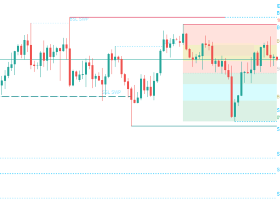
This is where many traders fail. In a textbook, a Double Top pattern is only considered "successful" if it breaks the Neckline and reaches the "target leg." However, in professional trading, Profit does not have to wait for a textbook definition.
-
The Statistical Reality: If the average historical movement from the second Head to the Neckline is 1,000 points, why risk waiting for a 2,000-point breakout that may never happen?
-
The Wise Choice: I prioritize Average Statistical Probability. It is far wiser to secure profits based on what the market usually does (historical averages) rather than forcing the market to reach an ideal target that rarely occurs.
5. Conclusion: From Concept to Automation
I have integrated this entire philosophy—multi-timeframe auditing, non-repaint confirmation, and dynamic statistical adaptation—into StatsCandleDNA. I automated this complexity because human emotion and fatigue cannot handle the constant, rigorous auditing required to "tame" the market effectively.
Trading is a business of numbers. When the variables align, the probability is on your side.