Bridging Machine Learning Predictions into MT5
Overview: This post discusses challenges MML Data Bridge solves when ingesting custom data into MT5 algorithms.
MML Data Bridge acts as a data pipeline that drip-feeds static data into the back tester and optimizer while returning live data to the platform. Although the bridge was built to integrate predictive data; any external data can be ingested into the trading platform.
- Purchase the bridge here: https://www.mql5.com/en/market/product/152143?source=Site+Market+Product+Page#description
- User Set Up Manual: https://www.mql5.com/en/blogs/post/766374
- Required files: https://www.mql5.com/en/blogs/post/766519
- Common Issues and Resolves: https://www.mql5.com/en/blogs/post/766376\
Below is a code example showcasing the bridges ease of use by populating objects with data from a file and printing the data to the expert's console. Visit the user set up manual for more details on how the bridge works.
//+------------------------------------------------------------------+
//|                                                       testmq5   |
//|                                Copyright 2025, MML Data Bridge   |
//+------------------------------------------------------------------+

#property copyright "Copyright 2025, MML Data Bridge "

#property link      "https://www.mql5.com/en/market/product/152143/controlpanel#!tab=description"
#property version   "1.00"

#include <Trade/Trade.mqh>
#include <MMLUtility.mqh>
#include <MMLDataStructs.mqh>

int OnInit() {
    initializeBridge("test");
    return(INIT_SUCCEEDED);
}


void OnDeinit(const int reason) {
    shutDownBridge();
}

//Declare objects to populate
DIRECTION direction;  // Direction signal data structure
HLC hlc;              // High/Low/Close predictions data structure
NEWS news;            // News data structure


//populate objects in OnTick()
void OnTick() {

if (returnData<DIRECTION>("direction_btc1h.csv", direction))
        PrintDirectionData(direction);

if (returnData<HLC>("hlc_predictions.csv", hlc))
        PrintHLCData(hlc);

if (returnData<NEWS>("news_predictions.tsv", news))
        PrintNewsData(news);

}
2025.12.27 11:23:10.651 test (BTC,H1) NEWS PREDICTIONS | Time: 2025.05.29 15:30:00 | Event: GDP Growth | Impact: Low | Currency: CHF | Actual: 95 | Forecast: 191 |Previous: 183
2025.12.27 11:23:18.660 test (BTC,H1) HLC PREDICTIONS | Time: 2023.12.25 19:30:00 | Currency: EURUSD | Timeframe: 15m | Predicted High: 1.08440 | Confidence High: 0.83000 | Predicted Low: 1.08300 | Confidence Low: 0.74000 | Predicted Close: 1.08400 | Confidence Close: 0.82000
2025.12.27 11:23:23.269 test (BTC,H1) DIRECTION PREDICTIONS | Time: 2024.07.30 16:00:00 | Signal: -1 (SELL)
2025.12.27 11:23:23.434 test (BTC,H1) CTrade::OrderSend: exchange sell 1.00 BTC sl: 38.90 tp: 38.15 [market closed]
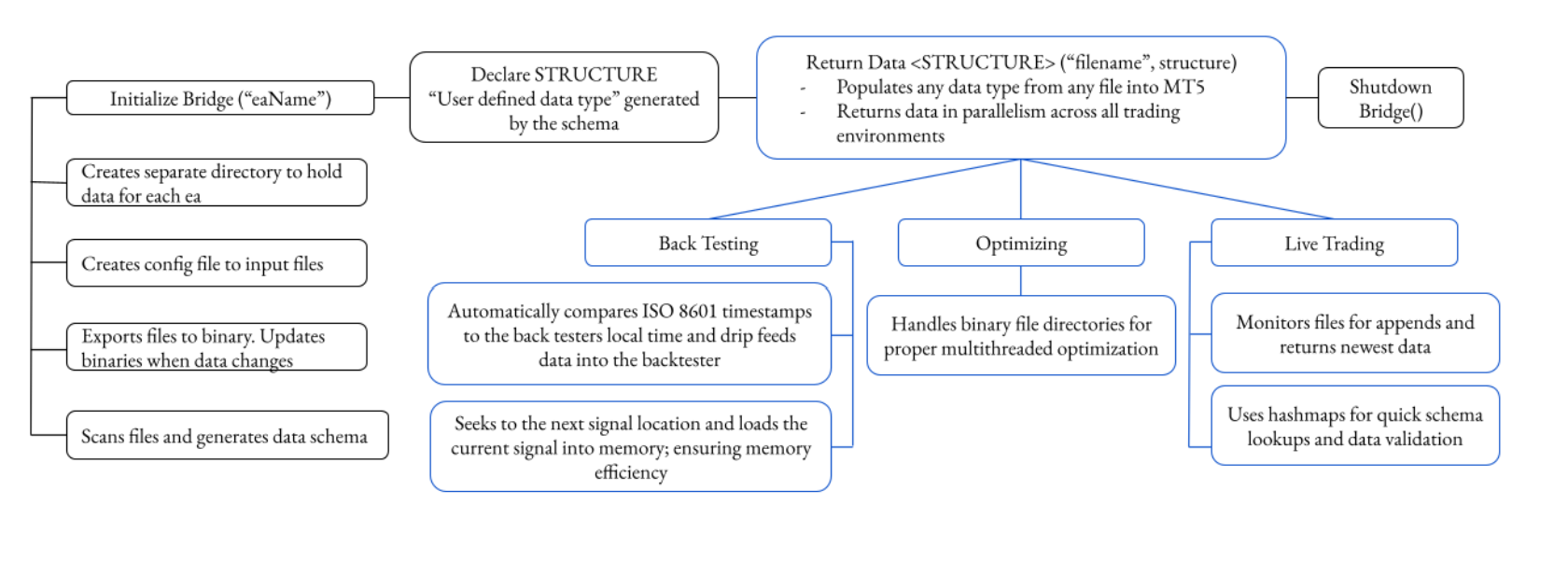
MML Bridge Hierarchical Structure
Challenges MML Data Bridge Solves
Compile-Time data type constraints
MQl5, being rooted in C++ enforces strict compile-time type checking making runtime data ingestion from varying data sources difficult. To address this issue, user defined datatypes are automatically detected and verified with a data schema on program start. This schema can then be used to define objects to populate.
Back Tester and Optimizer Bottlenecks
CSV parsing and improper data loading introduces significant overhead when ingesting high-frequency or real-time ML predictions, which may cause bottlenecks in execution. MML Data Bridge solves this issue by converting external data into optimized binary formats allowing the program to accurately load only the next record into memory and drip-feed the signal into the trading platform.
When running strategy optimizations, MT5 spawns parallel agents that simultaneously access data files, causing file locking conflicts and race conditions. MML Data Bridge solves this by automatically copying binary files to tester-local directories for each optimizer agent, eliminating conflicts and enabling parallel optimization without data access bottlenecks.
One EA, Three Modes: Context-Switching
MQL5 requires custom parsing logic for each data source, file format, and trading environment—slowing development and increasing complexity. MML Data Bridge replaces this with a single-function API that populates any user-defined data type from any file, consistently across back testing, optimization, and live trading. It automatically detects the current execution mode and adapts file handling and data access behavior accordingly. Signals are returned into the back tester immediately and live data is returned into MT5 immediately.
Time zone Conversions
Incorrect or inconsistent time zone handling can cause data to be misaligned in back tests leading to unreliable results. These errors are subtle and often go unnoticed until deployment. MML Data Bridge enforces UTC normalization with ISO 8601 validation, ensuring consistent timestamp alignment across all trading environments.
Runtime Schema-Struct Mismatch Detection
In MQL5's compile-time environment, mismatches between external data schemas and user-defined structs can cause data corruption or runtime crashes. The bridge provides comprehensive runtime validation by using cached schemas saved during back tests. If mismatches are detected then the program provides detailed diagnostic messages, telling developers exactly which fields are missing or incorrectly typed before data corruption occurs.
Automatic Change Detection and Incremental Updates
Manually regenerating data files whenever CSVs change is error-prone and time-consuming. The bridge automatically tracks file modification times and only regenerates binary files when source data actually changes, ensuring data freshness without unnecessary overhead or manual intervention. This allows for faster back tests after the initialize export
Multi-File Data Source Orchestration
Managing multiple CSV/TSV files with different schemas simultaneously requires tracking metadata, file handles, read positions, and validation state for each file. MML Data Bridge handles this orchestration automatically, allowing developers to focus on trading logic rather than file management complexity.
Metadata Persistence and Intelligent Merging
When configuration changes occur (files added, removed, or reordered), preserving existing metadata while updating what's necessary prevents data loss and avoids redundant processing. The bridge intelligently merges configuration changes with existing metadata, preserving modification times and schema information to minimize regeneration overhead.