The Risk-First Evolution of Automated Trading - What Two Years on the MQL5 Marketplace Changed in My Approach

Part 1 — What Two Years on the MQL5 Marketplace Changed in My Approach
When I first began publishing automated trading systems on the MQL5 marketplace, I assumed most traders evaluated Expert Advisors the same way I evaluated them while building: logic quality, risk control, and long-term stability under changing conditions. I quickly learned that most buying decisions happen much earlier and with much less structure. Many traders decide within minutes, based largely on visual performance and a few headline stats.
The first two numbers most people look at are win rate and net profit. The first visual they respond to is the smoothness of an equity curve. That makes sense emotionally. A smooth curve feels safe. A high win rate feels like certainty. But after two years of building, updating, supporting users, and reviewing how systems behave across different periods and conditions, I learned that this common evaluation method is responsible for a lot of unnecessary frustration for traders and a lot of misalignment between what traders expect and what robust systems actually look like.
This blog series is about that gap. Part 1 is personal and foundational: what the marketplace taught me, why I changed my system design philosophy, and what I’m carrying forward into 2026.
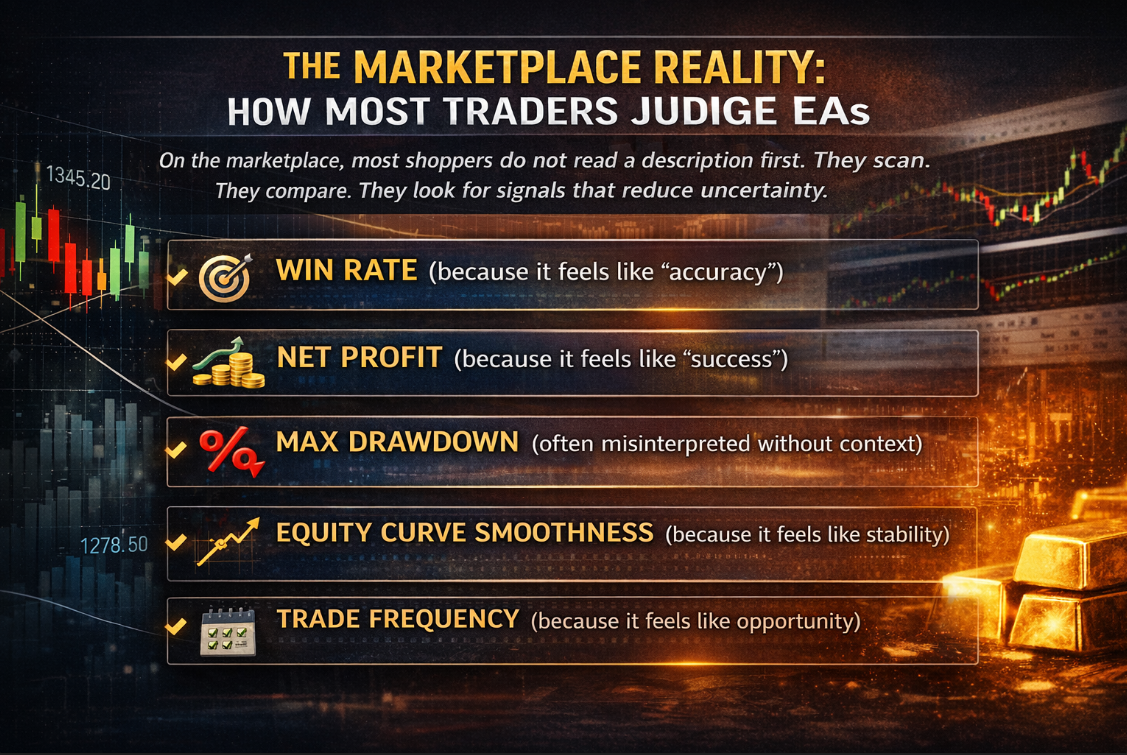
The Marketplace Reality: How Most Traders Judge EAs
On the marketplace, most shoppers do not read a description first. They scan. They compare. They look for signals that reduce uncertainty.
Most evaluations begin with:
-
Win rate (because it feels like “accuracy”)
-
Net profit (because it feels like “success”)
-
Max drawdown (often misinterpreted without context)
-
Equity curve smoothness (because it feels like stability)
-
Trade frequency (because it feels like opportunity)
None of these are “wrong” to look at. The problem is how they’re weighted, how they’re interpreted, and what they fail to reveal.
A system can show an impressive net profit while carrying risk that is not obvious at first glance. A system can show an extremely high win rate while building toward rare losses that erase months of gains. And a system can show honest drawdowns and losing streaks while still being mathematically stronger and more durable than the “perfect” looking alternative.
It took time for me to accept that the majority of new or inexperienced traders are not searching for robustness. They are searching for reassurance. That’s a human thing. But markets punish reassurance-based decision-making.
That tension—between what sells quickly and what survives long-term—is the core conflict that developers and traders run into.
The Early Mistake: Overvaluing Entries and Undervaluing Risk Architecture
Like many developers, my early focus was heavily weighted toward signal logic and entries. If entries were accurate, it felt like the hard part was solved. I treated risk management as something important, but secondary—something that could be “configured” rather than “engineered.”
Over time I learned a hard truth:
A system’s long-term identity is defined by its risk architecture, not its entries.
Entries decide where you start. Risk architecture decides whether you survive.
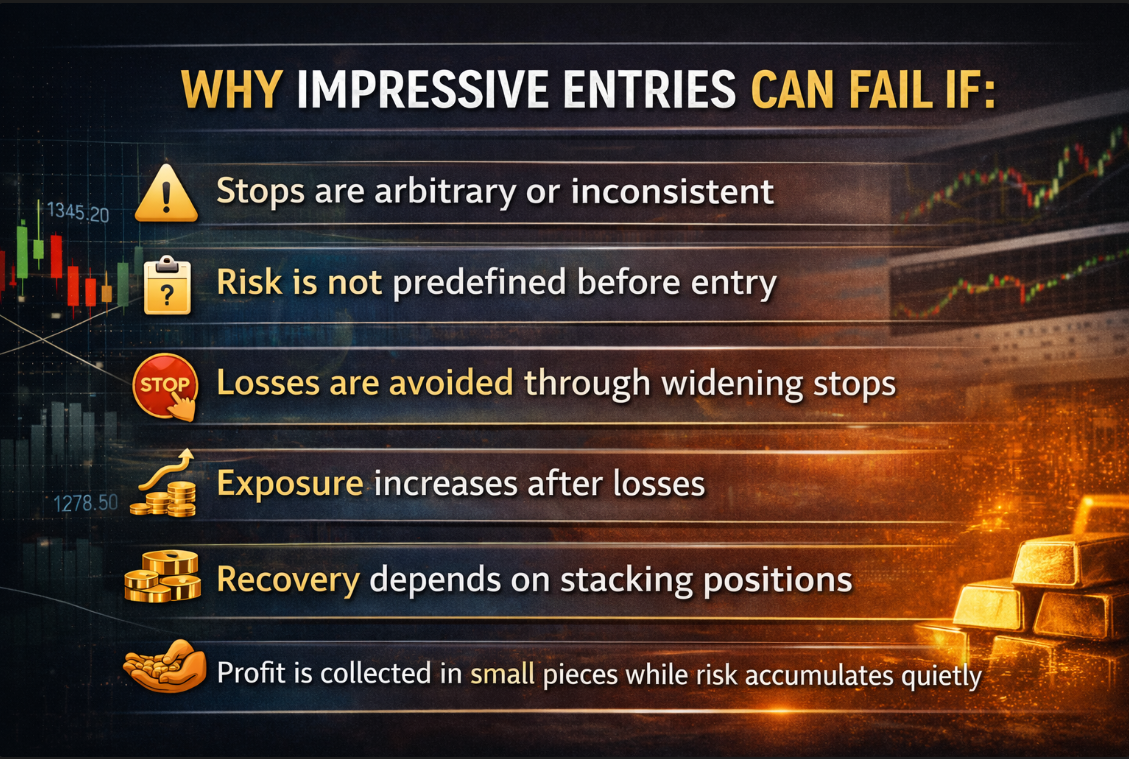
A system can have impressive entries and still fail as a product if:
-
Stops are arbitrary or inconsistent
-
Risk is not predefined before entry
-
Losses are avoided through widening stops
-
Exposure increases after losses
-
Recovery depends on stacking positions
-
Profit is collected in small pieces while risk accumulates quietly
Those behaviors can produce very attractive short-term results. They can also create a profile where the “bad event” is delayed, not removed.
This is one of the biggest reasons traders feel deceived. They buy a system expecting the visible curve to represent the real risk. Then the hidden part of the risk model shows up, and the trader interprets that as betrayal rather than structure.
The problem is not always malicious development. Often it’s misunderstanding: many traders simply don’t know how certain system structures create smoothness.
Smooth Equity Curves and High Win Rate: Why They Often Mislead
A smooth equity curve feels like proof of stability. A 90%+ win rate feels like proof of skill. But both can be produced by payoff structures that are fragile.
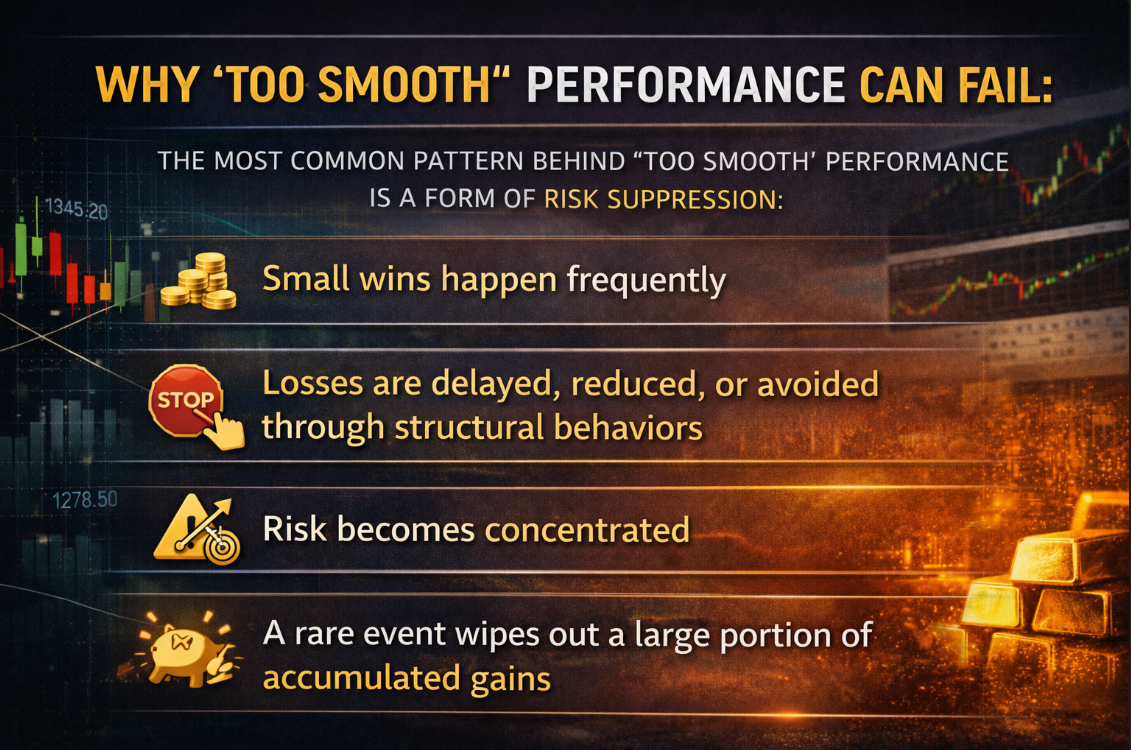
The most common pattern behind “too smooth” performance is a form of risk suppression:
-
Small wins happen frequently
-
Losses are delayed, reduced, or avoided through structural behaviors
-
Risk becomes concentrated
-
A rare event wipes out a large portion of accumulated gains
This is why traders can see months of “perfect” results and then experience a sudden collapse that feels impossible relative to what they expected. The system didn’t randomly break. The system revealed the part of the risk model that was previously hidden.
This is not a condemnation of any specific approach. It’s a statement about how payoff shapes work. The market has regimes. Volatility shifts. Trend and range conditions rotate. A payoff structure that depends on “conditions staying friendly” can look like perfection until conditions change.
After seeing this cycle repeatedly, I stopped using smoothness as a quality signal. Instead, I started asking a different question:
Is the system’s risk visible, controlled, and consistent?
If the answer is yes, the curve will not look perfect. It will look real.
The Turning Point: Losses Became the Most Important Part of the System
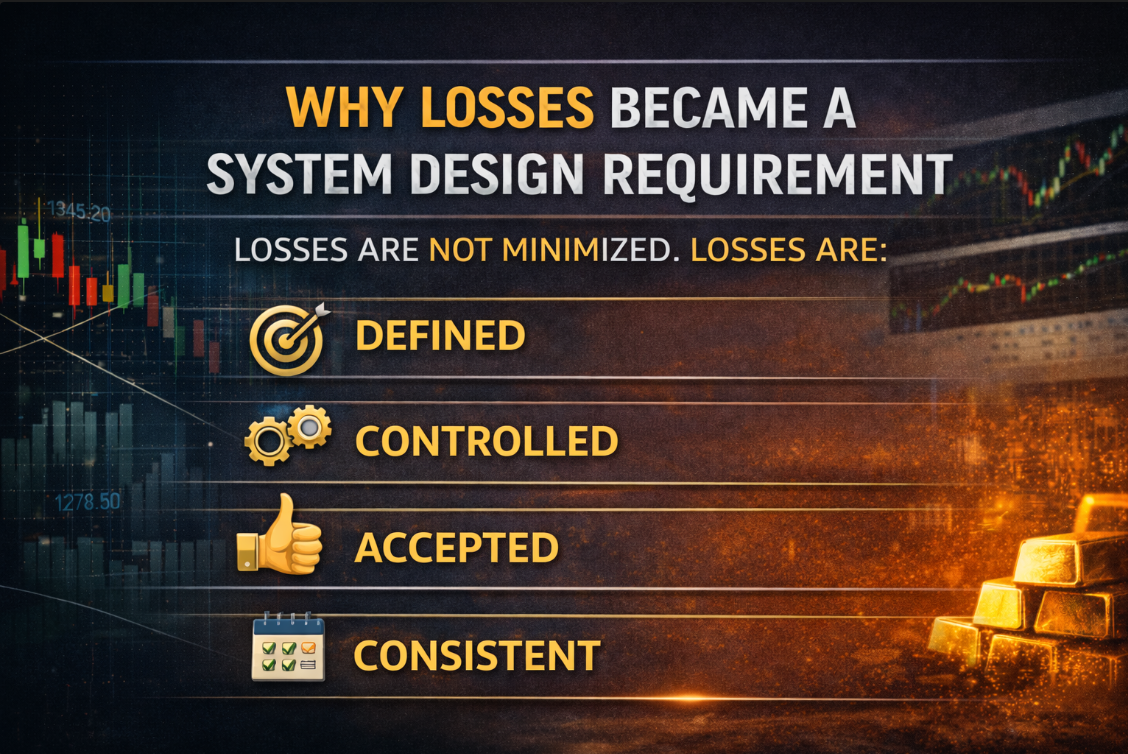
At some point in the process, I stopped treating losses like something to be minimized at all costs and started treating losses like a design requirement that must be:
-
Defined
-
Controlled
-
Accepted
-
Consistent
That sounds obvious, but it’s a major shift in how you build and explain systems.
This is where one principle began to guide nearly every design decision:
The stop defines the trade.
Most traders think the entry defines the trade. In reality, the entry is only meaningful in relation to invalidation. If you cannot define exactly where the trade idea is wrong, you cannot define risk. If you cannot define risk, the system is not engineered—it is reacting.
From that point forward, I treated stop placement not as a parameter, but as the foundation. Once the stop is structurally correct, everything else—position sizing, reward targeting, trailing behavior, trade management—has a real anchor.
Structural Invalidation vs. Arbitrary Stops
A major concept that shaped my development philosophy is the difference between:
-
Arbitrary stops (fixed distances, generalized ATR values applied without context, wide safety bands used to “avoid being stopped out”), and
-
Structural invalidation (a clear price level that objectively invalidates the trade idea)
Structural stops are not “tight” for the sake of tightness. They are tight because they sit at the boundary where the setup is no longer valid. This changes everything:
-
When you’re wrong, you’re wrong quickly and cheaply
-
Risk per trade remains predictable
-
Losing streaks are survivable
-
You avoid “hope-based” trade management
-
Performance becomes more stable across regime shifts
Arbitrary stops can be made to look safe by pushing them wider. But the wider the stop, the more the system is compensating for uncertainty rather than controlling it. Wide stops can hide weak entry logic, and they can hide it for a long time. That doesn’t mean a wide stop is always wrong—some models require room. But wide stops without structural reasoning are one of the clearest markers of non-engineered risk.
The Next Lesson: Win Rate Is Not the Goal—Expectancy Is
Another major shift came from watching how traders react to losing streaks. Many traders see a run of losses and immediately interpret it as a scam or broken system. The emotional response is understandable: if you bought something expecting high accuracy, losses feel like deception.
But asymmetric systems—systems designed for larger winners—do not look emotionally “safe” in the short term. They can lose repeatedly and still be profitable over a series of trades.
This is where expectancy matters. Expectancy is the relationship between:
-
how often a system wins
-
how much it wins when it wins
-
how much it loses when it loses
A system can have a low win rate and still be strong if winners outweigh clusters of losses. A system can have a high win rate and still be weak if rare losses erase many small wins.
This is one of the most important educational gaps on the marketplace. Many traders believe “high win rate = quality,” and then they buy systems that are structurally designed to create high win rate at the cost of hidden tail risk.
Over time, my development focus shifted away from trying to “look good” in terms of win rate and toward building systems that are mathematically coherent even when they feel uncomfortable.
Why Losing Streaks Became a Feature, Not a Bug
One of the hardest parts about building risk-first systems is that the performance profile is honest. Honest systems show:
-
losing streaks
-
drawdown periods
-
flat performance phases
-
clusters of outcomes rather than steady progress
That’s not a flaw. That is what statistical distribution looks like.
In a system with controlled losses and asymmetrical reward, you should expect:
-
periods where entries don’t align with expansion
-
clusters of stopped trades during noise
-
occasional expansion moves that recover multiple losses
This is where traders need a mindset change:
A system is not proven by never losing.
A system is proven by the fact that losing does not break it.
If the system’s risk model depends on never taking losses, it is fragile. If the system’s risk model assumes losses and controls them, it is engineered.
Trade Management: Why Trailing Must Be Volatility-Aware
As I continued updating and refining systems, one more lesson became clear: trade management can either preserve the payoff distribution or destroy it.
Trailing that is too aggressive can cut winners before the system’s edge expresses itself. Trailing that is too loose can allow profits to retrace unnecessarily and increase equity volatility. The goal is not “always trail.” The goal is to trail in a way that:
-
respects volatility
-
respects structure
-
protects realized gains without compressing winners into small profits
This is why volatility-aware management matters. Gold and FX pairs behave differently across sessions and regimes. A management method that ignores volatility can turn a mathematically sound model into a noisy, inconsistent one.
This principle is a core part of what I’m carrying forward into 2026: management should be part of the architecture, not an afterthought.
What I Will Not Build Around Anymore
Two years on the marketplace made it clear that certain structures consistently create problems for long-term sustainability and for trader expectations.
Moving into 2026, my systems are not centered around:
-
artificially maximizing win rate
-
creating “perfect” equity curves
-
avoiding losses through widening stops
-
recovery behavior that increases exposure
-
trade stacking intended to smooth results
This is not a moral stance. It’s a structural stance. Those design patterns tend to concentrate risk, and concentrated risk eventually becomes visible.
What 2026 Development Is Centered Around
The philosophy moving forward is simple:
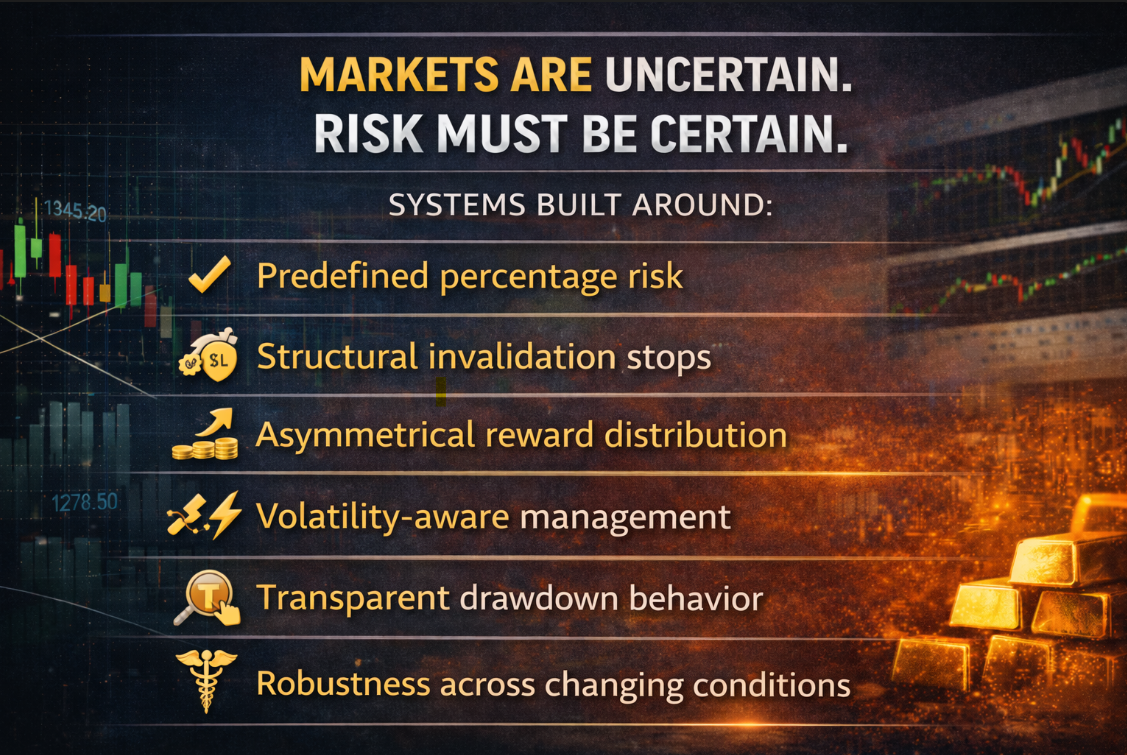
Markets are uncertain. Risk must be certain.
That means systems built around:
-
predefined percentage risk
-
structural invalidation stops
-
asymmetrical reward distribution
-
volatility-aware management
-
transparent drawdown behavior
-
robustness across changing conditions
This is the difference between building systems that impress quickly and building systems that endure.
What This Blog Series Will Cover Next
This is Part 1 because it’s the foundation: the “why” behind the shift.
The rest of the series will be practical and structured, focused on helping traders evaluate systems correctly and avoid common traps that look good on paper but fail under regime change.
Part 2 will focus on win rate—why it’s misunderstood, how it gets engineered artificially, and how to read system quality without being misled by a headline percentage.