
The Risk-First Evolution of Automated Trading - Why Win Rate Is the Most Misunderstood Metric in Automated Trading

Part 2 — Why Win Rate Is the Most Misunderstood Metric in Automated Trading
In Part 1, I explained how two years on the MQL5 marketplace shifted my development philosophy from signal-focused to risk-first design. One of the biggest drivers of that shift was observing how traders evaluate systems — and how often win rate dominates that evaluation.
Win rate is usually the first number people look at. It is treated as a proxy for accuracy, reliability, and safety. A 90% win rate looks impressive. A 75% win rate looks strong. A 40% win rate looks risky.
But after reviewing performance data across multiple systems, market conditions, and user experiences, I’ve learned that win rate by itself is one of the least reliable indicators of structural durability.
This post is not about dismissing win rate. It is about understanding what it does — and does not — tell you.
Why Win Rate Feels So Powerful
Win rate speaks directly to psychology.
A higher percentage of winning trades reduces emotional friction. Traders experience fewer losing moments. Confidence builds quickly. The system “feels” accurate. Even when drawdown occurs, it feels temporary because most trades appear to work.
For newer traders especially, frequent wins create a sense of control.
The problem is that markets do not reward emotional comfort. They reward coherent payoff distribution.
Win rate measures frequency. It does not measure the size of outcomes. It does not measure exposure. It does not measure structural risk.
Without context, it is incomplete.

The Critical Missing Context: Outcome Size
Every trading system produces a distribution of outcomes. That distribution has two components:
-
How often trades win
-
How large those wins are relative to losses
You cannot evaluate one without the other.
A system that wins 85% of the time but loses significantly more on its losing trades can be weaker than a system that wins only 35% of the time but produces larger asymmetrical winners.
This is where expectancy enters the picture.
Expectancy is not complicated. It simply reflects the average outcome per trade over a large sample. But most marketplace evaluations stop before asking whether expectancy is stable.
Instead, win rate becomes the focal point.

How Very High Win Rates Are Often Achieved
Through years of development and reviewing marketplace systems, I have observed common structural behaviors that tend to produce very high win rates:
-
Stops placed far from logical invalidation
-
Losses delayed rather than accepted
-
Exposure increased after losing trades
-
Recovery stacking or position averaging
-
Small profit targets relative to large stop zones
These behaviors are not inherently malicious. Some strategies are designed intentionally around high frequency and small targets. But they change the payoff structure.
When small profits are collected repeatedly while risk is suppressed or postponed, the equity curve can appear smooth for extended periods. The system “looks” stable. But risk may be concentrating rather than being eliminated.
When volatility shifts or conditions change, that suppressed risk may surface rapidly.
This is not a statement that all high win rate systems fail. It is a statement that high win rate alone does not guarantee structural integrity.

The Illusion of Smoothness
Smooth equity curves are appealing because they suggest control. However, smoothness can arise from two very different architectures:
-
Controlled risk with positive expectancy
-
Risk suppression with delayed exposure
From the outside, both can look similar. Internally, they behave very differently.
In risk-suppression models:
-
Small wins happen frequently
-
Losses are avoided or reduced temporarily
-
Risk becomes concentrated
-
A rare event wipes out accumulated gains
In controlled-risk models:
-
Losses occur regularly
-
Risk per trade remains constant
-
Exposure does not increase after loss
-
Recovery happens through asymmetrical reward
The second model often looks less impressive in short timeframes. But it tends to degrade gradually rather than collapse suddenly.
Why Lower Win Rate Does Not Mean Weakness
One of the most common misconceptions I see on the marketplace is the assumption that lower win rate equals poor quality.
In reality, many structurally sound systems operate in the 30–50% win rate range. This is especially true for strategies built around:
-
Structural invalidation stops
-
Fixed percentage risk
-
Asymmetrical reward-to-risk profiles
-
Expansion-phase capture
These systems accept small losses quickly. They do not widen stops to preserve statistics. They do not increase exposure to recover. They allow distribution to unfold naturally.
As a result, they show:
-
Losing streaks
-
Fluctuation
-
Uneven growth patterns
This is not instability. It is statistical honesty.
The Emotional Trap
A key reason win rate dominates decision-making is emotional bias.
Traders often equate fewer losses with better engineering. When a system produces a streak of losing trades, even if risk is small and predefined, doubt sets in quickly. The instinct is to assume something is broken.
But in asymmetric systems, losing streaks are mathematically expected. The question is not whether losses occur. The question is whether losses are:
-
Predefined
-
Controlled
-
Consistent
-
Non-escalating
If those conditions are met, losing streaks are part of the design — not evidence of failure.
What Win Rate Should Actually Be Used For
Win rate becomes meaningful when evaluated in context.
Instead of asking:
“What is the win rate?”
A more useful set of questions is:
-
What is the average reward relative to the average loss?
-
Is risk predefined before every trade?
-
Does exposure increase after losing trades?
-
Are large losses rare but catastrophic, or small and frequent?
-
Does the system degrade gradually across market regimes?
Win rate is a descriptive statistic. It is not a durability metric.
The Shift Moving Into 2026
As development continues into 2026, win rate is no longer treated as a design objective. It is treated as a byproduct of structure.
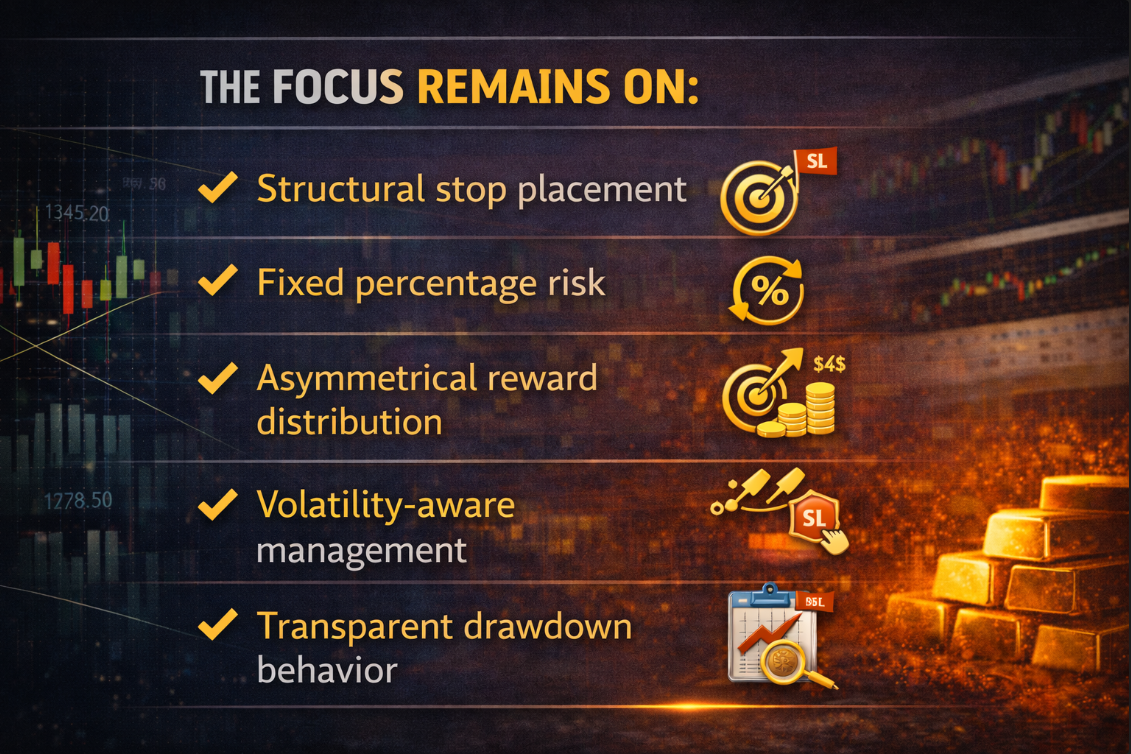
The focus remains on:
-
Structural stop placement
-
Fixed percentage risk
-
Asymmetrical reward distribution
-
Volatility-aware management
-
Transparent drawdown behavior
When those elements are engineered correctly, win rate finds its natural level.
Optimizing win rate directly often leads to hidden trade-offs.
Optimizing risk architecture tends to produce stability.
What Comes Next
In Part 3, I will break down expectancy in practical, accessible terms. We will explore how to evaluate payoff distribution clearly without relying on advanced mathematics — and how traders can identify whether a system’s edge is durable or conditional.
Understanding win rate correctly is the first step. Understanding expectancy is where evaluation becomes objective.