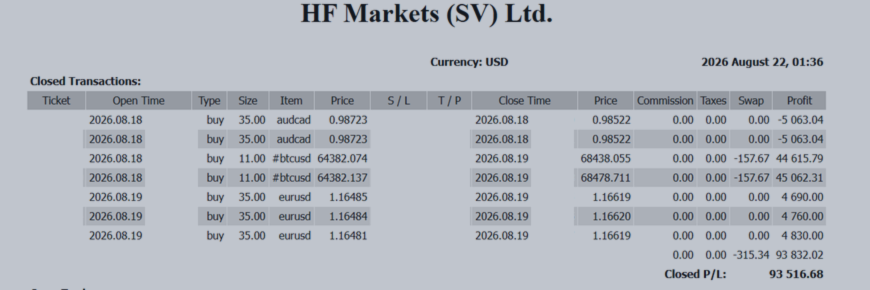
【+93,516 USD】Will Dollar Weakness Continue or Reverse? Jackson Hole and U.S. Yields to Set the Next Market Direction

【+93,516 USD】Will Dollar Weakness Continue or Reverse? Jackson Hole and U.S. Yields to Set the Next Market Direction
Trading Results, 17–21 August
Weekly Total: +93,516 USD
■ This Week’s Summary
This week, the dollar market shifted sharply after a rapid decline in U.S. long-term yields.
Early in the week, the dollar strengthened on rising U.S. yields and higher oil prices, pushing USD/JPY into the upper 159 range.
However, the U.S. Treasury’s announcement of expanded long-term Treasury buybacks triggered a substantial decline in long-term yields, leading to a sharp increase in dollar selling.
As a result:
・EUR/USD rose into the 1.17 range
・GBP/USD moved into the 1.36 range
・AUD and NZD also advanced
Broad dollar weakness intensified.
At the same time, the yen itself remained weak, limiting the decline in USD/JPY.
The defining feature of the week was:
“The dollar is weak, but the yen is even weaker.”
Weekly performance was +93,516 USD.
With market volatility remaining exceptionally high, the focus will remain on markets where a clear theme and trend are aligned, rather than increasing positions unnecessarily.
■ Going Forward
Rather than focusing only on USD/JPY, the priority is to monitor the direction of U.S. long-term yields.
The approach will be:
・Prioritize dollar selling if U.S. yields continue to fall
・Shift toward dollar buying if U.S. yields rebound
・Remain highly alert to intervention risk near USD/JPY 160.00
・Monitor strong currencies such as AUD and NZD against the dollar
・Keep positions smaller around major events
With many important events next week, the priority is not to pre-judge direction but to follow the trend formed after the data and headlines are released.
FX Strategy Update
24–28 August 2026 | Market Outlook
Previous Week’s Performance: +93,516 USD
■ Next Week’s Market Theme
The key theme next week is:
“Will falling U.S. yields and dollar weakness continue?”
The recent decline in U.S. long-term yields triggered a rapid increase in dollar selling.
If this move continues, the FX market may enter a more established dollar-weakness phase.
However, next week will include a concentration of major events:
・Jackson Hole Symposium
・Speech by Fed Chair Warsh
・Annual benchmark revision to U.S. employment data
・U.S. GDP and PCE data
・Tokyo CPI
・Australian CPI
The most important factor is not simply what Fed Chair Warsh says.
The key question is:
“How will U.S. long-term yields react to his comments?”
■ U.S. Long-Term Yields Are the Key Signal
The dollar is currently responding more strongly to long-term yields than to the policy rate itself.
If U.S. yields decline further, the following pattern may continue:
Lower U.S. yields
↓
Dollar selling
↓
EUR/USD and GBP/USD rise
↓
AUD/USD and NZD/USD rise
Conversely, if Fed Chair Warsh emphasizes inflation concerns and U.S. yields rebound, the market could rapidly reverse into dollar buying.
Next week’s approach is not to predict Fed comments, but to observe the market’s reaction in U.S. yields.
■ USD/JPY Strategy
The 160.00 level remains a major barrier for USD/JPY.
Falling U.S. yields should place downward pressure on USD/JPY. However, because the yen remains weak, dollar weakness may not be reflected as directly as it is in other major dollar pairs.
If U.S. yields rebound and USD/JPY moves back toward 160.00, intervention concerns from Japanese and U.S. authorities are likely to rise rapidly.
USD/JPY may therefore remain difficult to trade:
“Hard to chase higher, but also hard to sell aggressively on declines.”
Rather than making USD/JPY the main trading market, the focus will be on U.S. yields and the broader dollar trend.
■ EUR/USD Strategy
EUR/USD may test further upside if U.S. yields continue to fall.
However, the current euro strength appears to be driven more by dollar weakness than by independent euro strength.
If U.S. long-term yields rebound, EUR/USD could retreat relatively quickly.
The basic strategy is to buy dips while U.S. yields remain under downward pressure. If a reversal higher in yields is confirmed, the long-bias strategy should be paused.
■ GBP/USD Strategy
The pound is also benefiting from dollar weakness.
Persistent U.K. inflation and wage pressures are supporting expectations that the Bank of England will keep monetary policy restrictive for longer, providing support for the pound.
If U.S. yields continue to decline, GBP/USD may remain more resilient than EUR/USD.
However, the approach is to wait for pullbacks rather than chase the highs.
■ AUD/USD Strategy
Australian CPI will be important next week.
If inflation is stronger than expected, expectations for prolonged RBA tightening or additional rate hikes could strengthen, supporting the Australian dollar.
If this is combined with lower U.S. yields and dollar weakness, the market could see a particularly clear setup:
Australian dollar strength + dollar weakness
AUD/USD is one of the higher-priority pairs for next week.
■ NZD/USD Strategy
NZD has recently shown very strong price action.
A high-yield environment, dollar weakness, and risk appetite are all supporting the currency.
If U.S. long-term yields decline further, NZD/USD buy-on-dips opportunities will remain under close watch.
However, as the pair has already advanced substantially, it is preferable to wait for a correction rather than chase higher prices.
■ Gold Strategy
Gold also remains important.
Lower U.S. yields are generally supportive for non-yielding assets such as gold.
Continued concern over Middle East developments could also support safe-haven demand.
If the following three factors align:
Lower U.S. yields
+
Dollar weakness
+
Geopolitical risk
Gold could enter another strong trend.
The basic approach is to continue monitoring for buy-on-dips opportunities.
■ Core Strategy for Next Week
Next week, the top priority is:
“Watch U.S. yields, not just the dollar.”
The core strategy is:
・Continue favoring dollar selling if U.S. yields fall
・Monitor buy-on-dips opportunities in EUR/USD, AUD/USD, and NZD/USD
・Consider gold as a buy-on-dips candidate
・Reduce dollar-short exposure if U.S. yields rebound
・Avoid chasing USD/JPY higher near 160.00
・Keep positions smaller around Jackson Hole
・Do not chase the first move immediately after data releases
With so many major events, the focus should not be the news itself, but how the market prices and reacts to it.
■ Final Scenarios
There are two major scenarios for next week.
Scenario 1: Lower U.S. Yields and Continued Dollar Weakness
If Fed Chair Warsh maintains a cautious stance and the annual revision to U.S. employment data is weak, the following move could strengthen:
Lower U.S. yields
↓
Dollar weakness
↓
EUR/USD and GBP/USD rise
↓
AUD/USD and NZD/USD rise
↓
Gold rises
Scenario 2: U.S. Yield Rebound and Renewed Dollar Buying
Conversely, if Fed Chair Warsh emphasizes inflation risks and U.S. GDP and PCE data are strong:
U.S. yield rebound
↓
Dollar buying
↓
Dollar pairs decline
In this case, USD/JPY could move back toward 160.00, though intervention concerns make chasing the upside risky.
The basic policy for next week is:
“Do not predict Jackson Hole—follow the direction of U.S. yields.”
Important events are concentrated from 26 to 28 August. Rather than forcing positions early in the week, capital should be focused only on markets where the direction of U.S. yields and the dollar becomes clear.
■ Afterword: More Is Not Always Better
Recently, social media has seen growing trends such as:
“proteinmaxxing”
“fibermaxxing”
“sleepmaxxing”
These trends aim to maximize different aspects of health.
Protein, fiber, and sleep are all essential for good health.
However, the key point is:
“More is not always better.”
Too much protein can disrupt nutritional balance. Increasing fiber too quickly can lead to bloating, constipation, or diarrhea. Trying too hard to optimize sleep can create anxiety around sleep scores and routines, making it harder to sleep.
What matters most is not maximizing everything, but finding the amount that is right for you.
Trading is exactly the same.
Trying to maximize profits can lead to:
Increasing position size too much.
Opening too many trades.
Trying to capture every opportunity.
Watching charts around the clock.
At first glance, this can look like hard work.
However, trading is not a world where the person who does the most wins.
Instead, long-term success often comes from taking risk only when it is necessary and doing nothing when conditions are unclear.
Health and investing both lose their benefits when taken to extremes.
What matters is not pursuing the maximum.
It is finding the optimal balance.
Next week, rather than forcing profits to their maximum, the goal is to take risks that fit both market conditions and available capital—and to continue building a trading approach that can be sustained over the long term.