
0
6
Will USD/JPY’s Resilience Hold?
A week to weigh yields and policy signals
Review: 28 September–2 October 2026
Outlook: 5–9 October 2026
The test next week is the market’s reaction, not the headline.
Soft data that fail to pull US yields lower are unlikely to sustain dollar selling. Hawkish language will do little for the dollar if yields do not follow.
Last week USD/JPY retraced its post-payrolls decline. That bid is worth respecting.
So is the risk of a sharp reversal if officials step up warnings against yen weakness.
Payrolls weakened the dollar. They did not reverse it.
From 28 September to 2 October, USD/JPY traded in a 156–158 range.
Higher US yields supported the dollar. Verbal intervention from Japanese and US authorities capped the upside. The two forces cancelled each other out for much of the week.
The Bank of Japan’s Summary of Opinions was not read as a signal that rate hikes would be stacked in quick succession. Against that backdrop, USD/JPY rose to 158.45 on 1 October.
Firmer Tokyo inflation and official comments later drew yen buying. The move never became one-way.
Friday’s employment report was weak. The pair fell to 156.95 on the release.
It then recovered toward 157.90 as Treasury yields steadied.
Confirmation of a softer labour market was not, on its own, enough to turn the dollar lower.
US long-term yields — their level and their change — remain the reference for USD/JPY.
United States: services, and the Fed’s own reading
The US calendar is led by Monday’s ISM services survey and Thursday’s September FOMC minutes.
In the ISM, the headline is only part of the story. Employment and prices paid will show whether services are slowing with the payrolls report, or whether price pressure is persisting as activity cools. That distinction feeds the policy path.
The minutes are due at 3:00 a.m. Japan time on 8 October. The question is how widely the committee shared a view on further tightening.
They record a discussion from before this employment report. Read them with the data and remarks that followed.
Even if expectations of an early additional hike fade, concern over energy prices and inflation can keep US yields from falling far.
This is not an environment in which weak activity data alone justify a sustained dollar short.
Japan: monetary policy and fiscal policy together
The set pieces are Prime Minister Takaichi’s policy speech on 5 October and remarks from BoJ Governor Ueda on 6 October.
The speech should be read for the concrete programme, including a consumption-tax cut on food, and for how the funding is explained.
From the Governor, the point is whether the stance on further rate hikes has shifted.
Also on the domestic calendar:
7 October — real wages
8 October — regional economic report
9 October — household spending
If Japanese long-term yields rise, the reason matters. A move driven by hike expectations and a move driven by fiscal concern do not mean the same thing for the yen.
On USD/JPY, speed matters as much as level. A rapid slide in the yen raises the odds of official pushback or intervention. A market that is still bid can gap lower.
How to read rebounds elsewhere
Euro and sterling — look past the dollar
EUR/USD is pulled by US yields, and also by European energy-supply anxiety and by France’s fiscal and political strains.
A softer dollar bid will not produce much of a euro recovery if those concerns are unresolved.
Sterling had support from an upward revision to UK GDP. Slower growth, inflation, and fiscal unease have not gone away. Political developments in the UK–EU relationship are worth watching.
Strength against the euro does not automatically mean strength against the dollar or the yen. Each pair has its own drivers.
Australian dollar and rand — inflation versus the growth burden
The RBA lifted the cash rate to 4.60%. A cautious tone on further tightening meant the move did not lift the Australian dollar.
Next week AUD is likely to stay sensitive to US yields and to risk appetite. In AUD/JPY, Australian news is only half the risk. A sudden move in USD/JPY can dominate.
In the rand, higher fuel prices are lifting inflation and weighing on activity at the same time. Both sides of that trade-off are a drag.
Canadian dollar — jobs and crude set the policy read
Trade friction with the United States and a soft labour market remain the overhang.
Friday’s employment report should be checked for further job losses and slower wage growth. Read alongside crude, that will show whether the Bank of Canada’s outlook is shifting.
Calendar, 5–9 October (Japan time)
Monday 5: Prime Minister Takaichi’s policy speech. US ISM services at 23:00.
Tuesday 6: Remarks by BoJ Governor Ueda and Finance Minister Katayama. US trade balance.
Wednesday 7: Japan real wages. US weekly petroleum inventories.
Thursday 8: FOMC minutes at 3:00. BoJ regional economic report. ECB minutes. US jobless claims.
Friday 9: Japan household spending. Canada employment at 21:30. University of Michigan sentiment at 23:00.
Dates and times can change.
Do not chase the first print
The working rule: do not set direction on the first move after a release. Wait to see whether yields and the exchange rate agree.
USD/JPY has tended to be bought back after dips. Official warnings against yen weakness can still produce a sharp drop.
In any chase higher, define the loss on a reversal first.
If the euro or the Australian dollar rallies, ask whether it is short covering or the start of a turn.
With several pairs on, count not only the number of positions but the combined exposure to the dollar and to the yen. Different pairs can still be the same dollar short, or the same yen short. Losses then concentrate when the market turns.
Week’s record
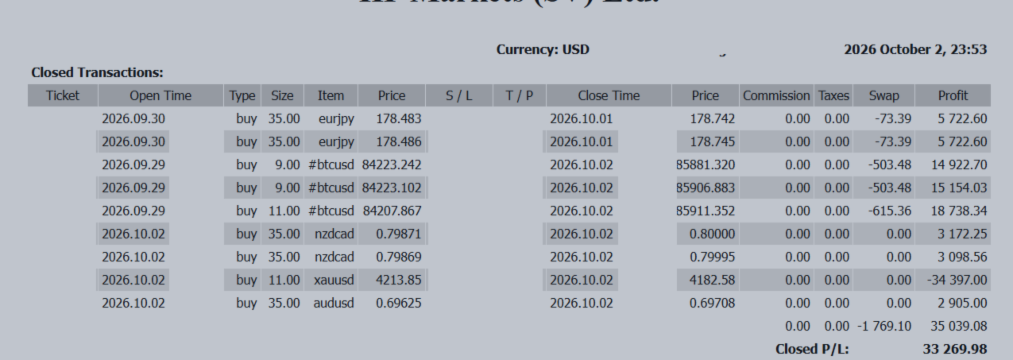
P&L for 28 September–2 October: plus 33,269 USD.
The bulk came from BTC/USD. EUR/JPY, NZD/CAD, and AUD/USD also contributed, and together absorbed a large loss in gold.
AUD/USD was fully closed by the weekend, and gold was stopped out. The book is flat. Next week’s positions will be built against the new data and the policy remarks.
Afterword — close the screen on purpose
There is a familiar version of the evening: one more look at the chart, and somehow it is late. On a US data day the post-release move is hard to leave alone.
Staying in this market for a long time also means treating sleep as part of the process.
There is specific evidence on evening screens. In a 2015 PNAS paper, Chang and colleagues had 12 healthy young adults read for about four hours before bed — five nights on a light-emitting device, five nights with a printed book.
With the device, time to fall asleep averaged about 26 minutes, against about 16 minutes with the book. Next-morning sleepiness was greater.
The sharper finding was timing: melatonin onset was delayed by roughly an hour and a half. Evening screen use does not only steal minutes. It can shift the clock that governs sleep.
A study of 12 people reading on a device for four hours is not a claim that a short look at a phone does the same thing to everyone. It is still a useful reason to put a boundary on late chart-checking.
On duration, a 2015 joint statement from the American Academy of Sleep Medicine and the Sleep Research Society, led by Watson and colleagues, recommends that adults regularly sleep seven hours or more. That is a synthesis of studies, not a single experiment. Need varies. It is still a fair test of whether data nights are steadily cutting into sleep.
Entries and stops are set in advance. The same discipline applies to the time the screen goes off.
Leave a note on what still matters, and leave anything that can wait until morning. The habit of opening the chart again after getting into bed is worth ending.
This is not a claim that better sleep raises returns. For anyone who intends to keep trading, the time spent protecting health belongs next to the rules that protect capital.
Next week, build both.