Logos
- Experts
- Versione: 1.0
- Attivazioni: 5

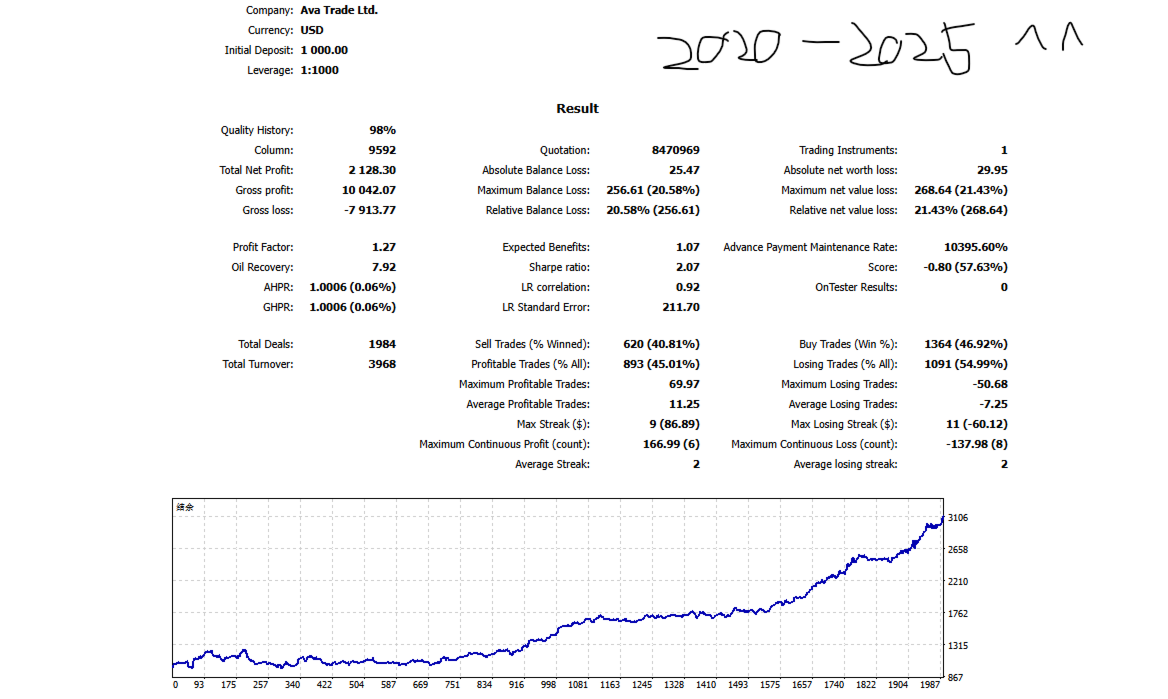
This is a strategy combination that integrates the dual attributes of trend following and bottom-hunting & top-picking. It constructs its trading logic based on the clear rules of "three entry criteria, three stop-profit mechanisms and one stop-loss rule". The backtest performance is outstanding, with a high Sharpe ratio and well-controlled maximum drawdown. Without further ado, let us delve straight into the core logic of the strategy.
I. Core Judgment Dimensions of the Strategy
The strategy’s assessment of market trends and long/short positions is primarily built on a comprehensive signal system consisting of four types of indicators:
- Moving Average System: A combination of multi-period moving averages paired with the middle band of Bollinger Bands serves as the core anchor for determining trend directions.
- Oscillator Indicator: The KDJ indicator is used to judge the overbought/oversold status of prices and capture potential reversal points.
- Price Action: The continuity of a trend is confirmed by identifying the breakout patterns of highs and lows within key timeframes.
- Bollinger Bands Indicator: The degree of deviation between the price and the middle band of Bollinger Bands is observed to assist in judging trend strength and reversal probability.
II. Three Entry Criteria (Entry is Permitted if Any One Criterion is Met)
The strategy’s entry logic is divided into two major directions: with-trend and counter-trend. The rules for going long and short are symmetrical. Below is an illustration based on long positions:
- Trend Golden Cross Entry (With-Trend Swing Trading) The price stays above both the long-period moving average and the middle band of Bollinger Bands simultaneously, and the KDJ indicator shows a bullish pattern where the K-line crosses above the D-line. This is a with-trend add-on signal in the continuation phase of a trend.
- Breakout Entry (Trend Intensification) The price stays above the long-period moving average and effectively breaks through the high of the recent timeframe, indicating a further enhancement of trend momentum. This is the core entry signal for trend following.
- Oversold Bottom-Hunting Entry (Counter-Trend Reversal) The J-line of the KDJ indicator enters an extreme oversold zone, presenting an opportunity to bet on a short-term price rebound. This signal requires comprehensive judgment in conjunction with the trend environment to avoid blind counter-trend operations in a strong trending market.
The logic for short positions is completely symmetrical to that of long positions. Entry is permitted if any of the following three conditions is met: the price stays below both the moving average and the middle band of Bollinger Bands along with a bearish KDJ pattern; the price breaks below the recent low; or the J-line enters an extreme overbought zone.
III. Refined Exit Rules (Three Stop-Profit Mechanisms + One Stop-Loss Rule)
The strategy’s exit rules are the key to controlling drawdowns and locking in profits. They are divided into two modules: stop-profit and stop-loss. The stop-profit rules are designed hierarchically to balance profit realization and trend extension:
- Three Stop-Profit Mechanisms
- Profit Target Stop-Profit: Actively exit the position when the floating profit of the holding reaches the preset target points.
- Indicator Reversal Stop-Profit: A stop-profit signal is triggered when the moving average system shows a reverse cross, indicating a high probability of a trend reversal.
- Pullback Magnitude Stop-Profit: This is divided into two scenarios. If the profit fails to reach the preset ratio, close the position once the price pulls back by a certain magnitude; if the profit exceeds the preset ratio, widen the pullback threshold to pursue further gains from trend extension.
- Rigid Stop-Loss Rule Unconditionally exit the position to stop loss when the holding loss reaches the preset points, or when signals such as a moving average reverse cross or a price breakout of recent highs/lows in the opposite direction emerge. This prevents losses from expanding due to stubbornly holding losing positions.
This strategy adopts XAUUSD H4 timeframe as its default parameter
2025、2020~2025 backtest ↓