
KAZ Kalman Adaptative Zone
- Indicators
- Version: 2.14
- Activations: 5

Kalman Adaptive Zones — Quantitative Probability Bands
Stop guessing where price is going. Start knowing where it statistically belongs.
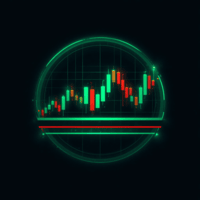
Kalman Adaptive Zones (KAZ) is a professional quantitative indicator that draws intelligent probability bands around price — bands that automatically adapt to market conditions in real time.
Unlike Bollinger Bands or Keltner Channels which use fixed lookback periods, KAZ combines multiple layers of quantitative analysis to produce bands that actually reflect what the market is doing right now.
How it works
At its core, KAZ runs an adaptive filter that continuously estimates the true underlying price, filtering out noise while remaining reactive to genuine moves.
Around this center line, the indicator builds probability zones whose width is driven by two forces simultaneously:
- Market uncertainty — the wider the filter's confidence interval, the wider the zones
- Regime instability — how much volatility itself is changing, not just volatility alone
The result is a band structure that breathes with the market: thin and precise during calm, predictable conditions, wide and cautious during chaotic regimes.
Stable Bands — the quantitative edge
The most unique feature of KAZ is its Stable Bands system.
Most band indicators repaint their levels on every bar — creating a constantly moving target that is impossible to trade against.
KAZ solves this with a fractal complexity engine that measures how chaotically price is accelerating and changing direction.
This complexity score — normalized using a statistical Z-Score — dynamically adjusts how the bands are anchored.
The Stable Bands then lock onto a level and hold it as long as price remains between them, acting as dynamic support and resistance.
They only reposition when a genuine breakout occurs — not on every tick of noise.
The practical result: you always know exactly where the key levels are, and the market has to earn a band shift.
Candle coloring
Every candle is colored based on its quantitative position within the band structure:
- Bright green — price in strong bullish extension zone
- Light green — price in bullish zone
- Gold — price in neutral mean-reversion zone
- Orange — price in bearish zone
- Red — price in strong bearish extension zone
Important — candle colors are context, not signals
A bright green candle means price is in a statistically overbought extension zone.
But what that means for your trade depends entirely on market context.
In a mean-reversion regime, a green candle near the upper band is a potential sell opportunity — price is stretched and likely to snap back.
In a trending regime, that same green candle is a continuation signal — strength attracting more strength.
KAZ does not tell you what to do.
It shows you where price is within the market's quantitative structure.
Reading that information correctly — trend or mean-reversion, extension or equilibrium — is the trader's job.
The indicator is a precision map. The decision is yours.
At a glance
You know exactly where price sits within the probability structure — no calculations needed.
Three modes, zero complexity
KAZ ships with three pre-calibrated modes optimized for different trading styles:
Mode: Fast
Best for: Scalping, tight ranges, quick reactions
Mode: Normal
Best for: Intraday trading, balanced sensitivity
Mode: Slow
Best for: Swing trading, broader structure, less noise
One click. No parameters to tune. No optimization rabbit holes.
Who is it for
- Traders who want quantitative structure without a PhD in mathematics
- Mean-reversion traders looking for statistically significant fade entries
- Trend traders who want dynamic, noise-resistant structure levels
- Anyone tired of bands that lag, repaint, or move every single bar
Key features
- Adaptive band width reacting to both volatility level and volatility instability
- Fractal complexity engine measuring market chaos in real time
- Stable Bands acting as dynamic support and resistance — no constant repainting
- 5-state candle coloring for instant visual position reading
- Three pre-calibrated modes for scalping, intraday and swing trading
- Full color customization
- Works on all symbols and all timeframes
Note — Real-time rendering
The band smoothing uses a centered kernel, which means the last 2 to 4 bars on the right edge of the chart may slightly adjust as new data arrives.
All bars beyond that point are completely stable and never change.
This has no impact on trading decisions made on confirmed closed bars.


























User didn't leave any comment to the rating