Artificial Intelligence in Trading: What It Can Really Do and What Scammers Promise

Hello, friends! Today I want to talk about a topic that has literally flooded news feeds, advertising and the private messages of beginner traders. Artificial intelligence is promised everywhere: in trading robots, in signals, in "smart" platforms that supposedly make money while you sleep. In more than twenty years of trading and developing robots for MetaTrader 4 and MetaTrader 5, I have seen many fashionable waves, but I have probably never seen so many loud promises at once.
In this article I will calmly and without unnecessary technical complexity explain what artificial intelligence can really do in trading, where its real limits are, and how scammers use a trendy word to take money from beginners. If you find this kind of breakdown useful, I invite you to add me as a friend on my MQL5 profile so you don't miss new materials. My other articles for beginners are collected in my MQL5 blog, and you can find my trading robots in my seller section. I post short notes and reviews in my Telegram channel, and demo versions of the robots are available for a calm introduction on the Trading-Go website.
Why There Is So Much Noise Around AI in Trading
Just a few years ago, the words "neural network" and "machine learning" were heard mostly at professional conferences. Today anyone can open a chat with a language model, ask a question and get a coherent, confident answer. It is genuinely impressive, and it is quite natural that many people think: if a machine writes texts and program code so well, it must also be able to predict the price of gold or the euro.
This is exactly the logic most advertising is built on. A person is shown a beautiful interface, profitability charts, the words "next-generation neural network" and "the algorithm analyzes thousands of factors." A beginner cannot verify any of these claims, but understands the main promise very well: the money will grow by itself. I have noticed that the louder the word "AI" sounds in an advertisement, the fewer specifics it contains about how trading decisions are actually made.
At the same time, it is important to understand that the technology itself is neither a magic wand nor a fraud. Artificial intelligence is a set of very real tools that professionals have been using for a long time. The problem starts when a tool is presented as a guarantee of results.
What Is Actually Called Artificial Intelligence
The words "artificial intelligence" in trading hide very different things, and it is useful for a beginner to tell them apart. Let's go through the main groups in plain language.
Machine Learning
These are methods in which a program searches for patterns in historical data. For example, it is given years of quotes and asked to find conditions after which the price rose more often than it fell. The program selects parameters and builds a model. It sounds great, but here lies the main trap: a model can perfectly "memorize" the past and completely fail in the future. This phenomenon is called overfitting, and I will talk about it in more detail later.
Neural Networks
A neural network is a special case of machine learning, a mathematical model made of many connected elements. It can find complex, non-linear relationships. In trading, people try to use neural networks to forecast price direction, estimate volatility and classify market conditions. The results can be interesting, but the markwt is constantly changing, and what a neural network found yesterday may stop working tomorrow.
Language Models
These are the chatbots almost everyone is familiar with now. They are trained on huge amounts of text and work excellently with language: they explain concepts, write and review code, and help structure thoughts. But a language model does not see the live market unless it has been specifically connected to it, and it has no knowledge of the future. When you ask it "where will the price go tomorrow," it produces plausible text, not a forecast based on some hidden knowledge.
What AI Can Really Do in Trading
Now for the good part. Artificial intelligence can indeed be a useful assistant if you treat it as a tool rather than an oracle. In practice, it works like this.
Learning and Explaining Concepts
For a beginner, this is perhaps the most valuable opportunity. A language model can patiently explain what a spread, swap, margin or stop loss is, give an example, and answer a follow-up question at three in the morning. However, I recommend always double-checking answers against reliable sources: a model sometimes makes mistakes in a very confident tone. For example, it is better to verify a position size calculation with your own formula, which I described in my article on calculating lot size.
Help With Programming
For those learning MQL4 and MQL5, AI becomes a good assistant: it can suggest syntax, find an obvious bug, propose a function structure and explain someone else's code. But I would not write a complete trading robot while trusting every line it produces. A model can invent a function that does not exist or handle an order opening error incorrectly. Code must always be understood, checked and tested in the strategy tester.
Processing Large Amounts of Information
AI handles routine work well: it can briefly summarize a long analytical article, group news by topic, and help review a trading journal to find recurring mistakes. For example, if you keep a trader's diary, you can ask the model to look for patterns: on which days of the week or after which events you most often had losing trades. This is not a market forecast but an analysis of your own behavior, and it can be very useful.
Searching for Patterns and Researching Ideas
In the hands of an experienced developer, machine learning helps test hypotheses faster: selecting filters, assessing under which conditions a strategy works better and under which it works worse. The key words here are "in the hands of an experienced developer." Without an understanding of statistics, without an out-of-sample period for verification and without honest testing, such research almost always ends with a beautiful but useless model.
What AI Cannot Do and Never Honestly Promises
The most important thing to remember is that no technology knows the future. The market is the result of decisions made by millions of participants, news, central bank decisions and unexpected events. Artificial intelligence can estimate a probability, but it cannot give a guarantee.
AI Does Not Eliminate Risk
Any trading system, whether a simple one based on two moving averages or a complex one based on a neural network, has losing trades and drawdown periods. If a seller says their "AI bot" trades without losses, that is already a reason to be cautious. Money management, a reasonable position size and an understanding of margin remain your responsibility, not the algorithm's.
AI Is Not Immune to Overfitting
Imagine a student who memorized the answers to one specific exam ticket but did not understand the subject itself. On that ticket he gets top marks, and on another he fails. An overfitted model behaves the same way: on history it shows an almost perfect equity curve, and on a real account it starts losing money. That is why a beautiful chart from the tester proves nothing by itself. I explained in detail why the tester and real trading diverge in a separate article on my blog.
AI Does Not Understand the Market the Way a Human Does
A model sees only the data it has been given. It does not know that important news is coming out tomorrow unless this is included in its input data. It will not sense that the market has become thin before the holidays, and it will not understand that the broker has widened spreads. A model meets any sudden change in market conditions "blindly."
AI Does Not Replace Discipline
Even the best system is useless if a trader switches it off after three losing trades or manually doubles the volume to "win it back faster." I have noticed that most beginner losses are related not to the quality of the strategy but to emotions and breaking one's own rules. No artificial intelligence will solve this problem for you.
How Scammers Use the Word "AI"
Now for the unpleasant but very important part. Scammers do not need a real neural network. They need a trendy word that inspires trust and a sense of technology. The schemes change, but their foundation is almost always the same. Let's look at the most common ones.
Guaranteed Returns
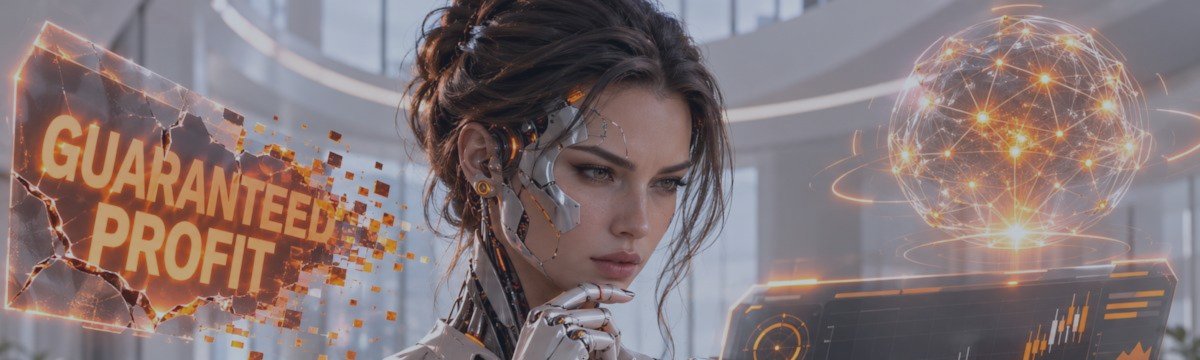
"Our AI makes 3% a day," "a stable 40% a month with no risk," "a neural network that never makes mistakes." Any promise of guaranteed profut in trading is a red flag. If an algorithm really brought such percentages consistently, its owner would not need to sell access to strangers on the internet: compound interest over a couple of years would make him richer than any sales could.
Send Us Your Money or Account Access
The classic scheme: you are offered to "connect an AI robot" to your account, but to do this you need to transfer money to the company's platform, send funds to a crypto wallet or hand over your login and trading password. For the first few weeks you see beautiful growth in your personal dashboard, and when you try to withdraw money, "fees," "taxes" and "verification" appear, or the dashboard simply stops opening. Often the numbers in such a dashboard have nothing to do with real trading at all.
A Secret Algorithm That Cannot Be Shown
An honest developer may not disclose the source code, and that is normal. But he explains the logic of the work: what principle the entry is based on, how risk is limited, which settings can be changed, and he gives you the opportunity to test the product. A scammer hides behind the words "closed development," "trade secret," "the algorithm is too complex to explain." If no one can describe in simple words what a system does, you will not be able to verify it either.
Screenshots Instead of a Verifiable History
A screenshot of a profitable account can be faked in a minute, and a demo account history can easily be passed off as a real one. Video testimonials from "happy clients" have also become cheap: today they are generated by the same neural networks. Scammers even "make" celebrities and well-known entrepreneurs advertise their projects using fake videos. If a famous person in a video confidently promises you wealth through an "AI platform," it is almost certainly a fake.
Pressure Through Time and Emotions
"Only three spots left," "the offer is valid until midnight," "for the chosen few only." The purpose of such pressure is to keep you from thinking, checking and asking for advice. A real trading tool will not disappear in a day, and a good strategy will not stop working if you spend a week testing it.
A Personal "Manager" in a Messenger
A polite person writes to you, first just chatting and sharing their "successes," then offering to try "AI signals" with a small amount. The small amount unexpectedly doubles, and you are offered to deposit more. This is a carefully built scenario designed around trust and excitement. I recommend not continuing financial conversations with strangers who approached you on their own with an offer to make money.
How to Tell an Honest Tool From a Scam
To make it easier for beginners to navigate, I have gathered the main differences into one table. It is convenient to keep it in front of you when you are looking at yet another "smart" product.
| Feature | Honest trading tool | Typical scam scheme |
|---|---|---|
| Returns | No guarantees, risks and drawdowns are discussed openly | Guaranteed percentages per day or month |
| Money | Stays in your account with your broker | Must be transferred to the company or a wallet |
| Logic | The principle is described, settings and limits are clear | "Secret algorithm," "too complex to explain" |
| Verification | Demo version available, can be tested in the tester | Only screenshots, testimonials and videos |
| Seller | Public profile, publication history, feedback | Anonymous accounts, pressure, limited time |
| Risk | You control the volume and settings yourself | "You don't need to do anything, AI does it all" |
Notice that this table says nothing about whether a product uses a neural network or not. The honesty of a tool is determined not by a trendy word in the description but by transparency, the ability to verify it, and where your money is kept.
How I Use AI in My Own Work
I am often asked: since I have been working with robots for so many years, do I use artificial intelligence? Yes, I do, but as an assistant. It helps me prepare texts and documentation, check ideas and speed up routine work with code. At the same time, I personally check every decision that goes into the trading logic, and I run every version of a robot through the strategy tester and on a demo account.
My trading robots work according to clear, predefined rules. For example, VR Smart Grid manages series of positions: it uses averaging, calculates the average price, manages volumes and partially closes positions. The user sees the settings, understands what the robot does, and can test it on history and on a demo account before making any decision. This approach seems less "magical" than neural network advertising, but it is honest: you know exactly what you are managing, and you are responsible for the level of risk yourself.
I deliberately do not call my algorithms "artificial intelligence" for the sake of marketing. I think it is right for a trader to understand the mechanics rather than believe in a miracle. Understanding the mechanics is the best protection both from scammers and from your own rash actions.
A Practical Checklist for Beginners
Before entrusting money to any product with the words "AI," "neural network" or "smart algorithm," go through these points. If the answer to even one question is alarming, it is better to stop.
- Are you promised guaranteed profit or "trading without losses"? If so, that is a reason to walk away.
- Does the money stay in your account with your broker, or are you asked to transfer it somewhere?
- Are you asked for your trading password, bank card details or access to a crypto wallet?
- Can you explain in your own words what principle the system works on?
- Is there a demo version or a way to test the product in the MetaTrader tester?
- Does the seller have a public profile, a publication history and real feedback?
- Are you being pressured with deadlines, "last spots" or emotions?
- Are you prepared to lose the amount you plan to use?
The last point is especially important. Even with the most honest and high-quality tool, trading remains an activity with risk. It is worth starting with a demo account, then a small real deposit, and only after gaining experience gradually increasing the load.
Recommendations
I recommend treating artificial intelligence as a smart assistant, not as a source of guaranteed income. Use it for learning, reviewing your mistakes, working with code and information, but make trading decisions while understanding their logic and risks.
I have noticed that beginners who first understand the basics — position size, margin, stop loss, drawdown — fall for loud promises much less often. Knowledge makes advertising for "AI bots with 5% daily returns" not attractive but funny.
In practice, it works like this: any trading tool is first checked in the strategy tester, then on a demo account, and only then on a real account with small risk. The money always stays with your broker, and passwords and card details are never shared with anyone. If a product does not meet these simple conditions, no neural network in its description will save it.
If you found this topic useful, visit my MQL5 blog: there I cover the basic questions of trading in plain language. Protect your deposit, verify everything you are promised, and let technology work for you, not for scammers.
Tags: artificial intelligence, AI in trading, trading robots, trading scams, trading for beginners