Why Do Trading Robots Open Multiple Positions and How Can You Manage the Risks?

Imagine installing an Expert Advisor in MetaTrader, enabling automated trading, and discovering that the robot has opened two positions instead of one. One is a BUY, the other is a SELL. A little later, several more positions appear. For a beginner, this may seem confusing. Why would a trading robot open multiple trades when it could simply identify the market direction and enter a single position?
Multiple-position management is a common concept in algorithmic trading. Some strategies gradually accumulate positions in the direction of a trend. Others distribute entries across different price levels or use opposing positions as part of a larger trading cycle.
However, opening more positions does not automatically improve profitability. It changes the way exposure, margin requirements, potential returns, and trading risks are distributed across the account.
In this article, we will explore why trading robots open multiple positions, how opposing BUY and SELL trades work, what breakeven protection actually means, and how traders can evaluate the risks of automated strategies.
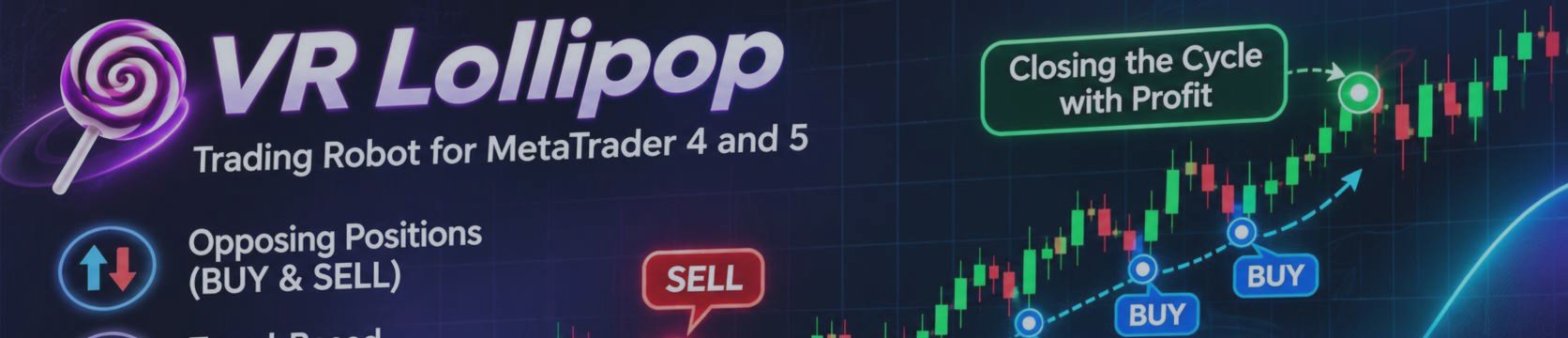
As a practical example, we will look at VR Lollipop, an Expert Advisor for MetaTrader 4 and MetaTrader 5 that uses paired positions, trend-based accumulation, breakeven management, and dynamic trailing stops.
You can explore the trading system in the official MQL5 Market:

Why Is One Position Sometimes Not Enough?
A conventional trading strategy usually begins with a single market entry. The trader identifies a direction, opens a BUY or SELL position, sets Stop Loss and Take Profit levels, and waits for the outcome.
This approach is relatively simple, but it does not always provide enough flexibility to respond to changing market conditions.
Suppose a trader opens a BUY position on EURUSD and the market begins to rise. The price moves 100 points, then another 100, and the trend continues. The original position generates a profit, but its trading volume remains unchanged.
A strategy that supports additional entries may gradually increase exposure as the trend develops. This can improve participation in a strong movement, but it also increases the potential loss if the market suddenly reverses.
Another situation occurs when the market initially moves against the position before returning to the expected direction. Some algorithms respond by opening additional positions at different price levels.
Other trading systems begin with opposing BUY and SELL positions and manage them according to subsequent market movements.
All these approaches share an important principle: the robot manages a sequence of trading operations rather than a single isolated trade.
Three Common Reasons Trading Robots Open Multiple Positions
1. Building Positions During a Trend
The first approach involves adding positions in the direction of an established market movement.
For example, a robot opens an initial BUY position on gold. As the price rises and additional conditions are satisfied, the algorithm opens a second and then a third BUY position.
This technique is commonly known as pyramiding. Instead of relying on one perfect entry, the system gradually increases its participation in a developing trend.
However, the total trading volume must remain under control. If positions are added too frequently, even a relatively small correction may significantly reduce accumulated floating profits.
For this reason, trend-based accumulation is often combined with breakeven protection, trailing stops, and limits on aggregate exposure.
2. Averaging Into an Adverse Price Movement
The second approach involves adding positions when the market moves against the original trade.
Suppose the first BUY position is opened at 1.1000 and a second BUY position is opened at 1.0950. If both positions have equal volume, their average entry price becomes 1.0975 before transaction costs.
The market no longer needs to return to the first entry price for the combined positions to approach breakeven.
However, this mechanism introduces substantial risk. If the price continues falling, the floating loss grows across multiple positions.
The situation becomes especially dangerous when position sizes increase aggressively. A small initial lot does not necessarily mean that the overall strategy is conservative.
3. Opening Opposing BUY and SELL Positions
Some algorithms open BUY and SELL positions simultaneously on the same financial instrument. This technique may be used in hedging systems or strategies designed to respond to emerging market direction.
Consider a BUY position of 0.01 lots and a SELL position of 0.01 lots. If the market rises, the BUY gains value while the SELL loses value. If the market falls, the opposite occurs.
The purpose of such a structure is not to generate instant profit. The trading algorithm must decide which side to close, which position to retain, when to increase exposure, and how to complete the trading cycle.
Opposing positions also generate transaction costs. Spreads, commissions, swaps, and slippage may produce a negative combined result. The trading account must also support the required hedging functionality.
What Is a Trading Cycle?
A trading cycle is a sequence of positions managed according to a common set of rules. The algorithm may open several trades, modify protective levels, close individual positions, and eventually complete the entire sequence.
The main advantage of analyzing trades as a cycle is that it encourages traders to focus on the combined result rather than individual transactions.
| Position | Volume | Floating Result |
|---|---|---|
| BUY 1 | 0.02 | +$18 |
| BUY 2 | 0.02 | +$9 |
| SELL 1 | 0.02 | −$12 |
| Total | 0.06 | +$15 |
This simplified example excludes additional transaction costs. It illustrates why a losing position does not necessarily mean that the entire trading cycle is losing money.
Equally, one profitable position does not guarantee that the complete series is profitable.
Traders should therefore monitor floating profit and loss, aggregate trading volume, available margin, and the conditions required to close the entire series.
The Hidden Risk of Position Multipliers
One of the most common mistakes in automated trading is evaluating an Expert Advisor based only on its initial lot size.
Suppose the first position is 0.01 lots and every subsequent position doubles in size.
| Position | Lot Size | Cumulative Volume |
|---|---|---|
| 1 | 0.01 | 0.01 |
| 2 | 0.02 | 0.03 |
| 3 | 0.04 | 0.07 |
| 4 | 0.08 | 0.15 |
| 5 | 0.16 | 0.31 |
| 6 | 0.32 | 0.63 |
After six entries, the combined volume reaches 0.63 lots. That is 63 times the initial position size.
The exact financial exposure depends on the instrument, contract specifications, trade directions, and account settings. Nevertheless, the underlying problem is clear: total volume can grow much faster than beginners expect.
Before using a multi-position strategy, traders should understand its maximum possible exposure, position limits, and potential drawdown under unfavorable market conditions.
Does Breakeven Make a Trading Strategy Risk-Free?
Breakeven protection is widely used in automated trading. It generally involves moving a Stop Loss toward the entry price after the market has moved favorably.
For example, a BUY position opened at 1.1000 may have its Stop Loss moved to 1.1005 after the price reaches 1.1050.
If the protective order executes at the intended price, the position may retain a small positive result before transaction costs.
However, breakeven protection is not an absolute guarantee. Price gaps or unfavorable execution may cause the position to close at a worse price.
More importantly, protecting one position does not eliminate the risks associated with other positions in the same trading cycle.
A robot may therefore combine individual stop management with aggregate profit limits, margin monitoring, and rules governing when additional positions can be opened.
Why Trailing Stops Matter in Trend Trading
A trailing stop is designed to adjust a protective level as the market moves in a profitable direction.
Imagine a robot holding several BUY positions during an upward trend. The earliest position may have accumulated a substantial floating profit, while the most recent position has only just entered the market.
As the trend develops, the algorithm can adjust protective levels to preserve part of the accumulated result while allowing the positions to remain open.
Different trailing methods are available. Some use a fixed distance in points. Others incorporate volatility, the distance already traveled by price, or percentage-based calculations.
The central challenge is balancing profit protection with the need to tolerate normal market pullbacks.
A trailing stop that is too tight may close positions prematurely. A trailing stop that is too loose may allow a significant portion of floating profit to disappear.
VR Lollipop: A Practical Example of Multi-Position Management
VR Lollipop is an Expert Advisor for MetaTrader 4 and MetaTrader 5 designed to manage trading cycles rather than relying exclusively on isolated entries.
The system combines opposing positions, trend-based position accumulation, breakeven protection, and dynamic trailing-stop management.
A trading cycle begins with opposing BUY and SELL positions. As market conditions develop, the algorithm manages the two sides and may build positions in the direction of the prevailing movement.
When the market establishes a directional move, the robot can close the position opposing that movement and retain positions aligned with the trend.
An important part of the strategy is the relationship between breakeven protection and subsequent trading cycles. The system uses protective conditions to organize the progression from one stage of trading to the next.
Dynamic trailing stops allow the algorithm to adjust protective levels as favorable price movements continue.
However, this does not mean that every market condition will produce a profitable outcome. Prolonged adverse movements, sharp reversals, changing spreads, and growing aggregate exposure can create significant drawdowns.
Consequently, VR Lollipop should be evaluated with particular attention to position sizing, entry distances, maximum exposure, and the behavior of complete trading cycles.
How to Evaluate the Risks of a Multi-Position Expert Advisor
Beginners often judge an automated strategy by its final backtest profit. A system that produces an attractive return may appear successful without further investigation.
However, two Expert Advisors with similar returns can have dramatically different risk profiles.
One may use relatively small positions and maintain moderate drawdowns. Another may achieve the same result by increasing exposure aggressively during difficult market conditions.
To distinguish between them, consider the following metrics:
- Maximum drawdown: the largest observed decline in account equity during testing.
- Maximum simultaneous positions: how many trades the strategy can hold at once.
- Maximum aggregate volume: the greatest combined exposure reached by the system.
- Margin utilization: the amount of account capital required to maintain open positions.
- Trading cycle duration: how long a series can remain active before completion.
- Transaction costs: the impact of spreads, commissions, and swaps.
- Market sensitivity: how the strategy behaves during trends, sideways markets, and periods of high volatility.
It is especially useful to study unfavorable scenarios. What happens if the market continues moving against a position series? Does the algorithm stop adding volume? How much free margin remains?
These questions reveal more about the sustainability of an automated strategy than a short period of strong profits.
Practical Risk Management Principles
Use Conservative Initial Position Sizes
The initial lot size should be selected with the full potential trading sequence in mind. A position that appears small in isolation may become part of a much larger aggregate exposure.
Understand Position Limits
Limiting the number of positions can help control the growth of exposure. Nevertheless, reaching a position limit does not automatically resolve existing floating losses.
Evaluate Entry Distances
Small distances between entries may increase trading frequency and transaction costs. Larger distances can reduce the number of entries but also alter the strategy's behavior and recovery characteristics.
Monitor Spreads and Execution
During major news releases or periods of limited liquidity, spreads may widen and execution quality may deteriorate. These effects can be especially important for strategies that open and close multiple positions.
Consider Account-Level Risk Limits
Some Expert Advisors offer settings for closing all positions when a predefined account-currency profit or loss threshold is reached.
Such controls can provide an additional layer of risk management, although execution is never guaranteed at an exact price.
Why Demo Testing Is Essential
MetaTrader's Strategy Tester is valuable for understanding an Expert Advisor's historical behavior. It can reveal how the algorithm opens positions, modifies stops, builds trading cycles, and reacts to price changes.
However, historical testing alone cannot guarantee similar results in live trading. Actual execution conditions, spreads, slippage, and liquidity may differ from the testing environment.
For a system such as VR Lollipop, a demo account provides an opportunity to observe the progression of trading cycles under the conditions offered by the selected broker.
Pay particular attention to prolonged trends, sharp reversals, and periods when several positions remain open simultaneously.
A few profitable days are not sufficient evidence that a strategy is robust. Testing should cover different market conditions and should focus on potential losses as carefully as potential gains.
Where Can You Download the VR Lollipop Demo Version?
You can find additional information in the VOLDEMAR author's profile on MQL5.
The profile provides access to 30-day working demo versions of trading robots, including VR Lollipop, along with configuration files and additional materials for studying automated trading systems.
You can also find information about the author's Telegram channels. These communities share educational materials for beginners, trading strategy discussions, MetaTrader tutorials, and updates about automated trading tools.
Before using the Expert Advisor on a live account, I recommend reviewing its strategy description, downloading the working demo version from the author's profile, and testing it on a practice account.
This allows you to observe how trading cycles develop, how positions are protected, and how the algorithm behaves under different market conditions.
Common Mistakes Beginners Should Avoid
The first mistake is assuming that more positions automatically mean more profit. Additional exposure can amplify losses just as easily as gains.
The second is treating breakeven as a guarantee that the entire trading account is protected. Individual position protection and aggregate account risk are different concepts.
The third is using aggressive lot multipliers without calculating their cumulative effect.
The fourth is reviewing only closed trades while ignoring floating losses and the margin requirements of open positions.
The fifth is relying entirely on historical results without observing the strategy on a demo account.
Effective risk management begins with understanding what the algorithm can do during unfavorable market conditions, not only what it has achieved during favorable ones.
Recommendations
Trading robots open multiple positions because their strategies require more sophisticated management of price movements, exposure, and trading cycles.
The number of positions alone does not determine whether a system is safe or profitable.
Before using a multi-position Expert Advisor, understand how it calculates volumes, when it adds new trades, how it protects existing positions, and what conditions are required to complete a trading cycle.
If you are interested in automated trend trading with opposing positions, position accumulation, breakeven management, and dynamic trailing stops, VR Lollipop provides an example of these concepts in practice.
Begin with conservative settings, observe the strategy on a demo account, and evaluate both profitable and unfavorable market scenarios.
Visit the author's MQL5 profile for demo versions, configuration files, and information about Telegram communities dedicated to trading education and automated strategies.
Automation can improve consistency, but it cannot eliminate market risk. Responsibility for strategy selection, position sizing, and capital management always remains with the trader.