How Much Should You Risk per Trade in a Prop Challenge? 12 Levels, 4 Trade Frequencies

Most prop challenge advice says “risk 1%”. I simulated it, and the right answer depends on two things that advice ignores: whether your challenge has a time limit, and how many trades you take per day.
The setup. A 10% profit target, 5% daily loss limit, 10% maximum loss and a 4-day minimum. Reward:risk is 1.5 and the strategy earns +0.10 R per trade after costs. Each point on the chart is 100,000 simulated challenges.
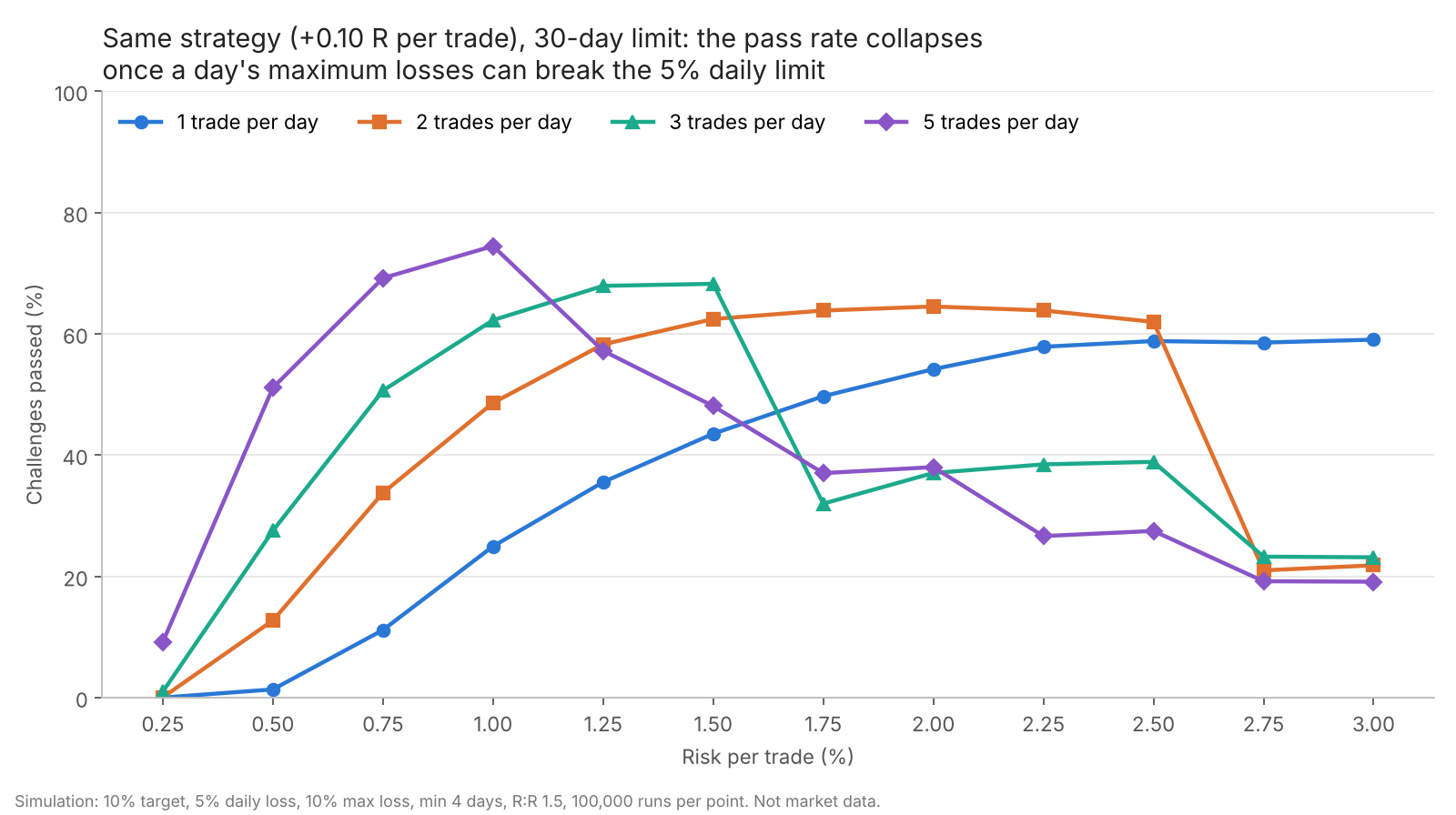
1. The time limit reverses the answer. With 2 trades per day and no time limit, 0.25% risk passes 96.8% of the time, 1% passes 80.1% and 2% passes 66.3%. With a 30-day limit, 0.50% passes only 12.7%, because most attempts run out of time. The best level becomes about 2%, at 64.5%.
2. There is a cliff, and you can calculate it. With 2 trades per day, going from 2.50% to 2.75% risk drops the pass rate from 62.0% to 21.0%. Two losses in one day now break the 5% daily limit. With 3 trades per day the cliff comes earlier: 68.2% at 1.50%, 32.0% at 1.75%. With 5 trades per day: 74.5% at 1.00%, 57.2% at 1.25%.
The rule of thumb: keep your risk per trade below your daily loss limit divided by the maximum number of trades you can lose in a day. Trading once a day, this cliff never appeared in the range I tested, up to 3%.
3. Risk sizing cannot create an edge. With zero expectancy, the best pass rate I found stayed below 50% at every risk level. With negative expectancy, higher risk scored better, which is simply how gambling works. Passing that way tells you nothing about your strategy.
What to do with this. If your challenge has no time limit and you have a real edge, lower risk usually wins. If it has a deadline, too little risk is also a way to fail. In both cases, work out your daily cliff before you start.
Limits of this study. This is a simulation with an assumed expectancy, not market data. Trades are independent and the outcomes are fixed at +1.5 R or -1 R. Real traders tend to overestimate their edge, real losses can exceed the stop, and open positions can lose together. Rules differ between firms, and this model does not include a trailing drawdown. These results do not guarantee any outcome.
If you want to run this calculation on your own trades or on an EA’s backtest, I built Challenge Odds PRO for MetaTrader 5: https://www.mql5.com/en/market/product/206363