Spread and Slippage in Automated Trading: How to Audit a Fill

When a live result differs from a tester report, I start with one order. A reliable diagnosis needs the quote, the request and the fill from a specific time. Comparing the two equity curves first can send you looking for a strategy problem when the evidence points to execution or a reporting difference.
Spread is a quote difference; slippage is an execution difference
An Expert Advisor can follow its rules correctly and still receive a different entry price from the one a trader expected. To investigate that difference, separate the quoted spread from slippage. They describe different parts of a trade, and combining them into a single unexplained cost can hide what happened.
This guide uses hypothetical XAUUSD prices to explain the distinction, then gives you a practical execution-review checklist. The figures are arithmetic examples, not current quotes, a trade recommendation or measured SmiteFX results. The hero is a conceptual illustration, not a price chart or a timeline to scale.
What spread means for an EA
The spread is the difference between the Ask and Bid quoted at the same moment. In a straightforward buy/sell example, a buy uses the Ask side and a sell uses the Bid side. The MQL5 symbol reference distinguishes these prices and separately defines points, tick size and contract size.
Suppose the Bid is 2,350.00 and the Ask is 2,350.20. The spread is 0.20 in quoted-price units. That number is not automatically 20 pips or a particular cash cost: the symbol specification, volume and account currency matter.
Record the spread when the EA makes its decision, not just a broker's advertised minimum. A minimum spread is not a promise about the quote available during every trade. For the intended account, check how spread, commission and overnight financing are actually charged.
What slippage means, including favourable fills
Slippage compares an actual fill with a clearly defined reference price. For a market buy, the reference might be the Ask observed when the trade request was sent. Using an earlier candle close, the opposite quote side or a signal provider's entry creates a different comparison.
If the reference Ask is 2,350.20 and the buy fills at 2,350.35, the buy has 0.15 of adverse slippage against that reference. A fill below the reference would be favourable. For a sell, a lower fill than the reference Bid is adverse; the direction reverses.
The platform's execution guide explains that execution modes and broker handling differ. An EA's permitted-deviation setting is not a universal guarantee of the maximum possible price difference across all order types and execution modes. Check the account's rules rather than assuming one setting controls every fill.
A worked example without double-counting costs
Keep the three measurements separate:
- Quote: Bid 2,350.00; Ask 2,350.20. Quoted spread: 0.20.
- Entry: Reference Ask 2,350.20; actual buy fill 2,350.35. Adverse entry slippage: 0.15.
- Exit: Actual closing sell fill 2,351.00. The actual entry-to-exit price difference is 0.65.
The final subtraction is 2,351.00 minus 2,350.35. Do not subtract the opening spread again from that fill-to-fill price difference: the entry and exit prices already reflect the sides at which those deals occurred. Commission, financing and any applicable conversion still need separate treatment when calculating cash profit or loss.
This example assumes a simple opening buy and closing sell. It does not specify a lot size, predict a return or describe a Fortune trade. Its purpose is to make a reconciliation possible: what was quoted, what was requested, what filled and what was charged?
Why a backtest and a live account can differ
A test is only as informative as its assumptions. Inspect the symbol, data period, modelling mode, costs and execution settings rather than relying on the headline return. The MT5 Strategy Tester documentation describes real-tick testing and execution-delay settings; those features do not guarantee that a test recreates a particular live fill.
For a breakout rule, distinguish a boundary being crossed from the order being executed. For a short-target strategy, inspect the size of costs relative to the intended price movement. Neither observation proves that a strategy has an edge or that a particular broker caused a loss.
Use our backtesting versus forward-testing guide to separate modelled evidence from subsequently observed behaviour. A profitable historical report is not evidence that future execution costs will be identical.
An execution log that can answer useful questions
When investigating a difference, preserve enough context to compare like with like. A useful review record includes:
- Symbol, broker account type, platform/EA version and order direction.
- Request time with its timezone, reference Bid/Ask and the reason that reference was chosen.
- Requested order type and size, actual executed price and volume, and any partial fills or rejections.
- Commission, financing and the contract specification used to interpret the figures.
- Relevant terminal messages and whether the software retried or changed an order.
For developers, OrderSend documentation warns that a successful return alone does not establish execution. Check the server result and subsequent trade events. The trade-result structure documents execution-result fields such as confirmed price, volume and return code. A request acknowledgement is not a substitute for a confirmed deal.
Compare a meaningful collection of observations across similar conditions; do not diagnose an account from one screenshot. Broker support or the EA developer may need the relevant logs. Remove passwords, account identifiers and unrelated private information before sharing them.
A VPS and copy trading do not remove execution differences
A VPS can keep a terminal running when a personal computer is off. It cannot promise a specific spread, available price or identical execution between accounts. Faster connectivity is not the same as eliminating market and broker-side uncertainty.
With copy trading, compare the source and receiving accounts rather than expecting a matching result. A source-account record does not establish the receiving account's fills, costs or exposure. Review our copy-trading setup guides for operating context, then check the actual account's conditions.
Apply this to a SmiteFX system review
When reviewing SmiteFX systems, ask which platform and account conditions the available evidence describes. For Fortune, separate the published market-structure breakout description from any hypothetical example in this guide. No proprietary entry filter, execution tolerance or measured slippage result is claimed here.
Read execution costs alongside the EA evaluation checklist, drawdown and profit factor. If the quote-side assumptions or supported setup are unclear, ask for clarification before configuring a system. There is no single spread or slippage threshold in this article that makes an EA suitable for everyone.
Leveraged trading can result in substantial losses. Historical, backtested and forward results do not guarantee future performance; an intended exit price does not guarantee an identical realised loss. This is educational material, not personalised financial advice. See the SmiteFX risk disclosure.
Audit one fill from quote to report
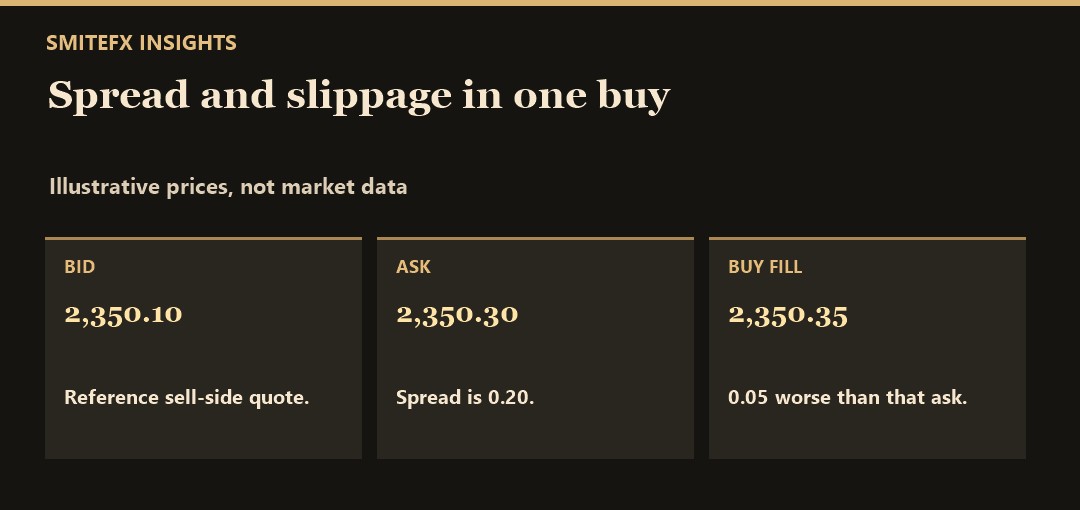
Imagine a hypothetical buy with bid 2,350.10, ask 2,350.30 and a fill at 2,350.35. The quote spread is 0.20 in price units. Relative to the contemporaneous ask, the fill is 0.05 worse for this buyer. A trader comparing it with the bid would see a 0.25 difference, but should not then add another 0.20 for spread. Use consistent units before converting differences to account currency.
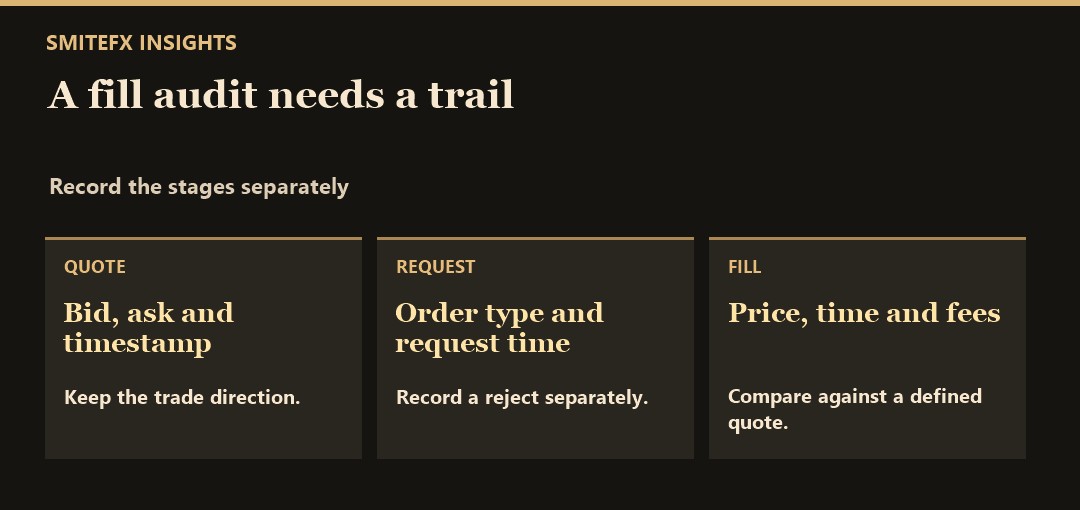
Keep the expected reference quote and the actual fill in the same row. Include the side, symbol, request time, fill time, commission and any swap separately. Record an order that was rejected or never filled as a different outcome, not a zero-slippage deal. A platform journal and broker deal history can corroborate different stages of the same order.
For a SmiteFX product reference, see Fortune MT5. When running this EA on demo, choose one short observation period and compare the reported fills with the tester’s assumptions. Treat the listing as the product reference. The example prices above are invented and do not represent Fortune’s fills.
Sources and review date
Primary platform references checked on 22 October 2026. Broker-specific terms must be checked separately for the intended account.