
Most grid or averaging EAs aren't sold as grid. The page says "smart recovery" or "adaptive entries", and the balance curve looks almost perfect.
I ran one myself for a while. The balance went up quietly, week after week. The equity was somewhere else, and i only really looked at it when the open losses were already big. Since then I check a few things before I buy, just from the signal or the backtest report.
1. Equity drawdown far above the balance drawdown
The balance only changes when a trade is closed. A grid keeps its losing positions open, so the loss sits in the equity. If the equity drawdown is much bigger than the balance drawdown, that gap is open loss the balance doesn't show yet.
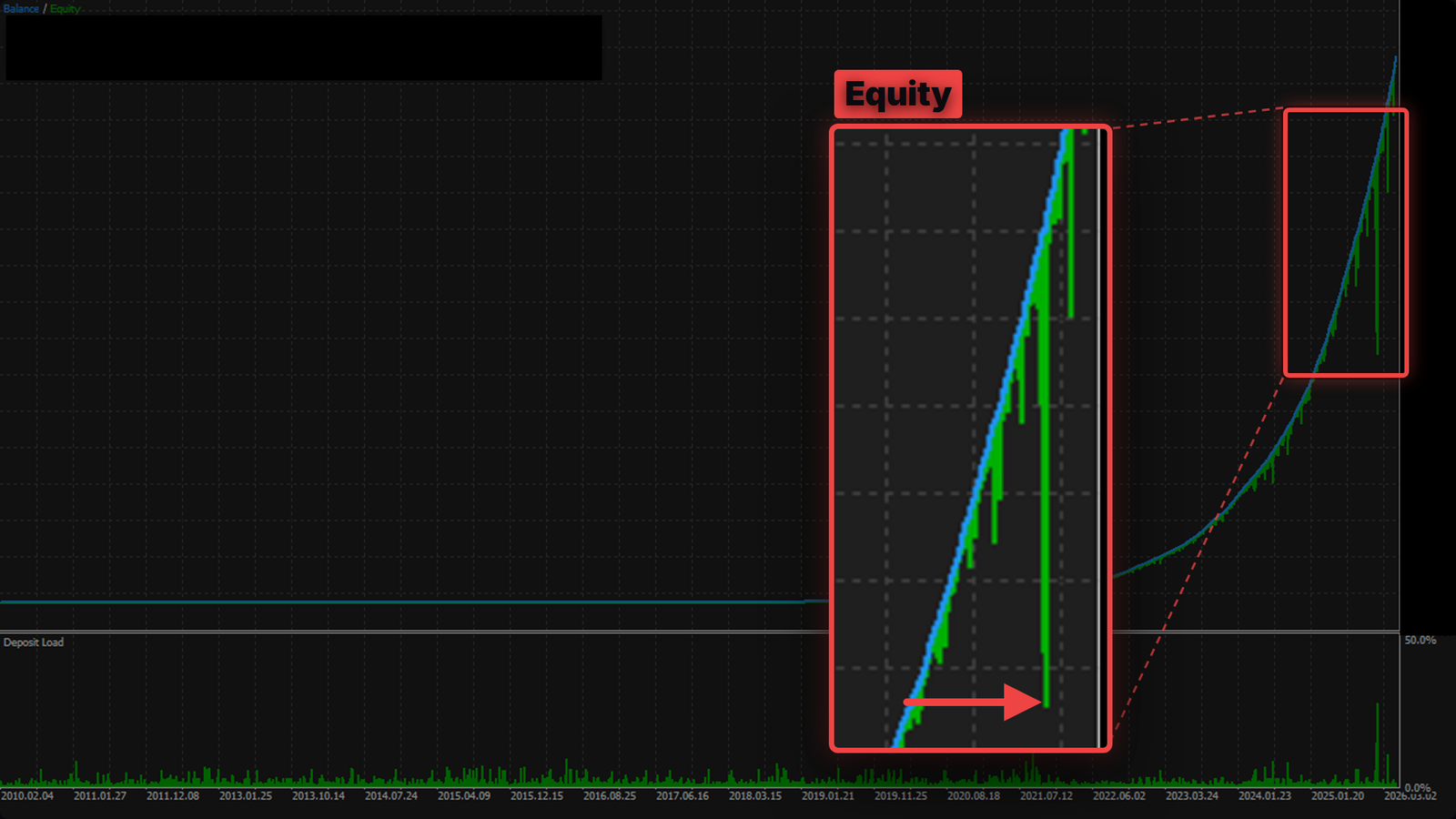
A published backtest of someone else's grid EA, name removed. Balance smooth, equity diving underneath.
2. A high win rate together with a long losing streak
At 90% wins, 7 losses in a row should almost never happen if the trades are independent. It's 0.1 to the power of 7, about 1 in 10 million. If the report shows it anyway, the trades probably aren't independent. Often they are one position split into many tickets.
3. Several positions open at the same time, in the same direction
On one symbol, or on pairs that share a currency. Five trades at the same price with 0.2 lots are really one trade with 1.0 lot. The signal still looks like "small lots".
4. Lot sizes that grow inside one series of trades
0.1, 0.2, 0.4, 0.8 is the classic martingale. Some EAs grow slower, like 0.01, 0.01, 0.02, 0.03. Its still the same idea, the next trade has to win back the ones before.
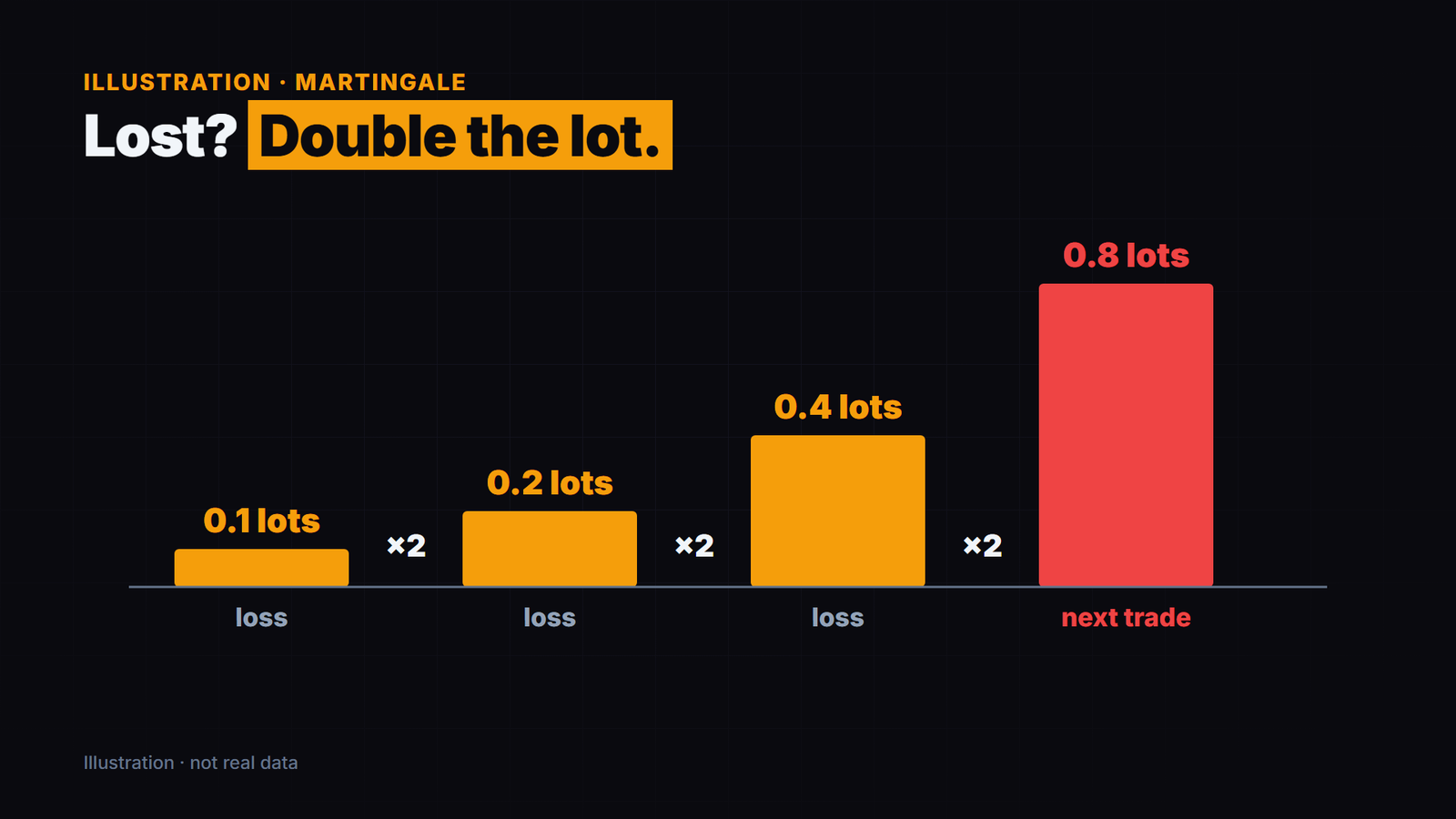
Illustration, not real data. After each loss the lot doubles.
5. Lots of small wins and a few very large losses
The average loss is many times the average win. The small wins pay for the time until the big loss comes.
What it means
None of these proves a grid on its own. A trend EA can have a long losing streak too. But when three or four show up together, I assume a grid until the seller explains otherwise.
That doesn't mean every grid is a scam. Some traders run one on purpose, with a small part of the account and a hard limit where they stop it. The problem starts when you run one and don't know it.
What do you check? If there is a sign that catches it earlier, I'd like to hear it in the comments.
Best regards,
Chris