XAUUSD and the $20 levels: gold does respect them, and the zone is one dollar wide

Ask most gold traders what happens at $4,400 or $4,420 and you will hear the same thing: price respects round numbers. It finds support and resistance there.
I tested that on 8.5 years of XAUUSD hourly data - 50,000 bars, $1,166 to $5,563. The folk wisdom is right. Approach a $20 level with momentum and price is measurably more likely to be turned back than carried through, in both directions, against a control that rules out coincidence.
What nobody seems to have measured is how big the effect is and how far it reaches. The second answer is the more useful one: the level's influence is about one dollar wide. At $1 away it is clear. At $2 it is a third as strong. By $3 it is gone.
And the same test on GBPUSD, EURUSD, USDJPY and AUDUSD finds nothing at all. This is a gold effect, not a round-number effect.
First, how often does this come up?
Gold crosses a $20 level 3.9 times on an average trading day - 8,095 crossings over the period. 18.9% of all hours sit within $2 of one. If you trade XAUUSD intraday you are near one of these levels more or less constantly.
The trap in every level study
Before the numbers, here is why most "levels" analysis is worthless - including, as you will see, my own first pass at this one.
Price does measurable things at any level you name. Draw a line anywhere, measure what happens when price reaches it, and you will find movement, because you only get to take a measurement on the occasions price travelled far enough to reach the line. That selection effect manufactures results out of nothing.
I know its size because I measured it separately: an entirely arbitrary level produced 7.7 pips of apparent post-break drift on GBPUSD, positive in nine years out of nine. It looked like an edge. It was noise.
So the question is never "does something happen at round numbers". It is "does something happen there that does not equally happen at arbitrary prices". Every number below is measured against a control built to answer that.
Test 1 - where does gold spend its time?
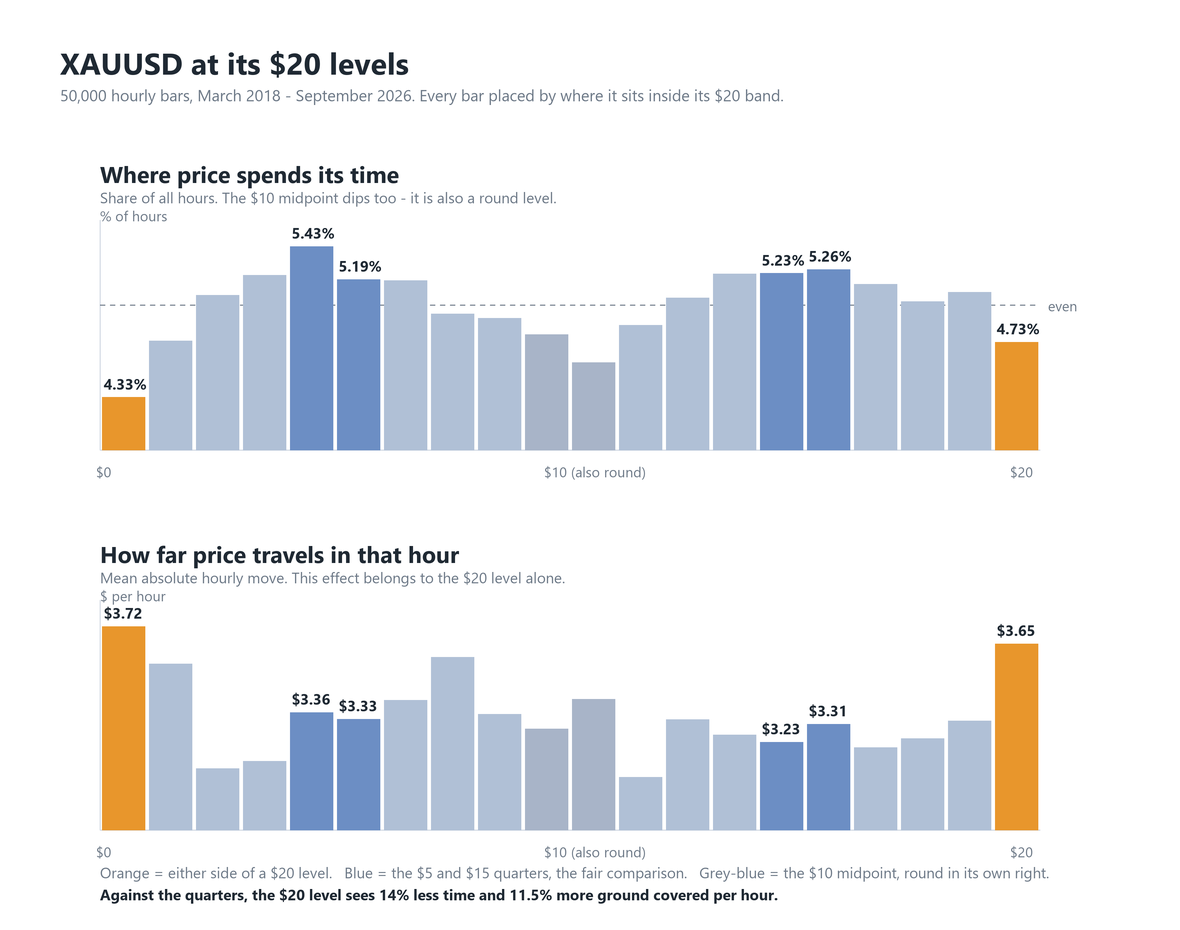
Take every hourly close and record where it sits inside its $20 band.
| position in band | share of time |
|---|---|
| the $20 level (the dollar either side) | 4.53% |
| the $10 midpoint | 4.68% |
| the $5 and $15 quarters | 5.28% |
| if levels meant nothing | 5.00% everywhere |
Price spends least time at the $20 level and most at the quarters.
A detail worth noticing: the $10 midpoint dips too. My first instinct was that this spoiled the result - it does the opposite, because $10 is a round level in its own right. The ordering runs $20, then $10, then the quarters, exactly as it should if roundness is what matters. It also means the fair comparison is the $20 level against the quarters, never against "mid-band", because mid-band is itself round.
Against a block bootstrap - the real returns resampled in 24-hour blocks and rebuilt into a synthetic path with gold's own volatility and autocorrelation but no reason to care about round numbers:
| period | real | synthetic | z |
|---|---|---|---|
| $10 | 163.1 | 21.9 | 17.6 |
| $20 | 146.0 | 33.7 | 6.7 |
| $19 (control) | 51.3 | 31.7 | 1.4 |
| $21 (control) | 61.6 | 36.1 | 1.4 |
The round periods separate cleanly. The non-round controls sit in the noise.
Test 2 - price moves further at a level, not less
If price spends less time there, it is covering that ground faster.
This needs a stricter control, because gold ran from $1,166 to $5,563 and dollar volatility scales with price. So rather than simulate a path, I kept the exact real series and rotated the round-number alignment 2,000 times. Identical data, identical trend, identical volatility - only the definition of "round" is broken.
| measure | real | rotated null | p |
|---|---|---|---|
| move size at level / quarters | 1.123 | 0.996 +/- 0.045 | 0.0000 |
The average hourly move is $3.69 at a $20 level against $3.31 at the quarters - about 38 cents more travel, roughly 11.5%. Unlike the dwell-time result, this belongs to the $20 level alone; the $10 midpoint shows no speed effect whatever.
Test 3 - the one that matters, and the one I got wrong first
Here is where I went wrong, and it is worth showing rather than hiding.
My first attempt measured the average next-hour move by position in the band. It found nothing - zero of twenty bins - and I nearly published that gold has no directional behaviour at round numbers.
That test cannot detect support and resistance. Support means price approaching from above turns up. Resistance means price approaching from below turns down. Average the two together, as I did, and they cancel exactly. A level working perfectly in both directions would score precisely zero.
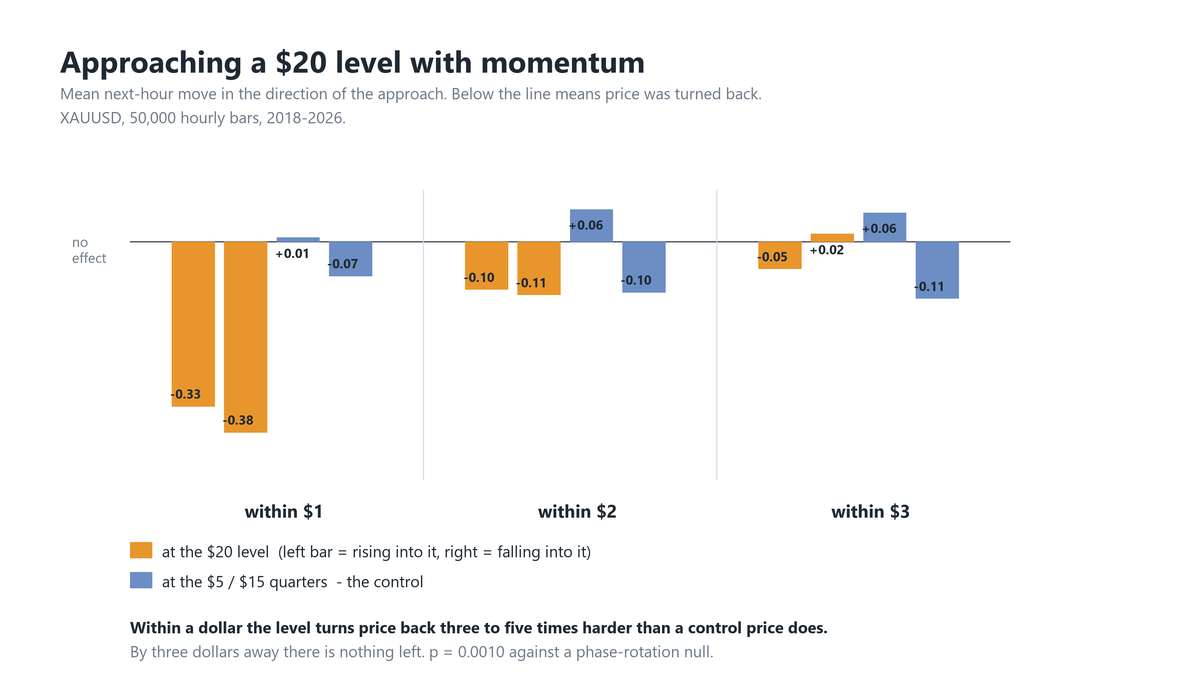
The correct test conditions on the direction of approach. Take only the bars that arrived at a level with momentum, and ask whether the next hour carried through or turned back:
| approach | n | mean next move | carried through |
|---|---|---|---|
| rising into the level (resistance) | 1,183 | -$0.331 | 49.2% |
| falling into the level (support) | 1,075 | -$0.383 | 45.2% |
| quarters, rising | 5,468 | +$0.008 | 49.7% |
| quarters, falling | 5,126 | -$0.069 | 47.0% |
Negative means price turned back. It happens on both approaches, and it is three to five times stronger than at the control positions.
Against the phase-rotation null:
real   -0.3570
null   -0.0161 +/- 0.1292
z      -2.64
p      0.0010
Gold's $20 levels do provide support and resistance.
And the zone is one dollar wide
| distance from the level | rejection strength |
|---|---|
| within $1 | -$0.33 / -$0.38 |
| within $2 | -$0.10 / -$0.11 |
| within $3 | -$0.06 / +$0.02 |
The effect sits almost entirely in the dollar either side. A level at $4,400 tells you something about $4,399-4,401 and essentially nothing about $4,397.
Putting the three together
They fit one picture. Price arrives at a $20 level, reacts sharply, and leaves - which is why it covers more ground per hour there and is recorded there less often. The reaction is more often a rejection than a break.
Note what that means about my first reading. I saw high movement plus low dwell time and concluded price was transiting faster. But a sharp turn away from a level produces exactly the same two signatures as a fast break through it. The data could not distinguish them, and the test I had chosen was incapable of telling me so.
Test 4 - is this gold, or is it round numbers?
| symbol | round level | move size ratio | p |
|---|---|---|---|
| XAUUSD | $20 | 1.123 | 0.0000 |
| GBPUSD | 0.0100 | 1.036 | 0.320 |
| EURUSD | 0.0100 | 1.017 | 0.241 |
| USDJPY | 1.00 | 1.033 | 0.390 |
| AUDUSD | 0.0100 | 0.983 | 0.774 |
Not one major shows it. On GBPUSD a deliberately non-round control period (0.0097) scored higher than the actual round level.
A hypothesis rather than a result: gold is quoted in whole dollars, $20 is a number a human reads instantly, and XAUUSD carries heavy retail participation. EURUSD at 1.1700 is dominated by flow with no particular reason to cluster on a decimal. I have not tested that, so treat it as a question.
What to do with it: targets and entries, not signals
Be honest about the size first. The rejection averages about 33 cents, and gold's spread runs $0.20-$0.35. As a standalone entry that is roughly break-even before slippage. This is not a signal, and anyone selling one built on round numbers is selling something thinner than the spread.
Where it earns its keep is as a location - somewhere to put an order you were going to place anyway. And there is one more measurement that decides exactly where.
Price stops about a dollar short
Given gold trades to within $2 of a $20 level, how close does it actually get?
| gets within | approaching from below | from above |
|---|---|---|
| $0.05 | 2.7% | 2.7% |
| $0.25 | 13.1% | 12.2% |
| $0.50 | 25.4% | 24.4% |
| $1.00 | 51.0% | 48.7% |
| median shortfall | $0.99 | $1.04 |
It typically stalls a dollar short. Only a quarter of approaches get within fifty cents, and fewer than three in a hundred actually touch the number.
That single fact sets everything else:
- Take profit a dollar short of the level, not on it. A target sitting exactly on $4,400 goes unfilled roughly half the time, because price turns away in front of it. Ask for $4,399 and you are inside where the turn actually happens.
- The same applies to a fade entry. Waiting for an exact touch of the number means missing about three-quarters of the reactions you are trying to trade.
- Stops need clearance the other way. A stop a dollar beyond the level sits inside the reaction zone. Give it two or three dollars and it is outside the range where the level does anything at all.
- Precision matters more than you would think. The zone is a dollar wide in each direction. Rounding a level to "about 4,400" throws away most of what makes it a level.
Note the asymmetry: this is stronger as an exit than an entry. Taking profit near a level costs nothing extra - you were closing anyway, and the level tells you where the move is likely to stop. Opening a position on the same 33 cents, against the spread, is a much thinner proposition.
Run it yourself
Every number comes from CopyRates on 50,000 H1 bars and a few dozen lines of Python. The method is worth more than the result:
- Never test a level without an arbitrary level of the same scale beside it.
- Block-bootstrap the returns for distribution questions, so the null keeps the real volatility and autocorrelation.
- Where price level or trend could contaminate things, rotate the alignment on the real series rather than simulating a new one.
- Condition on approach direction. Support and resistance are opposite effects; average them together and you will conclude, as I first did, that nothing is there.
- Test a second instrument before generalising.
If you want the levels drawn while you look at this yourself, BrioQuant Round Price Levels marks them - the chart below is XAUUSD M5 with a $20 figure step.
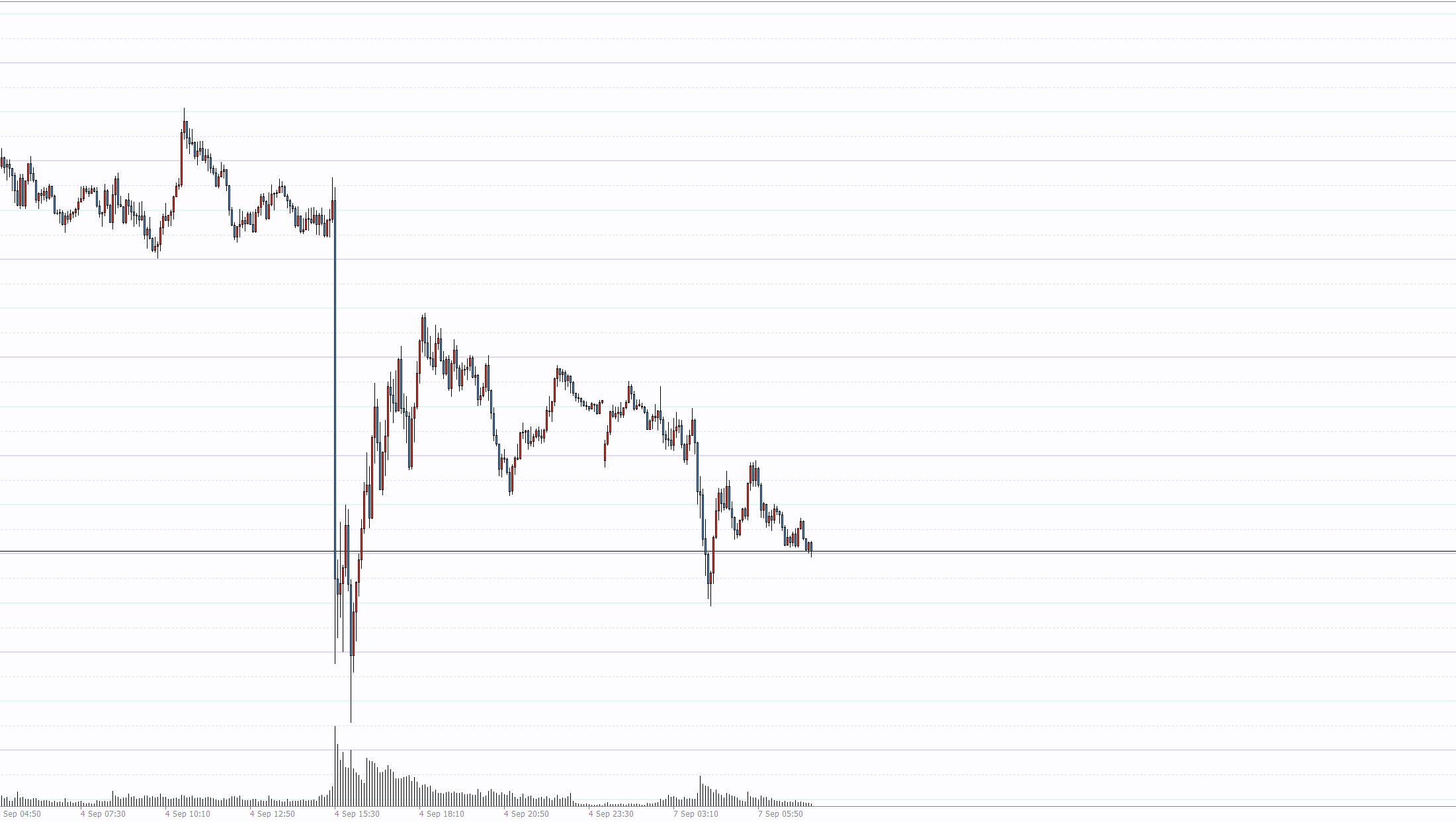
XAUUSD M5. Every horizontal line is a $20 level. The measurements above were made on H1 - the levels are identical on any timeframe, but the figures quoted are hourly.
Scope, stated plainly: one broker's XAUUSD feed, March 2018 to September 2026, hourly bars. A result on one feed is a result on one feed. If you run this on your own data and get something different, I would like to hear it.