Stock Market News - Bond Market - Currencies Markets: The Execution Logic Blind Spot

Stock Market News, Bond Markets, and Currency Markets: The Execution Logic Blind Spot
Most intermediate traders who build or evaluate automated systems spend the majority of their time on one question: does this signal work? They run backtests, adjust indicator parameters, and study entry logic carefully. Then they go live and discover that the signal was never the weakest link. The weakest link is everything that happens after the signal fires.
This article examines that blind spot directly. It uses the intersection of stock market news flow, bond market behaviour, and currency market volatility as the teaching environment, because that intersection is where execution assumptions tend to break down most visibly. The goal is not to predict what any market will do. The goal is to show how to structure an MT5 automated system so that it behaves responsibly regardless of what the market does.
1. The Structural Problem
Bond markets, equity markets, and currency markets frequently move in response to the same underlying catalysts: central bank communications, inflation readings, employment data, and geopolitical developments. A move in government bond yields can reprice equity risk premiums and simultaneously push safe-haven or risk-sensitive currency pairs within the same session. These dynamics recur in recognisable patterns, even though magnitude and sequence vary each time.
What does not vary is the structural challenge this creates for automated systems. An EA calibrated during a low-volatility, trending bond environment carries assumptions in its execution logic that can become harmful when regime conditions shift. The problem is evergreen: it arises whenever market structure changes and the system has no mechanism to detect that change.
Understanding why this problem recurs requires looking at how calibration periods are selected. Most developers choose historical windows where their signal logic performs best. That selection bias means the system is, by construction, optimised for a regime that may no longer be active at deployment. When conditions diverge from the calibration window, the system does not degrade gracefully. It continues operating as though conditions have not changed, because it has no framework to evaluate whether they have.
2. Why This Matters to an MT5 Trader
When stock market news drives a risk-off move, bond yields shift, equity indices reprice, and currency pairs such as EUR/USD or USD/JPY can gap or whipsaw within the same hour. A manual trader can observe this and adjust in real time. An automated system running on MT5 cannot, unless it has been explicitly programmed to detect and respond to changing conditions.
The following are standard execution consequences of regime change:
- Spreads widen. The EA's entry price assumption, calibrated on median spread, becomes inaccurate. A stop-loss that appeared adequate may now sit inside the spread itself.
- Slippage increases. Market orders fill at prices that differ materially from the price at signal time, particularly during news releases or illiquid sessions.
- Fixed ATR multiples become mis-scaled. If position sizing or stop distance is calculated using an ATR period tuned during a calm regime, stops will be proportionally too tight during volatility expansion and too wide during compression.
- Correlation changes. Currency pairs that behaved independently during calibration may move together during a risk event, concentrating exposure beyond what the per-trade risk percentage implies.
These are not exotic failure modes. They occur whether or not the signal logic is correct. A signal can be directionally right and the trade can still produce a poor outcome if the execution environment has moved outside the system's design parameters.
It is worth noting that slippage and spread widening are not random nuisances. They are predictable responses to liquidity withdrawal. When institutional participants step back from quoting risk during high-uncertainty periods, the cost of transacting rises for everyone. An automated system that does not account for this cost structure is not working with incomplete information about price direction. It is working with incomplete information about the cost of participating at all.
3. The One-Regime Assumption
The most common mistake in intermediate-level EA design is the one-regime assumption: the implicit belief that the market environment during the backtesting period is representative of the environment the system will encounter going forward.
This assumption rarely appears as a deliberate choice. It appears as an omission. The developer tests on historical data, finds parameter combinations that perform acceptably, and deploys. The system has no internal concept of regime. It does not know whether current volatility is high or low relative to its calibration period. It does not know whether spread conditions are normal or stressed. It fires entries and manages positions according to fixed rules.
When bond markets enter a period of elevated volatility — because of a policy communication shift or a repricing of inflation expectations, for example — that volatility transmits into currency markets quickly. An EA designed around a specific average daily range may overtrade in noise or have stops too tight to survive normal retracement once conditions change.
The problem is not using automation. The problem is using automation without a regime filter that checks whether the system's core assumptions are currently valid.
There is a related failure mode that compounds this issue: optimisation over too narrow a parameter range. When a developer tests multiple parameter combinations and selects the best-performing set, they are implicitly selecting the parameters most suited to the historical regime present in the test data. Those parameters are then the most likely to fail when a different regime appears. Wider parameter searches and out-of-sample validation windows help, but neither substitutes for a live regime detection mechanism built into the EA itself.
4. The Technical Sequence Behind Execution Risk
The following sequence describes what happens at the execution layer during a cross-market volatility event:
- An external catalyst changes conditions in one asset class. Bond yields move. Equity volatility rises. A major currency pair gaps at the open.
- Liquidity providers widen quotes. In MT5 terms, the difference between SymbolInfoDouble(symbol, SYMBOL_ASK) and SymbolInfoDouble(symbol, SYMBOL_BID) increases. This can happen in milliseconds, before the EA reads conditions prior to placing an order.
- The EA evaluates an entry signal. The signal is based on indicator values calculated on completed bars formed under the previous spread and volatility conditions. The signal is valid by its own rules but contextually stale.
- The order executes with slippage. The fill price differs from the price at signal time. In a fast market, this difference can consume a meaningful portion of the trade's expected reward.
- The stop-loss, calculated on a prior ATR reading, is now proportionally too tight. The position stops out on price movement that is normal for current conditions but was not normal when the stop was set.
- The EA re-enters. If the signal condition is still active, the EA fires again. The cycle repeats.
The fix requires intervention at steps 1 through 3: detect the regime shift before the entry fires, not after the loss is recorded.
One additional failure point deserves attention. Between steps 2 and 3, many EAs check only whether a position already exists before evaluating a new entry. They do not check whether market conditions have changed since the last completed bar was formed. This means the system can be operating on indicator values that are one full bar old in a market that has already moved substantially. Adding a condition-freshness check — confirming that current bid and ask are within an acceptable range of the prices present when the last bar closed — adds a layer of protection that most intermediate EAs omit entirely.
5. How to Test This in MetaTrader 5
The following workflow is intended for demo testing. Do not apply it to a live account until each step has been validated across multiple market sessions on a demo environment.
Step 1: Build a Spread and Volatility Monitor
Before evaluating any entry signal, the EA should read current market conditions. Use SymbolInfoTick to get live bid and ask data, and an ATR handle to get a current volatility reading.
// Pseudocode — illustrates logic structure only, not production-ready // Threshold values are examples; derive your own from historical data int atrHandle; double atrBuffer[]; int OnInit() { atrHandle = iATR(_Symbol, PERIOD_H1, 14); if(atrHandle == INVALID_HANDLE) return INIT_FAILED; ArraySetAsSeries(atrBuffer, true); return INIT_SUCCEEDED; } bool IsRegimeAcceptable() { MqlTick lastTick; if(!SymbolInfoTick(_Symbol, lastTick)) return false; double currentSpread = lastTick.ask - lastTick.bid; double maxAllowedSpread = 0.00030; // Replace with your calibrated threshold if(CopyBuffer(atrHandle, 0, 0, 2, atrBuffer) < 2) return false; double currentATR = atrBuffer[0]; double baselineATR = 0.00080; // Replace with your calibration period value double atrMultiplierLimit = 2.0; if(currentSpread > maxAllowedSpread) return false; if(currentATR > baselineATR * atrMultiplierLimit) return false; return true; }
The threshold values shown are illustrative. Your actual thresholds must be derived from your instrument's historical spread data and ATR distribution. The MQL5 API calls shown are structurally valid; the constants require your own calibration work.
Step 2: Gate Every Entry Through the Regime Check
In your OnTick or OnBar logic, the regime check must execute before any signal evaluation. If IsRegimeAcceptable() returns false, the EA exits the function without evaluating the signal, placing an order, or modifying an existing position.
// Pseudocode

void OnTick()
  {
   if(!IsRegimeAcceptable())
     {
      Print("Regime gate: entry suppressed. Spread or ATR outside parameters.");
      return;
     }

   // Signal evaluation proceeds only here
   EvaluateAndTrade();
  }
Step 3: Use Dynamic Stop Distances Based on Current ATR
Fixed pip stops are a direct symptom of the one-regime assumption. Replace them with ATR-scaled stops calculated at the moment of order placement, using the most recent completed ATR value.
// Pseudocode double GetDynamicStop() { if(CopyBuffer(atrHandle, 0, 1, 1, atrBuffer) < 1) return 0; double atr = atrBuffer[0]; // Completed bar, index 1 double multiplier = 1.5; // Calibrate through your own testing return atr * multiplier; }
Step 4: Test Across Varied Date Ranges in the Strategy Tester
Run the Strategy Tester across multiple distinct historical periods, not only the period where the signal logic performed best. Specifically:
- Test a period of low volatility.
- Test a period of high volatility.
- Compare the regime gate's suppression rate across both periods.
- Verify that the gate suppresses entries during high-spread periods and permits them during normal conditions.
If the gate never suppresses entries during high-volatility periods, the thresholds are too permissive. If it suppresses entries almost continuously, the thresholds are too restrictive. The objective is a gate calibrated to your instrument's actual spread and volatility distribution.
Step 5: Log All Gate Decisions During Demo Testing
Add print statements to every gate decision. After each demo session, review the logs to understand how often the regime filter activated, whether suppressed entries would have been profitable or losing, and whether thresholds need adjustment. This review is the mechanism by which you confirm the regime logic is working as designed.
Logging should capture not only whether the gate fired, but the specific values that triggered it. Recording the spread at suppression time and the ATR reading at that moment allows you to build a dataset of gate activations over time. That dataset becomes the basis for threshold refinement and, eventually, for assessing whether your calibration values have drifted relative to current market structure. A gate that was correctly calibrated six months ago may need adjustment as broker liquidity conditions or instrument volatility characteristics change.
6. A Practical Decision Checklist
Before activating any automated system during a session where cross-market volatility is elevated — from bond market repricing, equity news flow, or currency-specific data releases — work through the following gates:
| Gate | Question | Stop Condition |
|---|---|---|
| Spread Gate | Is current spread within the range observed during calibration? | Suppress entry if spread exceeds calibrated maximum |
| ATR Gate | Is current ATR within the multiplier limit relative to the baseline calibration ATR? | Suppress entry if ATR exceeds the multiplier threshold |
| Session Gate | Is the current time within the session window the system was calibrated for? | Suppress entry outside calibrated session hours |
| Correlation Gate | If trading multiple pairs, are they behaving independently or moving together in a way that concentrates risk? | Reduce position size or suspend secondary pairs during high-correlation periods |
| Stop Distance Gate | Is the dynamically calculated stop distance meaningful relative to current spread? | Suppress entry if calculated stop is less than 3× current spread |
| Re-entry Gate | Has the EA already taken a loss on this signal in this session? | Limit re-entries per session to a defined maximum, then halt |
Each gate is observable and produces a binary outcome: the condition is met or it is not. This is the design principle that distinguishes responsible automation from signal-chasing automation. The system is not predicting whether the signal will work. It is checking whether the current environment is within the operating parameters the system was designed for.
The re-entry gate deserves particular emphasis. Without it, a system that takes consecutive losses on the same signal in the same session can continue compounding those losses until manual intervention occurs. Setting a hard per-session re-entry limit — and requiring a manual review before resetting it — adds a friction layer that forces conscious evaluation after each failure cycle. That friction is not a weakness in the system design. It is a feature.
7. A Sequential Action Plan
Complete the following steps before activating any automated system in a cross-market environment:
- Audit your current EA for hardcoded spread and stop assumptions. Identify every place in the code where a fixed pip value, fixed stop distance, or fixed spread assumption exists. Document each one.
- Analyse your instrument's historical spread data. Most MT5 brokers make tick data available through the History Center. Examine the spread distribution for your primary instrument across different session times and volatility periods. Set your spread threshold from this distribution, not from an assumed value.
- Calculate the ATR distribution for your instrument. Use the Strategy Tester or a custom script to extract ATR(14) values across your available H1 data. Identify the 75th and 90th percentile values as candidate regime gate thresholds.
- Implement the regime gate in a demo EA. Add the gate logic to a copy of your EA and run it on a demo account for a minimum of two full trading weeks before drawing conclusions.
- Review logs after each session. Examine how many entries were suppressed, at what spread and ATR values, and what price action followed. Adjust thresholds if the gate is over-suppressing or under-suppressing.
- Do not move to a live account until gate behaviour is stable across at least three distinct market conditions. A gate that functions only in one type of environment has replaced one regime assumption with another.
Conclusion
A signal is not enough. The regime the signal operates in, the execution quality available at the moment of entry, and the risk controls governing position size and stop placement determine whether a signal can be used responsibly in a live automated system.
Cross-market environments — where equity news, bond repricing, and currency volatility interact simultaneously — expose the gap between a system that appears to work in testing and one that is designed to work across varying conditions. Closing that gap is not a matter of finding a better signal. It is a matter of building better infrastructure around the signal already in use.
The infrastructure described in this article — regime gates, dynamic stops, logging, and threshold calibration — is not complex to implement. What it requires is a deliberate decision to treat execution quality as a first-class concern rather than an afterthought. Most intermediate developers who make that decision find that their existing signals, which they may have been ready to discard, perform acceptably once the environment around them is properly controlled.
Test on demo first. Review the logs honestly. Adjust thresholds before risking capital.
Practical next step: If you want to evaluate this mechanism without forcing one strategy onto every market condition, the Ratio X Trader's Toolbox includes specialist MT5 systems for different jobs. Start on demo and examine how risk-control workflows apply to the context described above.
Real Screenshots From Ratio X Users
 Trade screenshot shared by a Ratio X user
 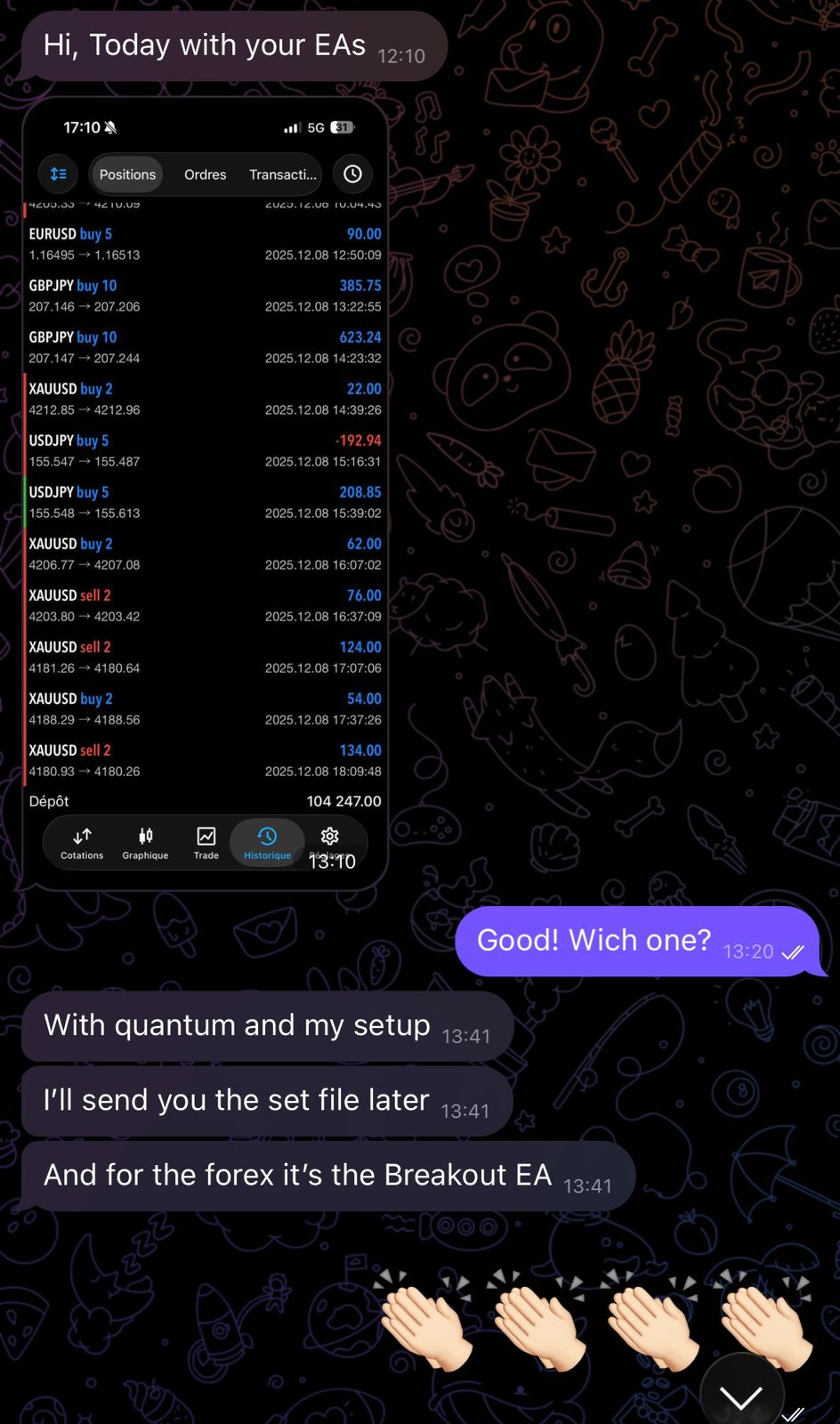 Multiple pairs running simultaneously, shared by a Ratio X user
 These are real screenshots shared by Ratio X users. They are examples of individual outcomes, not typical or guaranteed results. Trading involves risk of loss.
Evaluate the Ratio X Trader's Toolbox on Demo
The Ratio X Trader's Toolbox brings together 10 specialist systems, including one indicator, for regime analysis, trend, range, breakout, execution and XAUUSD workflows. It is designed for structured evaluation—not guaranteed trading results.
Lifetime access is available for a one-time payment of $147, backed by a 7-day money-back guarantee. Test one relevant module on demo, follow its setup guidance and decide whether it fits your process.
Explore the Ratio X Trader's Toolbox
If the Toolbox is the right fit and price is the final obstacle, use MQLFRIEND20 for 20% off. Only 10 coupons are available per month.