Gold Held the Breakout This Week — And the Quiet Part Is Where the Edge Lives

Last week I wrote that gold had finally cracked out of the airless range it spent a month building, running hard into the $4,360–$4,380 zone. The obvious question after a move like that is always the same one: does it hold, or does it hand it all back? This week gave the first answer — and for a breakout system, the way it held mattered more than the fireworks that got us there.
What actually happened
Gold pushed the breakout a step further before it paused. On Tuesday the metal touched $4,434, its highest level since early June, largely on safe-haven demand tied to the US–Iran standoff over the Strait of Hormuz and firmer oil. Then the week turned into a data test. July CPI on Wednesday came in subdued, and Thursday's producer prices rose less than expected, together trimming the odds of a September Fed rate hike from around 55% to roughly 35%.
Here's the part worth sitting with: that was, on balance, a supportive backdrop for gold — and price still pulled back below $4,350 into Friday on profit-taking after the sharp run. We're closing the week near $4,376, holding most of the breakout but well off the Tuesday high.
That gap between "the news looks bullish" and "price faded anyway" is the whole reason I trade levels instead of narratives. The tape doesn't owe the headline a response.
How I read this week as a breakout trader
The interesting line on my chart isn't the $4,434 high — it's $4,300. That was the ceiling that capped rallies for weeks. Now the pullbacks are respecting it as a floor. When old resistance flips into support and holds, that's the breakout confirming itself; the level has changed sides. Until that floor gives way, the path of least resistance stays up, and the job is simply to not get shaken out of that read by the noise around the highs.
The break itself is the loud, profitable part. The days after are the digestion — and digestion is exactly where single-instrument traders quietly bleed out, fading every wobble, catching every fake reversal near the top. So the discipline this week was mostly about what I didn't do.
My week, honestly
Quiet, and green. Two trades since last week's post, both small:
- A quick continuation buy on Monday's push, catching the move from around $4,371 up to $4,380 for a small, clean gain.
- A near-scratch long up near the $4,434 high on Tuesday — a few pips, essentially flat.
That's it. I didn't try to short the rejection off $4,434, and I didn't chase the Friday drop. After a week that did the heavy lifting, this one was about protecting the gains and letting the consolidation resolve on its own terms. Some weeks the edge is in the entries; this week it was in the restraint.
The numbers behind the approach
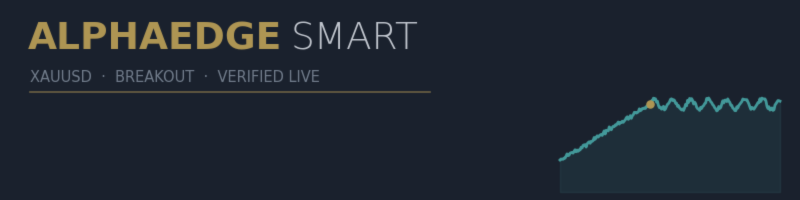
Everything above is trading a live account, and the record is public and third-party verified. As of this writing the account stands at a fresh high of +193.51% cumulative gain, with a 2.22 profit factor, an 80% win rate, and a maximum drawdown of 15.32% across more than a year and 790 trades. The monthly return runs around 4.6% — deliberately, not spectacularly.
I put the drawdown and the average month front and centre on purpose. The story here isn't a moonshot; it's the same breakout process applied to one instrument, week after week, with the losses kept small and defined. Weeks like this one — modest, disciplined, holding ground — are what a real long-run curve is actually made of.
What I'm watching next
The FOMC minutes and a run of August PMIs are the calendar risk this week. On the chart, the map is simple: $4,300 is the line in the sand — hold it and the breakout stays intact; lose it and we're back inside the old range and I go quiet again. Above, $4,434 is the high to beat before the next leg can even be discussed.
I'll keep trading the levels and reporting the results, win or lose.
Every trade behind this post is verified on the live account. If you want to follow the same breakout approach on gold, the signal is here:
👉 https://www.mql5.com/en/signals/2361276
Past performance does not guarantee future results. This is market commentary, not financial advice.