Dawnbreak – complete guide: how it trades, every setting, set files

Dawnbreak is a session range breakout Expert Advisor for MetaTrader 5. This post explains exactly how it trades, what every input does, how to set it up on your broker, and what the set files contain. Product page: https://www.mql5.com/en/market/product/178401
1. How Dawnbreak trades
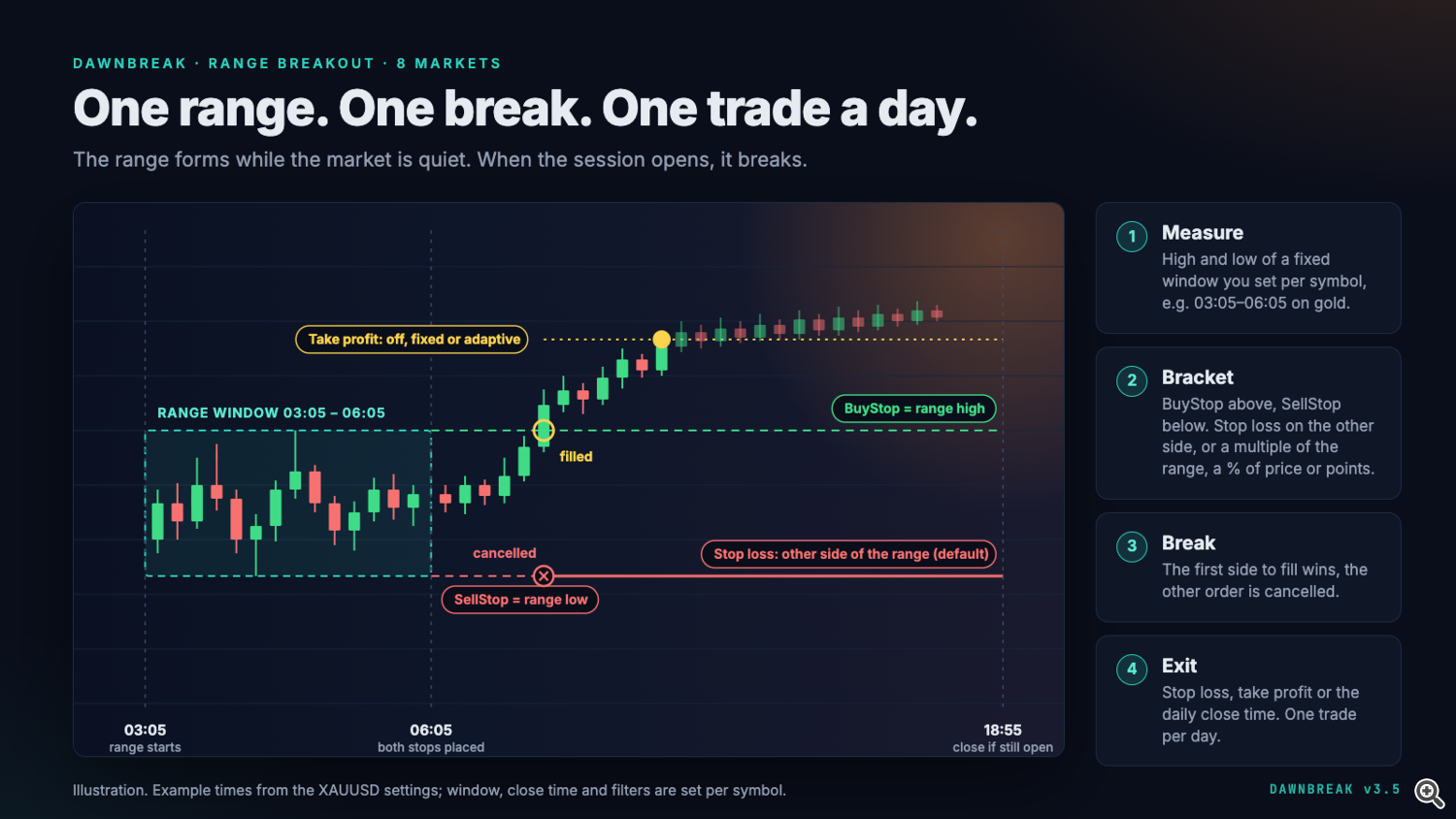
Every day, on every chart, the same four steps:
- Measure – Dawnbreak records the high and low of a fixed time window from M1 history, for example 03:05–06:05 server time on XAUUSD.
- Bracket – when the window closes, it places a BuyStop at the range high and a SellStop at the range low (plus an optional entry buffer).
- Break – the first order to fill wins; the other one is cancelled immediately (one cancels the other).
- Exit – the trade ends at the stop loss, the take profit or a fixed close time. Anything still open at the close time is closed.
One trade per day and chart. Every trade has a stop loss. No grid, no martingale, no averaging.
2. Markets and set files
Dawnbreak works on any symbol with M1 history: gold, currency pairs, stock indices and Bitcoin. Each chart gets its own range window, close time, stop mode and range filter.
Set files for nine setups on eight markets (all attached to this post):
| Set file | Symbol | Range window (server time) | Close | Take profit | Range filter |
|---|---|---|---|---|---|
| Dawnbreak_XAUUSD_classic_v3.5.set | XAUUSD | 03:05–06:05 | 18:55 | none | 0.2–1.5 % of price |
| Dawnbreak_XAUUSD_adaptive_v3.5.set | XAUUSD | 03:05–06:05 | 18:55 | adaptive | 0.2–1.5 % of price |
| Dawnbreak_EURUSD_v3.5.set | EURUSD | 01:00–02:00 | 18:00 | none | off |
| Dawnbreak_GBPUSD_v3.5.set | GBPUSD | 04:00–11:30 | 18:00 | none | off |
| Dawnbreak_USDJPY_v3.5.set | USDJPY | 03:00–04:30 | 18:00 | none | off |
| Dawnbreak_EURJPY_v3.5.set | EURJPY | 04:00–10:00 | 18:00 | none | off |
| Dawnbreak_DE40_v3.5.set | DE40 | 07:00–11:00 | 20:00 | none | off |
| Dawnbreak_US30_v3.5.set | US30 | 11:00–13:00 | 18:00 | none | off |
| Dawnbreak_BTCUSD_v3.5.set | BTCUSD | 05:00–09:30 | 20:00 | none | off |
All sets risk 1 % of the balance per trade with the stop loss at the opposite side of the range, and each uses its own magic number (20269301–20269308, gold adaptive 20269311), so several charts can run on one account.
Important: gold is the only market that has been backtested so far – the other sets are starting points. Server time, symbol names, spreads and contract sizes differ between brokers, so test each set in the Strategy Tester on your broker's data and on demo before going live.
3. Setup in five minutes
- Open an M1-capable chart of the symbol (any timeframe works; the range is read from M1).
- Attach Dawnbreak and load the matching set file (Inputs → Load).
- Check your broker's server time. The examples assume UTC+2 in winter and UTC+3 in summer. If your broker differs, shift the range window and close time by the difference.
- Check the Experts log: on start Dawnbreak prints the key settings (range window, close time, risk, TP/SL mode, range filter, pending-order expiry). If something looks wrong, the set file is wrong.
- Keep the terminal online during the session – a VPS is recommended. Dawnbreak cancels the second order and closes at the close time itself.
4. All settings explained
General
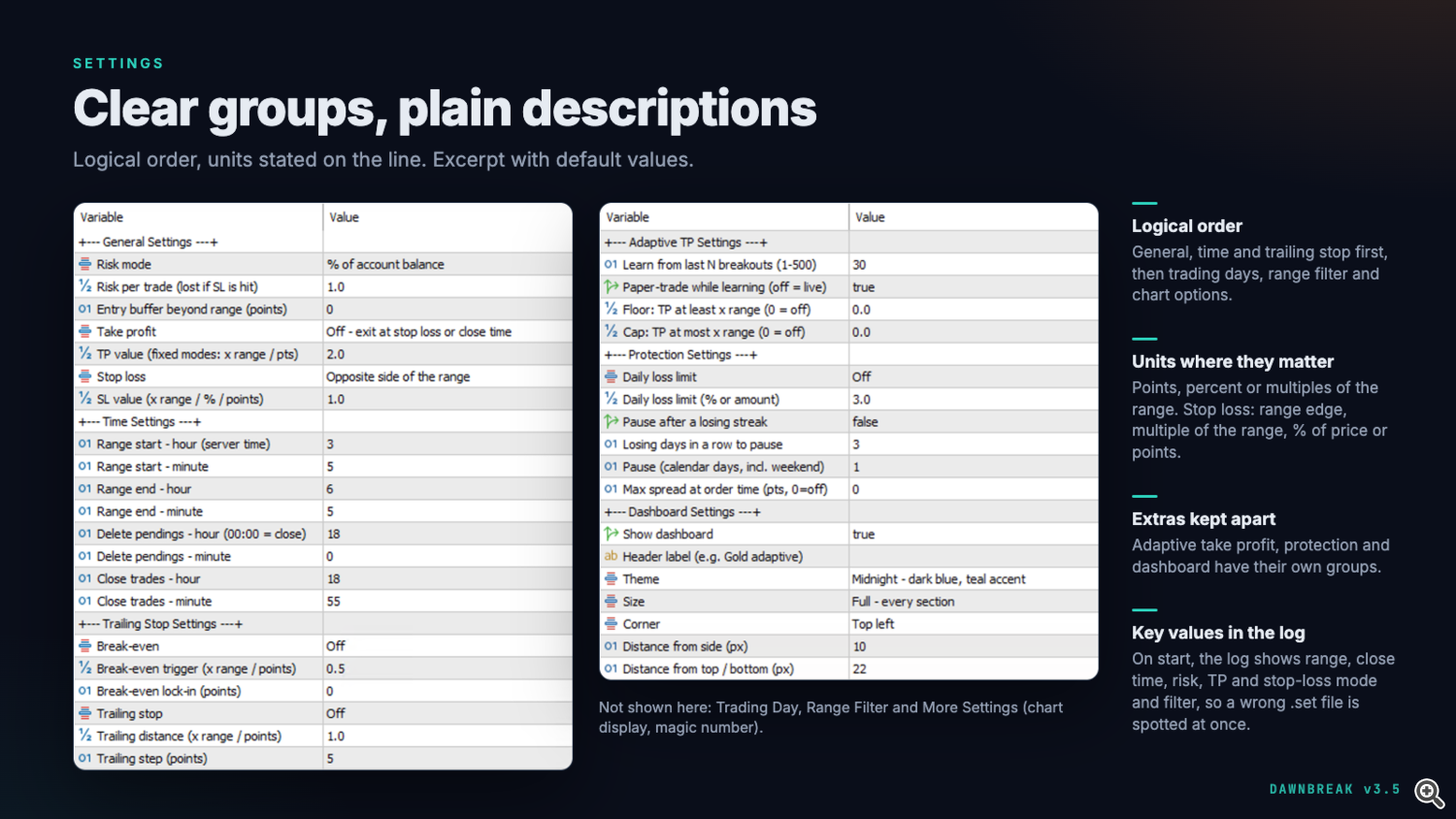
- Risk mode / Risk per trade – a fixed amount or a percentage of the balance. This is what you lose if the stop loss is hit; the lot size follows the stop distance.
- Entry buffer – extra points beyond the range high/low for the stop orders (0 = exactly at the range edge).
- Take profit – none, fixed (multiple of the range or points) or adaptive (see section 5).
- Stop loss – opposite side of the range (default), a multiple of the range from the entry, a percentage of price, or fixed points.
Lot sizes are capped to the broker's maximum volume and volume limit and reduced to fit 90 % of the free margin. If not even the minimum lot fits, Dawnbreak skips the day and says so in the log.
Time
- Range start / end – the measuring window in server time.
- Delete pendings – when unfilled stop orders are removed (00:00 = at the close time).
- Close trades – the fixed time at which an open trade is closed.
Break-even and trailing
- Break-even – off, or move the stop to entry after a trigger (multiple of the range or points), with an optional lock-in.
- Trailing stop – off, or trail by a distance (multiple of the range or points) in steps.
Trading days
Monday to Sunday, each on or off.
Range filter
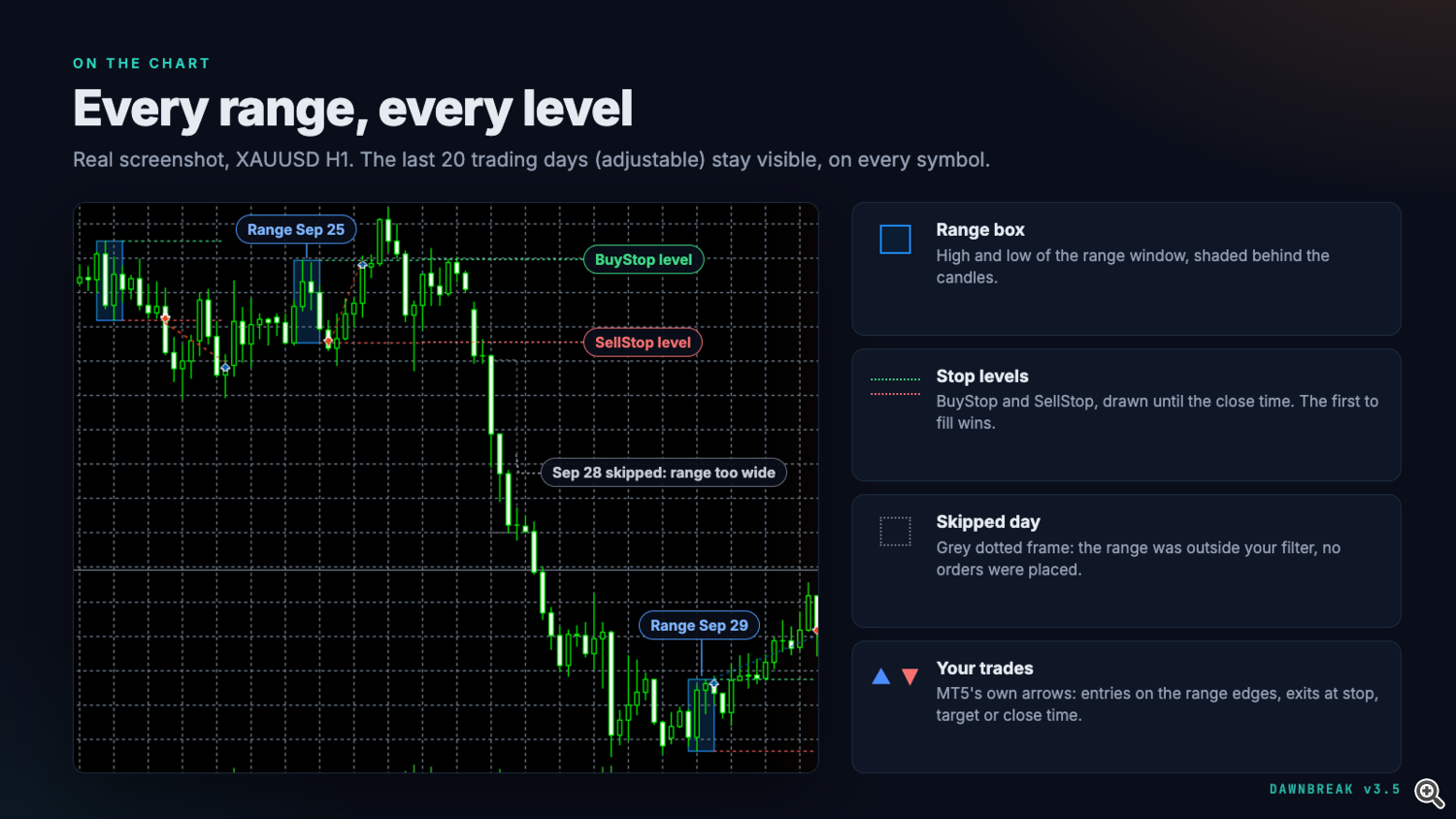
Skip days whose range is too small or too wide – in points or as a percentage of price. Skipped days are marked on the chart.
Protection
- Daily loss limit – per chart, closed plus open result, in % or as an amount.
- Pause after a losing streak – after N losing days in a row, pause for N calendar days.
- Max spread – no orders if the spread is wider at order time.
- If both pending orders disappear before a fill (deleted by hand, another program or the broker), the bracket is placed again – up to 8 times a day and only until the pending-order expiry. To stop for the day, remove the EA from the chart.
- After a terminal restart, Dawnbreak finds its own orders again; if a trade already filled that day, the leftover order is removed.
Dashboard
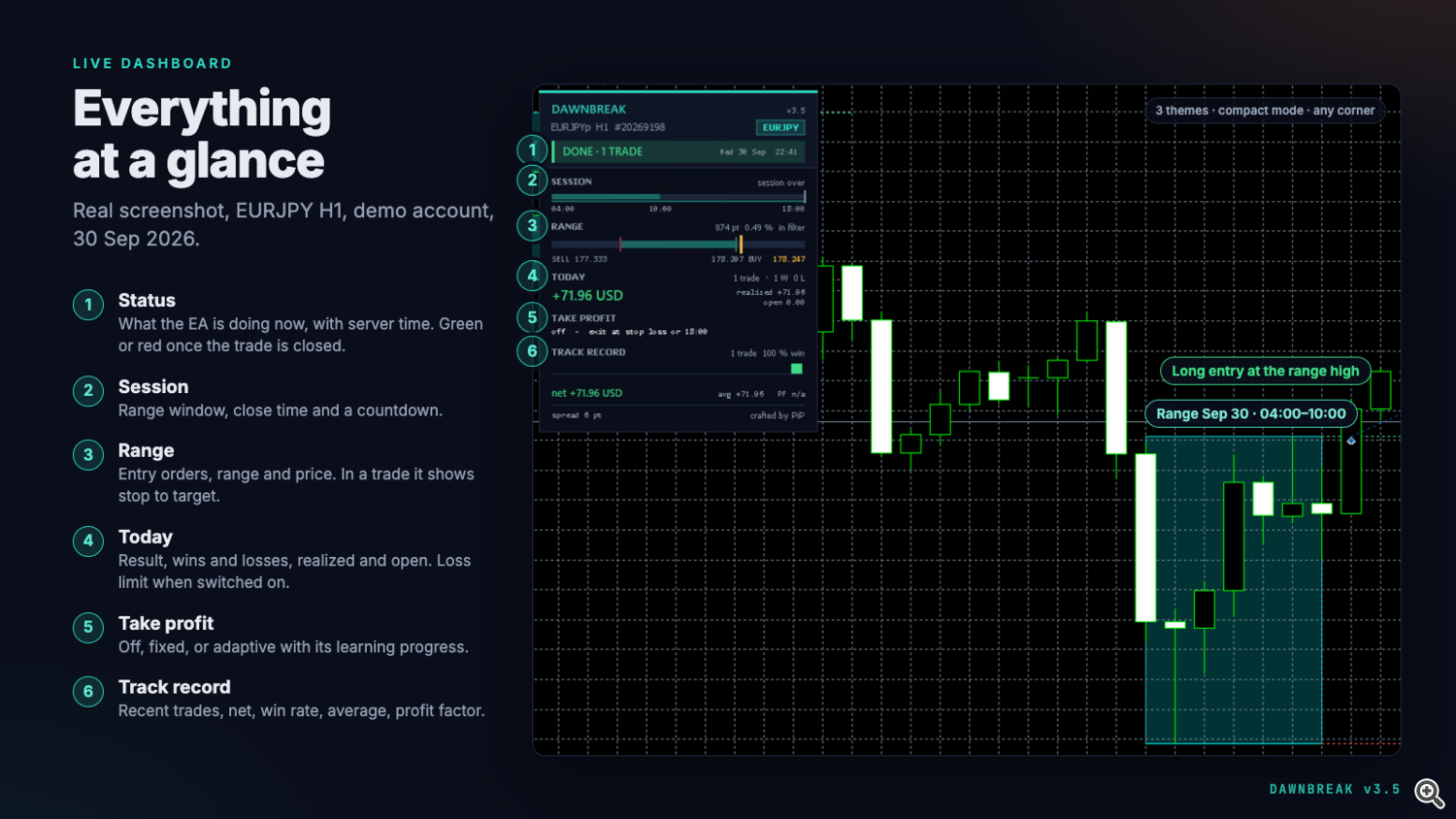
Status, session timeline, today's range and price, today's result, loss limit, take profit and recent trades. Three themes, compact mode, any chart corner. Past ranges with their BuyStop/SellStop levels are drawn for the last 20 trading days (adjustable).
5. Adaptive take profit
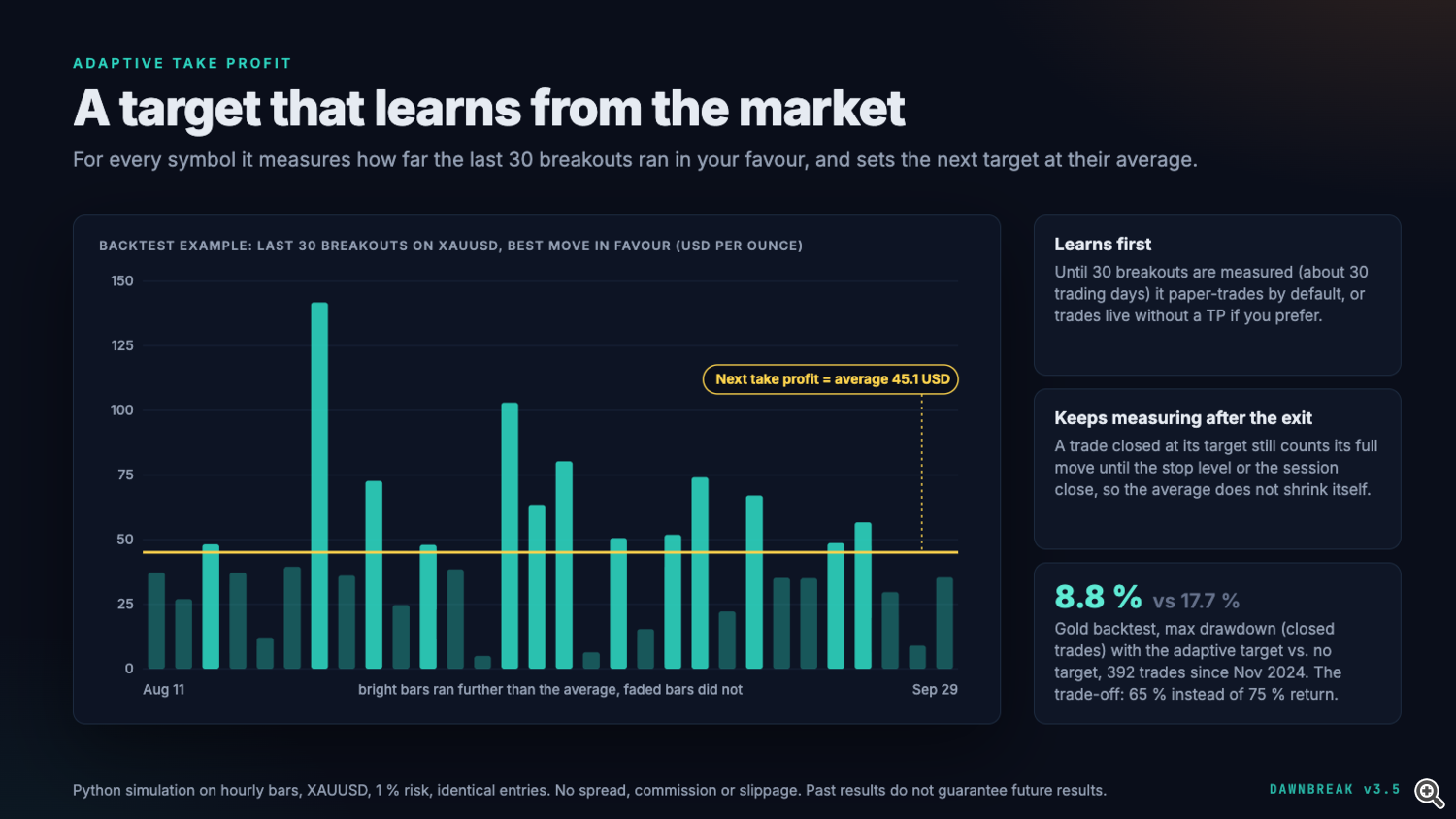
Instead of a fixed target, Dawnbreak can learn one per symbol:
- After every breakout it measures how far price moved in the trade's direction (until the stop level or the session close – also after a target was hit, so the average does not shrink itself).
- The next target is the average of the last 30 breakouts (adjustable 1–500).
- Until 30 breakouts are recorded – usually six to eight weeks – it paper-trades by default and places no orders. You can switch this off and trade live without a take profit during the learning phase.
- An optional floor and cap keep the target within a multiple of the range.
In the Strategy Tester the adaptive TP starts with no samples in every run; with paper trading on, the first 30 breakouts place no orders.
6. Risk and capital
- Wide ranges need more capital at the same risk: gold at 1 % risk with ranges of 20–75 USD needs about 7,500 USD or more.
- Risk adds up across charts. Several charts at 1 % each add up – four charts can put 4 % of the balance at risk on the same day.
- Hedging or netting account. On netting, do not trade the same symbol by hand or with another EA.
- Your broker must accept pending orders with an expiry time.
7. Backtest (gold only) – read the fine print
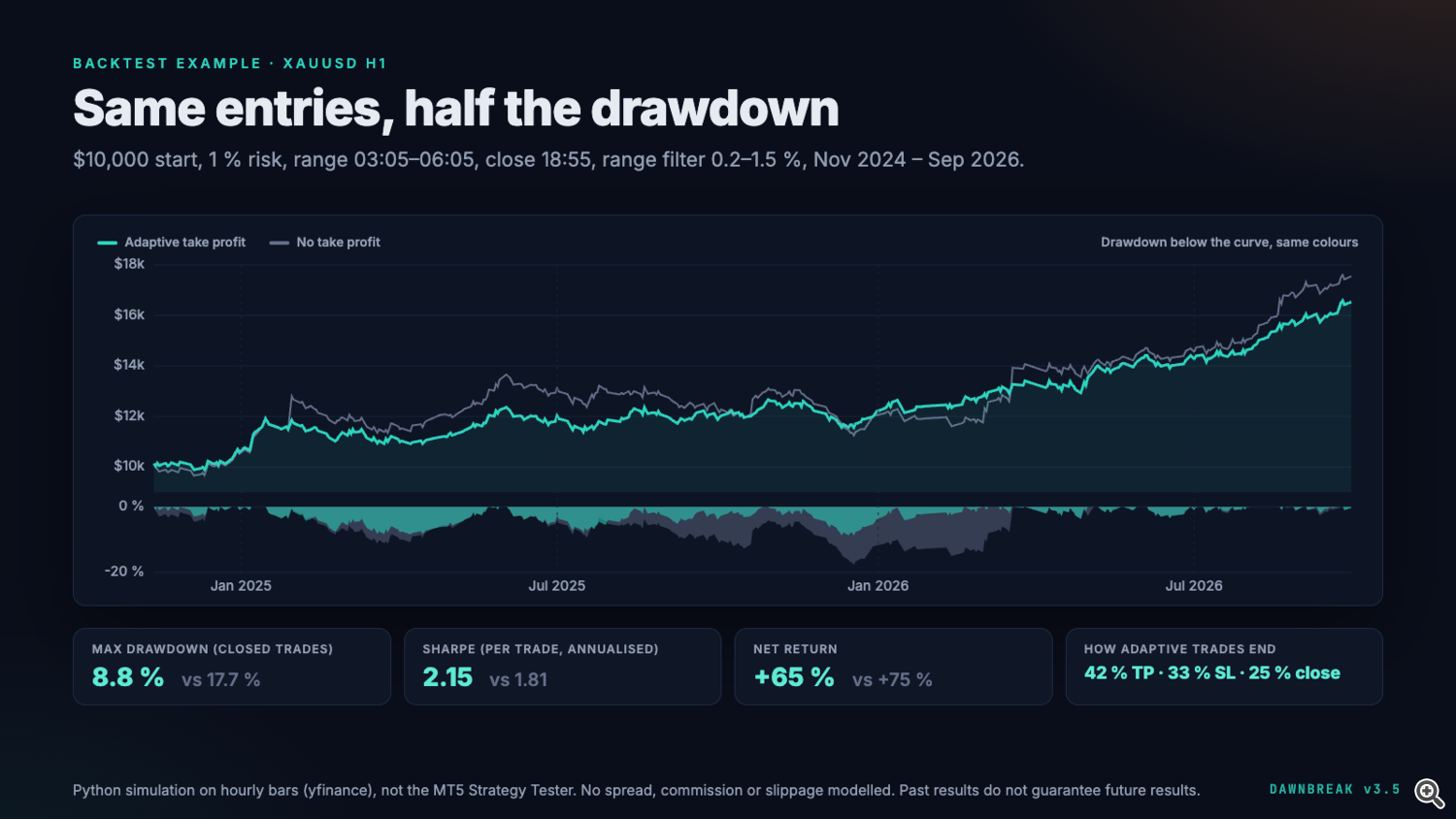
Gold example set: 1 % risk, range 03:05–06:05, close 18:55, stop at the opposite side of the range, range filter 0.2–1.5 %. Nov 2024 – Sep 2026, 392 trades:
- No take profit: +75 %, maximum drawdown 17.7 % (closed trades)
- Adaptive take profit, paper trading off: +65 %, maximum drawdown 8.8 % (closed trades)
This is a Python simulation on hourly gold futures data as a proxy for XAUUSD – not the MT5 Strategy Tester. Hourly bars cannot reproduce the exact range window, and no spread, commission or slippage is modelled. Other markets have not been backtested. Please run your own test with "Every tick based on real ticks".
8. Live
There is no public real-money signal yet. Dawnbreak currently runs on demo accounts at BlackBull (EURJPY and US30); a public live signal will be linked in the channel once it is running. Until then, treat every result as unproven.
9. Support
Post questions in the channel or the product comments, or send a private message. Please include your broker, symbol, the set file and the Experts log lines from the day in question.
Risk warning: trading forex and CFDs on margin carries a high risk of loss. Backtests are simulations; past results do not guarantee future results.