Exceptional or Just Lucky? How Many Trades Before You Can Trust an EA

A 90% win rate. A profit factor of 926. A drawdown of 26 cents. Numbers like these sell EAs every day, and most of the time they say more about how few trades have been taken than about the strategy.
Small samples lie in both directions. A handful of lucky trades can make a weak strategy look brilliant, and a handful of unlucky ones can make a good strategy look broken. Before judging an EA, the first question is not "how good are the numbers?" but "are there enough trades for the numbers to mean anything?"
A real example: three EAs, three different answers

These three EAs run on one of my live accounts.
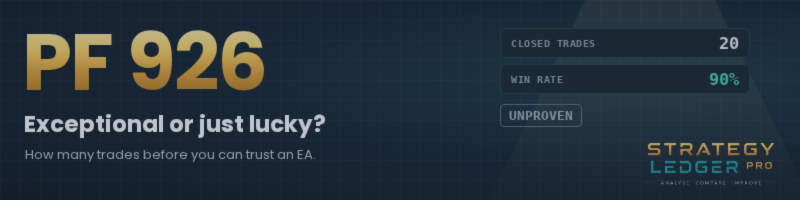
The one with the spectacular numbers is rated UNPROVEN. It has 20 closed trades, a 90% win rate, a profit factor of 926.28 and a maximum drawdown of €0.26. On paper, perfect. But 20 trades is far too few to separate skill from luck, so Strategy Ledger Pro refuses to grade it. Of its 19 strategies, 17 are still unproven and 2 are already losing.
The one with ordinary numbers is rated GOOD. 84 trades, a 74% win rate and a profit factor of 1.43 look far less exciting. But they come from enough trades to be judged, so they deserve more trust than the 926 above. Even so, the panel shows what sits inside: of its 20 strategies, 5 are losing and 15 are still unproven.
The third is GOOD but UNCONFIRMED. 187 trades and a profit factor of 1.44 earn a GOOD grade, but its edge is not yet statistically convincing. Of its 5 strategies, 1 is confirmed, 1 is unconfirmed and 3 are losing.
How to tell skill from luck
Three simple ideas do most of the work:
- Count decisions, not positions. A grid that opens 5 levels at once has made one decision, not five. Counting positions makes a sample look bigger, and a strategy look more certain, than it is.
- Measure the edge against the noise. The t-stat asks how large the average result is compared with how much results vary. Above about 2, luck becomes an unlikely explanation. One gold scalper on the same account scores 4.50, which is strong evidence.
- Replay the luck. Reshuffling the order of the closed trades thousands of times shows how deep a drawdown ordinary bad luck could produce. For that gold scalper it is €29.20. A real drawdown far beyond that range means something has changed; one inside it is just a bad run.
What Strategy Ledger Pro shows you
- Clear labels. UNPROVEN means too few setups to judge. UNCONFIRMED means profitable, but not yet statistically convincing. A grade appears only when the evidence supports one.
- What's inside every EA. Each EA row counts its strategies as confirmed, unconfirmed, losing or unproven, so a good total can't hide weak strategies underneath, and a "5 LOSING INSIDE" badge tells you where to look.
- Setups, not positions. Trades opened together count as one setup, so grids and baskets don't inflate their own confidence.
- The evidence, in numbers. Open any row for its t-stat, its edge-to-noise ratio, its confidence and its Monte Carlo drawdown.
- A verdict in plain words. Every row explains its grade, including how deep bad luck alone could take it.
The panel is read-only: it cannot place, modify or close trades, and nothing leaves your terminal.
A checklist before you trust an EA
- How many setups, not positions? A few dozen is the minimum before any number means much.
- Is the edge significant? Look for a t-stat of about 2 or more.
- Is the drawdown within the luck range? Compare it with the Monte Carlo figure.
- What's inside? A good EA total can hide losing strategies. Check them one by one.
- Be most suspicious of perfect numbers. A profit factor in the hundreds almost always means "not enough losing trades yet".
Judge with evidence, not excitement
The best-looking numbers on your account may be the least reliable ones. Strategy Ledger Pro tells you which figures you can already trust, and which still need time.