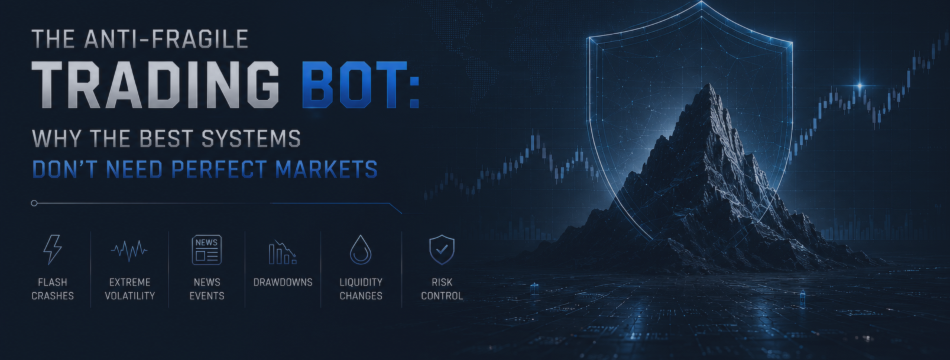
The Anti Fragile Trading Bot: Why the Best Systems Don't Need Perfect Markets

The Anti Fragile Trading Bot: Why the Best Systems Don't Need Perfect Markets
A strong trading system is not one that never experiences chaos. It is one designed to survive it. Sit with that for a second, because most of what you have ever read about trading systems gets this exactly backwards. Nobody builds a bridge and calls it well engineered because it has never once faced wind. They call it well engineered because they know, with genuine confidence, exactly what happens to it when the wind finally arrives at full force. Trading systems deserve the exact same standard, and almost nothing in this entire industry actually applies it. This is a long read. Get comfortable, because we are going to go somewhere most trading content never bothers to go, into what actually separates a system that merely looks good on a calm day from one built for the day everything goes wrong at once, verified throughout against ICONIC BTC AI+ and the flagship ICONIC KYBERNETIC AI+.
Part One: Three Words That Sound Similar and Mean Completely Different Things
Fragile. Robust. Anti fragile. Most people use these words as if they are basically synonyms for tough. They are not, and understanding the real difference between them is, without exaggeration, the single most important idea in this entire article. A fragile system breaks under stress, obviously, predictably, and gets worse the harder it is pushed. A robust system resists stress, holding steady, refusing to break, but gaining nothing from the encounter either. An anti fragile system does something genuinely different from both, it actually gets stronger, or at minimum gathers something genuinely useful, from exposure to disorder, volatility, and stress it was never specifically told to expect in advance. Most trading bots are fragile and do not know it yet. A meaningful few are genuinely robust. Almost none are built with real anti fragility in mind, and that gap is exactly what this article is about.
Part Two: Flash Crashes, the Moment Everyone's Assumptions Get Tested at Once
Picture it. Price is moving normally, nothing unusual, and then, within seconds, the floor simply disappears. Not a decline, a collapse, the kind of move that makes a chart look like someone cut the wire holding it up. This is a flash crash, and it is not a rare, once in a generation curiosity anymore. It is a structural feature of markets this densely populated by automated participants, a feature every genuinely serious system has to be built around, not merely hope never happens on its watch. A fragile system meets this moment with a fixed stop distance calibrated for an entirely different kind of day, and either gets obliterated instantly or, worse, sits there with no protection wide enough to matter at all. Ask yourself honestly, does your current system have any real answer for this specific moment, or does it simply assume this moment will not happen to it specifically.
Part Three: Extreme Volatility, When the Market Stops Behaving Like Itself
Volatility does not always announce itself politely. Sometimes it just arrives, all at once, and a market that was calm an hour ago is suddenly moving in ways that make yesterday's risk assumptions look almost quaint. Here is the honest truth most trading education skips entirely, volatility itself is not the enemy. Fixed, unchanging assumptions about volatility are the enemy. A system that calculated its stop distance once, weeks ago, against a completely different volatility regime, is not protected during a genuine expansion, it is exposed in exactly the way its original design never accounted for. This is where the difference between fragile and robust becomes brutally visible, not in the calm months, but in the specific hours when everything speeds up at once.
Part Four: News Events, The Moment Human Emotion Meets Automated Speed
You know the feeling. A headline drops, and the chart just goes vertical, or falls straight through the floor, and it happens faster than you can even finish reading the sentence that caused it. This is where a lot of otherwise decent systems quietly fall apart, not because their core logic is wrong, but because they were never built to respect the specific, temporary chaos a genuine news event creates. A system with no awareness of scheduled risk trades straight through it, blind, the same way it trades through any ordinary Tuesday afternoon. And here is the deeper problem worth sitting with, even unscheduled news, the kind nobody could have possibly seen coming, still demands a genuine answer, not a prediction of when it happens, but a structural readiness for what it does to price once it does.
Part Five: Drawdowns, The Test That Actually Determines Whether You Get to Keep Playing
Every single strategy that has ever existed loses money sometimes. That is not a flaw, that is just what trading is. The real question, the one that actually matters, is what happens next. Does the drawdown stay contained, survivable, the kind of dip a genuinely sound system recovers from in the normal course of compounding, or does it spiral, because nothing was ever built to stop it once it started. A fifty percent drawdown needs a full one hundred percent gain just to get back to even. Let that sink in for a second, because most traders never actually do the math on what a bad drawdown genuinely costs them, not just in dollars, but in the months, sometimes years, of compounding it quietly steals.
Part Six: Liquidity Changes, The Threat That Never Makes the Headlines
This one is quiet, and that is exactly what makes it dangerous. Liquidity does not always vanish with a bang, sometimes it just thins out, gradually, an hour at a time, until the exact price you thought you would get is not the price you actually get anymore. A system with no genuine awareness of current execution conditions keeps operating as if liquidity is constant, as if every hour of every day offers the same depth it did during the calmest, most orderly session it was ever tested against. It is not. And a system that never checks is a system quietly bleeding value on every single trade it takes during exactly the hours it should have been most careful.
Part Seven: Why That Beautiful Backtest Curve Might Actually Be Lying to You
Here is something worth genuinely sitting with, uncomfortable as it is. The single most impressive backtest you have ever seen is not automatically the safest system to trust. Sometimes it is the exact opposite. A curve that looks too smooth, too clean, too consistently perfect, usually got that way by being tuned, again and again, until it perfectly fit one specific stretch of history that will never repeat in exactly that shape again. Robustness almost never produces the prettiest backtest. It produces an honest one, with real drawdowns, real rough patches, because it was never squeezed to hide them in the first place. If you have to choose between the system with the most jaw dropping historical curve and the one whose developers can actually explain, in real detail, how it survives chaos, choose the second one. Every single time.
Part Eight: Profitable and Survivable Are Not the Same Word, and Confusing Them Is Expensive
A profitable system made money. Past tense. That is it, that is the entire claim. A survivable system is built to keep making money, or at minimum to keep existing long enough to have the chance, across every kind of condition this article has just walked you through, flash crashes, extreme volatility, news shocks, drawdowns, and liquidity that is not always there when you need it. Plenty of systems are genuinely profitable for a while and still are not survivable, because their profitability was never actually tested against the specific chaos that eventually, always, eventually, shows up. You do not find out which category your system belongs to during the calm months. You find out during the one week that actually matters, and by then, if the answer is the wrong one, it is already too late to do anything about it.
Part Nine: How ICONIC BTC AI+ Actually Answers a Flash Crash, Not Hopes One Never Happens
This is where theory has to become something real, verified, checkable. ICONIC BTC AI+ calculates its stop distance and position size directly from live ATR, meaning protection genuinely scales with real, current conditions rather than a number chosen once and forgotten. Even the touch tolerance deciding whether a level has genuinely been reached scales relative to current volatility. When conditions turn violent, the system's own risk footprint shrinks automatically, mechanically, with no human needing to notice and react in time. That is not a promise. That is math running continuously, on every single trade, whether anyone is watching or not.
Part Ten: How This Architecture Actually Handles Genuine Volatility Expansion
Grunwald Letnikov fractional calculus gives the engine genuine long memory momentum perception, capturing how past price behavior keeps influencing the present far better than a fixed lookback indicator ever could. Differentiable plasticity means the network's own internal weighting keeps rewiring itself in response to live feedback, continuously, not once at deployment and never again. An epigenetic methylation gate freezes that learning specifically during choppy, dangerous stretches, so the system does not draw the wrong lesson from exactly the kind of noise volatility spikes produce. This is not a system hoping calm returns soon. This is a system built assuming, correctly, that it will not.
Part Eleven: Why News Events Do Not Catch This System Off Guard
Live spread is checked against a defined maximum before any entry proceeds, rejecting a setup outright the instant execution conditions turn genuinely unfavorable, exactly the environment a major news release produces. And here is the part worth genuinely appreciating, protective management of any position already open continues running even during a lockout, because abandoning an open position simply because new risk taking has paused would be its own kind of failure. This is the honest, structural difference between a system that respects news risk and one that simply gets lucky, most of the time, until the one time it does not.
Part Twelve: Why Drawdowns Get Contained Instead of Spiraling
Smart Bail Out continuously estimates genuine recovery probability for any position sitting in adverse territory, and Adaptive Trailing does the same for winners, deciding when to lock in protection and when to let a real move breathe. Both are gated hard, thirty observed lessons before Smart Bail Out may act at all, Bayesian shrinkage pulling early estimates toward caution, a two reading confirmation before anything actually fires. This is not a system reacting emotionally to one bad candle. It is a system that earned the right to intervene through real, accumulated evidence, exactly the discipline that keeps a normal, expected losing stretch from becoming the kind of drawdown that ends everything.
Part Thirteen: Why Liquidity Shifts Do Not Silently Erode This System's Edge
Entry structure lives at genuine, meaningful levels, daily and previous day extremes, real support and resistance, order block zones drawn from actual price history, refreshed continuously through smart re arm so the map being traded reflects current reality rather than a stale calculation from hours earlier. This is a system built to notice when the ground has shifted, not one still confidently trading a map of terrain that no longer exists.
Part Fourteen: Where the Flagship Actually Becomes Genuinely Anti Fragile, Not Just Robust
Here is where things get genuinely interesting, because everything covered so far describes real, hard won robustness. The flagship ICONIC KYBERNETIC AI+ pushes into something meaningfully closer to true anti fragility, gaining genuine, structural advantage specifically because of how it responds to chaos, not merely surviving it. Its Physics Informed margin axiom enforces a hard, structural free margin floor the engine is mechanically incapable of violating, no exceptions, no override, ever. Its three tier portfolio drawdown framework escalates automatically, defensive posture first, then a full trading halt, then emergency closure if things genuinely deteriorate, precisely the kind of unbreakable law that turns a genuinely bad week into a survivable one instead of a final one.
Part Fifteen: Why Coordinating Two Markets Genuinely Gets Stronger Under Stress
This is the part that actually earns the word anti fragile rather than merely robust. When Bitcoin genuinely deteriorates while Gold remains comparatively orderly, ICONIC KYBERNETIC AI+ does not sit there helplessly absorbing the full shock on one exposed front. Stochastic Tunneling capital allocation continuously reassesses the balance between the two, shifting relative emphasis as real, current conditions on each front genuinely diverge. A single asset system has no such option, by definition, it has one front and nowhere else to send the weight. This coordinated system gets something genuinely valuable specifically because chaos hit unevenly, exactly the property that separates anti fragile design from merely robust design.
Part Sixteen: A Self Calibrating Confidence Gate That Actually Learns From Getting Hit
Adaptive Conformal Inference does not just sit there hoping its confidence stays accurate. It continuously checks its own stated confidence against what actually happened, and adjusts, in real time, when reality and its own assumptions start drifting apart. This is a system that treats being wrong as genuine information, not as an embarrassment to ignore. That is, in a real, technical sense, exactly what anti fragility means, extracting something useful from exactly the moments a fragile system would just quietly keep breaking.
Part Seventeen: Don't Build Algorithms for Perfect Markets. Build Algorithms for Real Ones.
Say that back to yourself. Don't build algorithms for perfect markets. Build algorithms for real ones. Because a perfect market, calm, orderly, predictable, generous with liquidity, patient with your mistakes, does not actually exist, has never existed, and is not going to start existing just because a backtest was calibrated as if it did. Every strategy that has ever been quietly abandoned was built, whether its developer realized it or not, for a market that was never actually real. The strategies that endure are the ones built specifically for the version of markets that genuinely shows up, flash crashes and all, extreme volatility and all, news shocks and drawdowns and vanishing liquidity, all of it, on purpose, from the very first design decision.
Part Eighteen: A Realistic Scenario, Watching Fragile, Robust, and Anti Fragile Face the Same Bad Week
Let's make this concrete. A genuinely severe week arrives, the kind every market eventually produces, a sudden liquidity driven cascade in Bitcoin colliding with a scheduled macro surprise hitting Gold on the exact same day. A fragile system, calibrated for calm conditions and never revisited, gets hit hard, its fixed stops either too tight to survive the initial shock or so wide the damage is already done by the time they finally trigger. A robust system holds the line, its ATR based sizing and hard risk enforcement absorbing the shock without breaking, ending the week bruised but genuinely intact, exactly what ICONIC BTC AI+ was built to deliver.
ICONIC KYBERNETIC AI+ experiences that same brutal week differently again. Its causal awareness of the relationship between Bitcoin and Gold, its continuous reallocation between the two fronts, its self calibrating confidence adjusting honestly to what actually happened, all of it working together, means the system does not merely survive this week. It comes out the other side having genuinely learned something real from it, positioned, calibrated, and ready in a way it was not before that week began. That is the entire, honest difference this article has been building toward, survive versus merely survive versus genuinely grow stronger from exactly the chaos that destroyed everything built for a market that was never actually real.
Part Nineteen: Ask Yourself This, Right Now, Before You Read Any Further
Stop for a second. Think about whatever system is currently trading your capital, whether it is the one covered throughout this article or something else entirely. Has it ever genuinely been tested against every single threat this article has walked through, a flash crash, a violent volatility expansion, a scheduled news shock, a real drawdown, a genuine liquidity thinning, all of it, not hypothetically, but with a specific, verifiable mechanism you could point to and explain? If you cannot answer that honestly and confidently, you do not actually know whether you are running something fragile, something robust, or something genuinely anti fragile. You are just hoping. And hope is not a risk management strategy, no matter how good the last few months have felt.
Part Twenty: Why the Calm Months Are Lying to You About What You Actually Own
This is the cruelest part of the whole thing, and it deserves to be said plainly. A genuinely fragile system and a genuinely robust one look almost identical during calm, orderly conditions. Both make money. Both look fine on a statement. The difference only becomes visible during the exact conditions this entire article has been describing, and by definition, those conditions are not the ones you are looking at right now if things currently feel calm. This means the confidence most traders feel about their current system was never actually earned through a genuine test. It was simply never challenged yet. That is not the same thing as being safe, and confusing the two is exactly how good months turn into a single terrible one that erases them all.
Part Twenty One: The Honest Limits, Because Overpromising Here Would Make Everything Else in This Article Worthless
Real talk for a second. Nothing covered throughout this article, no mechanism, no architecture, no amount of genuine engineering, eliminates market risk entirely or guarantees any specific outcome. Anti fragility is not magic, and it does not mean a system profits from every single chaotic event automatically. What it genuinely means, and what this article has verified mechanism by mechanism throughout, is a structural capacity to absorb, adapt to, and in the flagship's case, sometimes genuinely benefit from disorder that would flatten a fragile system outright. That is a real, meaningful, honestly earned claim. It is not, and was never meant to be, a promise that chaos stops mattering just because your architecture is genuinely sound.
Part Twenty Two: A Second Scenario, The One That Actually Keeps Developers Up at Night
Here is a genuinely uncomfortable one. A system has been running clean for months, and everyone involved, developer and trader alike, has started to relax a little. Then, without warning, a genuine flash crash arrives, the kind covered in Part Two, price simply falling through levels that were supposed to matter. A fragile system's fixed stops either fail to protect at all, gapped straight through, or protect so aggressively they cut a position that would have recovered fine within the hour. ICONIC BTC AI+ meets that exact same event with stop distance and sizing that had already been scaling with real, live volatility the entire time leading up to it, meaning the position going into that crash was never sized as if the calm months would last forever. This is not luck. This is the direct, structural consequence of never trusting a single, frozen risk assumption in the first place.
Part Twenty Three: Why Most Products in This Category Never Even Attempt This Standard
Be honest with yourself about what is actually being sold across most of this market. A product leading with one gorgeous backtest and a big, confident percentage number is not telling you anything about how it behaves during any of the five threats this entire article has walked through in detail. Building genuine resilience against flash crashes, real volatility adaptation, honest news awareness, disciplined drawdown containment, and genuine liquidity sensitivity is hard, unglamorous engineering work that does not produce an exciting screenshot. It produces something considerably more valuable, a system that is still standing, and still trading, long after the flashy alternative quietly disappeared from the marketplace.
Part Twenty Four: A Real Checklist You Can Actually Use, Today, on Anything You Are Considering
- Flash crashes. Does risk sizing genuinely scale with real time volatility, or does it sit at a fixed number regardless of whether the market is calm or collapsing right now.
- Extreme volatility. Does the underlying model keep learning and adapting continuously, or was it calibrated once and trusted forever no matter how far conditions eventually drift.
- News events. Is there genuine, calendar aware protection around scheduled releases, and does protective management of open positions actually continue during that exact window rather than being abandoned entirely.
- Drawdowns. Are there hard, structurally enforced boundaries incapable of being overridden, or does risk management exist as a setting someone could quietly disable under pressure.
- Liquidity changes. Are entries built on genuine, refreshed structural levels, or on a static calculation performed once and left untouched as real conditions shift underneath it.
Run this checklist against ICONIC BTC AI+ and ICONIC KYBERNETIC AI+ and every single answer is verifiable, specific, and already covered in detail throughout this article. Run it against most of what else is out there, and watch how quickly the confident marketing language runs out of actual, checkable substance to back it up.
Part Twenty Five: Why the Most Sophisticated Players in the World Have Already Made Their Choice on This
Nobody managing genuinely serious capital, with genuinely serious resources and a genuinely serious incentive to avoid catastrophic loss, builds a system and simply hopes chaos stays away forever. This exact standard, engineering explicitly for disorder rather than merely for the calm, favorable conditions a backtest happened to be built against, is well understood and taken seriously across the most sophisticated corners of quantitative finance. The fact that so much of the retail trading world still has not caught up to this standard is not evidence the standard does not matter. It is evidence of exactly the gap this entire article has been trying to close.
Part Twenty Six: The Version of This Story Nobody Wants to Tell You Honestly
Somewhere out there right now, a trader is running a system that has performed beautifully for months, feeling genuinely confident, maybe even a little proud, and has no real idea that a fragile design is sitting underneath all of it, untested by anything this article has actually described. That trader is not doing anything wrong exactly. They just have not been unlucky yet. The genuinely painful part is that the eventual event, whichever one of the five threats this article covered actually shows up first, will not care how good the months before it felt. It will not offer a warning. It will simply arrive, and the only thing that determines what happens next is whatever architecture was actually built in, quietly, long before that specific week ever began.
Part Twenty Seven: Answering the Doubt You Are Probably Having Right Now
Maybe you are thinking your current setup has already been through some rough patches and came out fine, so surely it is already robust enough. Fair thought, and worth taking seriously rather than dismissing. But ask yourself honestly which specific threats it has actually faced. A rough patch is not automatically the same as a genuine flash crash. A few volatile days are not automatically the same as the kind of structural regime violence covered in Part Three. Surviving some difficulty is real evidence, genuinely, but it is not the same as surviving all five categories this article has walked through in detail, and assuming it is exactly that kind of comfortable, unverified assumption that Part Twenty made the case against directly.
Part Twenty Eight: What Waiting Actually Costs, Stated Honestly Rather Than Softened
Every single day spent trading something fragile, without genuinely knowing it is fragile, is a day of real, ongoing exposure to every threat this article has described, whether that specific day happens to be the one that finally arrives or not. This is not manufactured urgency designed to rush you into a decision you would not otherwise genuinely benefit from. It is simply the honest, mathematical truth about risk that has not gone away just because it has not shown up yet. You do not get to choose when a flash crash happens. You only get to choose, right now, before it happens, whether what you are running is genuinely built for it.
Part Twenty Nine: Why Markets Are Only Becoming More Demanding, Not Less
It would be comforting to believe the specific chaos covered throughout this article is a temporary phase markets will eventually grow out of. The honest evidence points firmly the other way. Algorithmic density keeps increasing. Derivative driven leverage keeps expanding. Markets keep extending toward continuous, always on structures with fewer quiet hours to catch a breath in. Every single force shaping modern markets is pushing toward more of exactly the chaos this article has described, not less, which means the case for anti fragile design only strengthens with each passing year, never the reverse.
Part Thirty: Bringing Every Threat, Every Tier, and Every Mechanism Together
Step back and look at the whole picture. Fragile systems break under flash crashes, extreme volatility, news shocks, uncontained drawdowns, and vanishing liquidity, because they were never built with any of these five threats genuinely in mind. Robust systems absorb these same threats and keep standing, exactly what ICONIC BTC AI+ was engineered to deliver, verified throughout this article mechanism by mechanism rather than promised through a single, impressive backtest. Anti fragile systems go one step further, actually extracting genuine, structural advantage from exactly the chaos that would flatten anything less deliberately engineered, precisely what the flagship ICONIC KYBERNETIC AI+ was built to achieve through coordinated, continuously self calibrating intelligence spanning two markets at once.
Don't build algorithms for perfect markets. Build algorithms for real ones. This article has said it once already, and it deserves to be said again, because it is the entire idea this piece has been circling from its very first sentence. Perfect markets do not exist. Real ones do, chaos and all, and the only real question left is whether whatever is trading your capital right now was actually built for the one that shows up, or merely for the one you were hoping for.
Frequently Asked Questions
What is the actual difference between a fragile, robust, and anti fragile trading system? A fragile system breaks under stress and gets worse the harder it is pushed. A robust system resists stress and holds steady without necessarily gaining anything from it. An anti fragile system genuinely benefits, gaining real, structural advantage, from the exact disorder that would break a fragile alternative.
Why can a beautiful, smooth backtest actually be a warning sign? An unusually smooth historical curve with minimal drawdown is frequently the result of tuning a strategy repeatedly until it fits one specific historical window perfectly, memorizing noise unique to that period rather than reflecting genuine, repeatable structure likely to hold going forward.
Why do profitable and survivable mean genuinely different things? Profitable describes what already happened, in the past, under whatever conditions actually occurred. Survivable describes structural readiness for conditions that have not happened yet, and a system can be genuinely profitable for a period without ever having been tested against the specific chaos that eventually determines whether it endures.
How does ICONIC BTC AI+ specifically address a sudden flash crash? Through ATR based dynamic stop distance and position sizing that scale continuously with real, live volatility, meaning protective distance and exposure adjust automatically rather than relying on a fixed assumption calibrated for calmer conditions.
What specifically makes ICONIC KYBERNETIC AI+ genuinely anti fragile rather than merely robust? Its Stochastic Tunneling capital allocation can shift emphasis between Bitcoin and Gold as conditions on each front genuinely diverge, and its self calibrating confidence gate treats being wrong as genuine, actionable information rather than simply absorbing the error passively.
Does anti fragile architecture guarantee protection against every possible loss? No. No system eliminates market risk entirely or guarantees any specific outcome. Anti fragile design provides a structurally different, genuinely verified capacity to absorb and sometimes benefit from disorder, not an absolute guarantee against every conceivable scenario a genuinely uncertain market could produce.
Why does this specific standard matter more now than it did in the past? Algorithmic density, derivative driven leverage, and continuous, always on market structures are all increasing, meaning the specific forms of chaos this article describes are becoming more common features of modern markets rather than rare, fading exceptions.
Perfect Markets Were Never Coming. Real Ones Already Arrived.
Every trader eventually meets the exact moment this entire article has been describing, a flash crash, a violent volatility expansion, a news shock nobody saw coming, a drawdown that either gets contained or spirals, a liquidity thinning that quietly costs more than it should. That moment does not care how good the months before it felt. It only cares what was actually built, quietly, long before it arrived.
Deploy ICONIC BTC AI+ for genuine, verified robustness against every threat this article has walked through in detail. Step up to the flagship ICONIC KYBERNETIC AI+ for coordinated, self calibrating architecture that does not merely survive chaos, it genuinely learns from it. Don't build algorithms for perfect markets. Deploy the ones already built for the real one.
Risk Disclaimer. Trading foreign exchange, cryptocurrencies, commodities and other leveraged financial instruments carries a high level of risk and may not be suitable for all investors. The high degree of leverage can work against you as well as for you. Past performance is not indicative of future results. Automated trading systems and Expert Advisors do not guarantee profits and can produce losses. ICONIC.FX provides software tools only and does not provide investment advice, portfolio management or financial recommendations. You are solely responsible for your own trading decisions. Seek advice from an independent licensed financial advisor if you have any doubts.
Part Thirty One: Why This Idea Genuinely Extends Beyond Trading, and Why That Matters
This framework did not appear out of nowhere specifically for trading systems. Anti fragility as a genuine concept describes something real across engineering, biology, and complex systems generally, muscle actually grows stronger from the specific stress of resistance training, immune systems genuinely strengthen through controlled exposure to pathogens, well designed infrastructure is deliberately stress tested precisely so its real breaking points are known in advance rather than discovered during an actual emergency. Recognizing that this exact principle already governs how serious people build serious things across completely unrelated fields makes the case for applying it to trading architecture considerably harder to wave away as some clever, made up marketing angle invented specifically to sell a bot.
Part Thirty Two: The Uncomfortable Truth About Why This Standard Is So Rare in This Specific Industry
Here is the honest version, stated plainly rather than hinted at. Building genuine anti fragility is hard, slow, unglamorous work, and it does not produce the kind of screenshot that sells quickly. A fixed rule system with an aggressively curve fit backtest can be built in a weekend and marketed within days. A system genuinely engineered against flash crashes, volatility regime shifts, news risk, drawdown containment, and liquidity sensitivity, tested honestly rather than tuned to hide its rough edges, takes real time, real iteration, and a genuine willingness to show an honest curve instead of a flattering one. Most of this industry chooses the fast, flattering path, because it sells faster. That does not make it the right choice for whoever is actually trusting it with real money.
Part Thirty Three: A Third Scenario, The Slow Bleed Nobody Notices Until It Is Too Late
Not every failure is dramatic. Sometimes it is quiet, a system that never technically breaks, it just slowly, steadily underperforms during exactly the conditions this article has described, bleeding value hour after hour through poor execution during thin liquidity, through stale entry levels nobody refreshed, through a volatility assumption that quietly stopped matching reality weeks ago. This is arguably more dangerous than a dramatic, obvious failure, precisely because nothing forces the trader running it to notice and intervene. ICONIC BTC AI+ addresses this exact slow bleed directly, through continuously refreshed structural levels, continuously recalibrated volatility assumptions, and continuous learning that never stops checking its own assumptions against what is actually, currently true.
Part Thirty Four: What Genuinely Changes for You the Moment You Stop Trusting a Fragile System
Think about what it actually feels like to trade something you genuinely trust, not because it has never lost, everything loses sometimes, but because you know, specifically and confidently, what happens when the bad week finally arrives. That is a completely different experience than trading something you have simply never seen tested, hoping quietly, in the back of your mind, that today is not the day it finds out what it is actually made of. This article has walked you through every single mechanism that makes that first version genuinely possible, not through hope, but through verified, working architecture built specifically for exactly the chaos that eventually, always, eventually shows up.
Part Thirty Five: Why Coordinated Systems Handle the Worst Weeks Considerably Better Than People Expect
It is worth returning to the coordination advantage covered in Part Fifteen with one more layer of depth, because it deserves genuine emphasis rather than a single passing mention. The single worst weeks in any market rarely hit every instrument with identical severity. Something usually gets hit harder, something else usually holds up comparatively better, and a system with the structural capacity to notice this asymmetry in real time and actually respond to it holds a genuine, measurable advantage over one forced to simply absorb whatever happens to its single, exposed front. This is not a marginal, theoretical benefit. It is precisely the kind of structural advantage that separates a merely robust system from one that has genuinely earned the word anti fragile.
Part Thirty Six: The Specific Moment Most Traders Realize Their System Was Never Actually Tested
It usually happens the same way. A trader has been running something for a while, feeling good about it, and then a genuinely bad day arrives, the kind this article has walked through in exhaustive detail, and the system does something nobody expected, something the backtest never showed, something that reveals, all at once, that whatever confidence existed before that day was never actually earned through a real test. This moment is expensive, and it is also completely avoidable, specifically by asking the questions this article has raised throughout, before that moment ever arrives, rather than during it, when it is already too late to matter.
Part Thirty Seven: Why This Is the Message ICONIC.FX Was Actually Built Around, Not Just a Slogan
Don't build algorithms for perfect markets. Build algorithms for real ones. This is not a phrase invented for this specific article. It is the actual, honest description of the engineering philosophy verified throughout every single section of this piece, differentiable plasticity that never stops adapting, ATR based sizing that never trusts a fixed assumption, hard risk boundaries that never bend under pressure, causal coordination that never assumes one market's behavior transfers blindly to another. Every mechanism covered in this article exists because someone, somewhere in the development of these systems, sat down and genuinely asked the question this entire piece has been asking you, what happens when the market stops being calm, and built the answer directly into the architecture rather than hoping the question never came up.
Part Thirty Eight: The Full Weight of Everything This Article Has Actually Argued
Fragile systems break under flash crashes because they were calibrated for calm and never revisited. They break under extreme volatility because their risk assumptions were frozen the day they launched. They break under news events because they trade blindly through exactly the moments that deserve the most caution. They break under drawdowns because nothing was ever built to contain the bleeding before it became fatal. They bleed quietly under shifting liquidity because nobody built them to notice the ground had moved. Every single one of these failures is preventable, verified throughout this article as genuinely, structurally solved inside ICONIC BTC AI+, and taken further still, into genuine anti fragility, inside the flagship ICONIC KYBERNETIC AI+.
This was never really an article about five separate threats. It was an article about one single idea, stated at the very beginning and worth repeating one final time now that you have seen the entire case built out in full. A strong trading system is not one that never experiences chaos. It is one designed to survive it, and, if it is genuinely well built, to come out the other side of that chaos a little sharper, a little more calibrated, a little more ready for whatever real markets decide to throw at it next.
Part Thirty Nine: One More Honest Story, Because This Point Deserves to Land Fully
Picture two developers, both genuinely skilled, starting from the same basic idea. The first spends a weekend tuning that idea against a comfortable stretch of historical data, watching the curve get smoother with every adjustment, and ships it once it looks genuinely impressive. The second spends considerably longer, deliberately stress testing the same core idea against violent volatility spikes, against simulated liquidity gaps, against the exact kind of scheduled news chaos covered in Part Four, refusing to ship until the system has an honest, verified answer for every single one of those conditions, not merely a hope that they stay away.
The first developer's product hits the market faster, with a more exciting looking backtest, and genuinely outsells the second for a while, because breadth of promise beats depth of engineering in a marketplace that has not yet learned to ask the right questions. Then a genuinely bad week arrives, the kind this entire article has described from every possible angle, and the first product quietly disappears from conversation, while the second is still standing, still trading, precisely because it was built, from day one, for the version of markets that actually exists rather than the polite, cooperative one its developer wished existed instead. This is not a hypothetical morality tale invented to make a point. It is the honest, repeating pattern across this entire industry, and it is exactly why ICONIC BTC AI+ and ICONIC KYBERNETIC AI+ were built the second way.
Part Forty: The Only Question Actually Worth Asking Yourself Tonight
Not whether your current results have looked good lately. Not whether your backtest is impressive. Just this, honestly, sitting with it for a moment rather than rushing past it, if the exact chaos this article has walked through in exhaustive detail arrived tomorrow morning, a genuine flash crash, a violent volatility expansion, a news shock nobody predicted, a drawdown that either gets contained or spirals, a liquidity thinning that quietly costs more than it should, would whatever is currently trading your capital actually survive it, or would you simply be finding out, in real time, for the very first time, exactly what it was actually made of.