Meet ALMA: the moving average that stops making you choose between fast and calm
Every trader who has ever put a moving average on a chart knows the same frustration.
Make the average fast, and it follows the price closely — but it also jumps at every random tick, and you get signals that go nowhere.
Make it slow, and the line becomes beautifully smooth — but by the time it finally turns, half of the move is already gone.
For years the only answer was "pick your poison". Now there is a better one, and we have just added it to Moving Average Cross Signal (Full FREE project) : a smoothing method called ALMA — the Arnaud Legoux Moving Average.
This article explains what it is, in plain language, and why it can make your entries noticeably earlier without making your chart noisier.
First, what does a moving average actually do?
Imagine the last 20 candles on your chart. A moving average simply takes those 20 prices and calculates a single "fair" value out of them. Do that for every candle, join the values, and you get the line you see on your screen.
The only real question is: how much importance should each of those 20 candles get?
That single question is what separates every moving average ever invented.
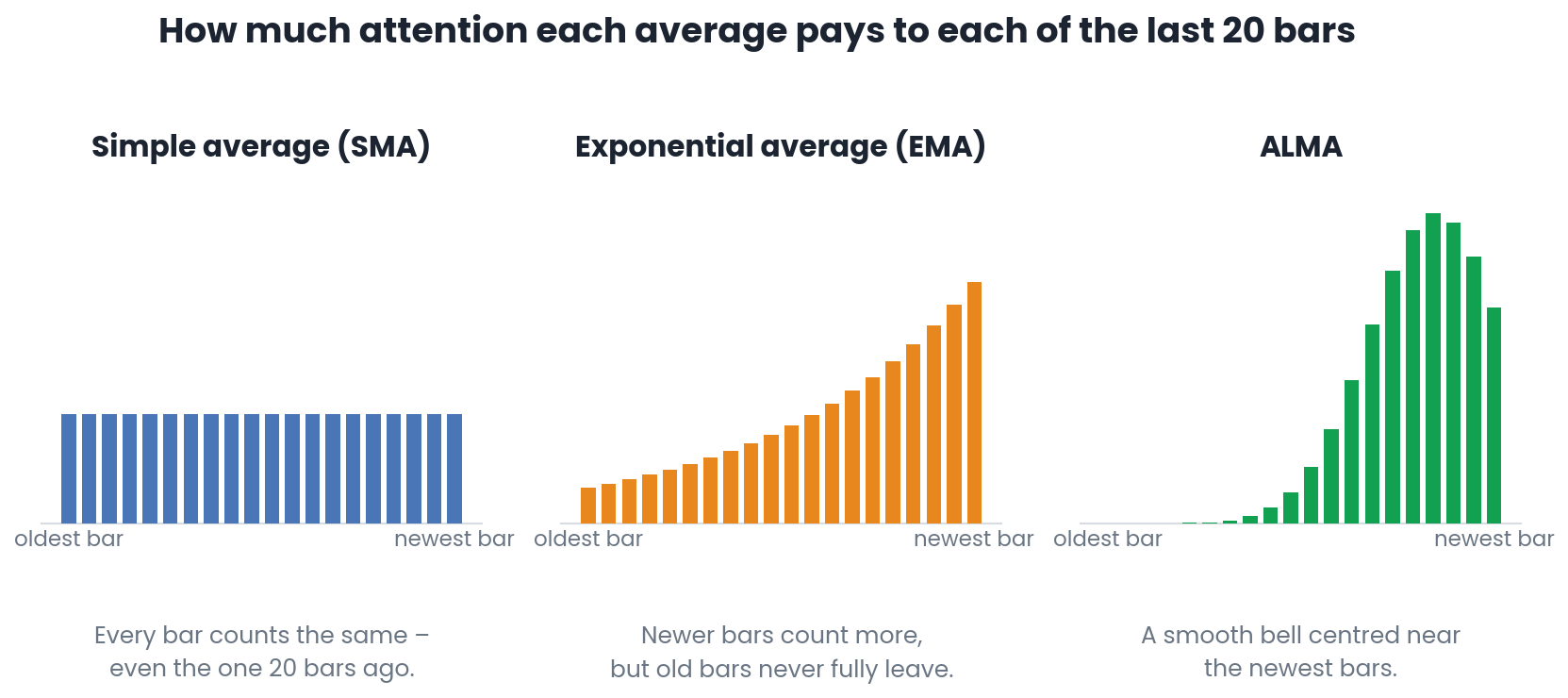
- SMA (simple) treats all 20 bars as equally important. The candle from 20 bars ago has exactly as much say as the one forming right now. That is why the SMA is smooth — and why it is slow.
- EMA (exponential) gives more weight to fresh bars and less to old ones. Faster, but it never truly forgets old prices, and it reacts nervously to single spikes.
- ALMA does something different. It puts a smooth bell over the last bars and places the top of that bell close to the newest candles.
That bell shape is the whole trick.
Why a bell works so well
Two things happen at the same time when you use a bell-shaped weighting.
One — the noise cancels out. Because the weights rise and fall smoothly, a single crazy spike never dominates the calculation. It gets absorbed by its neighbours. There are no sharp edges in the formula, so there are no sharp jumps in the line.
Two — the line stays close to the current price. The peak of the bell sits near the newest candles, so the average listens mostly to what is happening now, not to what happened 20 bars ago.
Classic averages could only do one of these. ALMA does both, and that is why traders often describe it as "smooth but not lazy".
ALMA has only two settings
You do not need mathematics to understand them. Both simply reshape the bell.
- Offset — where the bell sits. Push it towards the newest bar and the average reacts faster. Pull it back towards the middle and it becomes calmer and more conservative. The standard value is 0.85, which means "sit close to the fresh candles".
- Sigma — how wide the bell is. A wide bell spreads attention over many bars and gives an extra-smooth line. A narrow bell concentrates on a handful of bars and gives a sharper, twitchier one. The standard value is 6.
We ship ALMA with the classic 0.85 / 6 combination, so you can just select it and trade. There is nothing to tune before it works.
What this looks like on a real chart
Here is the moment that matters most to any trend trader: the top. All three lines below use exactly the same period — 20. The only difference is how they distribute their attention.
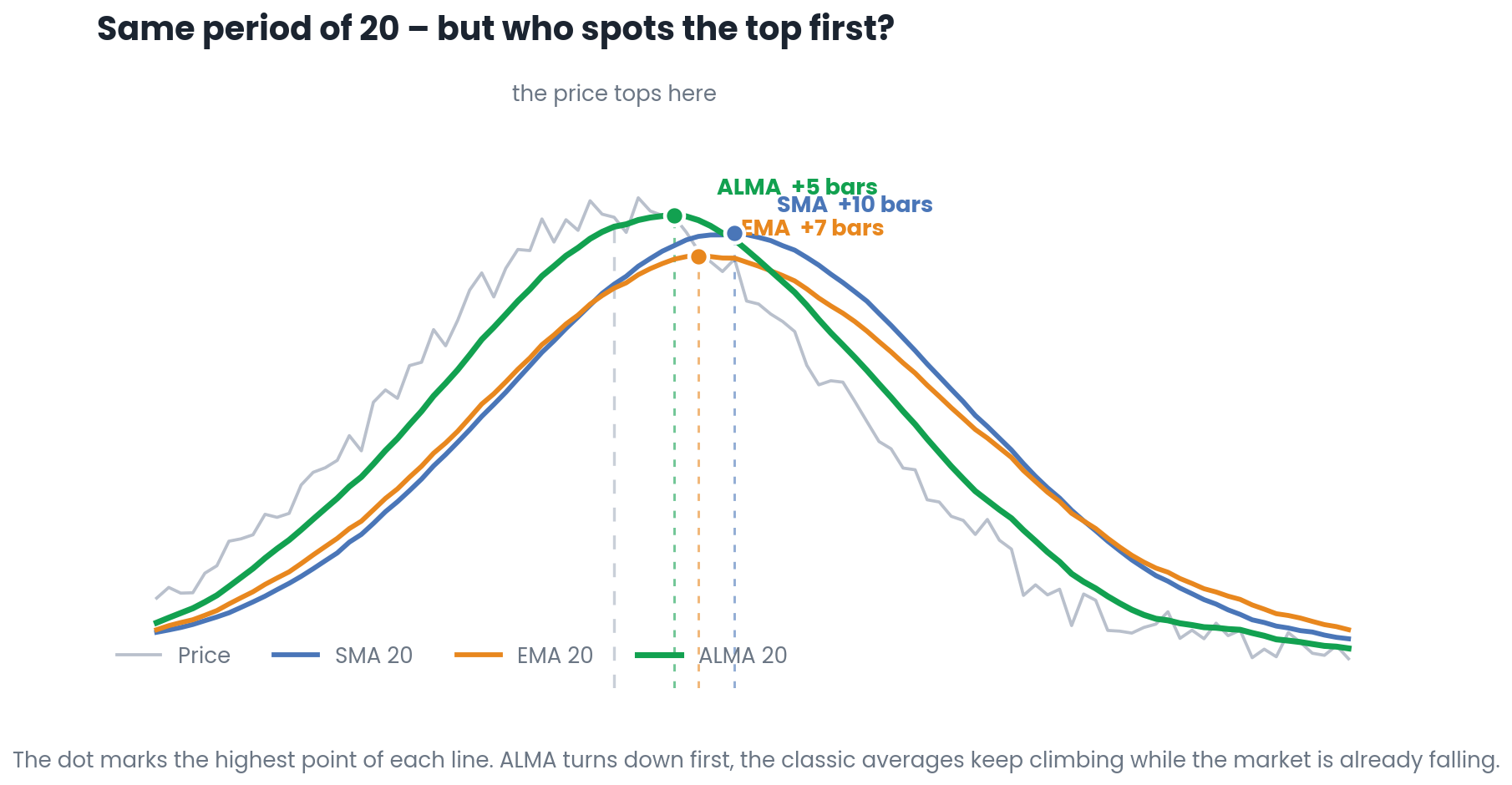
The market topped, and ALMA turned down five bars later. The EMA needed seven. The SMA kept climbing for ten bars while the market was already falling.
Five bars may not sound dramatic — until you remember that on an H1 chart that is five hours of a move, and on M5 it can be the difference between catching a leg and paying for it.
And what about the obvious objection: "sure, but a faster line is always noisier"? That is exactly what ALMA avoids. Below, ALMA 20 is compared with a fast EMA 7 — a setting chosen so that both react at roughly the same speed — during a quiet, directionless stretch of market.
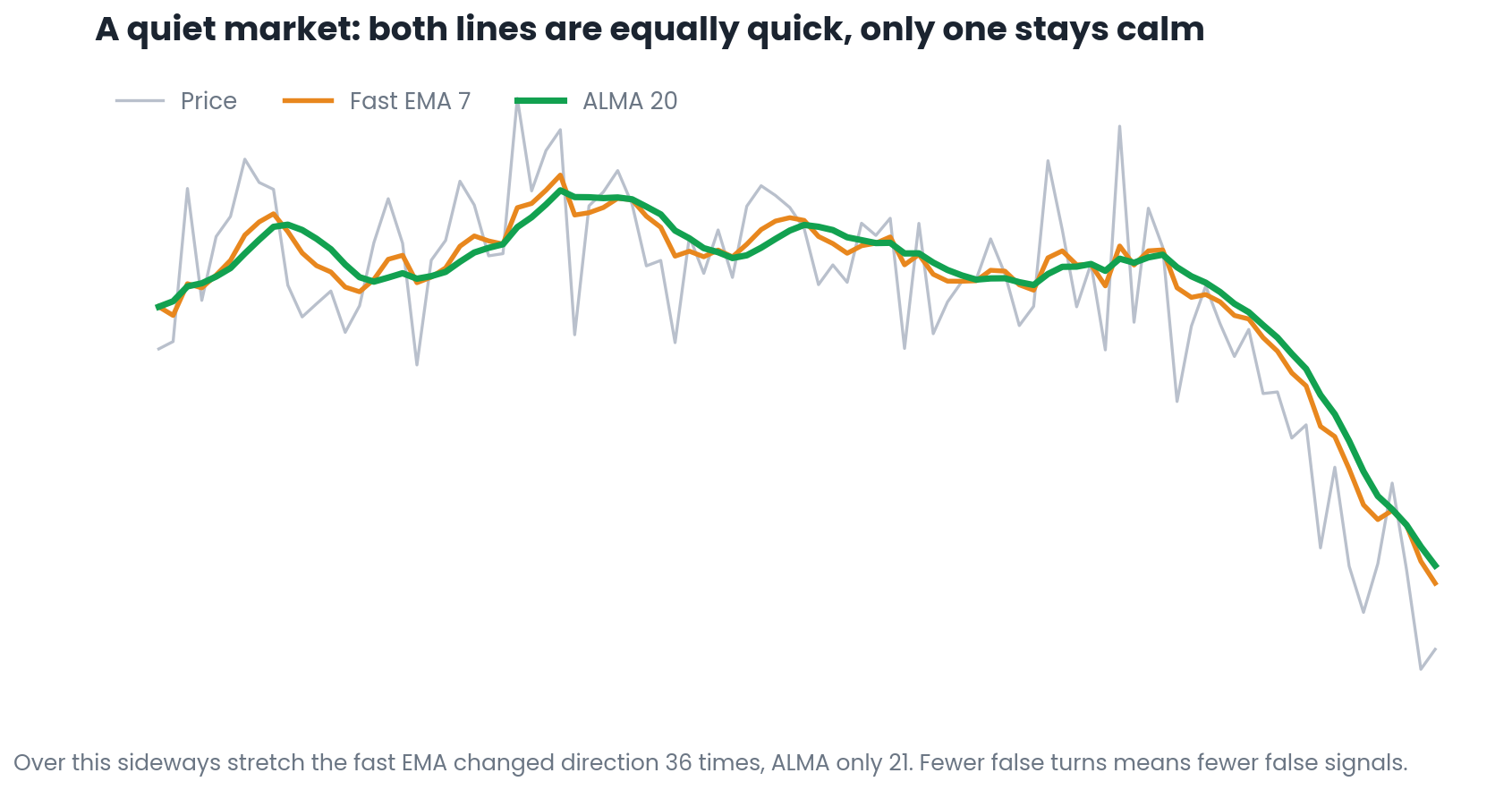
Same speed. One line wanders up and down constantly, the other keeps its composure. Every one of those extra wiggles is a potential false crossover, a potential alert at 3 a.m., and a potential losing trade.
Why this matters on currencies, stocks and metals
Different markets misbehave in different ways, and ALMA helps with all three flavours of trouble.
Currencies spend a large part of the day going nowhere, then move sharply on news. You need a line that ignores the aimless drift but wakes up quickly when the move starts. That is precisely the fast-but-calm combination ALMA is built for.
Stocks and indices open with gaps and spikes. A classic average carries an opening spike in its calculation for the entire period. ALMA's smooth weighting softens the impact of a single abnormal candle instead of letting it drag the line around.
Metals — gold and silver especially — trend beautifully but shake traders out with violent pullbacks. Here the value of ALMA is that it does not panic at every retracement, yet it still reverses early enough when the trend genuinely ends.
One honest note, because you deserve one: no moving average predicts the future. Not this one, not any other. What a good average does is tell you what is happening right now — sooner and with fewer false alarms. In trading, that head start is usually worth more than any prediction.
Using ALMA inside Moving Average Cross Signal
The indicator plots two moving averages and tells you when they cross. Set both of them to ALMA, and you get crossovers that arrive earlier and repeat themselves far less.
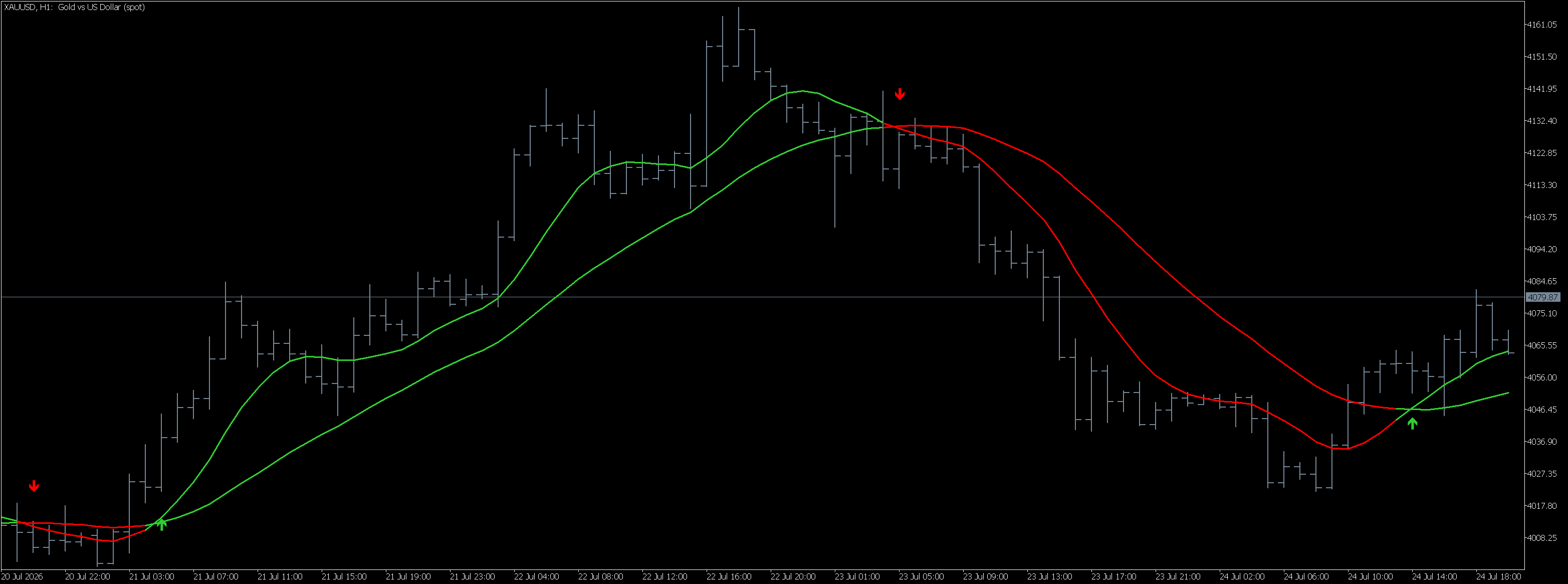
Everything else works exactly as before:
- an arrow appears on the chart at the crossing;
- the terminal beeps, sends a push notification to your phone and an e-mail;
- you get an early warning while the bar is still forming, and a confirmation once it closes;
- one signal per bar — no spam.
A good starting point for ALMA: fast 12, slow 40 on H1 for currencies and metals, or fast 9, slow 30 for faster intraday work. Then adjust to your own style and always test on history first.
Moving Average Cross Signal is completely free. More than ten smoothing methods, twelve price types, alerts on every channel, no repainting, and code fast enough to drop into your own Expert Advisor without restrictions.
👉 Download it here — free, for MetaTrader 5
If you try ALMA and find a combination of settings that works well for your instrument, tell me in the comments. The best ideas from users end up in the next update — that is how this indicator has been growing all along.
For the curious: the one line of maths
You can skip this part safely. ALMA weights every bar with the classic bell curve, w(i) = exp( -(i - m)² / 2s² ) , where m = Offset × (Period - 1) decides where the top of the bell sits and s = Period / Sigma decides how wide it is. The weights are then normalised so they add up to one. That is genuinely all there is to it — the elegance of ALMA is that such a simple idea solves such an old problem.