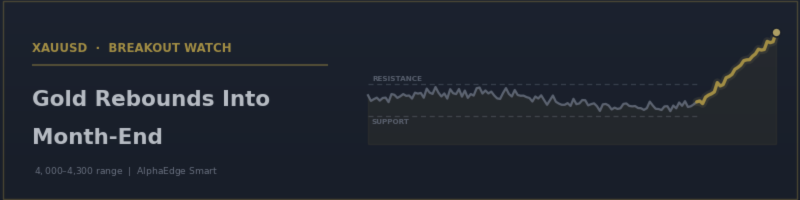
Gold Rebounds Into Month-End: Why a Tightening $4,000–$4,300 Range Is a Breakout Trader's Setup

Gold is closing July on the front foot, trading near $4,074 per ounce and heading for its first monthly gain in five months. After the Federal Reserve left rates unchanged at 3.75% this week, the metal drew support from a softer US dollar and lingering geopolitical risk, even as elevated Treasury yields kept a lid on any runaway move higher.
Step back and the bigger picture is one of consolidation. Gold has spent months working off the excesses of its January blow-off top near $5,597, correcting more than 25% and settling into a broad band roughly between $3,900 and $4,300. Support has repeatedly held around the $4,000–$4,040 zone, while the $4,300 area has capped rallies. Neither side has yet won the argument.
For a discretionary trader, a range like this can feel like dead time. For a systematic breakout approach, it is the opposite — it is the setup. Extended sideways action compresses volatility and stacks resting orders above resistance and below support. When one of those boundaries finally gives way, the release of that pressure is exactly the kind of directional impulse a breakout system is built to capture.
That is the core idea behind how AlphaEdge Smart trades XAUUSD. Rather than trying to predict which way gold breaks, the strategy waits for a decisive move through a level and positions to ride the follow-through, with a defined stop-loss and take-profit on every position. The edge is not a forecast — it is a repeatable, rules-based reaction to price actually breaking, applied only to gold.
What I am watching into next week:
- Support: the $4,038 / $4,011 zone, then the deeper $3,960 shelf. A clean break below opens room toward the lower end of the range.
- Resistance: $4,101 near-term, then the $4,300 ceiling that has repeatedly rejected rallies.
- Catalysts: US inflation data (PCE) and next Friday's payrolls, either of which can be the spark that resolves the range.
Whichever way it breaks, the plan does not change: let the level decide, react with defined risk, and manage the position by rules rather than opinion.
Past performance is not indicative of future results. Trading carries a substantial risk of loss and is not suitable for every investor. Nothing here is financial advice.