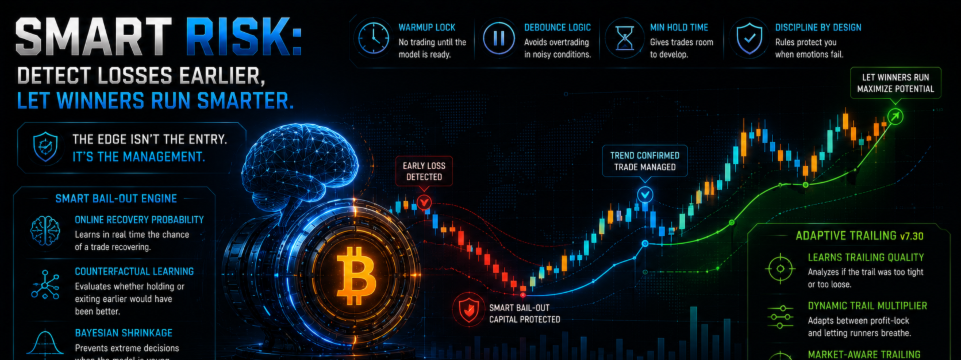
Smart Risk: Recognizing Losses Earlier, Letting Winners Run More Intelligently

Smart Risk: Recognizing Losses Earlier, Letting Winners Run More Intelligently
The entry gets you into the trade. Trade management decides whether you survive it. This single reframe separates institutional thinking from almost everything retail traders spend their time studying. Most trading education, and most trading bot marketing, obsesses over entries, the pattern, the indicator, the signal. Almost none of it seriously addresses the two decisions that actually determine long run survival, when to cut a struggling position before it fully deteriorates, and when to protect a winning position without strangling it before it has finished paying you. This article goes deep into exactly how ICONIC BTC AI+ handles both of these decisions, through two dedicated, verified learning systems, Smart Bail Out and Adaptive Trailing, walking through the actual mechanics, the actual parameters, and the actual reasoning behind every safeguard built into them.
Why Exit Management Is the Real Skill Almost Nobody Studies Seriously
Every trader has lived through the same two painful scenarios. A losing position gets held all the way to a full stop loss because the system had no genuine way to recognize the recovery odds had already collapsed long before the stop was actually hit. A winning position gets trailed so tightly that a completely normal pullback shakes it out minutes before the market resumes the exact move that would have paid out fully. Neither of these failures is an entry problem. The entry was fine in both cases. The failure lived entirely inside the management decision made after the position was already open, and this is precisely the layer where ICONIC BTC AI+ applies genuine, verified machine learning rather than a fixed, one size fits all rule.
Smart Bail Out: Learning the Actual Probability of Recovery
Here is how this system genuinely works, verified directly against its own parameters rather than described vaguely. Once a position moves into meaningful adverse territory, the engine begins tracking it as a potential candidate for early intervention, but it does not act immediately, and understanding exactly why it waits is the key to understanding why this system can be trusted at all.
The learning phase comes first, always. The model requires a minimum of thirty observed lessons, real, completed trades where the outcome from a similar adverse position is actually known, before it is ever permitted to cut a single trade early. Before that threshold is reached, the system simply cannot act on this mechanism at all, regardless of how a current position looks. This is a hard, structural guarantee against an undertrained model making consequential decisions on thin, unreliable evidence.
Once warmed up, evaluation still proceeds carefully. A position is not assessed continuously from the instant it drops into the red. Evaluation only begins after a minimum holding period of five minutes, specifically because a position only barely negative in its first few minutes often reflects nothing more than ordinary entry slippage or normal spread noise, not a genuine deteriorating setup. Once that window has passed, the model re evaluates recovery probability on a fixed sixty second cadence, not continuously on every tick, avoiding the kind of noisy, over reactive behavior that could otherwise cause needless flip flopping.
Bayesian Shrinkage, The Safeguard Against a Confidently Wrong Young Model
This is one of the most important and most frequently overlooked safeguards in the entire system. A model that has only observed a handful of genuinely similar situations can, by pure statistical chance, produce a raw probability estimate that looks confident but is actually built on far too little evidence to trust. Rather than acting directly on that raw number, every estimate is Bayesian shrunk toward a neutral fifty percent baseline, weighted by a defined pseudo lesson strength of twenty five. In plain terms, the model's estimate is deliberately pulled back toward genuine uncertainty in proportion to how little real evidence currently supports it, and only as accumulated lessons genuinely mount does the model's raw assessment gradually earn the right to be trusted more fully on its own. This single mechanism is precisely why the system does not swing toward extreme, overconfident cut decisions during its early operating life, exactly when an undisciplined learning system would be most dangerous.
Debounce and Confirmation, Refusing to Act on a Single Noisy Reading
Even once a position has cleared warmup, cleared the minimum holding period, and produced a shrunk probability estimate below the defined cut threshold, the system still does not act on that single reading alone. Two consecutive sub threshold evaluations, spaced across the sixty second cadence already described, are required before an early cut is actually triggered. This debounce requirement exists specifically to prevent the system from reacting to one momentarily pessimistic reading that might reverse on the very next evaluation, demanding genuine, sustained confirmation rather than a single noisy data point before ever intervening in a live position.
Walking Through a Single Evaluation Cycle From Start to Finish
It is worth tracing one complete cycle end to end, because the layered discipline only becomes fully clear when followed sequentially rather than described as isolated rules. A position opens and immediately moves into meaningful adverse territory. For the first five minutes, the system takes no action whatsoever regarding early exit, deliberately absorbing what is statistically far more likely to be entry slippage or normal noise than a genuine deteriorating setup. Once that window passes, and assuming the model has already cleared its thirty lesson warmup requirement from prior trading history, the first evaluation occurs, computing a raw recovery probability from current context. That raw number is immediately pulled toward fifty percent by the Bayesian shrinkage mechanism, in proportion to how much genuine historical evidence currently exists for a similar situation. If the resulting, shrunk estimate falls below the defined cut threshold, the system does not act yet, it simply notes one sub threshold reading and waits. Sixty seconds later, a second evaluation occurs. Only if this second reading also falls below the threshold does the debounce requirement clear, and only then does the system actually close the position early. Four separate, deliberate checkpoints, warmup, minimum hold, shrinkage, and confirmation, all had to align before a single early intervention occurred, precisely the layered caution a genuinely trustworthy learning system requires before it is ever allowed to override a position's original stop loss.
How Both Systems Work Together Across a Single Trade
Smart Bail Out and Adaptive Trailing are not two disconnected features bolted onto the same product. They govern opposite ends of the exact same underlying problem, and understanding how they interact across one position's actual lifetime clarifies why this matters as a complete system rather than two separate tricks. The moment a position opens, only Smart Bail Out is relevant, since the position has not yet moved favorably enough for trailing logic to activate at all. Should the position move immediately into adverse territory, Smart Bail Out governs the response entirely, following the layered evaluation sequence already described. Should the position instead move favorably, Adaptive Trailing takes over that role instead, continuously adjusting how tightly or loosely the position is protected as it develops. A single trade can, in principle, never touch either learning system if it moves cleanly to target without ever testing genuine adverse territory or triggering a meaningful pullback along the way. But for the far more common case, a trade that experiences real drawdown, real retracement, or both before it finally resolves, these two systems are what actually determine whether that resolution favors the account or quietly erodes it, working in sequence rather than isolation across the position's entire open duration.
Scenario A and B: Two Bots, One Deteriorating Trade
Picture a position moving meaningfully against its entry, the kind of drawdown every trader has stared at nervously more times than they would like to admit. A classical, rule based bot has exactly one option available to it, hold the position rigidly until the predetermined stop loss is finally hit, regardless of how the probability of genuine recovery has evolved in the meantime. There is no intermediate judgment available to it at all, only the original stop, waiting patiently to be triggered.
ICONIC BTC AI+, once genuinely warmed up on accumulated evidence, behaves differently. As the position crosses the minimum holding period, the engine begins genuinely assessing recovery probability, factoring in exactly the kind of context a discretionary trader would want to consider, current adverse excursion, trend alignment, and volatility regime, incorporated into the model's evaluation. If that shrunk, confirmed probability estimate genuinely falls below the defined threshold across two consecutive evaluations, the system closes the position early, converting what might otherwise have become a full, painful stop loss into a smaller, controlled loss instead. The classical bot's account absorbs the entire predetermined stop distance. The learning bot's account absorbs meaningfully less, specifically because it was built to ask a harder, more honest question than simply waiting for a fixed number to be reached.
Counterfactual Learning, Where the Model's Honesty Actually Comes From
This is the deepest and most important part of the entire mechanism, and it deserves to be understood precisely. Every single time a trade eventually closes, whether it was cut early, stopped out, or reached its target, the system looks backward and asks an honest, uncomfortable question about every earlier snapshot it took of that trade while it was still open. Would holding from that exact adverse point actually have produced a genuinely better outcome than cutting there, measured against a defined recovery margin. This margin matters specifically, the comparison is not simply whether price eventually crossed back to breakeven, it requires genuine, meaningful recovery beyond a defined threshold, ensuring the model is not rewarded for holding through adverse territory only to escape with a negligible, statistically insignificant improvement. This is counterfactual labeling, and it is what separates genuine learning from a fixed, hardcoded rule. If the position ultimately did recover meaningfully after a snapshot that looked bad in the moment, that snapshot becomes a lesson teaching the model to be less eager to cut in similar future situations. If the position continued deteriorating exactly as the pessimistic snapshot suggested, that snapshot reinforces the model's willingness to act. Over enough accumulated lessons, gated the entire time by the warmup and shrinkage safeguards already covered, the model's sense of genuine recovery probability becomes progressively more calibrated to what has actually, historically happened in comparable situations, not to a guess, and not to a fixed rule someone wrote once and never revisited.
Adaptive Trailing v7.30: Learning Whether Protection Was Too Tight or Too Loose
The mirror image problem receives the exact same rigorous treatment. A trailing stop that is too tight locks in profit reliably but repeatedly sacrifices larger moves by exiting during completely normal retracements inside an otherwise intact trend. A trailing stop that is too loose lets winners run further but gives back meaningfully more profit on the trades that do eventually reverse. Choosing one fixed trailing distance forever means accepting one of these two costs permanently, regardless of which specific trades would have actually benefited from the opposite choice.
Adaptive Trailing solves this by learning a dynamic multiplier applied to the base trailing parameters, ranging between a minimum of zero point seven five, the tightest setting, genuinely locking in profit defensively, and a maximum of one point four zero, the loosest setting, deliberately giving a genuine runner room to breathe rather than exiting prematurely. The system does not choose a fixed point between these two extremes and stay there. It learns, from real, accumulated evidence, which specific market conditions have actually favored a tighter multiplier and which have favored a looser one, and applies the appropriate setting dynamically as those conditions genuinely present themselves.
Scenario C and D: Two Bots, One Winning Trade Still Developing
Picture a position moving favorably, gaining genuine momentum, when a completely ordinary retracement occurs, the kind of pullback that happens inside almost every healthy trend without actually threatening the broader structure at all. A classical bot running a fixed, tight trailing stop closes the position immediately, converting what could have been a substantially larger win into a meaningfully smaller one, purely because its trailing logic had no way to distinguish a normal pullback from a genuine reversal.
Adaptive Trailing, informed by accumulated evidence about which conditions have actually favored looser protection, can widen its multiplier toward the one point four zero end of its range specifically when market structure and momentum genuinely support giving the position more room, allowing the retracement to occur without triggering an unnecessary exit, and letting the position continue capturing the larger move that was actually still developing underneath the temporary pullback. The classical bot's rigid trail converts a big win into a small one. The adaptive system's learned judgment lets the position breathe specifically when the evidence says breathing room is genuinely warranted, then tightens right back down toward zero point seven five once conditions actually shift toward genuinely protecting accumulated profit instead.
The Same Counterfactual Discipline Applied to Trailing
Adaptive Trailing learns through the identical honest, backward looking discipline as Smart Bail Out. Every time a position exits through its trailing stop without reaching its original target, the system records the exit context and continues genuinely watching what price actually did afterward. If price would have gone on to reach the original target anyway, that outcome teaches the model the trail was too tight in that specific context. If price would instead have reversed and hit the original stop level, that outcome teaches the model the tighter trail was actually the correct call. Neither lesson is trusted blindly and immediately. The same principle of requiring genuinely accumulated evidence before deviating meaningfully from a neutral default governs this learning process as well, ensuring the multiplier only moves confidently once real, demonstrated experience actually supports the move.
Thinking in Trade Lifecycles, Not Just Entries
ICONIC BTC AI+ does not think only in entries. It thinks in complete trade lifecycles, entry, protection, adjustment, exit, and learning, with every stage after the initial decision continuing to apply the same rigorous, evidence gated discipline rather than falling back on a single static rule the moment a position opens. This is precisely the difference between a system built to fire a signal and a system built to genuinely manage risk across the full duration a position remains open, a distinction almost invisible from the outside until you understand exactly what is happening underneath, and precisely the distinction that separates institutional grade thinking from the entry obsessed marketing that dominates most of this category.
Why This Matters More Than Almost Any Entry Refinement Ever Could
A marginally better entry technique improves outcomes at the margin. Genuinely intelligent exit management changes the entire shape of a system's return distribution, reducing the tail of catastrophic losses that never should have run all the way to a full stop, and extending the tail of genuine winners that never should have been cut short by an overly rigid trail. Over hundreds or thousands of trades, this compounds into a meaningfully different equity curve than an otherwise identical system relying purely on fixed, unadaptive exit rules, precisely why professional operations invest so heavily in this specific layer while retail attention remains almost entirely fixed on entries alone.
Consider the arithmetic honestly, using illustrative rather than guaranteed figures. If Smart Bail Out converts even a modest share of full stop losses into partial, controlled losses across a large sample of trades, the average loss size across the entire system shrinks directly, improving overall expectancy without requiring the entry logic to change even slightly. If Adaptive Trailing similarly allows even a modest share of prematurely trailed winners to instead reach a meaningfully larger portion of their original target, average win size grows the same way. Neither improvement depends on finding a better entry signal at all. Both depend entirely on refusing to treat every position identically once it is already open, extracting genuine additional expectancy from exactly the layer most competing systems never touch after the initial trigger fires.
Why This Intelligence Does Not Reset Every Time the Platform Restarts
A learning system that forgets everything it has accumulated every time a terminal restarts or a broker connection drops would be genuinely worthless in practice, regardless of how sound its underlying mechanics are in theory. Both Smart Bail Out and Adaptive Trailing rely on genuinely accumulated lessons, the thirty lesson warmup for bail out decisions, the growing evidence base informing the trailing multiplier, and that accumulated intelligence is persisted to disk rather than existing only in volatile memory. This means the system running after a week of live trading has genuinely more accumulated evidence behind its decisions than the system that was first attached to a chart, and a platform restart does not erase that progress and force the warmup clock back to zero. This detail matters enormously in practice, since it is precisely what separates a system that genuinely compounds its own experience over time from one that would otherwise reset to an undertrained, maximally cautious state every single time the terminal happened to restart.
Frequently Asked Questions
What is Smart Bail Out and how does it decide when to cut a losing trade early? An online learning system that estimates the probability of genuine recovery for a position in adverse territory, requiring a minimum of thirty observed lessons before acting at all, a five minute minimum holding period before evaluation begins, and two consecutive confirmed sub threshold readings before actually closing a position early.
What does Bayesian shrinkage actually protect against? It prevents an undertrained model from acting confidently on too little evidence, pulling raw probability estimates toward a neutral fifty percent baseline in proportion to how few genuine lessons currently support them, only allowing full confidence as real, accumulated evidence actually mounts.
How does Adaptive Trailing decide whether to trail tightly or loosely? Through a learned multiplier ranging between zero point seven five, the tightest, most defensive setting, and one point four zero, the loosest setting allowing genuine runners more room, adjusted dynamically based on accumulated evidence about which specific conditions have actually favored one extreme or the other.
What is counterfactual learning in this context? A backward looking evaluation process where the system asks, after a trade closes, whether an earlier decision to hold or cut, or to trail tighter or looser, would genuinely have produced a better outcome, converting every closed trade into a genuine lesson rather than treating each decision as isolated and unexamined.
Why does exit management matter more than entry refinement for long term results? Because genuinely intelligent exit management changes the entire shape of a system's return distribution, shortening catastrophic losses that never should have run to a full stop and extending genuine winners that never should have been cut short, compounding into a meaningfully different equity curve over hundreds of trades.
Do Smart Bail Out and Adaptive Trailing ever activate on the same trade? They govern opposite phases of a position's life, Smart Bail Out during adverse excursion, Adaptive Trailing during favorable movement, and a single trade that experiences both a drawdown and a subsequent recovery can genuinely be shaped by both systems across its full lifetime.
What stops these learning systems from making extreme decisions early in their operating life? A combination of hard warmup requirements before either system may act at all, Bayesian shrinkage pulling early estimates toward a neutral, cautious default, and debounce or confirmation requirements demanding sustained rather than single evidence before any meaningful intervention occurs.
ICONIC BTC AI+ Doesn't Think Only in Entries, It Thinks in Trade Lifecycles
Entry, protection, adjustment, exit, and learning, every single stage governed by the same rigorous, evidence gated discipline rather than a single static rule applied once and forgotten. This is what institutional grade trade management actually looks like, verified directly in working code rather than described vaguely in marketing copy.
Explore ICONIC BTC AI+ directly, or the complete ICONIC.FX ecosystem, at iconicfx.tech.
Risk Disclaimer. Trading foreign exchange, cryptocurrencies, commodities and other leveraged financial instruments carries a high level of risk and may not be suitable for all investors. The high degree of leverage can work against you as well as for you. Past performance is not indicative of future results. Automated trading systems and Expert Advisors do not guarantee profits and can produce losses. ICONIC.FX provides software tools only and does not provide investment advice, portfolio management or financial recommendations. You are solely responsible for your own trading decisions. Seek advice from an independent licensed financial advisor if you have any doubts.