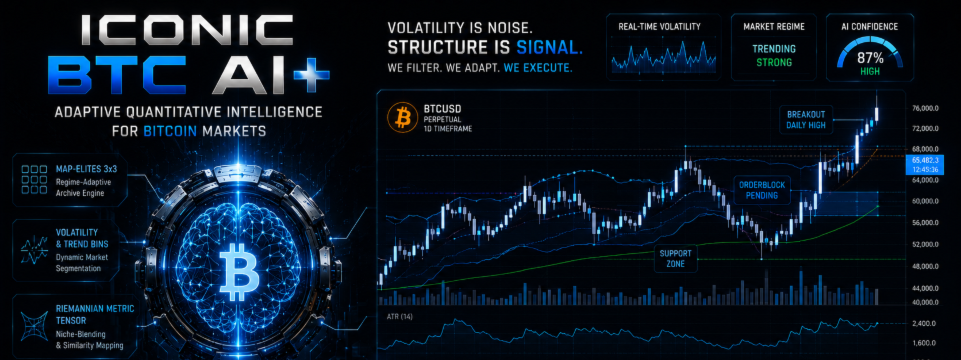

BTC Volatility as a Mathematically Filtered Opportunity
Picture a Bitcoin chart on any genuinely active session. Candles moving fast enough that a five minute absence from the screen means missing an entire structural move. A clean looking breakout that reverses within minutes, a fakeout designed, it seems, specifically to trigger every retail stop sitting just beyond the obvious level. A scheduled release, or sometimes no scheduled release at all, producing a violent spike that erases hours of orderly structure in seconds. Liquidity zones that look identical on the surface but behave completely differently depending on what is actually resting there. And, without warning, a volatility expansion that turns a calm session into a completely different market within a single candle.
Bitcoin is not the problem. Trying to trade this specific chaos with a simple signal machine is the problem. This is exactly why Bitcoin does not need a rigid bot executing one fixed rule regardless of context. It needs a system built to recognize volatility, trend structure and market regime, and to process every single candidate setup through a genuine filtering pipeline before ever committing real capital. This article walks through exactly that pipeline as implemented inside ICONIC BTC AI+, stage by stage, verified directly against its own working code.
The Difference Between a Signal Machine and a Quant Kernel
It is worth being precise about this distinction, because the language surrounding retail trading bots blurs it constantly. A signal machine watches for one specific condition, a crossover, a level touch, a candle pattern, and fires the instant that condition appears, with no genuine evaluation of the broader context surrounding it. It answers exactly one question, has the trigger fired, and nothing else. A quant kernel answers a fundamentally different, considerably harder question, given everything currently known about regime, trend quality, volatility, calibrated confidence and structural risk, does this specific candidate genuinely deserve capital right now. The first approach is cheap to build and easy to market, because a single trigger condition is simple to explain and simple to demonstrate in a short video. The second approach is expensive to build correctly, because it requires every one of those additional dimensions to be genuinely measured, calibrated and integrated rather than merely gestured at in a product description. ICONIC BTC AI+ was engineered as the second kind of system, and the six stage pipeline that follows exists specifically because Bitcoin's chaos punishes anything less.
Why Bitcoin's Chaos Demands a Filter Pipeline, Not a Signal Machine
A large share of what gets marketed as an intelligent trading bot is, underneath the label, a simple signal machine, one indicator crossing another, triggering an entry with no genuine layered evaluation behind it. This works, marginally, in a market with limited volatility and predictable structure. It does not survive Bitcoin, where the exact same crossover can mean something entirely different depending on current regime, current trend strength, current volatility, and current structural context. ICONIC BTC AI+ was engineered specifically around the opposite philosophy, not a single trigger, but a genuine sequential pipeline, Market Regime, then Trend Strength, then Volatility, then AI Confidence, then Risk Control, then finally an Entry Decision, where any single stage can reject a candidate setup regardless of how promising it looked at the stage before it.
Stage One: Market Regime, Reading Which Kind of Bitcoin You Are Actually Trading
Bitcoin does not behave as one consistent market. It behaves as several genuinely different markets taking turns, a strongly trending regime, a choppy, directionless regime, a high volatility expansion regime, each demanding a different response. Rather than forcing one universal strategy to handle all of them adequately, the engine maintains an in RAM MAP Elites archive structured as a three by three grid of specialist behavioral niches. Each niche represents a tuned response for a specific combination of trend character and volatility character, meaning the engine does not ask only whether a setup looks good in isolation, it asks which specific regime is currently active, and draws on the specialist elite genuinely suited to that regime rather than applying one compromised, average response to every condition indiscriminately.
The two axes defining this grid deserve to be understood specifically rather than treated as an abstract detail. One axis captures higher timeframe trend linearity, low, medium or high, the same R squared measurement covered in the next stage of this pipeline. The other axis captures current volatility character, again spanning low, medium and high bins derived from real time ATR readings rather than a static assumption. Nine possible combinations emerge from these two axes, a strongly trending, low volatility grind behaves nothing like a strongly trending, high volatility breakout, and treating them identically, as a single strategy inevitably must, discards genuinely useful information the archive is specifically built to preserve and act on instead.
When conditions shift, the engine transitions between these specialist niches through a genuine Riemannian metric tensor blending along geodesic distance, the mathematically correct notion of shortest path across a curved parameter space, ensuring the handoff between one regime specialist and another remains smooth and valid rather than a jarring, distorted jump between two incompatible behaviors.
Stage Two: Trend Strength, Quantifying Whether a Move Actually Deserves Trust
Not every directional move is a genuine trend, and treating every one as equally tradeable is precisely the mistake that destroys breakout systems during choppy conditions. The engine evaluates trend character through a one hundred period EMA on the hourly chart, establishing the strategic directional bias, combined with a trend linearity measurement, an R squared statistic computed over sixty bars of the higher timeframe. This is not a simple slope reading. R squared specifically quantifies how cleanly price has actually followed a directional path versus how much of the apparent move is genuinely just noise arranged to look directional by coincidence. A high reading confirms a market moving with real, orderly conviction. A low reading signals exactly the kind of disorderly churn that breaks naive breakout systems, and the engine treats that low reading as a genuine reason to withhold action rather than trading blindly on every level touch regardless of context.
How This Pipeline Specifically Defeats the Bitcoin Fakeout
The fakeout deserves its own dedicated treatment, because it is arguably the single most common way a naive breakout bot loses money on Bitcoin specifically. Price approaches an obvious level, pierces it convincingly enough to trigger every retail stop and every simple signal machine watching that exact price, and then reverses violently, leaving the naive system holding a fresh loss precisely at the moment liquidity was harvested from it. A single trigger condition, price crossed level, cannot distinguish a genuine breakout from this exact trap, because from the perspective of that one narrow question, they look identical in the first instant.
The pipeline described throughout this article defeats this specific trap precisely because it never asks only that one narrow question. Trend Strength asks whether the broader structure genuinely supported continuation before the level was even reached, a fakeout frequently occurs precisely during low R squared, disorderly conditions the trend stage is specifically built to flag. AI Confidence asks whether the engine's own long memory momentum read, incorporating genuine price history rather than the immediate tick, supports the move, and a fakeout's lack of real underlying conviction often shows up directly in a depressed confidence score even when the price action alone looks convincing. And even if a setup somehow clears both of these stages, ATR relative touch tolerance in the volatility stage prevents the engine from treating a marginal, barely qualifying touch the same as a genuinely decisive break. No single stage guarantees immunity to every fakeout that will ever occur, markets remain genuinely unpredictable, but stacking five independent questions before ever committing capital is precisely why this architecture survives a trap that reliably destroys single trigger systems.
Stage Three: Volatility, ATR Driven Adaptive Calibration Instead of Fixed Assumptions
A fixed stop distance or a fixed position size makes a silent, dangerous assumption, that current volatility resembles whatever volatility existed when that number was originally chosen. Bitcoin routinely violates that assumption within a single session. The engine instead calibrates dynamically against Average True Range at every stage of its decision process. Stop distance is calculated as a genuine function of current ATR rather than a static point value, meaning protection scales honestly with real, present conditions rather than a number calibrated for a different volatility regime entirely. Position sizing is derived from a defined percentage of account equity combined with that same ATR based stop distance, so that as volatility widens and the stop distance grows, position size mechanically shrinks to compensate, holding actual dollar risk consistent regardless of how wild or calm the market currently happens to be. Even the touch tolerance used to determine whether price has genuinely reached a breakout level is calculated relative to current ATR rather than a fixed point distance, ensuring trigger sensitivity scales correctly with Bitcoin's actual volatility instead of a number tuned for calmer conditions and never revisited.
Stage Four: AI Confidence, The Gate That Decides Whether a Setup Even Earns a Vote
This is where the engine's deeper perception genuinely earns its place in the pipeline. Momentum itself is measured through Grunwald Letnikov fractional calculus, a mathematical technique specifically designed to capture long memory, meaning the engine's read on acceleration and persistence incorporates a considerably richer sense of how past price behavior continues influencing the present than any conventional, fixed lookback indicator ever could. This long memory feature channel feeds directly into the engine's overall confidence assessment for the current setup, alongside its live perception of the active regime niche and current trend linearity.
The resulting confidence score is not decorative. It directly gates what happens next. When calibrated confidence falls below a defined threshold, the engine automatically shifts into a defensive posture, reducing position sizing rather than proceeding at full size on a conviction it does not genuinely hold. If confidence deteriorates further still, the engine can actively veto the setup entirely, a genuine, code level refusal to act on a candidate that might look structurally tempting on the surface but fails the engine's own internal judgment once its full perception, regime, trend quality, and long memory momentum, is properly weighed together.
Stage Five: Risk Control, The Structural Gate That Has No Opinion About How Exciting a Setup Looks
Even a setup that has cleared every prior stage still passes through a final, entirely mechanical layer of checks with no exceptions carved out for how promising anything appears. Live spread is measured against a defined maximum threshold, and a setup is rejected outright the moment spread conditions turn genuinely unfavorable, protecting against exactly the moments execution quality itself becomes the real risk. Range and volatility conditions are checked to ensure current structure genuinely supports a defined stop and target relationship rather than assuming favorable conditions by default. And account level drawdown state is monitored continuously, with the engine's own risk posture adjusting automatically as accumulated drawdown grows, rather than treating every trade as though the account were starting fresh regardless of recent history. None of these checks care how attractive a setup looked at any earlier stage of the pipeline. They exist specifically because a structurally sound idea executed under genuinely unfavorable conditions is not actually a good trade.
News Spikes and Liquidity Zones, Two More Faces of the Same Chaos
A sudden news driven spike and a deceptively calm looking liquidity zone are, from the pipeline's perspective, simply two more forms of the same underlying problem, current conditions that a fixed, unadaptive system cannot correctly interpret. A violent, news driven spike almost always registers as a genuine volatility regime shift, which the Market Regime and Volatility stages are specifically built to recognize and respond to, scaling risk down and demanding stronger confirmation rather than treating a sudden five times normal range candle the same as an ordinary one. A liquidity zone that looks like clean, tradeable structure on the surface but is actually a concentration point other participants are specifically defending or attacking is exactly what the combination of trend linearity and calibrated confidence is built to see through, since genuine structural conviction and a purely mechanical liquidity grab tend to leave measurably different signatures once evaluated across multiple independent dimensions rather than judged on price alone.
Stage Six: Entry Decision, Breakout Logic Built on Real Structure, Not Arbitrary Levels
Only after clearing every stage above does the engine actually consider where to place a trade, and even here it does not chase price after the fact. It prepares in advance by placing pending stop orders directly at genuinely significant levels, so the position triggers at the breakout itself rather than seconds later at a worse price once the move has already run. Three distinct classes of structural level feed this process. Daily and previous day high and low levels represent genuine liquidity concentration points, where stop orders naturally cluster and institutional interest tends to gather. Support and resistance levels are identified by scanning a meaningful window of recent price history for zones where the market has repeatedly reacted. And order block levels are identified over a shorter, more recent lookback, marking the footprints of concentrated buying or selling pressure. When multiple levels sit too close together, a deconfliction process prevents redundant, stacked orders sitting at effectively the same price, and the entire pending structure is refreshed at regular intervals through a smart re arm process, ensuring the levels actually being traded reflect current market structure rather than a stale calibration from hours earlier.
Why the Pending Structure Itself Has to Keep Adapting
This last point deserves more attention than it typically receives, because it exposes another quiet failure mode in naive systems. A bot that calculates its structural levels once at startup and never revisits them is trading against a map of the market that grows more outdated by the hour, particularly on an instrument that moves as fast as Bitcoin. A support level identified during a quiet overnight session may hold no genuine relevance twelve hours later once a completely different volatility regime has taken over. Smart re arm addresses this directly, periodically refreshing the pending order structure so the specific levels the engine is actually watching reflect current, recent price behavior rather than a snapshot from a market that no longer exists. Combined with the deconfliction logic preventing redundant orders from stacking at effectively the same price, this ensures the entry stage of the pipeline is always evaluating genuinely current structure, not a fossilized map drawn hours before conditions changed underneath it.
What Happens After Entry, The Same Filtering Philosophy Continues
The pipeline does not end the moment a position opens. An epigenetic methylation gate can freeze the engine's own learning process during choppy conditions or an accelerating drawdown, preventing it from absorbing misleading lessons during exactly the periods markets are least trustworthy to learn from. A dedicated Smart Bail Out system applies a genuinely trained model, gated by strict warmup and statistical discipline, to decide whether a struggling position genuinely deserves an early cut. A separate Adaptive Trailing system applies the same rigor to deciding how tightly a winning position should be protected. Trade management, in this architecture, is not an afterthought bolted onto entry logic. It is the same filtering discipline, continuously applied for as long as the position remains open.
The Complete Pipeline, Walked Through With a Single Example
Consider a concrete scenario to see the entire pipeline working together rather than as six abstract stages. Price approaches a well defined previous day high, the kind of level a naive bot would trigger on immediately. Market Regime first identifies whether the current specialist niche genuinely favors breakout continuation or reversal behavior at this moment. Trend Strength then checks whether the broader hourly structure shows a genuinely clean, high R squared directional read, or whether recent price action has actually been disorderly chop dressed up as a trend. Volatility calibrates exactly how far price needs to move beyond that level, relative to current ATR, before the touch is even considered genuine rather than noise. AI Confidence weighs the engine's long memory momentum read alongside everything gathered so far, and can veto the entire setup here if its own internal judgment does not support it, regardless of how clean the level looked. Risk Control checks live spread, range conditions and current drawdown state, capable of rejecting the trade even if every prior stage approved it. Only if a candidate setup survives every single one of these stages does an Entry Decision actually place a pending order at that previous day high, with a stop and target already calculated from current, real time volatility rather than a fixed assumption. A naive bot would have simply bought the level the moment price touched it. This engine asks six separate, genuinely independent questions first.
Why Six Sequential Filters Compound Rather Than Simply Add Up
It is worth understanding precisely why this architecture is so much more selective than the sum of its individual parts might suggest. Each stage in the pipeline does not merely subtract a small, fixed percentage of candidates independently. Because every stage must be cleared in sequence, the probability of a genuinely weak setup surviving the entire chain compounds multiplicatively rather than additively. A setup with even a moderate weakness at two or three separate stages, a slightly unclear regime read, a mediocre trend linearity score, an average confidence level, is considerably more likely to be rejected somewhere along the pipeline than a setup that is genuinely strong across every dimension simultaneously. This is precisely the mathematical property that makes the difference between a system that occasionally trades and a system that only trades when multiple, genuinely independent lines of evidence align. A single trigger signal machine has no equivalent property at all, it either fires or it does not, with no accumulating weight of evidence behind that single binary decision.
Frequently Asked Questions
Why does ICONIC BTC AI+ use a multi stage filtering pipeline instead of a single entry signal? Because Bitcoin's chaotic character means the same price action can represent genuinely different opportunities depending on current regime, trend quality and volatility, and a single fixed trigger cannot distinguish between them the way a layered, sequential evaluation can.
What does the Market Regime stage actually check? It identifies which specialist behavioral niche, drawn from an in RAM MAP Elites archive tuned across different trend and volatility combinations, genuinely matches current conditions, rather than applying one compromised, average strategy regardless of context.
How does the engine measure whether a trend is genuine or just noise? Through an R squared trend linearity statistic computed over the higher timeframe, quantifying how cleanly price has actually followed a directional path rather than merely noting that price ended up somewhere directional.
Can the AI actually refuse to take a trade that looks structurally valid? Yes. When calibrated confidence, incorporating long memory momentum, regime state and trend quality together, falls below a defined threshold, the engine can veto the setup entirely rather than proceeding on a conviction it does not genuinely hold.
Does the filtering process stop once a trade is opened? No. Dedicated systems continue applying disciplined, statistically gated logic to whether a losing position deserves an early cut and how tightly a winning position should be trailed, with learning itself paused during genuinely dangerous conditions through an epigenetic methylation gate.
ICONIC BTC AI+ Was Not Built to Chase Every Move
It was built to filter Bitcoin's setups through an adaptive quant system, Market Regime, Trend Strength, Volatility, AI Confidence, Risk Control, and only then an Entry Decision, rejecting far more candidates than it ever accepts, precisely because the market it trades punishes anything less than genuine, layered discipline. This is not a buy and sell signal machine wearing a sophisticated label. It is a regime adaptive quant kernel built specifically for the one market it was designed to survive.
Explore ICONIC BTC AI+ directly, or the complete ICONIC.FX ecosystem, at iconicfx.tech.
Risk Disclaimer. Trading foreign exchange, cryptocurrencies, commodities and other leveraged financial instruments carries a high level of risk and may not be suitable for all investors. The high degree of leverage can work against you as well as for you. Past performance is not indicative of future results. Automated trading systems and Expert Advisors do not guarantee profits and can produce losses. ICONIC.FX provides software tools only and does not provide investment advice, portfolio management or financial recommendations. You are solely responsible for your own trading decisions. Seek advice from an independent licensed financial advisor if you have any doubts.