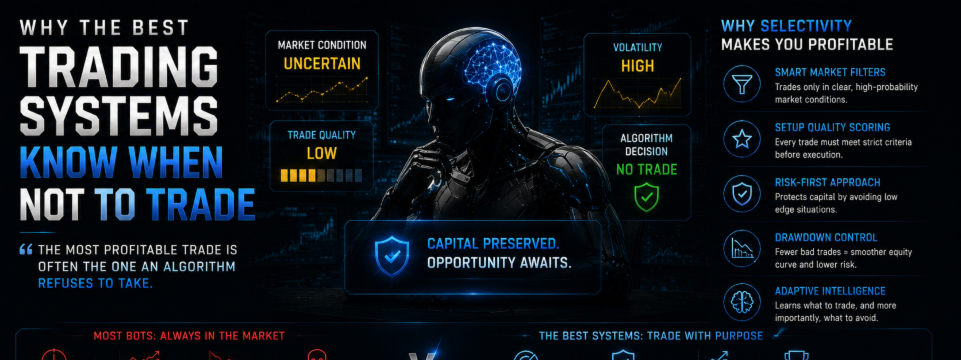

Why the Best Trading Systems Know When Not to Trade
The most profitable trade is often the one an algorithm refuses to take. Most traders, and uncomfortably many bot developers, still operate on an unspoken assumption worth naming directly, that a system sitting idle is a system wasting opportunity. This assumption is false, and understanding precisely why is what separates genuinely professional selectivity from the illusion of productivity that constant activity provides.
Part One: The Myth That More Trades Means More Opportunity
A market offers a continuous stream of price action, but it does not offer a continuous stream of genuinely favorable setups. Treating every tick as an opportunity to be captured, rather than recognizing that the overwhelming majority of moments contain no statistically meaningful edge at all, is precisely the mistake that separates a disciplined system from an overactive one. Activity is not the same thing as opportunity, and confusing the two is one of the most expensive, least examined assumptions in all of retail trading.
Part Two: The Hidden Cost of a Mediocre Trade Taken Just to Stay Active
Every single trade carries real transaction costs, spread and commission, regardless of whether it ultimately wins or loses. A trade taken purely to maintain a sense of activity, without genuine statistical justification, does not merely fail to add value on average, it directly dilutes the aggregate expectancy built by the system's genuinely good decisions. A system with a strong, positive expectancy on its best setups can watch that edge quietly erode trade by trade if a meaningful share of its overall activity consists of marginal or negative expectancy positions taken simply because the system was unwilling to sit still.
Part Three: The Opportunity Cost of Capital Tied Up in a Mediocre Position
Here is the argument almost nobody makes, and it deserves real attention because it reframes selectivity entirely. Capital and risk budget committed to a mediocre position are capital and risk budget genuinely unavailable the moment a truly excellent setup appears immediately afterward. A system that trades indiscriminately does not merely accept some bad trades alongside its good ones, it can literally miss its own best opportunities because it is already committed elsewhere to something inferior. Selectivity is not only about avoiding losses. It is about preserving the capacity to fully capitalize on the rare, genuinely high quality setups that matter most, precisely the setups an overactive system has often already spent its available risk budget on something worse.
Part Four: The Human Bias Toward Action, and the Genuine Advantage Automation Holds Here
Behavioral research describes a well documented tendency called action bias, the discomfort humans feel with inaction, even when inaction is the statistically correct choice, driving a persistent urge to do something rather than nothing. This bias explains an enormous share of retail overtrading, not a lack of knowledge about proper selectivity, but a genuine, uncomfortable psychological pull toward activity that has nothing to do with whether activity is actually justified in that moment. This is precisely where a properly engineered automated system holds a real, structural advantage that has nothing to do with speed or computation. It simply does not experience the discomfort of sitting idle, and can therefore apply genuine selectivity with total consistency, in a way no human, however disciplined, can sustain indefinitely against their own wired in psychology.
Part Five: What Genuine Selectivity Actually Looks Like in Engineering
ICONIC TITAN AI demonstrates this principle directly, gating every potential signal through multiple simultaneous probability thresholds, a minimum estimated likelihood of reaching the first target and a maximum tolerated probability of hitting the stop, together, before ever surfacing an alert. Silence is treated as a legitimate, disciplined output in its own right, not a failure to perform. ICONIC BTC AI+ and ICONIC GOLD AI+ apply the same underlying philosophy through trend linearity and ATR distance filters that actively withhold action during genuinely disorderly conditions rather than trading blindly on every level touch. The flagship ICONIC KYBERNETIC AI+ extends this further still, its regime buckets can close themselves entirely based on accumulated evidence of real, demonstrated poor performance in specific conditions, actively choosing not to trade a given regime rather than continuing regardless of mounting evidence that doing so no longer makes sense.
Part Six: Genuine Selectivity Versus Fake Selectivity
Not all restraint is created equal, and this distinction matters when evaluating any system. Fake selectivity is an arbitrary, unprincipled restriction, trading only within a fixed clock window for no statistically grounded reason, that happens to reduce trade frequency without any genuine connection to setup quality. Genuine selectivity is grounded in measurable, inspectable criteria, calibrated probability thresholds, quantified trend quality, accumulated evidence of real profitability in specific conditions, criteria you can actually examine and validate rather than simply trust on faith. A system that trades rarely is not automatically disciplined. A system that trades rarely for reasons you can verify and understand genuinely is.
Frequently Asked Questions
Why is a trading system that trades less often not automatically wasting opportunity? Because the market offers continuous price action but not continuous genuine opportunity, and capital committed to a mediocre trade is capital unavailable the moment a genuinely excellent setup appears, meaning excessive activity can directly cause a system to miss its own best opportunities.
How does a low quality trade hurt overall performance even if it does not lose money? Every trade carries real transaction costs regardless of outcome, and a marginal or negative expectancy trade taken purely to stay active dilutes the aggregate expectancy built by the system's genuinely strong decisions.
Why do humans struggle with disciplined selectivity more than automated systems? Action bias, a well documented psychological tendency, creates genuine discomfort with inaction even when inaction is statistically correct, driving overtrading that has nothing to do with a lack of knowledge and everything to do with an uncomfortable, persistent pull toward doing something.
How can you tell genuine selectivity apart from a system that simply trades infrequently? Genuine selectivity is grounded in measurable, inspectable criteria such as calibrated probability thresholds or quantified trend quality. Fake selectivity is an arbitrary restriction with no genuine statistical connection to setup quality.
Silence Is a Strategy, Not a Failure to Perform
The best trading systems are not the ones that never stop moving. They are the ones disciplined enough to recognize the overwhelming majority of moments do not deserve their capital, and structurally built to say so without hesitation, without discomfort, and without the human urge to manufacture activity where none is genuinely justified.
Explore systems built around exactly this disciplined selectivity, including ICONIC TITAN AI, ICONIC BTC AI+, ICONIC GOLD AI+ and the flagship ICONIC KYBERNETIC AI+, at iconicfx.tech.
Risk Disclaimer. Trading foreign exchange, cryptocurrencies, commodities and other leveraged financial instruments carries a high level of risk and may not be suitable for all investors. The high degree of leverage can work against you as well as for you. Past performance is not indicative of future results. Automated trading systems, indicators and Expert Advisors do not guarantee profits and can produce losses. ICONIC.FX provides software tools only and does not provide investment advice, portfolio management or financial recommendations. You are solely responsible for your own trading decisions. Seek advice from an independent licensed financial advisor if you have any doubts.