
Why Most Trading Robots Fail Within Six Months
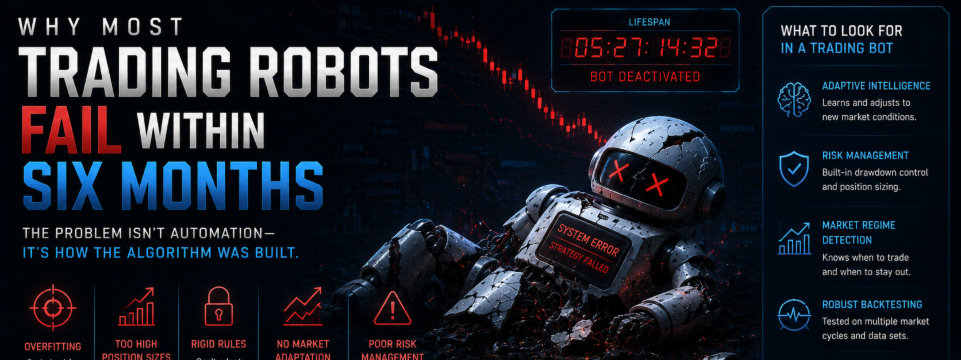
The problem is not automation, it is how the algorithm was built. This is not a coincidence or a superstition traders have simply noticed anecdotally. The six month failure window has a genuine, explainable statistical basis, and understanding exactly why failure clusters at this specific point, rather than immediately or years later, is what actually protects you from deploying the next system destined to join the pattern.
Part One: Why Six Months Specifically, Not One Month and Not Two Years
Early performance, the first several weeks of any system's live operation, is dominated by small sample variance rather than genuine statistical signal. Over a handful of trades, a fundamentally flawed system and a genuinely sound one can look nearly identical purely by chance, since noise has not yet had enough opportunity to average out. By roughly six months, a moderately active system has typically accumulated enough trades for the law of large numbers to begin dominating over that early noise, meaning the system's true underlying statistical character, whether genuinely sound or fundamentally flawed, finally starts to reveal itself honestly. This is also, not coincidentally, roughly the timeframe over which markets commonly experience at least one genuine shift in character, and the same window in which a large enough number of trades has typically accumulated for a statistically unlucky, but entirely normal, losing sequence to actually occur. Six months is not a magic number. It is simply the point where accumulated trades and accumulated market drift together stop letting flaws hide behind small sample luck.
Part Two: Overfitting, The Flaw That Only Reveals Itself Once History Stops Repeating
An overfit system, tuned too precisely to a specific historical dataset, often performs well immediately after deployment, simply because early live conditions frequently still resemble the recent historical window the system was calibrated against. The failure becomes undeniable only once genuine market conditions diverge meaningfully from that original calibration window, and given typical regime persistence, that divergence often takes a few months to fully materialize, precisely the timeframe this failure pattern keeps appearing within.
Part Three: Oversized Positions, The Mistake That Needs an Unlucky Sequence to Reveal Itself
Oversized position sizing rarely fails on the very first trade. It specifically requires a genuinely adverse sequence, a realistic losing streak that any system, however sound, will eventually experience, to expose the underlying danger. The statistical probability of encountering at least one meaningfully adverse sequence rises directly with the number of trades accumulated, meaning this is fundamentally a when, not an if problem, and a period of several months is often exactly enough accumulated trade volume for that inevitable sequence to finally arrive and expose sizing that was never sustainable in the first place.
Part Four: Rigid Rules, The Mistake That Needs a Genuine Regime Change to Reveal Itself
A rigid, non adaptive rule set does not fail because its underlying logic is wrong in some absolute sense. It fails because market regimes genuinely shift over time, and most markets do not hold the exact same statistical character uninterrupted for a full year. A genuine regime change occurring within a several month window is common enough that a system with zero capacity to notice or adapt to that shift is likely to encounter one well before reaching its first full year of live operation.
Part Five: No Adaptation to Market Conditions, The Meta Mistake That Turns the Other Three Fatal
This is the mistake that actually unifies the other three, and understanding it precisely is the real insight this article is building toward. A system could, in principle, survive an occasional overfitting artifact, an unlucky losing sequence, or a genuine regime shift, if it possessed real mechanisms to detect and adapt to these events as they actually happen. The absence of any such mechanism is what converts a survivable rough patch into a terminal one. It is not overfitting alone, not oversized risk alone, and not rigid rules alone that typically kills a system within six months. It is the complete absence of any capacity to notice these problems occurring and correct course before the damage compounds beyond recovery.
Part Six: What to Actually Look for When Choosing a Trading Bot
Given everything explained above, the evaluation questions that actually matter become clear and specific rather than vague.
- Ask how the strategy was validated. Genuine out of sample or walk forward testing, not a single flattering historical backtest, directly addresses the overfitting risk covered in Part Two.
- Ask about position sizing philosophy and real maximum drawdown history. A system with disciplined, percentage based sizing and a genuinely survivable maximum drawdown has already been tested against the adverse sequence risk covered in Part Three.
- Ask whether the system genuinely recognizes different market conditions. Quantifiable regime awareness, not a vague claim of intelligence, is the direct answer to the rigid rules problem covered in Part Four.
- Ask whether the system continues learning after deployment. This is the single most important question of all, since it directly addresses the meta mistake covered in Part Five, the actual mechanism that determines whether the other three risks get caught in time or compound silently until the six month mark arrives.
How This Standard Shows Up in Real Architecture
ICONIC BTC AI+ and ICONIC GOLD AI+ address overfitting through continuously adaptive neural architecture rather than a single frozen calibration, address oversized risk through ATR adaptive sizing paired with an absolute point cap, and address rigid rules through genuine trend linearity gating that adjusts trade eligibility to real, current conditions. The flagship ICONIC KYBERNETIC AI+ answers the meta mistake most directly of all, its self calibrating confidence gate and continuously updated regime tracking mean the system is structurally built to notice drift and adapt to it, precisely the mechanism whose absence is what actually kills most trading robots within their first six months.
Frequently Asked Questions
Why do so many trading bots specifically fail around the six month mark? Early performance is dominated by small sample noise that can mask genuine flaws. By roughly six months, enough trades have typically accumulated for the true statistical character of a system to reveal itself, coinciding with the timeframe over which genuine market regime shifts and statistically inevitable losing sequences commonly occur.
Is overfitting the main reason trading robots fail? It is one of four interlocking causes, alongside oversized position sizing, rigid non adaptive rules, and, most importantly, the absence of any mechanism to detect and adapt to these problems once they begin appearing.
What is the single most important question to ask before trusting any trading bot? Whether the system continues genuinely learning and adapting after deployment, since this directly determines whether the other common failure modes get caught and corrected in time or are allowed to compound silently until the damage becomes irreversible.
Can a well built system avoid the six month failure pattern entirely? Yes, specifically through genuine regime awareness, disciplined and adaptive risk sizing, rigorous out of sample validation, and continuous online learning that keeps the system honestly calibrated against live, current conditions rather than a single historical snapshot.
The Robots That Survive Were Built to Notice They Are Wrong
Automation was never the problem. A system built without genuine adaptation, validated on a single flattering backtest, and sized without regard for the statistically inevitable losing sequence, was destined to fail from the moment it was deployed, the six month mark is simply when accumulated evidence finally makes that destiny undeniable.
Explore systems engineered specifically to avoid this entire failure pattern, including ICONIC BTC AI+, ICONIC GOLD AI+ and the flagship ICONIC KYBERNETIC AI+, at iconicfx.tech.
Risk Disclaimer. Trading foreign exchange, cryptocurrencies, commodities and other leveraged financial instruments carries a high level of risk and may not be suitable for all investors. The high degree of leverage can work against you as well as for you. Past performance is not indicative of future results. Automated trading systems and Expert Advisors do not guarantee profits and can produce losses. Backtests and simulated results have inherent limitations and do not represent actual trading. ICONIC.FX provides software tools only and does not provide investment advice, portfolio management or financial recommendations. You are solely responsible for your own trading decisions. Seek advice from an independent licensed financial advisor if you have any doubts.