Trading Without Magic: A Developer’s And Trader’s Honest View On “Holy Grails” And Reality


Just to be clear from the start. This article is about a real, honest trading perspective. Over the years I have seen the same misunderstandings repeat again and again, so I thought it would be useful to put everything into one article with both practical notes and real chart examples.
If you are only here for the practical side, feel free to scroll down to the technical part. But I still think the mindset part matters, because a lot of trading mistakes don’t come from the tool itself, they come from unrealistic expectations.
A Few Words About “Holy Grails” And Expectations
Let me be honest with you.
I have been in the market since 2004, so more than 22 years now, and just like everyone else I had my ups and downs. Along the way I wrote a lot of algorithms. Most of them were not made for sale, but for myself, close friends and some bigger private clients. With time you start to value experience more and more – your own and the experience of mentors who helped you along the way.
In the beginning I was also looking for a “holy grail”. It felt like I was always one step away from building a system where almost every single trade would be a winner. There was a very intense period that I would never try to repeat, because the stress level was insane and the nerves you lose along the way are just not worth it.
With experience you realize something simple: there is no holy grail. What really matters is discipline and consistency instead of chaos and overtrading.
So when I see reviews full of impatience and hunger for fast profits, I often remember myself 15–20 years ago. I also used to suffer emotionally from every losing trade. I asked myself: “How can I be so smart and still take a loss? This should not happen.” But that is just ego talking, and the market does not forgive ego for very long.
I often tell my clients and friends: we are all different. The same strategy can be totally wrong for one person and fit perfectly into the toolbox of another. And that is absolutely fine. The world would be extremely boring if we all traded the same way, behaved the same way and had the same risk tolerance.

Why Good Reviews Are Rare And Bad Reviews Come Fast
There is another funny feature: writing a good review is harder and usually happens “later”. People are busy, they trade, they live their lives. If everything works, there is no urgent reason to sit down and write a long positive comment.
But if, God forbid, one arrow appears “in the wrong place” in someone’s eyes, then suddenly there is a lot of motivation to write something like:
“Developer doesn’t understand trading at all and codes like a monkey.”
By the way, dear hypothetical monkey – no offense, this is just a metaphor 🙂
I don’t want to brag, but I’ll be honest: I have been around trading in one way or another for 22 years. I’ve seen a lot and tested countless systems, indicators and expert advisors. At this point I can clearly see where pure scam starts.
You can notice it yourself even in the top of marketplaces. Some products don’t even let you properly test anything on history, but thanks to bought reviews they “explode” and jump above really strong work. And by strong work I don’t only mean my own tools. There are quite a few serious developers who build solid products, not “one day” tools designed just to grab quick money and disappear. These people support their products and spend time answering real questions.
As for myself, I always feel responsible for my products and actively support them. I answer questions, I explain things when something is unclear or complex. That’s actually one of the reasons why I don’t have 60 products in my portfolio. Maintaining 60 real products is simply not possible. Even supporting several serious projects already takes a lot of energy. Anyone who has really developed something professionally will understand: even one product can consume plenty of time and effort.
And this is exactly why I never really understand people who give 1 star without even trying to read the manual or ask a single question.
Why You Shouldn’t Waste Your Life On “Holy Grails”
So why am I writing all this?
Guys, please don’t waste your life searching for a holy grail. You will just spend your time chasing an illusion while you could use that same time to grow as a trader or as a developer. Or as both.
One more problem with “holy grails” is that they are always temporary. Remember that intense period I mentioned? Those were strategies that simply wouldn’t work in the same way today. At that time it was night scalping, high frequency trading, arbitrage and some specific conditions. The market changes. Some things stop working completely. Some things need to be adapted heavily to stay relevant.
My simple advice: follow the trends and be ready to change together with the market. The market is not static.
Why I Don’t Want To Sell Signals (At Least For Now)
I don’t want to go into a “buy here, sell there” signal service format. I think this would be wrong for two reasons:
- It doesn’t really teach anything.
- It creates even more unrealistic expectations that someone else will just do the hard work for us.
At the same time, I enjoy sharing both my experience and my tools. My personal belief is very simple: when you receive something valuable, it’s better not to lock it inside yourself. Sharing creates a healthy flow of knowledge between people.
That’s why I’m also thinking about sharing my personal market views – what I’m watching, which conditions look interesting, and what I believe is worth paying attention to. Not as “buy here, sell there” calls, but as honest guidance from someone who has been around this market for a while.
Because of that, I feel I’m getting close to building some kind of club – a group of people who, just like me, love exploring new ideas, testing, researching, building strategies, enjoying profitable phases and surviving difficult ones. I honestly think many people will like this vibe.
So, the philosophical “warm up” is over now. Let’s move into the practical part.

From Philosophy To Practice: Let’s Talk About Scalper Inside PRO
After all of that, it makes sense to move from the general ideas to a specific tool.
Let’s take one of my products that raised those very questions – the indicator Scalper Inside PRO. I have been updating it to match current market conditions since 2020, and this kind of continuous support over so many years is already pretty rare on most marketplaces. But let’s put that aside for now.
When someone says “this indicator doesn’t make profit”, there is an important mix-up between roles. The job of the tool is to give correct signals and statistics. The job of the trader is to choose instruments, timeframes, trend filters, levels, sessions and news filters, and then turn all of that into a disciplined trading plan.
In this article I’ll show several real examples of how Scalper Inside PRO can be used in practice: how the picture changes with different settings, how HTF filters and strong levels turn “just arrows” into a structured system, and why looking only at one number like WR% (win rate) can be misleading.
What Scalper Inside PRO Actually Is
Scalper Inside PRO is not an automated expert advisor and not a “press one button and forget” system. It’s a multi-functional tool for intraday market analysis. It helps you:
- find promising instruments for trading
- locate potential entry points
- see current signal statistics
- compare different TP/SL models
- adapt your approach to each instrument and market phase
The indicator has been evolving since 2020 and has been updated many times to follow changing market conditions. This alone says a lot about the approach behind it. There are many tools that appear with a lot of noise, then barely receive any real updates. This one was designed to stay alive, flexible and useful in the long run.
So it’s important to treat Scalper Inside PRO as an analysis engine – a kind of “combiner” – not as a magic profit generator. When you use it to study how the market reacts to different scenarios and build your own process on top, its real strength becomes obvious.
One of the reviews described it perfectly:
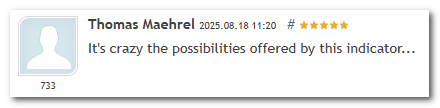
That’s exactly what I was aiming for.
Why One WR% Number Is Not Enough
Can you just focus on one WR% number and make decisions based only on that?
Short answer: no.
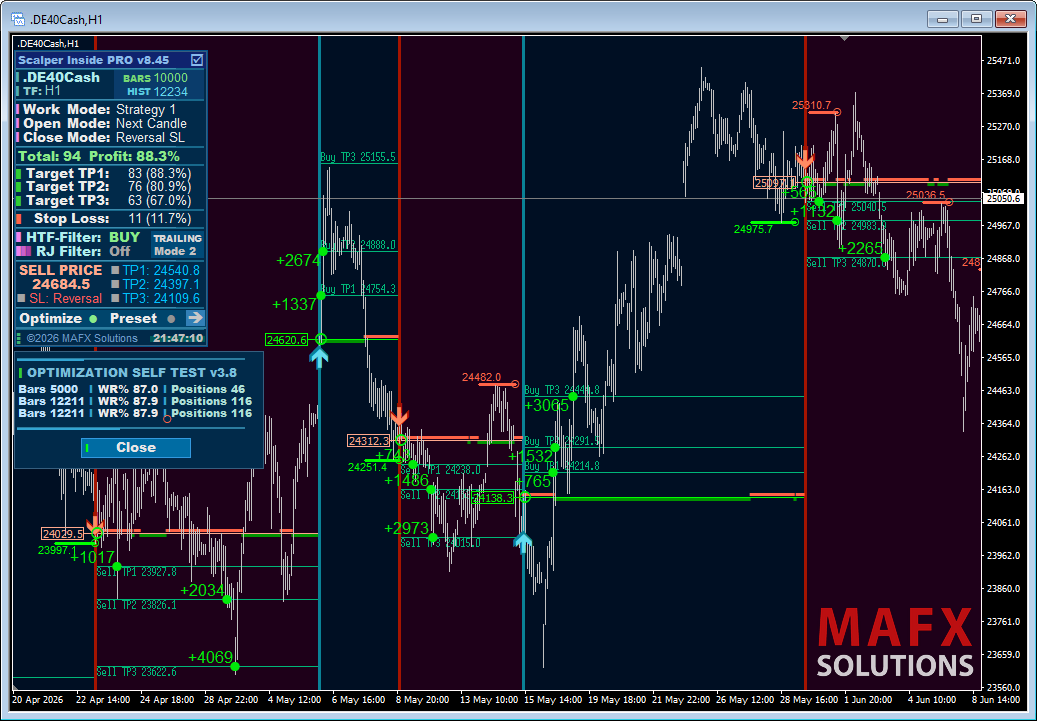
WR% is great for a first filter when you select instruments worth your attention. It helps you quickly see which markets currently look more promising. But after that you must go deeper.
If an instrument shows a very low WR% from the start, you can try the built-in optimizer to check whether it’s possible to find better settings for this symbol or if it’s simply not a good match.
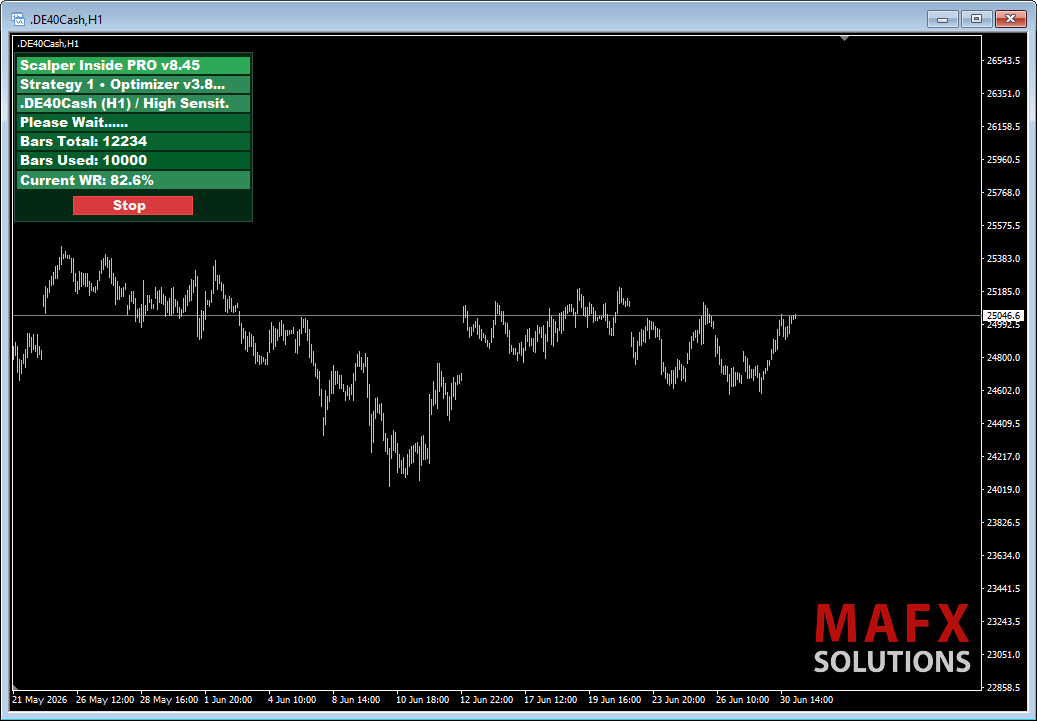
Besides WR%, it also makes sense to keep an eye on TP2 targets – they help confirm that you can capture a wider profit range.
Choosing Instruments With The Statistics Panel
The same currency pair or any other instrument on M5 can show very different behavior in different market phases:
- during active London and New York sessions
- in a slow range or flat
- before major news
- after major news
- in a clear directional impulse
- in a “choppy” environment with fake moves
This is where the statistics panel becomes a research tool rather than a magic screen. It helps you answer practical questions like:
- which instruments currently look more interesting
- where price action is cleaner
- which TP level is more realistic
- in which phase the indicator behaves better
But this panel should never be treated as a guarantee for the future. Its job is to help you make smarter decisions, not to switch your brain off.
Small TP And Big SL: Is That Always Bad?
If someone says “the high win rate is only because TP is very small and then a few big stop losses erase all profits”, there is a rational point inside that complaint. This situation does happen.
But it doesn’t mean the indicator is useless or the logic “doesn’t work”. It means that the chosen TP/SL model for this symbol, timeframe and market phase needs improvement.
And you can improve it in many ways:
- pick a different TP level
- test a different stop loss
- change instrument
- change timeframe
- filter out bad sessions
- add an HTF filter
- add strong level filtering
- reduce risk per trade
- stop trading every signal mechanically
Because the indicator is flexible, you can test almost any idea. For example, you can set a manual stop loss and see how the strategy behaves with that SL model.

HTF-Filter: A Very Underestimated Part
HTF-Filter is one of the most underrated components, in my opinion.
In simple terms:
- green blocks show bullish background
- red blocks show bearish background
The main arrow is about the local impulse. HTF-Filter is about the overall tendency.
If you look at the examples:
- on AUDCAD all blocks are green – strong bullish mood before, during and after the signal

- on EURJPY you see a strong bullish background at the moment of the signal, which actually started even earlier – this is already a hint

Price pushes through TP2, and it looks like TP3 could be possible. But we never trade pure “expectations” – every move must be checked. Price is not obliged to reach the levels we want. That’s why it’s so important to watch how price behaves near the levels.
In the EURJPY example price pulls back from TP2, then tries again. At that point HTF-Filter starts to show “weakness”: on a previously bullish background (green blocks) you begin to see red blocks, first one, then two in a row.
This does not guarantee that price will never go higher. But it tells us:
- Price didn’t have enough power to break TP2 and stay above it at once.
- Bears didn’t immediately reverse the market either.
- Price tries again with a bullish background from HTF-Filter.
- At the same time, bearish signs appear in HTF-Filter.
So we have two options:
- take profit around the level
- move the stop under the last local low and watch how price behaves
If you add price action around levels or even VSA analysis, you get more tools to confirm decisions.
Another example of how the HTF-Filter confirms a BUY signal:

Price is trying to move down, but the HTF-Filter keeps a clear buy sentiment, confirming the continuation of the upward move.
Why TP1, TP2 And TP3 Can Be Treated As Strong Levels
TP1, TP2 and TP3 are all basically strong levels. In general, Scalper Inside PRO can be considered an “impulse indicator”, which is why sometimes it may look like signals appear with a small delay.
That is intentional. The goal of the strategies is to find already somewhat confirmed situations – moments where price is preparing for an impulse move to the target and intends to pass TP1, TP2, TP3 as quickly as possible.
In the ideal case you see price moving “like butter” through the targets.

If, instead, you begin to notice hesitation, bounces from levels, multiple touches and at the same time HTF-Filter changes its mood, it might be wise to close the position or watch price behavior much more carefully around TP1, TP2, TP3.

This is what I call an adult way of using an indicator: not waiting for one fixed model to magically work everywhere, but testing where the current logic gives the best balance between probability, distance and risk.
Why Trading Every Arrow Mechanically Is A Weak Plan
Scalper Inside PRO was never built on the “one signal, one click” idea. That approach can sometimes show nice short-term phases, but in the long run it almost always becomes unstable.
The reason is simple: the market is not homogeneous. The same type of signal has very different value in different conditions:
- signal with trend, in an active session, with clear space to a strong level and no major news ahead – that’s one story
- the same signal directly under resistance, in a flat, or right before important news – that’s another story
So the indicator should not replace your head. Its job is to give you a structured base: direction, statistics, entry ideas, possible targets, material to compare. Context, filters and risk management are your part of the work.
How To Use Scalper Inside PRO More Practically
The most sensible way to start is not to spread yourself too thin.
1. Start with a small watchlist
Don’t try to monitor twenty instruments from day one. In the beginning it’s better to start with just 3-5 you already know a bit. That helps you keep focus and see patterns faster.
You can:
- choose a few familiar instruments
- compare them on M5, M15, M30 and maybe H1
- see where price action looks cleaner
- avoid chasing “more signals” for the sake of it
- give yourself time to get used to the rhythm of those markets
A very common beginner mistake is to think: “the more instruments, the more potential profit”. I’ve been there too. In reality, attention gets scattered and decision quality drops. It’s better to add instruments gradually. Diversification is good, but only when you can actually follow what you are doing.
2. Trade in active hours
Because Scalper Inside PRO is built around trend and impulse ideas, in many cases it works better in more active periods:
- London session
- New York session
- overlap between them
On low-volatility markets, especially in tight Asian ranges, many instruments behave less predictably for this style. There are exceptions, but directional moves in active sessions are usually easier to read.
Don’t ignore this, it’s more important than it may seem at first.
3. Respect the news
A beautiful technical picture can be broken by strong news. Price can first move sharply against your position, collect stops, and only then go where you expected. Technically your idea could be fine, but the entry timing was hit by fundamentals.
So before entering, always check the calendar. Key events are:
- CPI
- NFP
- FOMC
- rate decisions
- other high impact releases
This doesn’t mean you should be scared of news forever or stop trading around them. It means you must know when statistics get distorted by a strong fundamental impulse.
Why HTF And Strong Levels Are So Important
One of the best habits is top-down analysis.
Before trading on M5 or M15, mark strong levels from higher timeframes like H1, H4, D1. This helps you see where price might slow down, reverse, make a fake breakout, or where it actually has room to continue.

Very often this simple step removes many weak trades.
For example:
- if a buy signal appears directly under a strong resistance, it is not the same buy as a signal with “open space” above
- if a sell comes right near strong support, the trade might have limited potential
- if price moves towards a big level in line with the higher timeframe trend, that level can become either a logical target or an obstacle you’d better wait through
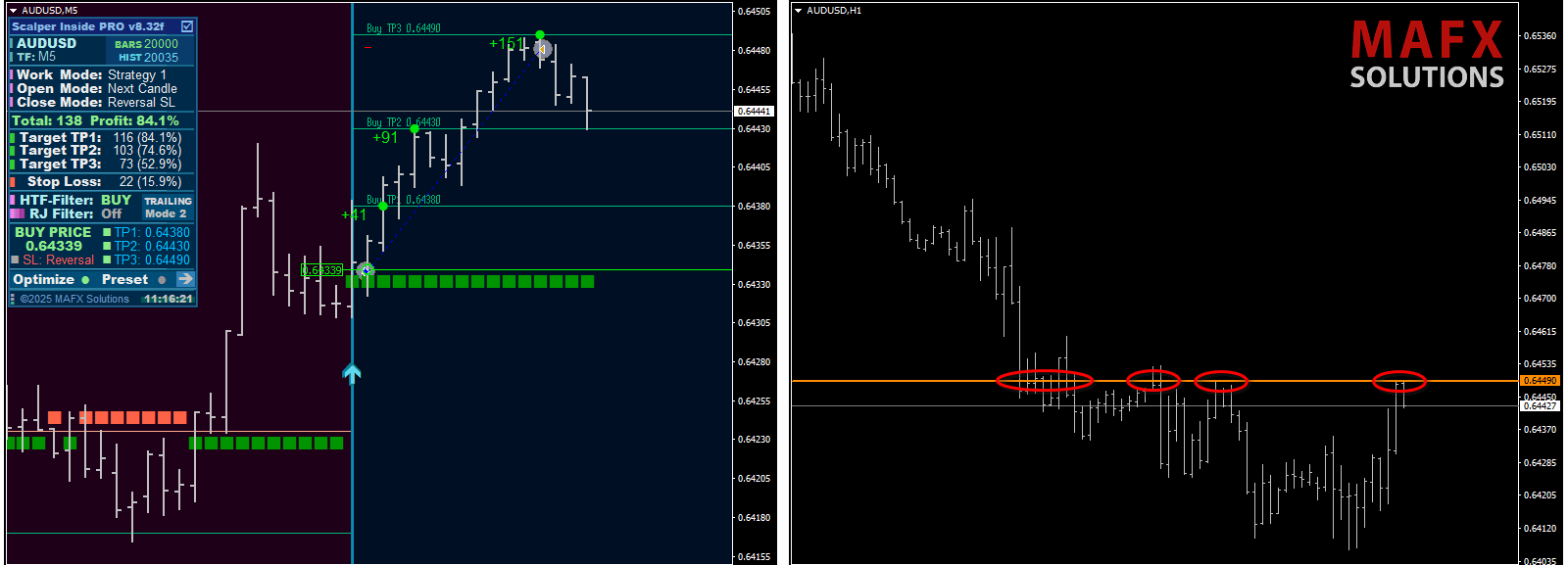
This is also where tools like HTF-Filter Trailing become really useful. They help not only with managing the trade, but also with understanding where a more realistic target is, where it may be time to tighten protection, and where the market is starting to hit a serious barrier.
What To Do With Stop Loss In Reality
Stop loss is one of the most sensitive topics. Yes, in some modes and on some instruments SL can look wide.
But this should be evaluated technically, not emotionally.
A wide stop doesn’t automatically mean a bad system. Sometimes it simply reflects real volatility and the need to give price room to move. The important part is that your SL must match:
- account size
- risk in percentage
- target potential
- market phase
- quality of the entry
If the stop feels too heavy, it’s not a sign that you must throw the indicator away. It’s a sign to ask the right questions:
- can we change the instrument
- can we change the timeframe
- can we use manual SL
- can we improve filtering
- can we reduce the number of trades and keep only higher quality setups
- can we use partial exits or another exit style
In many cases, arguing with raw statistics is less useful than trying to build a model that fits your trading style.

Closing Trades As a Group
If you have several positions open and important news is coming, or one of the instruments is clearly “stuck” under TP1, or you simply start doubting your trade, there is nothing wrong with closing everything together in a net positive result.
Sometimes it’s better to end the trading day or clear a questionable position instead of dragging it into the next session. In one real example, four trades were closed at the same time – that was a basket close on total profit at the end of the session. And regarding complex settings: all of those trades were opened with default settings.
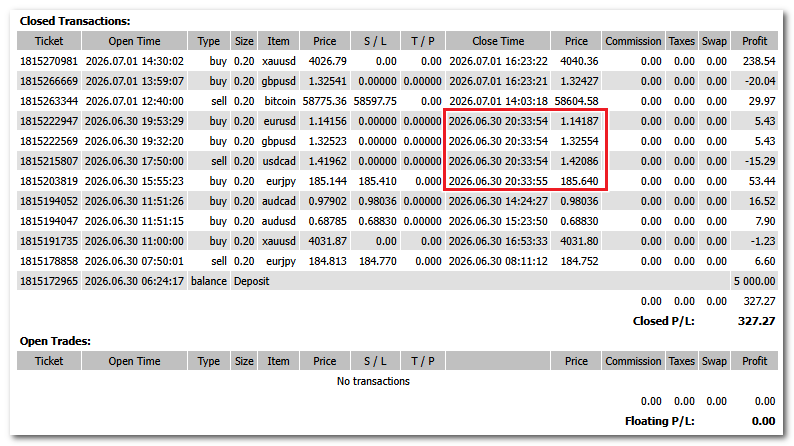
It’s good to remember this option. It can save you in real situations.
Optimization And Flexibility
One of the strong sides of Scalper Inside PRO is flexibility. It doesn’t just show signals – it allows you to explore many settings and approaches.
The same instrument can behave differently on different timeframes. The same SL logic can be perfect in one mode and uncomfortable in another.
A practical way to work:
- don’t change everything at once
- pick one instrument and one timeframe
- test at least 50-100 signals with clear rules
- understand (or write down) why each signal was taken or filtered out
- change only one parameter at a time
The indicator gives you tools for this kind of research. The result, however, will depend not on the existence of settings, but on how disciplined you are when using them.
Where The Indicator Is Really Useful
Scalper Inside PRO is especially useful where you don’t want a black box, but need a tool to build your own framework.
It can help you:
- find potential entries
- compare signal behavior across instruments and timeframes
- see recent performance
- choose more realistic targets
- see where the market currently looks cleaner
- plug signals into your own filtering system
If you use it with context, it becomes a real analytical module, not just a set of arrows. If you expect every single arrow to turn into a winning trade, disappointment is almost guaranteed.
What The Indicator Cannot Promise
Let’s be very direct here.
No indicator can promise:
- profit on every trade
- fixed profit every month
- success without filtering
- success without risk management
- success if you trade every signal blindly
- a market with no weak periods
And frankly, no honest developer should promise that either.
Any tool operates inside a market environment that constantly changes. The real goal is not to find an eternal money generator, but to build a working system that gives you an edge in certain conditions with a reasonable control of risk.
How You Can Build Your Workflow With It
If you use Scalper Inside PRO in a smart way, your process might look like this:
- Pick a small set of instruments.
- Find those with the most reasonable statistics right now.
- Check the news background.
- Look at H1/H4/D1.
- Mark strong levels.
- See if the signal actually has room to move.
- Choose a TP/SL model that makes sense.
- Limit risk per trade.
- Avoid trading every signal mechanically.
- Collect your own statistics and adjust step by step.
This demands more involvement than just pressing Buy/Sell on the first arrow you see. But this is exactly the path from chaotic trading to something systematic.
A Few Extra Examples
High TP2 hit rate allows you to treat TP2 as a realistic target, not just a dream level.


HTF-Filter example
- without HTF-Filter: price bounces from TP1 and starts moving against your sell, and you begin to doubt what to do next

- with HTF-Filter on: the filter still confirms the sell, doesn’t react to the small pullback, and you can manage the position more confidently towards your targets

News and gaps example
A large gap after the weekend can completely change the technical picture.

You probably know the classic rule: price tends to close gaps. So after you see a strong downward gap, it’s reasonable to expect price to move up to close it. However, many classic technical tools may show this as a strong downtrend and treat it as a normal sell situation.
In reality, it’s often smarter to avoid such signals or trade them very carefully. Also, for intraday trading with small targets, keeping positions open over the weekend usually isn’t a great idea, and opening trades right before the weekend is not ideal either. Important news or events can happen while the market is closed, creating gaps and changing the whole structure.
One More Note About HTF-Filter
Following an indicator signal, we entered another BUY on XAUUSD (Gold):

Price didn’t immediately show any eagerness to reach our target levels TP2-TP3.
Let’s watch what happens next. HTF-Filter starts to show weakness in the bulls and growing pressure from the bears aiming for a move down – a pretty good reason to pull our stop up to the HTF-Trailing Level:

Then we see the bulls and bears fighting again, and this already looks more like a range situation. HTF-Filter forms bearish (red) bars once more, which tells us there are problems breaking through TP2 and reaching TP3:
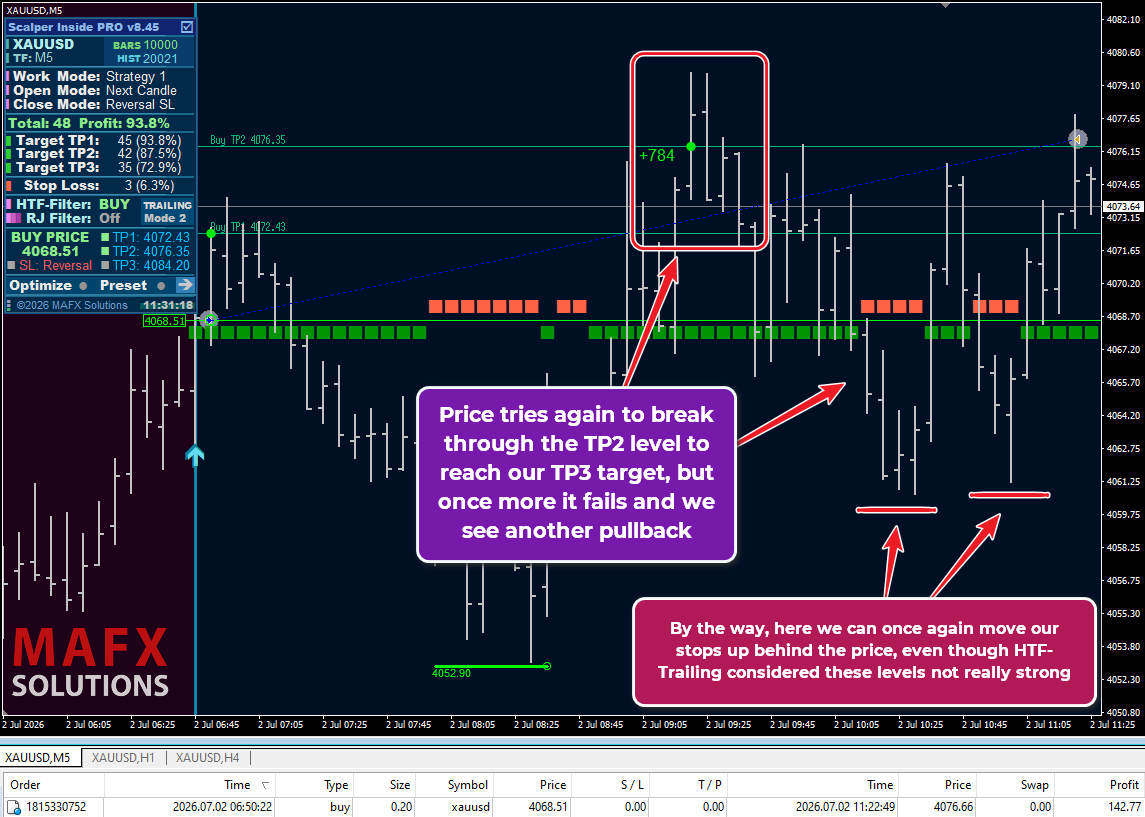
By the way, at this point we could tighten the stop behind price once more, even though HTF-Trailing considered those levels not strong enough.
Can price still reach TP3 after all this? Absolutely it can – but such a move has to be watched through price action near the level. The bears couldn’t fully break the strength of the bulls and HTF-Filter kept forming levels a bit higher. But we’re treating this only as an example, so we simply lock in profit at TP2 to avoid risk.

As you can see from the report, this XAUUSD trade closed at 4076.66 (just above TP2 at 4076.35) with a final result of +142.77. And this is exactly the point of the whole article: we don’t chase “expectations”, we work from real price behavior and HTF-Filter confirmations.
Notice what really happened here: HTF-Filter didn’t just get us in – it kept us on the right side of every pullback and told us exactly when the move was running out of steam. That’s the difference between guessing and reading the market. This is the kind of decision-making HTF-Filter gives you on every trade.
Final Thoughts
The main idea of this article is simple. Complaints focused only on hit rate make sense only when someone tries to judge a tool in a very simplified way. At the same time, it would also be wrong to say that having flexible logic automatically makes an indicator “too complicated”.
Even with default settings, the indicator can work and bring profit if you respect the recommendations and treat it as a part of a trading process, not as a magic machine.
Scalper Inside PRO is a tool for analysis and for building a workflow. It does not remove risk, it does not cancel the need to think, and it does not promise a holy grail. But it can give a lot to traders who are ready to look at the market through probability, context, higher timeframes, strong levels, sessions, news and disciplined risk.
And finally, it’s still an indicator, not an automated trading system. A lot will depend on the trader, on practice and on the time you are willing to invest. Don’t rush into live trading from day one. First, try everything on a demo account, get used to the signals, fine-tune some aspects for your personal style. There are many settings that allow you to adapt Scalper Inside PRO to your way of trading and to your experience.
Remember that we are all different: different characters, temperaments and backgrounds. Some people love scalping, some prefer swing trading, others open the terminal only for long-term positions. That’s why it is so important to adapt any tool, including this one, to your own experience and long-term goals.

Product URL: https://www.mql5.com/en/market/product/53124
Current Version: v8.45
Trading Instruments: Any
Working Timeframe: Any (M5 recommended)
Trading Platform: MetaTrader 4