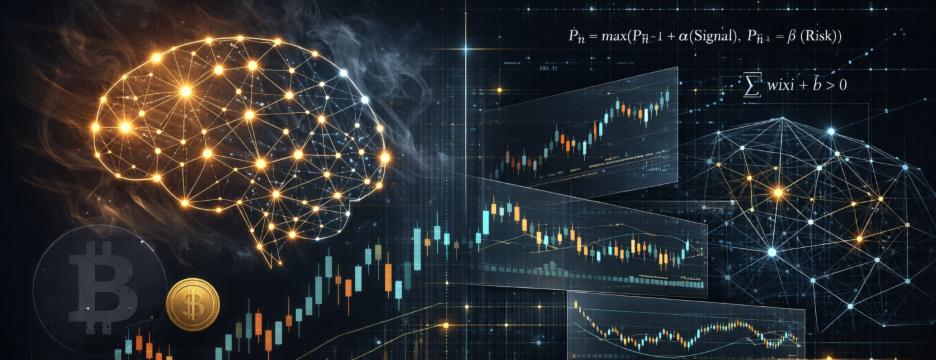
From Gut Feeling to Mathematical Discipline: The New Era of AI Trading

From Gut Feeling to Mathematical Discipline: The New Era of AI Trading
For a long time, trading was romanticized as a game of instinct.
The trader was imagined as someone who could feel the market. Someone who could sense momentum before it appeared clearly on the chart. Someone who could sit in front of price action and make decisions from experience, intuition, and timing. There is some truth in that image. Experienced traders do develop pattern recognition. They do begin to notice rhythm, volatility, hesitation, acceleration, and exhaustion in ways that beginners cannot see yet.
But there is also a dangerous illusion inside that image.
Because what traders often call instinct is not always market intelligence. Sometimes it is memory. Sometimes it is bias. Sometimes it is fear dressed as caution or greed dressed as confidence. Sometimes it is nothing more than the emotional residue of the last trade, quietly influencing the next decision.
A trader who just took a loss does not see the next setup with the same mind as a trader who just won. A trader who missed a large move does not read the next candle with the same patience. A trader in drawdown does not experience risk the same way as a trader at new equity highs. The chart may be the same, but the person looking at it is not.
This is the weakness of gut feeling.
It can feel powerful because it is immediate. It gives the trader a sense of closeness to the market. It creates the impression of control. But in a live environment, especially in fast markets like Bitcoin or macro-sensitive instruments like Gold, gut feeling can become unstable very quickly. It bends under pressure. It reacts to pain. It overweights recent outcomes. It turns probability into emotion.
The new era of trading is not about eliminating human intelligence. It is about giving intelligence a stronger operating structure.
That structure is mathematical discipline.
Not coldness. Not blind automation. Not a fantasy that machines always know better than humans. Mathematical discipline means that the trading process is built around rules, risk, context, data, and repeatable decision layers instead of emotional interpretation. It means a setup is not taken simply because it feels right. It is taken because the conditions justify exposure.
This is where AI trading becomes serious.
Not as a slogan.
Not as a shortcut.
Not as a promise that technology can remove uncertainty from the market.
But as a decision architecture that helps evaluate conditions with more consistency than the human nervous system can usually maintain under pressure.
That is the real shift.
From gut feeling to mathematical discipline.
From emotional conviction to structured confidence.
From guessing what the market might do next to defining when the system is allowed to participate.
The Problem With Gut Feeling Is Not That It Is Always Wrong
Gut feeling is not useless. That would be too simple. Many experienced traders develop intuition because they have seen thousands of market situations. They recognize how price behaves before a breakout, how volatility expands before a continuation, how weak momentum feels before reversal, or how certain sessions tend to behave around liquidity.
The problem is not that intuition has no value.
The problem is that intuition is difficult to measure, difficult to repeat, and easy to contaminate.
A trader may believe he is following instinct, but instinct does not exist in isolation. It is affected by the last win, the last loss, the current mood, sleep quality, account size, fear of missing out, fear of being wrong, and the emotional weight attached to the next outcome.
This is why discretionary trading can feel brilliant one week and completely unstable the next. The trader may be looking at similar setups, but his internal state has changed. His patience changes. His aggression changes. His willingness to hold changes. His tolerance for loss changes. His confidence becomes a variable inside the strategy.
That is dangerous.
A strategy should not depend on whether the trader feels sharp that day.
A risk model should not depend on whether the trader is frustrated.
A trade entry should not depend on whether the last position hurt.
A stop loss should not depend on whether the trader still believes he is right.
This is where mathematical discipline becomes superior. It does not mean every rule will be perfect. It does not mean every model will win. It means the decision process becomes explicit. It can be tested, reviewed, adjusted, and repeated. It turns trading from a personal emotional performance into an operational framework.
That is a major evolution.
Because the market does not reward traders for feeling certain. It rewards structured participation under uncertainty.
Mathematical Discipline Begins Before The Trade
Most traders think discipline starts at the moment of execution. They believe discipline means not closing too early, not moving the stop, not overtrading, not revenge trading, and not breaking the plan once the trade is active.
That is part of it.
But real discipline begins earlier.
It begins in the design of the decision process.
Before a trade is ever placed, the system should already know what qualifies as a valid environment. It should know what volatility conditions are acceptable. It should know whether spread is efficient enough. It should know whether the market structure supports the setup. It should know whether a major news event creates unnecessary risk. It should know how much exposure is allowed. It should know when trading should pause.
This is where the difference between emotional trading and systematic trading becomes clear.
The emotional trader starts with a feeling.
The systematic trader starts with conditions.
A candle pattern alone is not enough. A moving average cross alone is not enough. A breakout alone is not enough. A signal only becomes meaningful when it is placed inside context. Without context, a signal is just an event. With context, it becomes a decision candidate.
This is why modern Expert Advisors cannot be reduced to simple entry machines. A serious EA should act as a decision environment. It should evaluate the market before execution and manage the trade after execution. It should connect entry logic with risk logic, news awareness, volatility filters, market-condition validation, and trade lifecycle management.
Systems like ICONIC BTC AI+ and ICONIC GOLD AI+ are built around this principle. The point is not simply to automate buying and selling. The point is to define when trading is justified, how risk should be controlled, and how the position should be managed once the system is exposed.
That is mathematical discipline in practice.
The trade is not taken because the trader feels something.
The trade is taken because the framework permits it.
AI Trading Is Not A Crystal Ball
The weakest way to talk about AI trading is to pretend that artificial intelligence knows the future.
It does not.
Markets are uncertain. Liquidity shifts. News changes conditions. Volatility expands without asking permission. Regimes rotate. Human behavior, institutional flow, macro expectations, and risk sentiment all interact in ways no system can fully control.
Any product that presents AI as a guarantee should immediately create skepticism.
The serious use of AI in trading is not prophecy.
It is evaluation.
AI can help evaluate whether a setup deserves attention. It can help weigh conditions. It can support confidence scoring. It can assist with regime awareness. It can identify when the environment is stronger, weaker, cleaner, or more chaotic than a basic signal suggests.
That is a much more credible role.
A trading system may detect a technical opportunity, but that does not mean the opportunity deserves capital. The trend may be unclear. Momentum may be fading. Volatility may be too unstable. Spread may be inefficient. A news event may be too close. The higher-timeframe picture may not support the trade. The system may already be near a daily risk limit.
A basic bot may execute because the signal appeared.
An AI-supported framework can ask a better question:
Is this signal good enough under these conditions?
That is the real value.
The ICONIC AI and Neurocore logic are positioned around this kind of decision quality. AI is not treated as a decorative label. It is part of a structured process that evaluates context, confidence, market structure, and trade quality before execution. It helps turn raw signals into filtered decisions.
That distinction matters.
Because in trading, avoiding low-quality trades can be just as important as taking high-quality ones.
The Market Does Not Move In One Regime Forever
One of the main reasons gut feeling fails is that traders often assume the market they are seeing now will continue behaving the same way. A trending market makes traders believe trend continuation is easy. A ranging market makes them skeptical of breakouts. A volatile market makes them aggressive or fearful. A slow market makes them impatient.
But markets rotate.
They trend, range, expand, compress, reverse, consolidate, and break structure. Conditions that were profitable last week may become inefficient this week. A strategy that works well during clean momentum can suffer during chop. A breakout model can become dangerous when liquidity is thin. A mean-reversion instinct can become destructive during expansion.
This is why market regime matters.
A serious trading framework should not only ask whether a signal exists. It should ask what kind of environment the signal exists inside. Is the market trending or ranging? Is volatility expanding or contracting? Is momentum aligned or fading? Is price moving cleanly or erratically? Is the instrument reacting to technical structure or macro pressure?
These questions are difficult to answer consistently through gut feeling alone, especially when the trader is emotionally involved. The human mind tends to anchor to recent experience. If the last three breakouts worked, the trader expects the fourth to work. If the last two trades failed, the next valid setup suddenly feels suspicious.
A system does not need to feel confident.
It needs to evaluate conditions.
This is where regime detection and market-condition validation become important. They help the system understand whether the current environment supports the type of trade being considered. They reduce the chance of forcing a setup into a market that no longer fits it.
The ICONIC ecosystem reflects this through structured market analysis, volatility awareness, trend context, and AI-supported filtering. The purpose is not to make the system complicated for the sake of complexity. The purpose is to prevent one-dimensional execution in markets that are constantly changing.
A market is not just a chart.
It is a condition.
And the condition matters.
Multi-Timeframe Thinking Creates A Wider Lens
A common weakness of gut-based trading is tunnel vision. The trader becomes attached to the timeframe in front of him. A candle looks strong. A breakout looks clean. A rejection looks obvious. The immediate chart begins to feel like the entire truth.
But one timeframe rarely tells the whole story.
A lower-timeframe buy signal may appear inside a higher-timeframe resistance area. A short-term breakout may be moving against broader trend structure. A fast intraday move may be nothing more than noise inside a larger consolidation. Without a wider lens, the trader can mistake local movement for meaningful opportunity.
This is why multi-timeframe analysis matters.
It forces the system to ask whether the immediate setup is aligned with broader context. It helps distinguish between a trade that only looks attractive in isolation and a trade that fits into a larger structure. It also reduces the emotional pull of the current candle by placing it inside a broader framework.
The ICONIC AI SIGNAL system includes multi-timeframe edge analysis, trend context, signal generation, alerts, and dashboard visibility. This is important because modern trading is not only about detecting a signal. It is about understanding where that signal sits inside the broader market environment.
A trader operating from gut feeling may see only the urgency of the moment.
A system with multi-timeframe logic can see the hierarchy.
That does not guarantee the trade will win. Nothing does. But it improves the quality of the question being asked. Instead of asking, “Does this candle look strong?” the system can ask, “Does this setup have enough contextual support across the relevant structure?”
That is a better question.
And better questions usually create better trading processes.
BTC And Gold Are Not The Same Mathematical Problem
One of the mistakes traders make when they move from manual trading to automation is assuming that one model should work everywhere. If the logic is good, they think it should work on every market.
That sounds efficient.
It is often wrong.
Markets have different personalities. Bitcoin and Gold are perfect examples.
BTC is driven by speed, sentiment, liquidity bursts, volatility expansion, weekend behavior, structural breaks, and aggressive momentum shifts. It can move with force and reverse with equal force. It attracts emotional participation because its movements often feel urgent. Traders are pulled into chasing, overleveraging, and reacting too quickly.
Gold behaves differently. XAUUSD is deeply connected to macroeconomic expectations, USD strength, interest rates, inflation narratives, geopolitical risk, session liquidity, and economic releases. Gold can respect technical structure beautifully, but it can also become violent around news. It often requires a different level of awareness around timing, volatility, and macro conditions.
This is why mathematical discipline cannot be generic.
A BTC model should not blindly behave like a Gold model. A Gold model should not be treated like a crypto momentum engine. The same indicator can produce different meaning across different instruments because the underlying behavior is different.
This is where dedicated Expert Advisor logic matters.
ICONIC BTC AI+ is built around Bitcoin-specific behavior, where volatility, speed, and sentiment require controlled execution and intelligent filtering. ICONIC GOLD AI+ is built around the Gold environment, where macro sensitivity, news awareness, liquidity windows, and volatility control matter deeply.The point is not to overcomplicate trading.
The point is to respect the instrument.
A system that ignores the personality of the market is not disciplined. It is generic.
And generic logic is rarely enough in markets where conditions shift quickly.
Risk Is Where Mathematics Becomes Real
Many traders like the idea of AI, but they underestimate the importance of risk architecture. This is a mistake.
AI without risk control is just a smarter way to create uncontrolled exposure.
A system may identify high-quality setups, but if position sizing is unstable, if daily limits are missing, if volatility is ignored, if spread is not validated, if losing streaks trigger no adjustment or pause, then the system remains fragile. Intelligence at the entry level cannot compensate for weakness in the risk layer.
This is why mathematical discipline must include risk from the beginning.
Risk defines how much the system is allowed to be wrong. It defines how much damage a single trade can create. It defines when the system should stop. It defines whether conditions justify exposure. It defines how volatility affects stop placement and how trade management should behave after entry.
Without this, trading becomes emotional even if the entry is automated.
A serious Expert Advisor should not only know when to trade. It should know when not to trade, when to reduce action, when to pause, and how to keep losses inside predefined boundaries.
The ICONIC framework reflects this through configurable risk parameters, daily trading limits, cooldown logic, market-condition validation, spread and volatility awareness, stop-loss and take-profit rules, trailing-stop management, and break-even handling. These are not secondary components. They are the mathematical skeleton of the system.
Risk is where discipline becomes measurable.
A trader may say he is disciplined, but the risk profile tells the truth. Lot size tells the truth. Stop behavior tells the truth. Drawdown control tells the truth. Daily limits tell the truth.
The market does not care about intention.
It responds to exposure.
That is why mathematical discipline must control exposure before it ever thinks about profit.
News Filters Exist Because The Market Has Context
A chart can be technically clean and still be dangerous.
This is something many traders learn the hard way. They see a valid setup. The structure makes sense. The entry triggers. Then a macro event hits, volatility explodes, spread widens, and the trade behaves nothing like the technical model expected.
This is not always a strategy failure.
Sometimes it is a context failure.
Markets do not exist in isolation. Gold reacts strongly to macroeconomic information, interest-rate expectations, inflation data, central bank language, geopolitical tension, and USD movement. Bitcoin may react to broader risk sentiment, liquidity conditions, regulatory narratives, macro shifts, and sudden market-wide sentiment changes.
A trading system that ignores context is incomplete.
This is why news filtering matters. It is not about predicting the news outcome. It is about recognizing that certain periods carry abnormal execution risk. Around these moments, normal technical behavior can become unreliable. Spreads can change. Volatility can expand. Liquidity can thin. Price can move through levels that would normally matter.
A professional EA should be able to reduce or pause activity when the environment becomes structurally dangerous.
That is not fear.
That is discipline.
The ICONIC systems include news filtering and market-condition awareness because serious execution requires more than reading candles. It requires understanding when the environment itself may distort the signal.
Gut feeling often reacts after the damage begins.
A system can be designed to prepare before it happens.
That is the difference.
The New Trader Is Not A Fortune Teller. He Is A System Operator
The old image of trading was built around prediction. The trader studies the chart, forms an opinion, enters the market, and waits to see whether he was right.
The new image is different.
The modern trader is less of a fortune teller and more of a system operator.
He does not need to predict every move. He needs to build or operate a framework that defines when participation is justified, how risk is controlled, how decisions are filtered, and how execution remains consistent under changing conditions.
This is a more professional identity.
A system operator does not wake up asking, “What do I feel the market will do today?” He asks whether the environment fits the system. He asks whether volatility is acceptable, whether news risk is present, whether spread conditions are efficient, whether the market regime supports the model, and whether risk exposure is within the defined architecture.
This shift is important because it removes the trader from the emotional center of every decision. The market no longer becomes a test of personal intuition. It becomes a field of conditions that the system evaluates.
That does not remove responsibility. In fact, it increases responsibility. The trader must understand the system, monitor it, review it, and respect its limitations. But responsibility becomes strategic instead of reactive.
The trader is no longer fighting every candle.
He is operating a process.
That is the future of AI-assisted trading when it is done correctly.
Not blind trust in machines.
Not emotional dependence on signals.
Not fantasy promises.
A structured relationship between human oversight and automated discipline.
From Gut Feeling To Structured Confidence
There is a difference between confidence and conviction.
Conviction often comes from emotion. It feels strong because the trader wants the outcome to happen. Structured confidence is different. It comes from conditions. It comes from alignment. It comes from the system evaluating enough factors to justify participation.
This distinction matters.
A trader may feel confident because price is moving fast. But fast movement alone does not equal quality. A trader may feel confident because the setup looks familiar. But familiarity alone does not equal edge. A trader may feel confident because the last similar trade worked. But recent memory alone does not equal probability.
Structured confidence is built differently.
It asks whether the signal aligns with trend context. It asks whether volatility supports the setup. It asks whether risk is acceptable. It asks whether the market regime fits the model. It asks whether news risk is present. It asks whether execution conditions are efficient. It asks whether the trade is worth taking compared to doing nothing.
That is a better foundation.
This is where AI-supported confidence scoring and Neurocore-style decision logic become valuable inside the ICONIC framework. The purpose is not to create blind trust in a number. The purpose is to add another structured layer between raw market movement and trade execution.
The trader no longer has to rely on whether something feels right.
The system evaluates whether the setup meets the standard.
That is the new discipline.
Not emotional certainty.
Operational confidence.
The ICONIC Perspective: Trading As Architecture
The philosophy behind ICONIC is not that technology should replace the trader’s intelligence. The philosophy is that technology should protect intelligence from emotional distortion and execute defined logic with consistency.
A trader should still think. He should understand markets. He should understand risk. He should understand the system’s role, limitations, and operating environment. But his intelligence should be used where it is strongest: designing the framework, selecting the right tools, evaluating performance, and improving the architecture.
It should not be wasted fighting impulses in the middle of a live trade.
That is where automation earns its place.
ICONIC BTC AI+ translates Bitcoin-specific behavior into controlled execution logic. ICONIC GOLD AI+ applies market-aware structure to Gold, where macro conditions and news sensitivity can dominate intraday behavior. ICONIC AI SIGNAL adds signal visibility, trend context, multi-timeframe edge analysis, and alert logic. ICONIC NEUROCORE AI+ connects AI-supported decision-making, multi-symbol coordination, portfolio awareness, risk management, and trade lifecycle control.Together, these systems are not positioned as toys for passive speculation. They are part of a broader idea: trading should be treated as infrastructure.
That means every layer matters.
Signal quality matters. Risk matters. Market conditions matter. Volatility matters. News matters. Trade management matters. Portfolio exposure matters. Discipline matters.
And the more these layers can be defined, measured, filtered, and executed systematically, the less the trader has to rely on fragile instinct.
This is the core of the new era.
Not man versus machine.
Not intuition versus intelligence.
But human strategy supported by mathematical execution.
Final Thought: Gut Feeling Is Not The Enemy. Unstructured Trading Is.
The goal is not to destroy intuition. A trader’s experience still matters. Pattern recognition still matters. Market understanding still matters. Human judgment still matters.
But intuition must be placed inside structure.
Without structure, gut feeling becomes unstable. It becomes vulnerable to fear, greed, frustration, overconfidence, and recent outcomes. It becomes difficult to measure and almost impossible to improve. The trader may feel connected to the market, but connection without discipline can become expensive.
Mathematical discipline does not make trading emotionless. It makes trading more accountable.
It defines what matters before pressure begins. It separates valid conditions from emotional temptation. It gives risk a framework. It gives AI a practical role. It gives the trader a process that can be reviewed instead of a feeling that can only be defended.
That is the evolution.
From instinct to structure.
From reaction to evaluation.
From emotional conviction to AI-supported confidence.
From gut feeling to mathematical discipline.
The market will always remain uncertain. That will not change. But the way a trader responds to uncertainty can change completely.
And for traders ready to move beyond subjective execution, this is where the next generation begins.
Move From Instinct To Infrastructure
If your trading still depends on whether the market feels right in the moment, your process is exposed to your emotional state. That does not mean you lack skill. It means your skill needs structure.
ICONIC was built for traders who want to move from gut feeling to mathematical discipline - with AI-supported filtering, market-specific Expert Advisors, structured risk control, news awareness, multi-timeframe context, and automated execution across BTC, Gold, and modern algorithmic trading environments.Not as hype.
Not as a shortcut.
As infrastructure.