From Manual Chaos to Controlled Execution: A Practical Guide to Trade Management on MT5

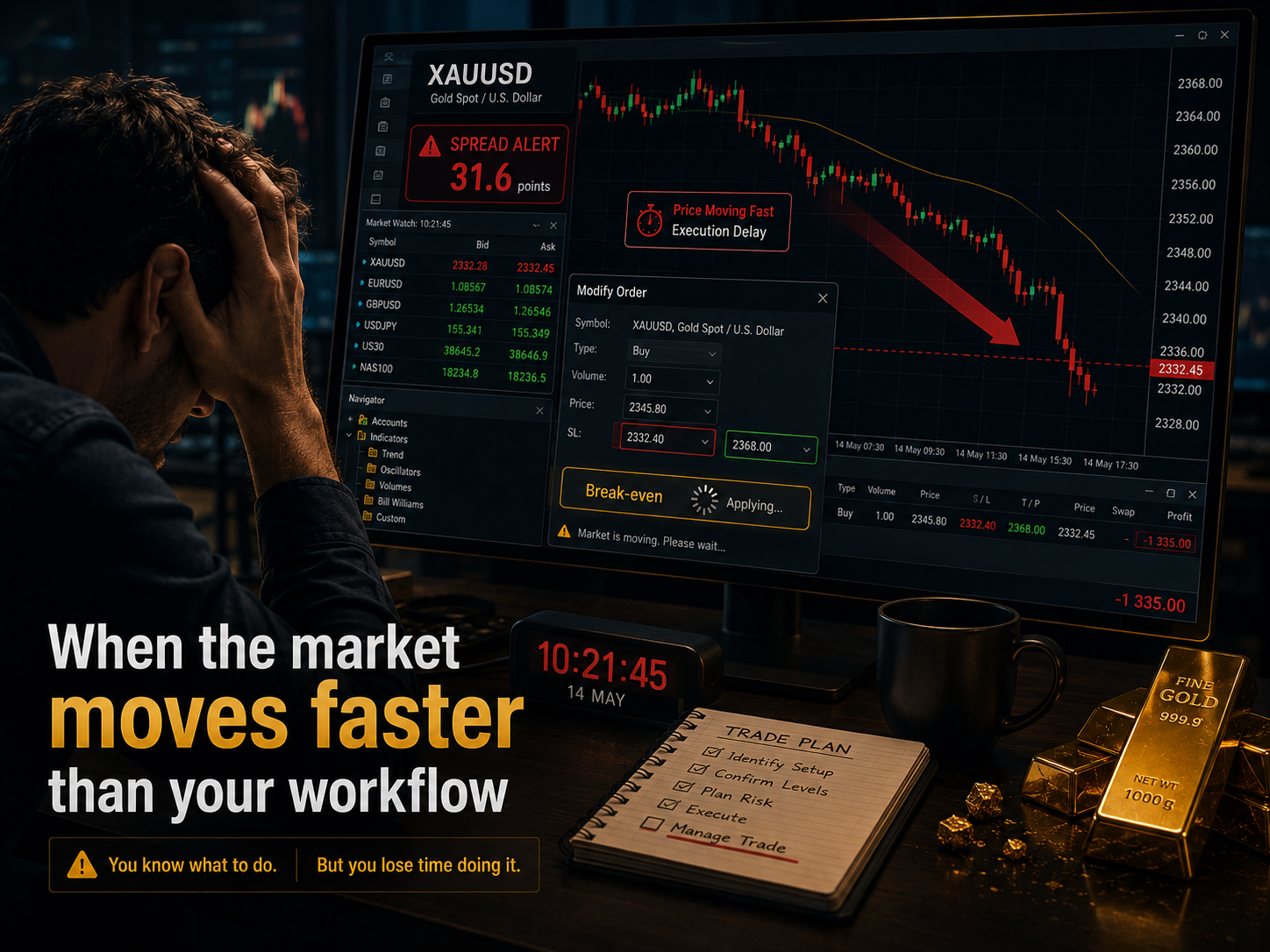
Thursday, London open, sometime in early 2024. Gold was running hard on a Fed minutes leak, spread blew out past 30 pips, and I knew exactly what needed to happen - close half, move stop to break-even, let the rest run. Simple. Obvious.
Except I was still fumbling through MT5's modify dialog. Right-click, find the ticket, open modify, do the price math in my head while the candle was moving, type the new stop level, hit OK. By the time the modification went through, price was already well against me. What started as a manageable trade ended as one of those losses that sticks with you.
Not because I didn't know what to do. Because the tooling slowed me down enough that it didn't matter.
🌟 The MT5 Interface Problem Nobody Talks About
Most trading content focuses on entries. Where to buy, where to sell, which indicator confirmed what. The execution infrastructure - how you actually manage a position once it's open - gets almost no attention.
MT5's native interface works fine when markets are slow. On a Tuesday morning with one position drifting in your direction and 45 minutes before the next event, right-clicking through the modify dialog is just mildly annoying. During London open on gold, or when three positions need different treatment simultaneously, that same workflow becomes genuinely dangerous.
The math problem is underrated. XAUUSD in the $4,400–$4,500 range means a 50-pip stop is roughly a $50 move per 0.1 lot. Doing that conversion accurately, under pressure, while typing a price level into a small input field, while watching spread widen - I've fat-fingered that more than once. Typed one extra zero and set a stop 1,000 pips out instead of 100. Found out when the position didn't close where I expected it to.
That's not a beginner mistake. That's what happens to experienced traders when the interface requires too much from working memory at the wrong moment.
🌟 Entry First: The Fumble Before the Position Even Opens
The modify dialog isn't the only problem. The standard order ticket in MT5 requires volume input, order type selection, SL and TP in price terms, confirmation. Five or six clicks minimum for a market order with stops attached.
On fast gold, that matters. Price doesn't wait.
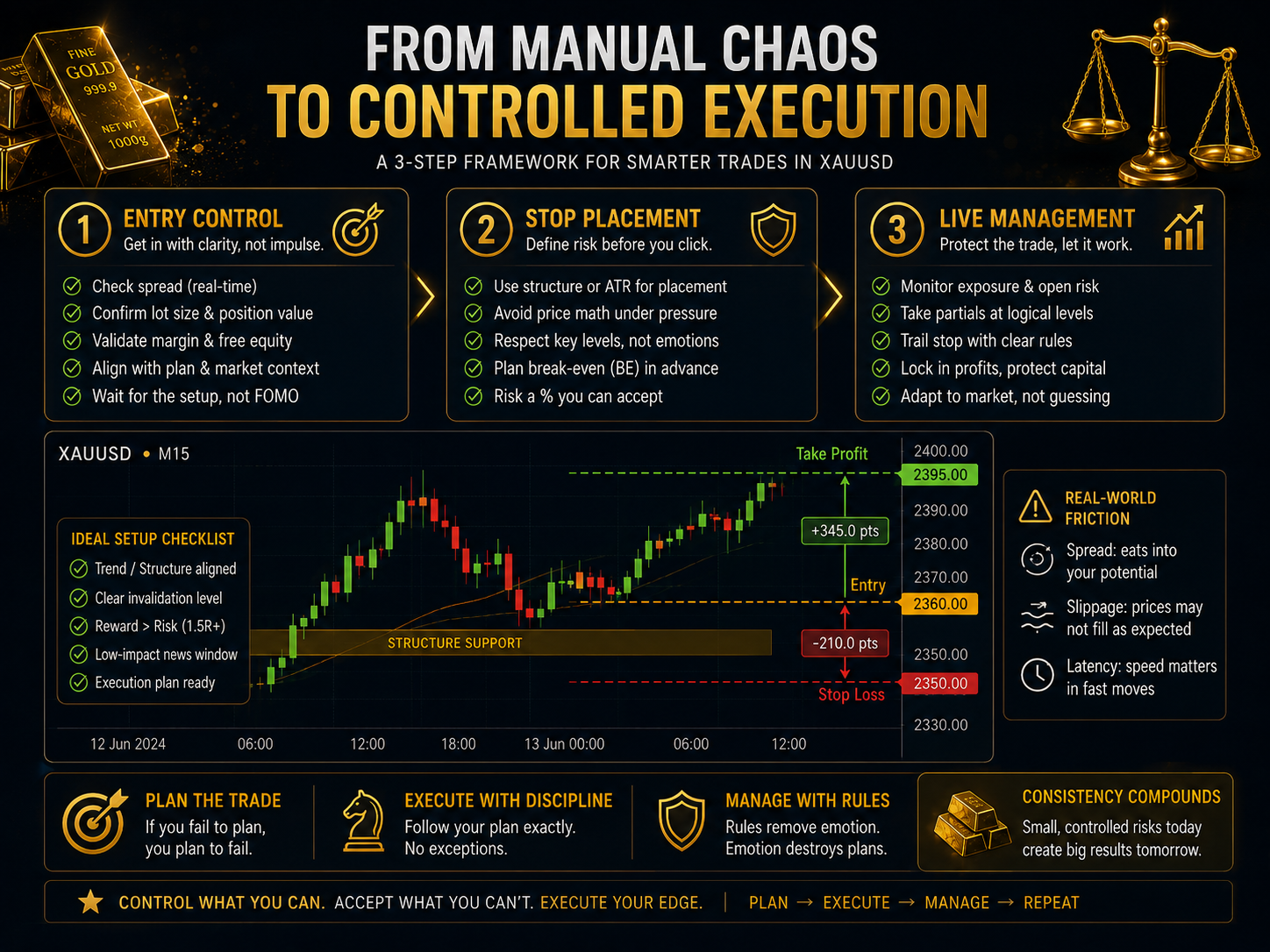
My one-click panel - Gold One Click Trader - collapses that sequence. Risk defined in advance, lot size calculated, one button to send. The panel runs validation before submission: margin check, volume against the broker's minimum and step requirements, spread check. If something's wrong, it blocks and reports rather than sending a bad order silently.
That last part sounds obvious until you've used commercial panels that show "Order Sent" on screen while the trade was actually rejected server-side. You find out when the position doesn't appear in the terminal. Price has already moved.
Gold spread behavior is worth knowing: on a RAW account during normal London hours, it can sit under 2 pips. Hit a major economic release and it goes to 15–30+ in seconds. A panel that calculates lot size using a fixed assumed spread gives you systematically wrong position sizing during exactly the worst conditions. The one-click panel I use pulls live spread before calculating.
Limitation worth stating: none of this fixes VPS latency. If you're running on a slow VPS with 200ms+ round trips, there's a ceiling on how fast any client-side tool can operate. The panel executes as fast as the connection allows. No more, no less.
🌟 Stop Placement Without the Price Math
After entry, the next failure point is stop and target placement.
The native workflow: open modify, calculate the price level you want based on pip distance, type it manually. Under normal conditions, annoying. When gold is moving and you're under cognitive load, error-prone.
Smart TP SL Manager lets me work in pips from the current position rather than absolute price levels. I define risk in familiar terms - "50-pip stop" - and the tool handles the price conversion and submits the modification. It also handles breakeven moves and staged management once the trade is running.
Real limitation here, and it's worth knowing: MT5 modification requests are not instant. The broker has to accept the change. During fast moves, there's a gap between when you initiate and when the modification lands. On a hyper-active candle, that gap matters. There's no magic here - dragging a line on the chart and confirming still depends on your connection and the broker's server response time. Anyone telling you otherwise is overselling it.
What it does well that I actually rely on: batch stop moves on multiple positions. If I have three trades open and want to move all stops to break-even after a partial target hit, doing that one by one through the native interface is where I make mistakes. The batch operation on this tool is meaningfully faster and less error-prone.
🔍 Managing Positions Once They're Live
This is where most discretionary traders leak money. Not on bad entries - on bad management of decent entries.
You're long gold from 4,422. Target at 4,448. Stop at 4,410. Price grinds to 4,435 then starts pulling back. Hold? Trail? Partial close? Exit? Whatever you decide, you need to act cleanly and quickly.
Gold Trade Manager is what I use for this layer. Equity panel showing dollar exposure per position, not just percentage. Quick partial close by percentage rather than volume calculation. Trailing stop with configurable activation. The dollar display specifically - when you're managing XAUUSD, seeing "$180 floating on this trade" is more useful than 0.4% because it maps directly to your risk parameters.

The trailing stop runs tick-based rather than timer-based. On fast gold moves, a timer that polls every few seconds can miss meaningful price action between polls. Tick-based responds to price events rather than schedules. That said - broker modification limits, VPS latency, and partial fills still apply. Tick-based is a better design, not a guarantee.
What this tool doesn't do: anything about broker-side problems. If the server returns a trade disabled code during maintenance, the manager logs it and alerts. It can't force execution through a frozen terminal. I've had brokers go silent during NFP. Nothing on the client side saves you from that. Fix your broker setup first.
🚀 When You're Running Multiple Strategies
Standard is enough for most scenarios. But if you're running correlated positions across a session, or need systematic risk control across all open trades, the Standard version doesn't have everything.
Gold Trade Manager PRO adds cross-position equity monitoring. When total floating loss across all open positions hits a defined threshold, it can trigger scale-down or close actions across the board. This is the opposite of martingale - it's a hard circuit breaker on runaway multi-position exposure.
Session-aware parameters are the other addition I find genuinely useful. Gold behaves differently across sessions. Asian range is compressed, London open is volatile, New York overlap tends to be directional. Having different trailing configurations apply automatically by session means I'm not manually reconfiguring on each transition - which realistically means I was either using one setting all day (suboptimal) or forgetting to switch (worse).
PRO has more settings and they interact. Misconfiguring the session filters combined with the equity guard can result in positions being managed more conservatively than intended. Not a bug, just complexity. Run it on demo for a few weeks across different session behaviors before trusting it with live capital. I learned that lesson the expensive way early on.
🌟 Which Tool, When
Not everyone starts at PRO.
If you're a discretionary trader whose main problem is execution fumble - wrong volume, wrong stop distance, slow entry on fast moves - the one-click panel is the right starting point. Most immediate impact for least complexity.
If entries are already clean but you're losing ground on stop placement and active management across a few positions, Smart TP SL Manager handles the pip-based workflow.
If you're trading actively enough that you need live equity tracking, trailing, and partial close management, Trade Manager Standard is built for that.
PRO makes sense when you're systematic enough to want session-aware automation and multi-position equity control. If you're still deciding entries discretionarily on feel, the PRO automation layer adds more complexity than value.
🌟 What None of This Fixes
Worth being explicit.
If your broker runs a B-book operation that freezes terminals during volatile events or requotes market orders systematically, no management tool changes that. The problem is upstream of the software. Sort your execution environment before worrying about management tools.
Bad trade management strategy, executed efficiently, is still bad trade management. If you're moving stops in the wrong direction or trailing too early, the tools will execute that behavior more reliably. That's not an improvement.
Connection reliability matters more than most traders budget for. Client-side tools depend on the terminal staying connected. If the connection drops during an active trailing sequence, the trail stops updating until reconnect. For critical trades where you can't tolerate that gap, you need a different solution - and very few retail brokers offer server-side trailing on gold.
🔥 Final Note
Eight years of live gold trading has convinced me that execution infrastructure matters more than most traders acknowledge publicly. The tooling layer between your decision and the market action has real costs when it's slow, clumsy, or unreliable.
None of the tools described here are complex to understand. The difficulty is in verifying they behave correctly across different broker conditions, session volatility profiles, and the kind of fast-moving gold price action that can turn a reasonable position into a blown risk tolerance before you finish right-clicking.
That's the problem these tools were built for. Not to generate signals. Not to find entries. Just to make sure that when you know what to do, the execution actually follows through.
For broker execution environment guidance: https://www.mql5.com/en/blogs/post/769009
🎁 New to Gold Algo Lab?
Start with the Gold Algo Lab Tool Map - a practical guide that organizes our MT5 tools into 6 connected stages: market context, setup selection, risk planning, trade execution, position management and account protection.
→ Gold Algo Lab Tool Map: Where to Actually Start With MT5 Tools for XAUUSD
https://www.mql5.com/en/blogs/post/771930
Do not choose a tool by its name alone. Start with the part of your trading process that needs the most control, then build your workflow one layer at a time.
Gold Algo Lab builds practical, risk-first MT5 tools for serious XAUUSD traders, shaped by 8 years of developing and trading real systems to help traders identify clearer setups, manage risk with greater confidence and execute with more discipline.