Building an Opening Range Breakout Portfolio on a Single Chart in MQL5
11 June 2026, 18:43

0
279
The Opening Range Breakout Portfolio: Diversification Over Aggression
Most automated trading systems share the same hidden weakness. They take one setup, on one symbol, and try to squeeze returns out of it with aggressive risk. It looks fine on a good month - and then the single edge enters a drawdown and the whole account falls in a straight line, because there is nothing to offset it.
I built the Opening Range Breakout Portfolio around the opposite idea: strength through breadth, not through leverage. Instead of betting everything on one setup, it runs a small portfolio of independent breakout combinations across US stock indices, all from a single chart. The result is a far smoother equity curve and a strategy whose worst case is knowable in advance.
WHY THE OPENING RANGE
Every trading day, the US cash session opens with a burst of accumulated order flow. Orders that built up overnight - from funds, institutions and traders across the globe - are released within a compressed window, producing a brief but statistically meaningful surge of volatility and direction.
The opening range is the high-to-low band price forms in those first minutes. A decisive break beyond it often means one side has won the early auction and momentum is likely to continue. Floor traders have used this for decades. What separates a profitable version from a losing one is not the idea - it is the discipline of execution.
ANATOMY OF A TRADE
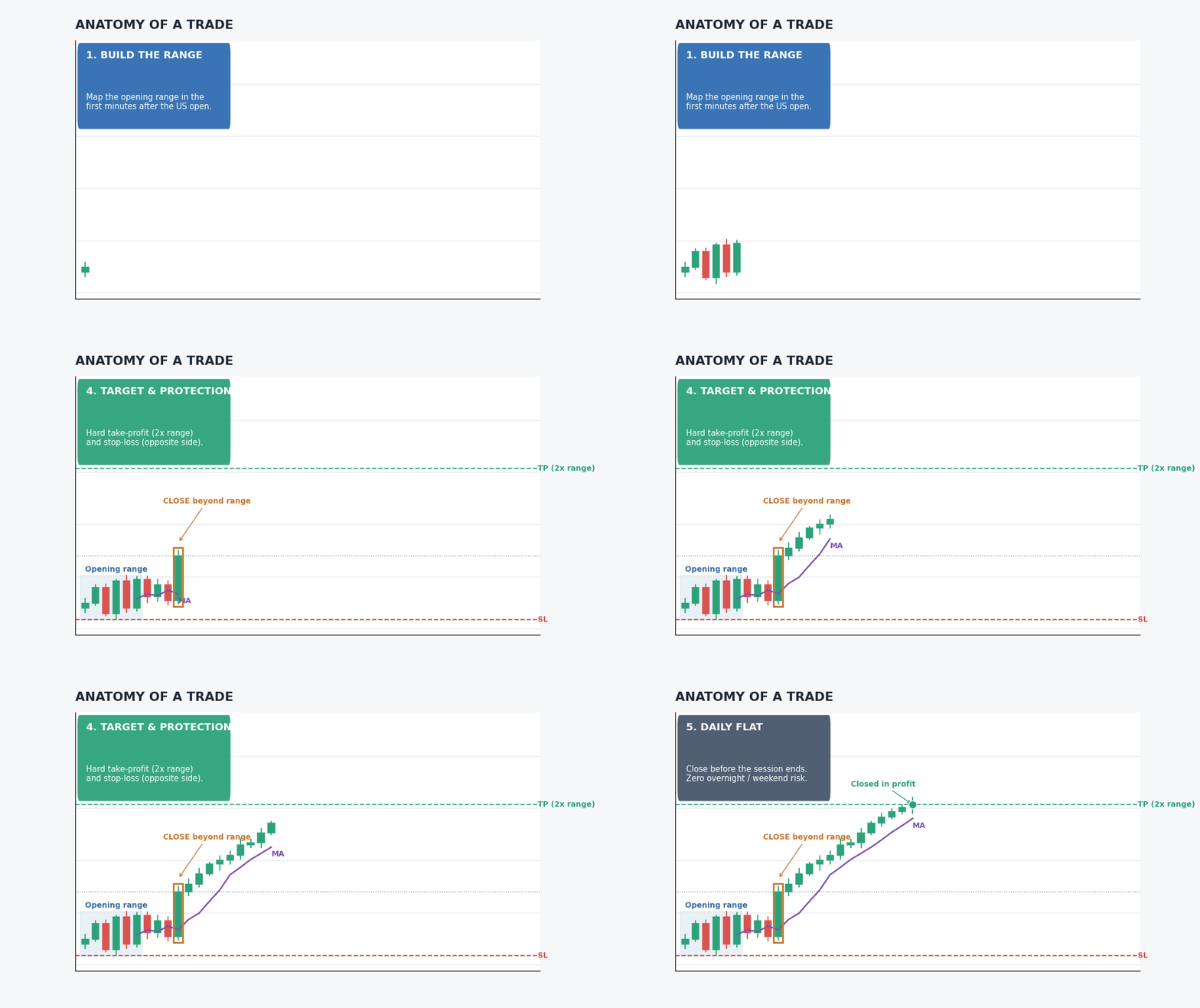
Every position passes through five strict, mechanical stages:
1. Build the range. The system maps the opening range during the first minutes after the US cash open. No trades during this phase - it is only observing.
2. Trend filter. A breakout is only valid in the direction of the prevailing trend (price versus a moving average). This alone removes a large share of low-probability, counter-trend breakouts.
3. Breakout confirmation. Entry is triggered only on a candle CLOSE beyond the range - never on an intrabar spike. Markets are full of false wicks that pierce a level, trigger breakout orders, then snap back. Demanding a confirmed close filters out these traps.
4. Target and protection. The moment a trade opens, a hard take-profit (a multiple of the range) and a hard stop-loss (the opposite side of the range) are placed. Risk is defined before the trade is live - no discretionary management.
5. Daily flat. Before the session ends, every position is closed. The account finishes each day in cash. Zero overnight exposure, zero weekend gap risk.
SIX STRATEGIES, ONE INSTANCE
Attaching the EA to a single chart deploys six independent combinations: two index symbols (US Tech-100 and S&P 500) across three timeframes (M5, M15, M30). The chart symbol and timeframe are irrelevant - the portfolio runs internally.
This is where the smoothness comes from. The six combinations are not perfectly correlated. A choppy morning that produces a false breakout on the Tech-100 M5 often produces a clean trend trade on the S&P 500 M30. Losing setups on one timeframe are frequently offset by winners on another. When you sum many partially independent edges, the peaks and valleys of the equity curve average out, and the aggregate drawdown is far shallower than any single combination alone. It is the same principle institutional desks use: many small uncorrelated bets beat one large concentrated bet.
STRICT SAFETY: WHAT IT REFUSES TO DO
A system is defined as much by what it will not do. This one categorically excludes every account-killer:
- No martingale. Position size never increases after a loss.
- No grid. It never layers orders into a moving market.
- No averaging down. A loser is closed at its stop, never doubled.
- No hedging. Every position has one clean, honest outcome.
What it enforces instead:
- Fixed lot per leg - total exposure is simply legs multiplied by lot, a number you can calculate before it ever trades.
- One trade per day per combination - no revenge trading.
- 100% intraday - flat before every close.
The point is simple: the worst case is knowable in advance. That is the single most important property a serious capital allocator looks for.
BUILT FOR THE REAL WORLD
Two practical problems break most time-based systems. This one solves both internally.
Session and DST. The US session opens at 09:30 New York time, but every broker server sits at a different GMT offset, and daylight-saving shifts twice a year. You set your broker offset once, and the system resolves the correct US open in server time automatically, including DST. The resolved time is printed to the Journal so you can verify it at a glance.
Broker independence. Index CFDs are named differently everywhere - NAS100, US100, USTEC, US500, SPX500. The system recognizes the common variants and finds the right instrument on your broker automatically.
PERFORMANCE (BACKTEST RESULTS)
Backtested over 2020 through early 2026 at 100% history modeling quality:
- Profit Factor: 1.32
- Sharpe Ratio: 4.13
- Maximal equity drawdown: 5.51%
- Recovery Factor: 14.38
- Total trades: 8,310 (large, robust sample)
- Win rate: 52.92%
A defining trait is the low deposit load, peaking near 25%. The system achieved its results while keeping roughly three-quarters of the account in reserve at all times - proof that the growth comes from a statistical edge, not from over-leveraging. This is not a money printer; a profit factor in the low 1.3s is a modest but durable edge that survives precisely because of the strict risk rules above.


(Past performance from backtesting does not guarantee future results.)
WHO IT IS FOR
- Disciplined traders who value consistency and capital preservation over lottery-ticket returns.
- Index specialists who want the cleanest, most liquid breakout conditions in global markets.
- Busy professionals who want a hands-off, fully mechanical system on a VPS.
- Risk-conscious allocators who require a strategy with a bounded, knowable worst case.
It is not for anyone seeking overnight riches or high-leverage gambling. It is deliberately the opposite.
The Opening Range Breakout Portfolio is available in my MQL5 Market profile as "ORB Indices by ARGUS". It runs from a single chart, auto-resolves your session, and ships with a built-in calendar filter. Always validate on a demo account with your own broker's symbols and spreads before going live.