Understanding Reverse Trade Copying in MetaTrader 5 Signal Copier: Advanced Inverted Execution Logic

PRODUCT ACCESS LINK ON MQL5 MARKET:
https://www.mql5.com/en/ market/product/191385
Reverse trade copying is a configuration mode in MT5 Trade Copier systems where Slave accounts execute trades in the opposite direction of the Master account.
Unlike standard copy trading, where trades are replicated exactly, reverse mode inverts every trade signal before execution on Slave terminals.
For example:
• Master BUY → Slave SELL
• Master SELL → Slave BUY
This inversion happens automatically inside the copier logic without any manual intervention.
Understanding Reverse Trade Copying
Reverse trade copying is not a simple variation of trade replication; it represents a structural modification in how trading signals are interpreted and executed.
In a standard copy trading system, the objective is to mirror Master trades as accurately as possible.
In reverse trade copying, the objective is to create opposite market exposure while still using the same signal source.
This means that although both Master and Slave accounts are reacting to the same market signal, their positions are directionally opposed.
This structure is often used when traders want:
• Opposite exposure from a single strategy
• Hedge-style portfolio structures
• Strategy behavior testing under inverse conditions
• Multi-account diversification with directional separation
The key advantage is automation. Once reverse mode is enabled, the system handles all directional inversion internally.
How Reverse Trade Copying Works Internally
When a trade is executed on the Master account, the MT5 Trade Copier processes it through several stages before sending it to Slave accounts.
The internal workflow is:
- Detection of new trade on Master terminal
- Identification of trade direction (BUY or SELL)
- Retrieval of trade parameters (lot size, symbol, SL/TP)
- Application of inversion logic for reverse-enabled accounts
- Construction of opposite order for Slave terminal
- Execution of the modified order on Slave account
This process occurs in real time and is designed to ensure minimal delay between Master execution and Slave response.
Even though direction is inverted, all other trade parameters such as stop loss, take profit, and lot scaling can still be preserved or modified depending on configuration.
Use Cases of Reverse Trade Copying
Reverse trade copying is used in several professional trading scenarios where directional inversion is beneficial.
Strategy Behavior Analysis
One of the most important use cases is evaluating how a trading strategy behaves when market exposure is reversed.
By comparing normal and reverse accounts, traders can identify:
• Whether the strategy is direction-sensitive
• How performance changes under opposite conditions
• Whether entries are statistically biased toward one direction
This provides deeper insight into strategy robustness.
Hedging Multi-Account Structures
Reverse copying can be used to build hedged account structures.
For example:
• Account A follows normal copy mode
• Account B runs reverse mode
This creates opposite exposure across accounts while using the same signal source.
Such structures can reduce directional risk depending on market behavior.
Portfolio Diversification
Reverse mode can also be used to diversify trading behavior across multiple accounts.
Instead of all accounts reacting in the same direction, some accounts can be configured to operate inversely, creating differentiated performance profiles within the same trading system.
Multi-Account Reverse Configuration
In multi-account environments, reverse copying is not limited to a single global setting.
Each Slave account can be configured independently.
For example:
• Slave 1 → Normal mode
• Slave 2 → Reverse mode
• Slave 3 → Reverse mode with scaling
• Slave 4 → Mixed configuration
This allows complex portfolio structures where different accounts behave differently under the same Master signals.
Balance-Based Lot Scaling with Reverse Mode
Reverse trade copying can be combined with advanced lot management systems.
One of the most commonly used methods is balance-based scaling.
In this model:
• Lot size is calculated based on account balance ratio
• Larger accounts receive proportionally larger positions
• Smaller accounts are protected from overexposure
Reverse mode does not affect the scaling logic; it only changes trade direction while keeping lot calculation consistent.
Fixed and Multiplier Lot Structures
In addition to balance-based scaling, reverse copying can also work with:
Fixed Lot Mode
All reversed trades use a fixed predefined lot size regardless of Master trade size.
This is often used in testing environments.
Multiplier Mode
Slave lot size is calculated as a multiple of Master lot size.
This allows controlled amplification or reduction of exposure even in reverse mode.
Execution Accuracy in Reverse Trade Copying
Execution accuracy remains critical even when trades are inverted.
Important factors include:
• Correct identification of trade direction
• Proper inversion of BUY/SELL logic
• Accurate lot calculation
• Correct symbol mapping
• Stable execution timing
Any inconsistency in these elements can result in incorrect exposure or mismatched positions.
Symbol Mapping in Reverse Systems
Symbol Mapping ensures that trades are executed on correct instruments across different brokers.
Since brokers may use different naming conventions, the same asset may appear differently:
• EURUSD → EURUSDm
• XAUUSD → GOLD
• US30 → US30.cash
Reverse trade copying still depends on correct symbol alignment to ensure proper execution.
Without Symbol Mapping, reversed trades may fail or execute on incorrect instruments.
Execution Timing and Reverse Mode Behavior
Execution timing plays a significant role in reverse trade copying systems.
Even when logic is correct, delays between Master and Slave execution can cause:
• Different entry prices
• Slippage variation
• Temporary exposure mismatch
These timing differences are usually caused by:
• Broker execution speed
• VPS performance
• Network latency
Monitoring in Reverse Trade Systems
Monitoring becomes even more important when reverse mode is active.
A proper monitoring system tracks:
• Slave connection status
• Trade execution consistency
• Synchronization delays
• Missing or failed trades
Without monitoring, reverse systems can develop hidden inconsistencies across accounts.
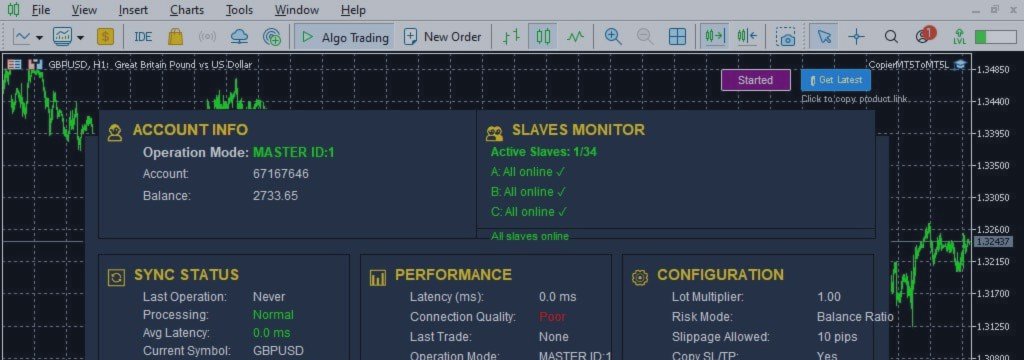
Dashboard Overview
The dashboard acts as the central control interface of the MT5 Trade Copier system.
It provides real-time visibility into:
• All connected Slave accounts
• Reverse mode status per account
• Execution flow direction
• System health indicators
This ensures full operational awareness across all trading terminals.
Account Information System
The account information section displays:
• Account mode (Master / Slave)
• Account number
• Balance
• Equity
• Reverse mode status
This helps identify the role of each account in the trading structure.
Synchronization Status
The synchronization system shows:
• Last executed trade time
• Signal transmission status
• Processing delay
• System state (active / hold / waiting)
This ensures that reversed trades remain aligned with Master execution timing.
Performance Monitoring
Performance monitoring evaluates system behavior across all accounts.
It tracks:
• Execution latency
• Connection stability
• Trade processing speed
• System responsiveness
This is especially important in high-frequency or volatile market conditions.
Configuration System
The configuration layer controls how reverse trade copying behaves.
It includes:
• Copy mode selection
• Master ID definition
• Slave identification
• Reverse activation per account
• Trade rule settings
This allows precise control over system behavior.
Trade Settings in Reverse Mode
Trade settings include:
• Stop Loss / Take Profit replication
• Pending order handling
• Slippage control
• Spread filtering
• Direction inversion logic
These settings ensure structural consistency of reversed trades.
Key Features of Reverse Trade Copying
• Automatic trade inversion logic
• Per-account configuration support
• Multi-account compatibility
• Integration with Symbol Mapping
• Execution timing synchronization
• Monitoring system compatibility
• Lot scaling integration
• Real-time execution processing
Setup Guide
Master Setup
• Install EA on Master terminal
• Enable Master mode
• Activate AutoTrading
• Set Master ID
• Ensure symbol availability
Slave Setup
• Install EA on Slave terminal
• Enable Slave mode
• Link Master ID
• Assign Slave number
• Enable reverse mode if required
• Activate AutoTrading
System Validation
After setup:
• Trades are replicated correctly
• Reverse logic is applied where enabled
• Dashboard shows correct status
• Monitoring confirms all connections
FAQ
Is reverse mode applied automatically?
Yes, once enabled per Slave account.
Can reverse and normal mode coexist?
Yes, per-account configuration allows mixed setups.
Does reverse mode affect execution speed?
No significant impact on execution performance.
Is monitoring required?
Yes, it is strongly recommended for stability.
Overview of MT5 Trade Copier System
MT5 Trade Copier is a multi-account trade replication system designed to synchronize trading activity between Master and Slave accounts.
It includes:
• Trade execution engine
• Symbol Mapping system
• Slave Monitoring module
• Synchronization controller
• Configuration framework
• Performance tracking system
Reverse trade copying is one configurable layer within this architecture.
Dashboard Overview
The dashboard provides centralized visibility of all connected accounts.
It displays:
• Online / Offline status
• Trade flow direction
• System synchronization state
Account Information
Displays:
• Account role
• Balance
• Equity
Sync Status
Tracks communication timing between accounts.
Performance Monitoring
Evaluates system stability and execution speed.
Configuration System
Defines how trading logic is applied across accounts.
Final Conclusion
Reverse trade copying is an advanced configuration in MT5 Trade Copier systems that allows full inversion of trade direction across selected Slave accounts.
When integrated with Symbol Mapping, execution timing control, monitoring systems, and synchronization architecture, it becomes part of a complete multi-account trading infrastructure.
This enables traders to build hedging structures, test strategy behavior under opposite conditions, and diversify portfolio exposure across multiple accounts.
Proper configuration and monitoring are essential to ensure that reverse execution remains stable, accurate, and consistent across all connected terminals.
PRODUCT ACCESS LINK ON MQL5 MARKET:
https://www.mql5.com/en/ market/product/191385