![[TLV]: When a Timing Should Be Ignored Liquidity Activation Point ≠ automatic entry](https://c.mql5.com/6/1006/splash-770298.png "[TLV]: When a Timing Should Be Ignored Liquidity Activation Point ≠ automatic entry")
[TLV]: When a Timing Should Be Ignored Liquidity Activation Point ≠ automatic entry

One of the most important rules inside TLV (Time Language VISTmany):
👉 A timing is a moment of attention, not an automatic signal.
Many beginner mistakes happen because traders:
see a timing,
but ignore market context,
neighboring timing structures,
impulse direction,
and liquidity conditions.
⸻
Core Idea
Markets rarely move linearly.
Even if a timing appears:
it does not guarantee
that the movement will continue in that direction.
Very often:
👉 the next timing located ahead on the chart is more important than the current one.
That is why TLV always requires traders to analyze:
which timings are located ahead,
how close they are,
and how they interact with current market momentum.
Situation #1
Sell Timing After a Strong Down Move
This is one of the most dangerous situations.
For example:
the market already made a strong daily decline,
the daily low has been updated,
volatility is exhausted,
liquidity has partially been collected.
And then:
👉 a new Sell timing appears.
⸻
What Usually Happens
Very often:
the market is already near exhaustion,
sellers are weakening,
the movement is overheated,
liquidity is already partially activated.
In this situation:
👉 the Sell timing may produce only a small impulse,
or fail completely.
⸻
What Should Be Done
Analyze:
👉 which timings are located ahead on the right side of the chart.
If nearby there is:
a Buy timing,
a timing spectrum,
a Momentum Cluster,
or a timing intersection,
then:
👉 the Sell timing is often better ignored.
Even if the market still produces:
a small downward impulse,
a candle wick,
or a false breakout,
this often becomes:
👉 the final phase of the movement.
⸻
Situation #2
Buy Timing After a Strong Rally
This is the mirrored situation.
If:
the market already made a strong rally,
the daily high has been updated,
momentum is exhausted,
liquidity has already been collected,
and then:
👉 a new Buy timing appears,
very often:
the movement is already near completion,
the market prepares for reversal,
or accumulation begins.
⸻
What Should Be Done
If nearby there is:
a Sell timing,
a timing spectrum,
a Momentum Cluster,
or a timing intersection,
then:
👉 the Buy timing is often better ignored.

Important TLV Observation
At market extremes:
lows often create rebounds,
highs often create corrections,
even if the timing direction matches the previous impulse.
That is why:
👉 timings should never be analyzed separately from market structure.
⸻
News and Timing Structures
It is also critically important to monitor:
👉 news events.
If a timing appears during:
major economic news,
FOMC,
CPI,
NFP,
geopolitical events,
then:
timing reactions may become distorted,
impulses may become chaotic,
or liquidity activation may become delayed.
⸻
Scalping and Fast Scalping
Inside TLV:
many movements are extremely fast,
timing reactions may last only minutes,
impulse execution may occur instantly.
Therefore:
👉 traders must understand in advance
which timing zones are located ahead.
⸻
Why This Matters
Very often the market:
activates a timing,
creates a short impulse,
then immediately reverses,
because a stronger timing structure was located ahead.
⸻
Core Timing Filtering Rule
After a strong decline:
👉 Sell timings must be filtered carefully.
After a strong rally:
👉 Buy timings must be filtered carefully.
⸻
Context Is More Important Than Timing
TLV does not attempt to trade:
arrows,
signals,
or isolated timing points.
The core idea is:
👉 analysis of interaction between time, price, and liquidity structures.
⸻
TLV Analysis Model
Always consider:
daily directional movement,
exhaustion,
timing spectrums,
neighboring timings,
Momentum Clusters,
volatility,
and liquidity behavior.
It is very important to understand:
👉 timing ≠ guaranteed movement
A timing is:
a probability,
an activation zone,
a potential impulse point.
But the market always remains:
a nonlinear system,
driven by liquidity behavior,
volatility,
news,
and timing interactions.
⸻
TLV Is Market Research
TLV (Time Language VISTmany)
is an attempt to study:
time mechanics,
price interaction,
and liquidity behavior.
By carefully researching:
timing reactions,
tests,
false impulses,
exhaustion,
and liquidity shifts,
it becomes possible to gradually understand:
👉 how the market reacts to time.
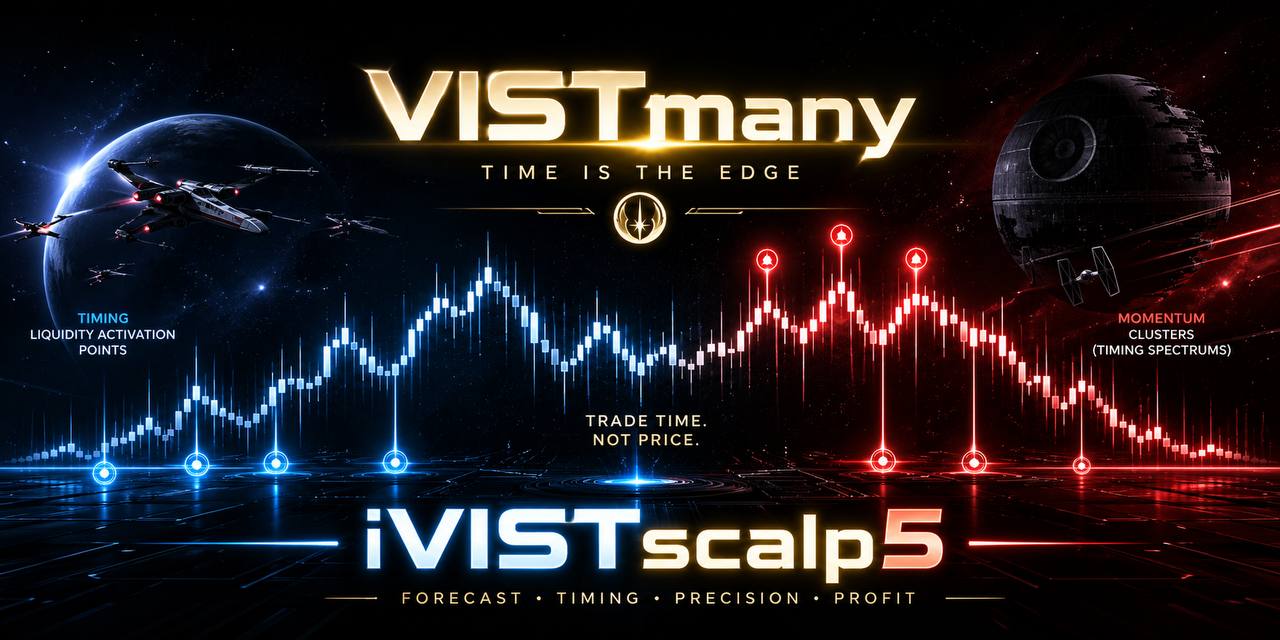
iVISTscalp5 indicator - Welcome to the world of time!
The system projects time, direction, and expected movement
through Liquidity Activation Points (timings). Timing-Based Market Forecasting System