

MQL5 Developer Gotchas (Part 1): A Parameter Mapper for Calling Indicators with Input Groups
 98
 0

Contents
- Introduction
- What the documentation and the forum say
- Section 1: The slots the terminal sees
- Section 2: What each slot accepts
- Section 3: What the shift does to a real indicator
- Section 4: IndicatorInputs.mqh, the mapper class
- Section 5: The Strategy Tester
- Section 6: The verification script
- Section 7: A consistency check in Python
- Using it in your own EA
- Limitations
- Conclusion
- Attached files
Introduction
When an EA calls a custom indicator through iCustom() or IndicatorCreate(), it must pass the inputs in the order the terminal expects. If the indicator uses input groups, that order differs from the one in the inputs dialog. Each group line takes a slot of its own. In my tests on builds 6204 and 6230, the terminal accepted a shifted list of numeric values without any error. The CIndicatorInputs class reads the slot order from a running indicator instance. You set each value by its input number. The class fills the group slots and, on a chart, reads the created handle back to check every value. In the Strategy Tester the terminal does not report the order. There the class builds the handle from a layout file saved on a chart, and that handle stays unverified.
BandsLite, the small bands indicator attached to this article, has four inputs in two groups. I called it with iCustom(..., 50, 2.5, 3, 80.0), the way the parameter list of iCustom() suggests. The handle was valid and nothing appeared in the journal. The indicator received a period of 2, a deviation of 3.0, and the defaults for the other two inputs. Over 4,577 bars of EURUSD H1 in 2026, the intended settings gave 32 signals and the call I actually wrote gave 0. An EA built on that call would compile, load, and run without ever opening a trade.
The article measures the problem first and then builds the class. It covers which values each slot accepts through both functions, including negative, out-of-range, and non-finite values. It also covers a Strategy Tester restriction and how the class works around it. There are 61 unit tests, a tester EA, and a Python script that repeats the main calculations as a consistency check.
This is Part 1 of a series on MQL5 code that compiles and runs but quietly does something other than what it says.
What the documentation and the forum say
The Input Variables page describes input groups as a way to visually separate parameters in the inputs dialog. The same page says that iCustom() parameters "should go in a strict accordance with the declaration of input variables" of the indicator. The iCustom() page says the type and order of the parameters must match. Neither page says that a group line takes a place in that order.
The forum found it anyway. In January 2024 a user reported the behavior as a bug with input group and iCustom(), with sample code, on build 4150. A few days later Dominik Egert wrote in the documentation errors thread that the terminal handles group lines as regular inputs, and that each one has to be passed as an empty string. In May 2025 Robert Northen asked whether input group affects the parameter array of IndicatorCreate() and confirmed that three inputs under two group lines need five MqlParam entries. He asked MetaQuotes to put the rule in the documentation, and the pages above still don't mention it.
So the rule itself is known to people who read the forum, and anyone can count the group lines by hand. Counting by hand needs the source code, however, and the count breaks quietly the day the author adds a group. I could not find a class that reads the layout from a running indicator. I also found no measurement of when the shift fails with an error and when it stays silent, and nothing that covered the Strategy Tester. Those three points are what this article adds.
Section 1: The slots the terminal sees
IndicatorParameters() returns the parameters of an indicator handle as an array of MqlParam. For a custom indicator the first entry is the file name, and one entry follows for every slot. I created a BandsLite handle with no parameters, so it ran with its defaults, and printed what came back. The group lines are there as strings of the form "@group 'Name'", in the same places as in the source. In the output, IcustomGroups\BandsLite is a path. IcustomGroups is the project folder under MQL5\Indicators, not a misspelling of iCustom().
//+------------------------------------------------------------------+
//| Inputs: 4 numbers in 2 groups                                    |
//+------------------------------------------------------------------+
input group  "Bands"
input int    InpPeriod      =20;                  // Moving average period
input double InpDeviation   =2.0;                 // Width in standard deviations
input group  "Signal"
input int    InpConfirmBars =2;                   // Closes outside the band before a signal
input double InpMinWidthPts =50.0;                // Skip bands narrower than this, points
IcustomGroups\BandsLite: 6 slots, 4 inputs, 2 groups
  slot  0  group     STRING        "@group 'Bands'"
  slot  1  input 0   INT           20
  slot  2  input 1   DOUBLE        2.0000
  slot  3  group     STRING        "@group 'Signal'"
  slot  4  input 2   INT           2
  slot  5  input 3   DOUBLE        50.0000
This is the layout the class works from. The slot numbers are what IndicatorCreate() and iCustom() count. The input numbers are what a person counts when reading the inputs dialog. Each group line above an input adds 1 to the gap between the two numbers.
Group lines are not the only extra slots. An indicator written with the short form of OnCalculate(), the one that receives a single price array, has an extra slot at the end for the applied price. InputEcho, the second test indicator, has five inputs in three groups and reports nine slots for that reason. SlotProbe, a third attached indicator, starts with an sinput variable and then has an empty group line. Both took a slot of their own, and the unit tests below set the sinput through the class like any other input.
The types in the reply are not always the declared ones. TypeSlots, the indicator used for the type tests in Section 2, has one group line and one input of each common type, followed by four narrower types. On build 6230 the reply described it like this:
IcustomGroups\TypeSlots: 13 slots, 11 inputs, 1 group
  slot  0  group     STRING        "@group 'Slots'"
  slot  1  input 0   INT           1
  slot  2  input 1   DOUBLE        1.0000
  slot  3  input 2   BOOL          0
  slot  4  input 3   STRING        "s"
  slot  5  input 4   INT           0
  slot  6  input 5   LONG          1577836800
  slot  7  input 6   UINT          0
  slot  8  input 7   UCHAR         1
  slot  9  input 8   SHORT         1
  slot 10  input 9   UINT          1
  slot 11  input 10  DOUBLE        1.0000
  slot 12  price     INT           1
The enum input comes back as INT, the datetime as LONG, the color as UINT, and the float as DOUBLE. On build 6230, the reply alone cannot distinguish an enum from an int, a datetime from a long, a color from a uint, or a float from a double. Section 4 shows how the class detects the float case and what it does about the others.
Section 2: What each slot accepts
TypeMatrix.mq5 creates TypeSlots 72 times per function. Each time it puts one of nine test values into one of the first eight slots, with valid values in the slots before it. It then reads the handle back to see what the terminal stored. On build 6204 I ran the matrix through IndicatorCreate() only. On build 6230 IndicatorCreate() and iCustom() gave the same result in all 72 cells, and both matched the build 6204 table below. A failed creation returned error 4002 in every case. The datetime test value is 1 January 2026, which is 1767225600 as a number.
| Slot | int 7 | long 9 | double 2.5 | double 3.0 | bool true | datetime | color red | string "abc" | string "12" |
|---|---|---|---|---|---|---|---|---|---|
| group line | kept | kept | kept | kept | kept | kept | kept | kept | kept |
| int | 7 | 9 | 2 | 3 | 1 | 1767225600 | 255 | 4002 | 4002 |
| double | 7.00 | 9.00 | 2.50 | 3.00 | 1.00 | 1767225600.00 | 255.00 | 4002 | 4002 |
| bool | 1 | 1 | 1 | 1 | 1 | 1 | 1 | 4002 | 4002 |
| string | 4002 | 4002 | 4002 | 4002 | 4002 | 4002 | 4002 | "abc" | "12" |
| enum | 7 | 9 | 2 | 3 | 1 | 1767225600 | 255 | 4002 | 4002 |
| datetime | 7 | 9 | 2 | 3 | 1 | 1767225600 | 255 | 4002 | 4002 |
| color | 7 | 9 | 2 | 3 | 1 | 1767225600 | 255 | 4002 | 4002 |
Within these 72 cells, three rules describe every result. A group slot accepts any value and keeps its own text. A string slot accepts only a string. Every other slot accepts any number and never a string. Along the way the fraction of a double is dropped in an integer slot, so 2.5 becomes 2 without a word. Any number other than 0 becomes true in a bool slot.
The 72 cells use small positive values only, so the same script also sends 24 edge values through both functions. Both functions gave the same result in all 24 cases, shown in the next table.
| Slot | Value sent | Stored by the terminal |
|---|---|---|
| int | int -5 | -5 |
| int | long 3000000000 | -1294967296 |
| int | double -2.5 | -2 |
| int | double 1e20 | -2147483648 |
| int | double NaN | -2147483648 |
| double | double NaN | NaN |
| double | double inf | inf |
| double | int -5 | -5 |
| bool | int -1 | 1 |
| bool | double 0.4 | 1 |
| string | empty string | empty, the indicator got 0 characters |
| string | 245 characters | 245 characters, the indicator got 245 |
| string | 246 characters | 245 characters, the indicator got 245 |
| enum | int 99 | 99 |
| enum | int -1 | -1 |
| datetime | long -1 | -1 |
| color | int -1 | 4294967295 |
| uchar | int 300 | 44 |
| uchar | int -1 | 255 |
| short | int 40000 | -25536 |
| uint | int -1 | 4294967295 |
| uint | long 5000000000 | 705032704 |
| float | double 1e40 | inf |
| float | double 0.1 | 0.1000000015 |
No edge value was refused, so the three rules about what loads still held. The stored values follow the usual C conversions. Integers wrap around, a double loses its fraction toward zero, and a double outside the int range becomes -2147483648. The bool 0.4 case was unexpected, since the value became true instead of losing its fraction and becoming 0. The terminal does not check an enum against its list, so 99 reached the indicator as a value the enum does not declare. Two results change values without any error: a float slot rounds to float precision, and a string slot keeps only the first 245 characters. TypeSlots writes the length of the string it received into a buffer, so the 245 is what the indicator itself saw, not only what IndicatorParameters() reported.
These rules cover the values in the two tables and nothing more. I did not test char, ushort, long, or ulong slots, and I did not try strings with characters outside the Latin range in a matrix cell.
What do the tables say about errors? Within this test set the terminal refused a handle only when a string met a numeric slot or a number met a string slot, with error 4002. So a shifted call to an indicator whose inputs are all numbers never produced 4002 here. A handle can still fail for reasons outside the matrix, such as a missing symbol, missing history, or a missing indicator file. A check inside the indicator's own OnInit() does not even make the handle invalid. NeedsInputs, attached for that case, refuses to start with its default period of 0. Its handle was valid, and BarsCalculated() stayed at -1.
The unit tests also checked a value placed past the last slot. A 7th value of 1 for BandsLite, which has six slots, was dropped and the handle loaded. A 7th value of 99 failed in both functions with error 4804, ERR_INDICATOR_CANNOT_APPLY. The terminal seems to read that position as the data source of the indicator, a price type or the handle of another indicator. I did not test that reading further.
Section 3: What the shift does to a real indicator
BandsLite is a plain Bollinger-style indicator. It draws a simple moving average with bands a number of standard deviations away. It marks a signal when price closes back inside after a number of closes outside. Figure 1 shows where the four values of the plain call end up, and where the same values end up with a placeholder in each group slot.
Where the values of iCustom(..., 50, 2.5, 3, 80.0) land
BandsLite: four inputs under two input group lines, six slots
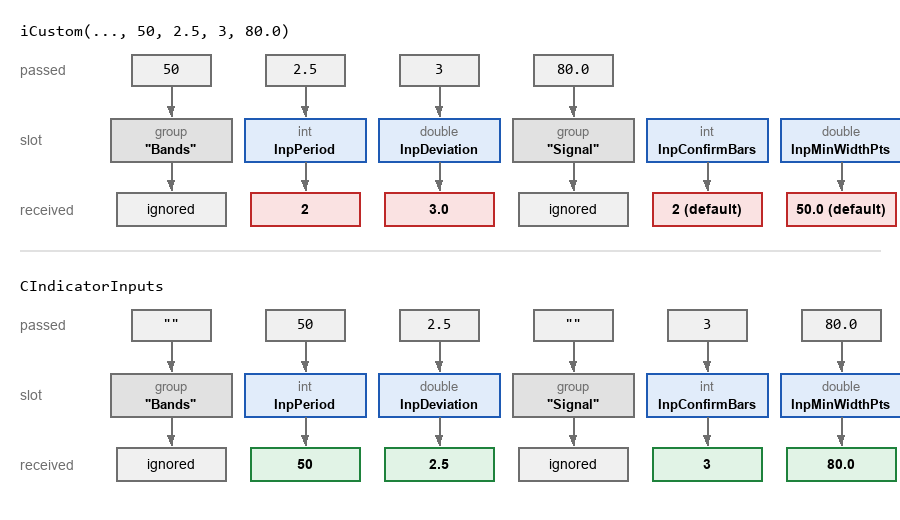
Fig. 1. The values of the plain call move one slot to the left at each group line, while the call with placeholders puts every value on its input
ShiftCost.mq5 creates both handles on EURUSD H1, copies their buffers over 2026 and counts the signals. The first two lines come from BandsLite itself, which prints its inputs in OnInit().
BandsLite received: period=2 deviation=3.00 confirm=2 min_width=50.0
BandsLite received: period=50 deviation=2.50 confirm=3 min_width=80.0
ShiftCost EURUSD PERIOD_H1, 4577 bars from 2026.01.02 to 2026.09.25
intended inputs: 18 buy and 14 sell signals, mean band width 1057 points
raw call:        0 buy and 0 sell signals, mean band width 171 points
signals on the same bar with the same side: 0
The 0 comes from the period of 2. With two closes, each close sits exactly 1 standard deviation from their mean. A band 3 deviations from the mean can never be crossed, so BandsLite with these inputs can never give a signal on any symbol. The bands are also far narrower and follow every bar. Figure 2 shows 150 bars in July.
EURUSD H1, 16 to 27 July 2026
The same indicator with the intended inputs and with the inputs the plain call delivered
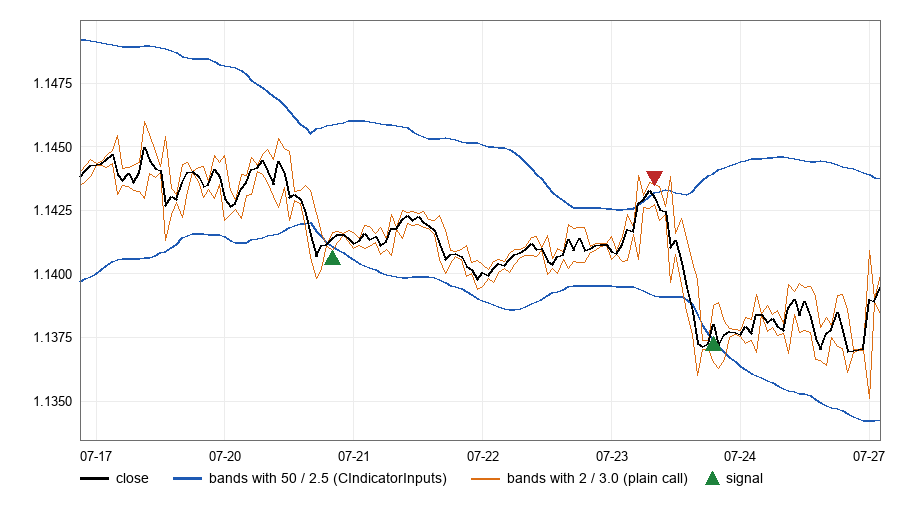
Fig. 2. The intended bands stay wide and give 3 signals in these 150 bars, while the bands from the plain call hug the close and give none
Band width on every bar of 2026
EURUSD H1, 4,525 bars from 6 January, 100-point bins, 41 intended bars wider than 3,000 points not shown
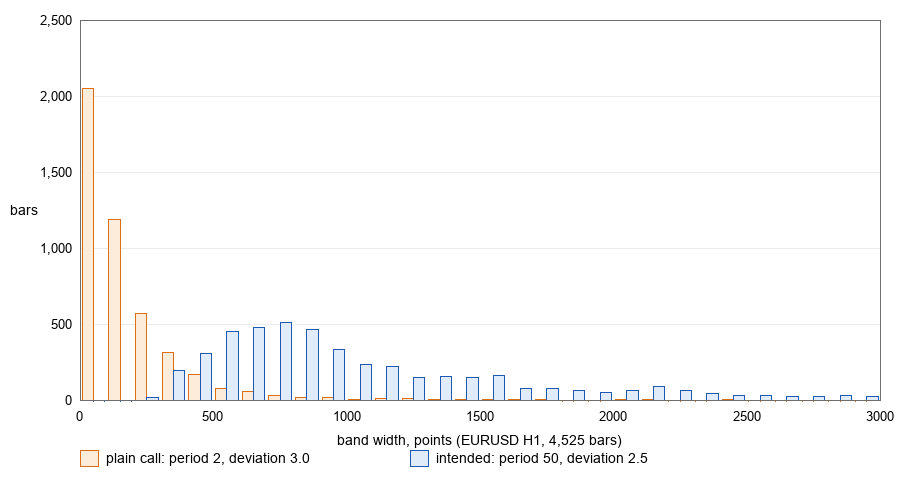
Fig. 3. Most bands from the plain call are under 300 points wide, while the intended bands spread from about 300 to over 2,000 points
BandsLite is one example. When numeric inputs sit under group lines and the call passes no placeholders, the indicator runs with values nobody chose. A call with "" in each group slot does not have the problem. How visible the damage is depends on how far the shifted values are from the intended ones.
Section 4: IndicatorInputs.mqh, the mapper class
CIndicatorInputs takes the counting away from the caller. It reads the layout from the terminal and lets the caller set values by input number. It fills the group slots itself and checks the handle when it is created. Figure 4 shows the whole path, including the tester branch from Section 5.
How CIndicatorInputs builds a handle
On a chart or in a script the layout comes from the terminal. In the Strategy Tester it comes from a file.
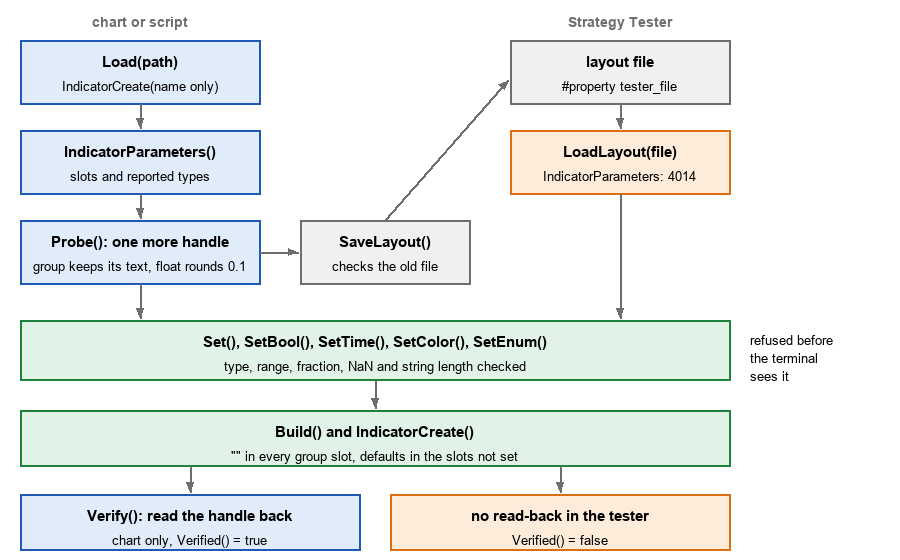
Fig. 4. Load reads the slots, Probe sorts out groups and float inputs, Set checks each value, and Create builds the handle. On a chart Verify reads it back, while the tester reads a saved layout and skips the read-back
//+------------------------------------------------------------------+ //| Builds the parameter list of a custom indicator by input number | //| and inserts a placeholder for every input group line | //+------------------------------------------------------------------+ class CIndicatorInputs { private: string m_path; // indicator path as given to iCustom() MqlParam m_slots[]; // every slot after the name, with its default bool m_group[]; // true when the slot is an input group line bool m_float[]; // a DOUBLE slot that rounds to float precision int m_input_slot[]; // input number -> slot number bool m_price_slot; // the last slot is the applied price bool m_verified; // the last handle was read back and matched int m_mismatch; // slots where the group text and the probe disagreed string m_error; // reason for the last failure static bool IsGroup(const MqlParam &p); static bool IsInteger(const ENUM_DATATYPE type); static bool Range(const ENUM_DATATYPE type,long &lo,long &hi); static string Number(const double value); static string Quoted(const string value); void Index(void); bool Probe(void); bool CheckInput(const int input_no,const bool is_string); bool CheckType(const int input_no,const ENUM_DATATYPE type,const ENUM_DATATYPE reported); bool Store(const int input_no,const long value); bool Same(const MqlParam &a,const MqlParam &b) const; public: //--- constructor: no layout yet CIndicatorInputs(void) : m_price_slot(false), m_verified(false), m_mismatch(0) {} //--- the layout: from a live handle, or from a file for the tester bool Load(const string path,const bool price_slot=false,const bool probe=true); bool SaveLayout(const string file_name) const; bool LoadLayout(const string file_name); //--- true when both layouts have the same slots, types, groups and defaults bool SameLayout(const CIndicatorInputs &other); //--- slots where the "@group '" text and the probe in Load() disagreed int PrefixMismatches(void) const { return(m_mismatch); } //--- number of inputs, not counting group lines or the price slot int Inputs(void) const { return(ArraySize(m_input_slot)); } //--- number of slots after the indicator name int Slots(void) const { return(ArraySize(m_slots)); } int Groups(void) const; int InputOf(const string group,const int position) const; string Describe(void) const; //--- the iCustom() call for the current values, with "" in every group slot string CallText(void) const; //--- reason for the last failure, empty after a success string LastError(void) const { return(m_error); } //--- true when Create() read the handle back and every input matched bool Verified(void) const { return(m_verified); } //--- values by input number bool Set(const int input_no,const long value); bool Set(const int input_no,const double value); bool Set(const int input_no,const string value); bool SetBool(const int input_no,const bool value); bool SetTime(const int input_no,const datetime value); bool SetColor(const int input_no,const color value); bool SetEnum(const int input_no,const int value); bool SetPrice(const ENUM_APPLIED_PRICE price); //--- the parameter array and the handle int Build(MqlParam ¶ms[]) const; int Create(const string symbol,const ENUM_TIMEFRAMES period); bool Verify(const int handle); };
Load() creates the indicator with nothing but its name, so every slot holds its default. It keeps whatever IndicatorParameters() returns. The caller has to say whether the last slot is an applied price, because nothing in the reply marks it. For a short-form indicator the price looks like any other int.
//+------------------------------------------------------------------+
//| Read the slot layout from a handle created with the defaults     |
//+------------------------------------------------------------------+
bool CIndicatorInputs::Load(const string path,const bool price_slot=false,const bool probe=true)
  {
   m_path      =path;
   m_price_slot=price_slot;
   m_mismatch  =0;
   m_error     ="";
   ArrayFree(m_slots);
   ArrayFree(m_group);
   ArrayFree(m_float);
   ArrayFree(m_input_slot);
//--- a handle with no inputs uses the defaults and reports every slot
   MqlParam name[1];
   name[0].type        =TYPE_STRING;
   name[0].string_value=path;
   ResetLastError();
   int handle=IndicatorCreate(_Symbol,PERIOD_CURRENT,IND_CUSTOM,1,name);
   if(handle==INVALID_HANDLE)
     {
      m_error=StringFormat("cannot load %s, error %d",path,GetLastError());
      return(false);
     }
   MqlParam got[];
   ENUM_INDICATOR type;
   ResetLastError();
   int n=IndicatorParameters(handle,type,got);
   int err=GetLastError();
   IndicatorRelease(handle);
//--- the Strategy Tester answers 4014 here, a saved layout is needed there
   if(n<1)
     {
      m_error=StringFormat("IndicatorParameters() returned %d for %s, error %d",n,path,err);
      return(false);
     }
//--- slot 0 of the reply is the indicator name, the inputs follow
   ArrayResize(m_slots,n-1);
   ArrayResize(m_group,n-1);
   ArrayResize(m_float,n-1);
   for(int s=0; s<n-1; s++)
     {
      m_slots[s]=got[s+1];
      m_group[s]=IsGroup(m_slots[s]);
      m_float[s]=false;
     }
//--- the text is a first guess, the probe decides
   if(probe && !Probe())
     {
      ArrayFree(m_slots);
      ArrayFree(m_group);
      ArrayFree(m_float);
      return(false);
     }
   Index();
   return(true);
  }
My first version decided which slots are groups by the text alone, a string value that starts with "@group '". That text format is not documented anywhere I could find. A regular string input whose default happens to start with the same text would also pass for a group. SlotProbe has such an input, and the text test counted three groups where there are two. So the text is now only a first guess. Probe() creates one more handle with a marker string in every string slot and 0.1 in every double slot. A group slot keeps its own text whatever it is given, which the matrix showed, while a string input takes the marker. A float input rounds 0.1 to 0.1000000015, which is how the class finds a float behind a DOUBLE type.
//+------------------------------------------------------------------+
//| One handle with a probe value in every string and double slot.   |
//| A group slot keeps its own text, a string input takes the probe. |
//| A float input is reported as DOUBLE and rounds 0.1 to float.     |
//+------------------------------------------------------------------+
bool CIndicatorInputs::Probe(void)
  {
   MqlParam params[];
   int n=Build(params);
   int last_input=(m_price_slot ? Slots()-1 : Slots());
   for(int s=0; s<last_input; s++)
     {
      if(m_slots[s].type==TYPE_STRING)
         params[s+1].string_value=II_PROBE_TEXT;
      if(m_slots[s].type==TYPE_DOUBLE)
         params[s+1].double_value=II_PROBE_REAL;
     }
   ResetLastError();
   int handle=IndicatorCreate(_Symbol,PERIOD_CURRENT,IND_CUSTOM,n,params);
   if(handle==INVALID_HANDLE)
     {
      m_error=StringFormat("the probe handle failed, error %d",GetLastError());
      return(false);
     }
   MqlParam got[];
   ENUM_INDICATOR type;
   int count=IndicatorParameters(handle,type,got);
   IndicatorRelease(handle);
   if(count!=n)
     {
      m_error=StringFormat("the probe handle reports %d slots, expected %d",count-1,n-1);
      return(false);
     }
   for(int s=0; s<last_input; s++)
     {
      if(m_slots[s].type==TYPE_STRING)
        {
         bool group=(got[s+1].string_value!=II_PROBE_TEXT);
         if(group!=m_group[s])
            m_mismatch++;
         m_group[s]=group;
        }
      if(m_slots[s].type==TYPE_DOUBLE)
         m_float[s]=(got[s+1].double_value!=II_PROBE_REAL);
     }
   return(true);
  }
IcustomGroups\SlotProbe: 5 slots, 3 inputs, 2 groups
  slot  0  input 0   INT           1
  slot  1  group     STRING        "@group 'Empty'"
  slot  2  group     STRING        "@group 'Real'"
  slot  3  input 1   INT           2
  slot  4  input 2   STRING        "@group 'Fake'"
  1 slot(s) where the group text and the probe disagreed, the probe was used
The probe rests on two observed behaviors, the group slot that keeps its text and the float rounding. A future build could change either one, and then the probe would sort the slots wrongly. PrefixMismatches() reports how many slots the text and the probe disagreed on, so a change in the group format at least shows up as a number.
Load() needs the indicator to be created with its defaults. NeedsInputs fails its own OnInit() with those defaults, and Load() still read all its slots, because the terminal creates the handle and reports the parameters even when the indicator refuses to calculate. However, NeedsInputs is a single case. An indicator whose handle can't be created at all, for example because the file is missing, can't be loaded.
The setters check the value against the slot before anything reaches the terminal. A number for a string input and a string for a numeric input are refused, since the terminal would answer with 4002 anyway. The other refusals cover the silent changes from the edge table. They refuse a fraction or an out-of-range number for an integer input, NaN and inf, a number beyond the float range for a float input, and a string over 245 characters.
//+------------------------------------------------------------------+
//| Set a double input, or a whole number into an integer input      |
//+------------------------------------------------------------------+
bool CIndicatorInputs::Set(const int input_no,const double value)
  {
   if(!CheckInput(input_no,false))
      return(false);
   int s=m_input_slot[input_no];
//--- NaN and inf are stored, but no read-back can confirm them
   if(!MathIsValidNumber(value))
     {
      m_error=StringFormat("input %d: %.8g is not a finite number",input_no,value);
      return(false);
     }
//--- the terminal would drop the fraction without a word
   if(IsInteger(m_slots[s].type))
     {
      if(value!=MathFloor(value) || MathAbs(value)>9.0e18)
        {
         m_error=StringFormat("input %d is %s, %.8g is not a whole number it can hold",input_no,
                              StringSubstr(EnumToString(m_slots[s].type),5),value);
         return(false);
        }
      return(Store(input_no,(long)value));
     }
//--- a float input keeps float precision, and 1e40 would become inf
   if(m_float[s] || m_slots[s].type==TYPE_FLOAT)
     {
      if(MathAbs(value)>FLT_MAX)
        {
         m_error=StringFormat("input %d is float, %.8g is outside its range",input_no,value);
         return(false);
        }
      m_slots[s].double_value=(double)(float)value;
     }
   else
      m_slots[s].double_value=value;
   m_slots[s].integer_value=(long)value;
   return(true);
  }
//+------------------------------------------------------------------+
//| Store a whole number if the slot keeps it without wrapping       |
//+------------------------------------------------------------------+
bool CIndicatorInputs::Store(const int input_no,const long value)
  {
   int  s=m_input_slot[input_no];
   long lo=0,hi=0;
   if(Range(m_slots[s].type,lo,hi) && (value<lo || value>hi))
     {
      m_error=StringFormat("input %d is %s, %I64d is outside %I64d..%I64d",input_no,
                           StringSubstr(EnumToString(m_slots[s].type),5),value,lo,hi);
      return(false);
     }
   m_slots[s].integer_value=value;
   m_slots[s].double_value =(double)value;
   return(true);
  }
SetBool(), SetTime(), SetColor(), and SetEnum() add a type check where the reply allows one. SetBool() needs a BOOL slot. SetTime() accepts a DATETIME or LONG slot, and SetColor() a COLOR or UINT slot, because build 6230 reported those types that way. SetEnum() needs an INT slot and can't check the enum range. So the type model stays partial. SetColor() on a uint input passes, and SetEnum(4, 99) passes as well.
Build() writes the array for IndicatorCreate(): the name first, then every slot, with an empty string in each group slot. The slots the caller never set keep the defaults read by Load(). Create() makes the handle and, outside the tester, calls Verify(). Verify() reads the new handle back and compares every input slot with what was set. A layout that no longer matches the indicator shows up there, not 3 weeks later in a backtest report.
//+------------------------------------------------------------------+ //| Fill the IndicatorCreate() array: the name, then every slot | //+------------------------------------------------------------------+ int CIndicatorInputs::Build(MqlParam ¶ms[]) const { int n=Slots()+1; ArrayResize(params,n); params[0].type =TYPE_STRING; params[0].string_value=m_path; for(int s=0; s<Slots(); s++) { params[s+1]=m_slots[s]; //--- a group slot takes any value, an empty string is the usual one if(m_group[s]) params[s+1].string_value=""; } return(n); }
//+------------------------------------------------------------------+
//| Create the handle and check that every input landed in place     |
//+------------------------------------------------------------------+
int CIndicatorInputs::Create(const string symbol,const ENUM_TIMEFRAMES period)
  {
   m_error   ="";
   m_verified=false;
   if(Slots()==0)
     {
      m_error="no layout, Load() has not succeeded";
      return(INVALID_HANDLE);
     }
   MqlParam params[];
   int n=Build(params);
   ResetLastError();
   int handle=IndicatorCreate(symbol,period,IND_CUSTOM,n,params);
   if(handle==INVALID_HANDLE)
     {
      m_error=StringFormat("IndicatorCreate() failed, error %d",GetLastError());
      return(INVALID_HANDLE);
     }
//--- IndicatorParameters() is not allowed in the Strategy Tester, the handle stays unverified
   if(MQLInfoInteger(MQL_TESTER) || MQLInfoInteger(MQL_OPTIMIZATION))
      return(handle);
   if(!Verify(handle))
     {
      IndicatorRelease(handle);
      return(INVALID_HANDLE);
     }
   m_verified=true;
   return(handle);
  }
My first version cleared m_verified only after IndicatorCreate() had succeeded. A failed Create() that followed a good one left Verified() returning true. Now the flag is cleared on the first line, and one of the unit tests covers the case.
The class has no idea what an input is called. MqlParam carries a type and a value, not a name. Describe() prints the layout with input numbers so you can match them to the inputs dialog once. InputOf() finds an input by its group name and position when the groups are named well.
CallText() turns the same layout into source text. It returns an iCustom() call with the current values and "" in every group slot. SaveLayout.mq5 prints that line. An EA that doesn't use the class can paste the line and still pass the values in the right order.
Section 5: The Strategy Tester
My first tester run of the EA below failed in OnInit(). Load() reported that IndicatorParameters() returned -1. TesterProbeEA.mq5 isolates the failure. It creates BandsLite and a built-in iMA. Then it calls IndicatorParameters() on both, once in OnInit() and once on the 100th tick.
2026.09.01 00:00:00   OnInit, BandsLite: IndicatorParameters()=-1, error 4014, BarsCalculated()=-1
2026.09.01 00:00:00   OnInit, iMA: IndicatorParameters()=-1, error 4014, BarsCalculated()=-1
2026.09.01 00:46:30   tick 100, BandsLite: IndicatorParameters()=-1, error 4014, BarsCalculated()=10317
2026.09.01 00:46:30   tick 100, iMA: IndicatorParameters()=-1, error 4014, BarsCalculated()=10317
Error 4014 is "function is not allowed for call". The result was the same for the custom indicator and for iMA, before and after they had calculated. The same restriction came up on the forum back in 2013, and build 6230 still has the restriction. So inside the tester the layout can't be read, and a created handle can't be verified either.
The class works around the first part with a file and can do nothing about the second. Tester support is therefore partial. SaveLayout.mq5 runs on a chart, loads the layout, prints the CallText() line, and writes the layout to MQL5\Files with SaveLayout(). The EA names that file in a tester_file property, so the tester copies the file to the agent. The EA then reads the file with LoadLayout().
IcustomGroups\BandsLite: 6 slots, 4 inputs, 2 groups
  slot  0  group     STRING        "@group 'Bands'"
  slot  1  input 0   INT           20
  slot  2  input 1   DOUBLE        2.0000
  slot  3  group     STRING        "@group 'Signal'"
  slot  4  input 2   INT           2
  slot  5  input 3   DOUBLE        50.0000

SaveLayout: iCustom(_Symbol,_Period,"IcustomGroups\\BandsLite","",20,2.0,"",2,50.0)
SaveLayout: the existing file matches the indicator
SaveLayout: written to MQL5\Files\IcustomGroups\BandsLite.layout.txt
//+------------------------------------------------------------------+
//| Expert initialization function                                   |
//+------------------------------------------------------------------+
int OnInit()
  {
   const string path="IcustomGroups\\BandsLite";
   if(InpUseMapper)
     {
      CIndicatorInputs in;
      //--- the tester can't read a layout from a handle, so it reads the saved file
      bool tester=(bool)MQLInfoInteger(MQL_TESTER);
      bool ok=(tester ? in.LoadLayout(path+".layout.txt") : in.Load(path));
      ok=ok && in.Set(0,(long)InpPeriod) && in.Set(1,InpDeviation) &&
         in.Set(2,(long)InpConfirm) && in.Set(3,InpMinWidth);
      if(ok)
         g_handle=in.Create(_Symbol,_Period);
      if(g_handle==INVALID_HANDLE)
        {
         Print("GroupCallerEA: ",in.LastError());
         return(INIT_FAILED);
        }
      PrintFormat("GroupCallerEA: handle from CIndicatorInputs, %s",
                  (in.Verified() ? "verified" : "layout from the saved file, not verifiable in the tester"));
     }
   else
     {
      g_handle=iCustom(_Symbol,_Period,path,InpPeriod,InpDeviation,InpConfirm,InpMinWidth);
      if(g_handle==INVALID_HANDLE)
         return(INIT_FAILED);
      Print("GroupCallerEA: handle from a plain iCustom() call");
     }
   g_trade.SetExpertMagicNumber(InpMagic);
   return(INIT_SUCCEEDED);
  }
Inside the tester Create() skips the read-back, so Verified() returns false, and the EA prints that the handle is not verifiable. A layout file written before the indicator changed would build a wrong array without any warning in the tester. SaveLayout.mq5 guards against that outside the tester. Before it writes, it loads the existing file and compares it with the running indicator through SameLayout(). To test the guard, I changed the default period of BandsLite from 20 to 25 in the terminal copy only, compiled it, and ran SaveLayout.mq5 against a copy of the good file.
SaveLayout: iCustom(_Symbol,_Period,"IcustomGroups\\BandsLite","",25,2.0,"",2,50.0)
SaveLayout: the existing file is OUT OF DATE (slot 1: the default changed)
The guard works only if you run SaveLayout.mq5 after each indicator change and before testing. The tester itself has no way to notice a stale file.
GroupCallerEA.mq5 trades BandsLite signals with a fixed stop and target of 250 points. I ran it twice on EURUSD H1 from 1 January to 26 September 2026, 1-minute OHLC, 10,000 USD, with no execution delay. The two runs differ only in InpUseMapper. Build 6204 and build 6230 gave the same numbers.
| Run | Handle | BandsLite received | Signals | Trades | Net profit, USD | Profit factor |
|---|---|---|---|---|---|---|
| InpUseMapper=true | CIndicatorInputs, layout from the file | 50, 2.50, 3, 80.0 | 32 | 31 | -226.66 | 0.55 |
| InpUseMapper=false | plain iCustom() | 2, 3.00, 2, 50.0 | 0 | 0 | 0.00 | no trades |
The 32 signals match ShiftCost. One of them, a sell on 23 July, came while the buy from 20 July was still open, so it gave no trade. The strategy itself lost money: 11 of the 31 trades reached the target. That is not what the run was for, and I didn't tune the strategy. The second row is the one that matters here. Its tester journal has no error and no warning, yet the EA placed no trade in 9 months.
Section 6: The verification script
TestIndicatorInputs.mq5 runs 61 checks on a chart. It uses BandsLite for the numeric case and InputEcho for a string input, an enum, a bool, and the price slot. SlotProbe covers the sinput and the look-alike string, NeedsInputs covers defaults that fail, and TypeSlots covers every setter and range. The main checks compare buffers as well as parameters. The handle from the class draws exactly the same upper band as a hand-written call with placeholders over 200 bars. The plain call loads without an error and draws a different one. The last part of the output covers the setters:
PASS  SetBool refused for an int input  (input 0 is INT, not BOOL)
PASS  SetColor refused for a datetime input  (input 5 is LONG, not COLOR)
PASS  3000000000 refused for an int input  (input 0 is INT, 3000000000 is outside -2147483648..2147483647)
PASS  5 refused for a bool input  (input 2 is BOOL, 5 is outside 0..1)
PASS  NaN refused for a double input  (input 1: -nan(ind) is not a finite number)
PASS  300 refused for a uchar input  (input 7 is UCHAR, 300 is outside 0..255)
PASS  40000 refused for a short input  (input 8 is SHORT, 40000 is outside -32768..32767)
PASS  -1 refused for a uint input  (input 9 is UINT, -1 is outside 0..4294967295)
PASS  1e40 refused for a float input  (input 10 is float, 1e+40 is outside its range)
PASS  246 chars refused for a string input  (input 3: 246 chars, the terminal keeps 245)
PASS  bool, enum, datetime, color, uchar, short, uint, float and 245 chars set
PASS  TypeSlots handle verified, float compared at float precision
PASS  SetEnum accepts 99, the enum range can't be checked
PASS  SetColor accepts a uint input, both are reported as UINT
custom indicator 'IcustomGroups\NoSuchIndicator' cannot load [4802]
PASS  a missing indicator fails with a reason  (cannot load IcustomGroups\NoSuchIndicator, error 4802)
PASS  Create after a failed Load fails  (no layout, Load() has not succeeded)
TestIndicatorInputs: 61 passed, 0 failed
These checks prove that the class does what it claims on build 6230. They don't prove anything about the terminal beyond the cases they run.
The first version of the script taught me something unrelated to input groups. I wrote each check as Check(name,in.Set(...),in.LastError()), and every reason printed one line late. The reason argument was evaluated before the call next to it, so it showed the error of the previous check. Now every call runs on its own line before Check(). The script has a comment about the trap for the next person who tidies it up.
Section 7: A consistency check in Python
crosscheck.py is a Python 3 script that uses only the standard library. It reads the files the MQL5 programs write and repeats the main calculations. It is not an independent reference. It applies the same rules this article states, so it catches slips in the MQL5 code and in my logs, not a wrong rule. It predicts all 72 main cells from the three rules in Section 2, and the 24 edge cells from the C conversions and the 245-character limit.
def predict(slot, value, precise):
    """(loads, stored) under the 3 rules plus the conversions."""
    kind, v = parse(value)
    is_string = kind == "string"
    if slot == "group":                      # rule 1: a group slot takes anything and keeps its own text
        return True, "kept"
    if slot == "string":                     # rule 2: a string slot takes only strings
        if not is_string:
            return False, ""
        if precise:
            n = min(len(v), MAX_STRING)
            return True, "%d chars, indicator got %d" % (n, n)
        return True, v
    if is_string:                            # rule 3: a numeric slot takes any number, never a string
        return False, ""
    if slot == "double":
        return True, show_real(float(v), precise)
    if slot == "float":
        x = float(v)
        if not math.isinf(x) and not math.isnan(x):
            x = float("inf") if abs(x) > 3.4028234663852886e38 else struct.unpack("f", struct.pack("f", x))[0]
        return True, show_real(x, precise)
    if slot == "bool":
        return True, "1" if v != 0 else "0"
    bits, signed = BITS[slot]
    return True, str(to_integer(v, bits, signed))
It then replays the plain call on the saved layout file slot by slot. Finally it recomputes both sets of bands from the closes in shift_cost.csv and counts the signals again with the BandsLite rule. Run on the files from this article, it printed:
main IndicatorCreate 72 of 72 cells match the rules
main iCustom         72 of 72 cells match the rules
main: the 2 APIs agree in 72 of 72 cells
edge IndicatorCreate 24 of 24 cells match the rules
edge iCustom         24 of 24 cells match the rules
edge: the 2 APIs agree in 24 of 24 cells
plain call on the saved layout: period=2 deviation=3.00 confirm=2 min_width=50.0
ok  period 50 dev 2.5: upper band max diff 0.000005, closes outside the bands 218, signals Python 17/14, MQL5 17/14
raw period 2 dev 3.0: upper band max diff 0.000000, closes outside the bands 0, signals Python 0/0, MQL5 0/0
The 0.000005 difference in the intended bands is the rounding of the CSV file, which stores prices with five digits. The recount skips the first 52 bars of 2026, because their bands need closes from December 2025 that the file doesn't hold. One of the 18 buy signals falls in those bars, which is why Python and MQL5 both show 17 there. The 0 closes outside the bands of the plain call is the period-of-2 argument from Section 3, checked on every bar.
Using it in your own EA
The change is small, and OnInit() of GroupCallerEA.mq5 in Section 5 shows the whole change. Replace the iCustom() call with a CIndicatorInputs object. Then set the values by input number, create the handle, and print LastError() if the handle comes back invalid.
Run Describe() once and compare it with the inputs dialog, so you know which input number is which. If the EA will be tested, run SaveLayout.mq5 for each indicator it calls, after every change to that indicator. Add a tester_file property for each layout file and load it with LoadLayout() when MQL_TESTER is set.
If you would rather not include the class, run SaveLayout.mq5 on the indicator and copy the line it prints. That line already has "" in every group slot. You then change the values in it by hand.
The class never opens the source file. IndicatorCreate() loads the compiled indicator, and IndicatorParameters() reads the slots from the running copy. I checked the .ex5 case on my own BandsLite only. I moved BandsLite.mq5 out of the terminal's Indicators folder and ran SaveLayout.mq5 on the .ex5 alone. It printed the same six slots and this call:
SaveLayout: iCustom(_Symbol,_Period,"IcustomGroups\\BandsLite","",20,2.0,"",2,50.0)
I have not tried an indicator bought on the Market or protected in another way. Such a file may behave differently, so the .ex5 result applies to an indicator compiled locally.
Indicators you write yourself allow a second option: leave out the input groups. The only cost is that the inputs dialog loses its headings.
Limitations
Everything here was measured on one terminal with MetaQuotes-Demo, first on build 6204 and again on build 6230. The main matrix and the tester runs gave the same results on both builds. The edge values, the reported types, the 245-character limit, and the 7th-value results come from build 6230 only.
Several results rest on behavior the documentation does not describe. They include the "@group '" text, the group slot that keeps its own text, the reported types, the float rounding, and the 245-character limit. A future build could change any of these. On a chart Verify() would then report a mismatch for a value that moved. However, a wrong group or float decision in Probe() can also shift the input numbers themselves, and only Describe() would show that.
The class knows slots, types, and defaults, but not the names of the inputs. The caller can still swap two inputs of the same type that sit next to each other, and Verify() would accept the result. The class can't tell an enum from an int, a datetime from a long, or a color from a uint, and it doesn't check an enum range.
Whether the last slot is an applied price has to be passed to Load(). I found no way to tell from the reply. A wrong flag shows up as one input too many or one too few in Describe().
Load() needs a handle created with the defaults. NeedsInputs showed that a refusal in OnInit() doesn't stop the layout from loading, but that is one indicator. An indicator whose handle can't be created with its defaults can't be loaded.
Tester support is partial. In the Strategy Tester the handle is not verified, because IndicatorParameters() is not allowed there. The tester relies on a layout file written earlier on a chart, and only SaveLayout.mq5, run outside the tester, can tell that the file is stale.
I tested custom indicators that take their inputs from iCustom() and IndicatorCreate() by value. I did not test indicators that receive another indicator's handle as their price source, indicators called on a custom symbol, or Market indicators. The two tables cover the listed values only.
crosscheck.py applies the rules from this article a second time. It checks the MQL5 results against a second implementation of the same rules, not against an outside reference.
Conclusion
On builds 6204 and 6230, every input group line in the five indicators I tested took a parameter slot in iCustom() and IndicatorCreate(). The documentation doesn't say so, and for numeric values the terminal didn't say so either. Within the tested values, a value that lands in the wrong numeric slot is accepted, and only a mix of strings and numbers gave error 4002. Some values change even in the right slot: integers wrap, floats round, and strings longer than 245 characters are cut. BandsLite called the obvious way ran for 9 months of EURUSD H1 with a period of 2 and produced no signal at all.
CIndicatorInputs reads the layout from a running indicator and probes which slots are groups or floats. It fills the group slots, refuses values the terminal would silently change, and checks the handle after it is made on a chart. For an EA that doesn't use the class, CallText() gives the same order as one ready iCustom() line. In the Strategy Tester, where IndicatorParameters() fails with error 4014, the class builds the handle from a layout file but can't verify it. SaveLayout.mq5 reports a stale file before the test.
The next part of the series looks at chart labels that stop at 63 characters without a warning.
To try it, unpack MQL5.zip into the terminal's data folder and compile the indicators first. Run TestIndicatorInputs.mq5, TypeMatrix.mq5, and ShiftCost.mq5 on a EURUSD H1 chart, and run SaveLayout.mq5 before testing GroupCallerEA.mq5. crosscheck.py reads the files they write to MQL5\Files\IcustomGroups.
Attached files
| # | Name | Folder | Description |
|---|---|---|---|
| 1 | IndicatorInputs.mqh | MQL5\Include\IcustomGroups\ | CIndicatorInputs: reads and probes the slot layout, fills the group slots, checks values and the handle, prints a ready iCustom() call, saves, loads, and compares layout files |
| 2 | BandsLite.mq5 | MQL5\Indicators\IcustomGroups\ | Bands indicator with four inputs in two groups, used in every example |
| 3 | InputEcho.mq5 | MQL5\Indicators\IcustomGroups\ | Test indicator that writes the values it received into its buffers |
| 4 | TypeSlots.mq5 | MQL5\Indicators\IcustomGroups\ | Test indicator with one group line, one input of each common type, and four narrower types |
| 5 | SlotProbe.mq5 | MQL5\Indicators\IcustomGroups\ | Test indicator with an sinput, an empty group, and a string input whose default looks like a group line |
| 6 | NeedsInputs.mq5 | MQL5\Indicators\IcustomGroups\ | Test indicator that refuses to start with its default input |
| 7 | TestIndicatorInputs.mq5 | MQL5\Scripts\IcustomGroups\ | Verification script, 61 checks with PASS or FAIL |
| 8 | TypeMatrix.mq5 | MQL5\Scripts\IcustomGroups\ | Which values each slot accepts through IndicatorCreate() and iCustom(), with edge values, saved as type_matrix.csv |
| 9 | ShiftCost.mq5 | MQL5\Scripts\IcustomGroups\ | BandsLite with the intended inputs against the plain call, saved as shift_cost.csv |
| 10 | SaveLayout.mq5 | MQL5\Scripts\IcustomGroups\ | Prints the layout of a custom indicator and a ready iCustom() call, reports a stale layout file, and saves the layout for the Strategy Tester |
| 11 | GroupCallerEA.mq5 | MQL5\Experts\IcustomGroups\ | Tester EA that trades BandsLite signals through the class or through a plain iCustom() call |
| 12 | TesterProbeEA.mq5 | MQL5\Experts\IcustomGroups\ | Shows what IndicatorParameters() returns inside the Strategy Tester |
| 13 | BandsLite.layout.txt | MQL5\Files\IcustomGroups\ | The BandsLite layout written by SaveLayout.mq5, read by GroupCallerEA.mq5 in the tester |
| 14 | crosscheck.py | MQL5\Files\IcustomGroups\ | Python 3 consistency check of the type tables, the shift, and the signals |
| 15 | MQL5.zip | Unpack into the terminal's data folder | All 14 files, with MQL5 as the root folder and an IcustomGroups subfolder in Include, Indicators, Scripts, Experts, and Files |
Every MQL5 file compiles with 0 errors and 0 warnings in MetaEditor build 6230. Tested on MetaTrader 5 build 6230, MetaQuotes-Demo, hedging account. crosscheck.py was run with Python 3.12.
Warning: All rights to these materials are reserved by MetaQuotes Ltd. Copying or reprinting of these materials in whole or in part is prohibited.
This article was written by a user of the site and reflects their personal views. MetaQuotes Ltd is not responsible for the accuracy of the information presented, nor for any consequences resulting from the use of the solutions, strategies or recommendations described.


