Nemesis Gold
- 专家
- 版本: 2.15
- 激活: 10

NEMESIS - gold grid system with built-in safety filters
Nemesis trades gold (XAUUSD) with nine independent modules, each active only during its own part of the trading day. It never uses a stop loss: a basket of trades is closed as a whole when price comes back above the average entry plus a small take-profit. Please read the capital and risk sections before buying.
QUICK FACTS
- Symbol: XAUUSD (gold) only. Chart timeframe: any (M1 is fine). One chart per account.
- Account: hedging, ECN/raw-spread type. Leverage 1:500 or higher (1:200 minimum).
- Trade frequency: about 2 positions per working day on average (roughly 30 to 45 baskets a month in recent years). Some days have no trade at all.
- Typical position lifetime: about 20 minutes. Largest basket seen in testing: 14 levels.
- Magic numbers: 1235 to 1246 (base 1234 + module). Order comments look like NEMESIS[T1/S02].
- A VPS is recommended: orders carry no server-side stop loss or take-profit, so the EA has to stay connected.
HOW IT WORKS
- Nine independent modules, each active only during its own part of the trading day, with a mix of buy and sell logic.
- A module opens a basket when its entry conditions are met. If price moves against the basket, it adds levels at fixed distances. The basket is closed only in profit.
- Built-in safety filters block new entries on high-risk days: major economic events such as FOMC (read live from the MetaTrader economic calendar, with an internal backup), the first Friday of the month, Good Friday, the year-end period and Friday evenings. A spread filter and a floating-loss guard stop new baskets in bad conditions.
- Position size follows the account balance (a multiplier input scales it) with a hard cap per order.
- On-chart dashboard: status, per-module results, balance, equity, floating drawdown and next entry window.
CAPITAL (my recommendation, based on tests; not a guarantee)
- Minimum: 300 USD. This is the lowest amount I would consider; at this size the minimum lot of 0.01 is large compared with the account and a deep basket can wipe it out. Use the cautious multiplier (InpRiskMult 1.0) and expect to be close to the limit.
- Recommended: 500 USD. This is the size I tested most with the default settings.
- Comfortable: 1000 USD or more on an ECN account. A larger balance gives more room for the grid and smoother behaviour. With the default multiplier the lot is roughly 0.01 per 400 USD of balance (about 0.03 lot at 1000 USD).
- Only risk money you can afford to lose. The grid has no stop loss, so a sharp one-way move can cost most of the account.
BROKER AND ACCOUNT
- Developed and tested on a PU Prime ECN-type account (gold symbol with a .p suffix). I have not tested other brokers, so please run it on a demo first.
- What matters: raw spread plus commission. Gold spread ideally 7 to 15 points with commission up to about 7 USD per lot round trip. The system stayed stable in my tests up to a total round-trip cost of about 16 points and broke down above roughly 18-20 points. Standard accounts with wide spreads gave much worse results and much deeper drawdowns; I do not recommend them.
- Server time: the entry windows assume a broker server at GMT+2, switching to GMT+3 with US daylight saving (typical of New York-close brokers). On another server time the windows are shifted and the EA will lose money. Check this first.
- Required: hedging account, market execution, minimum lot 0.01, lot step 0.01, gold quoted with 2 decimals (the spread filter counts in points of 0.01).
- Execution speed is not critical: in my tests a delay of up to 500 ms changed results by only a few percent.
SETTINGS BY PROFILE
- Default (ECN account, 500 USD or more): InpRiskMult 1.5. This is the setting I tested most. 1.75 is the upper limit; higher values left too little margin in my tests.
- Cautious (small account or lower risk): InpRiskMult 1.0. Smaller lots, smaller drawdowns, lower gains.
- Other inputs: InpMaxLot (cap per order, default 10), InpFlatLoss (no new basket if floating loss exceeds this percent of balance, default 10), InpDashboard and InpDashScale (dashboard, default size 130 percent).
- Do not change the strategy inputs unless you know what you are doing; the defaults are the tested ones.
WHAT TO EXPECT (BACKTEST, NOT LIVE)
Real-tick tests on a 2 USD per lot commission ECN account, 1000 USD start each year, default settings, short execution delay:
2021: +206 percent, max equity drawdown 13 percent
2022: +260 percent, 37 percent
2023: +227 percent, 58 percent
2024: +600 percent, 45 percent
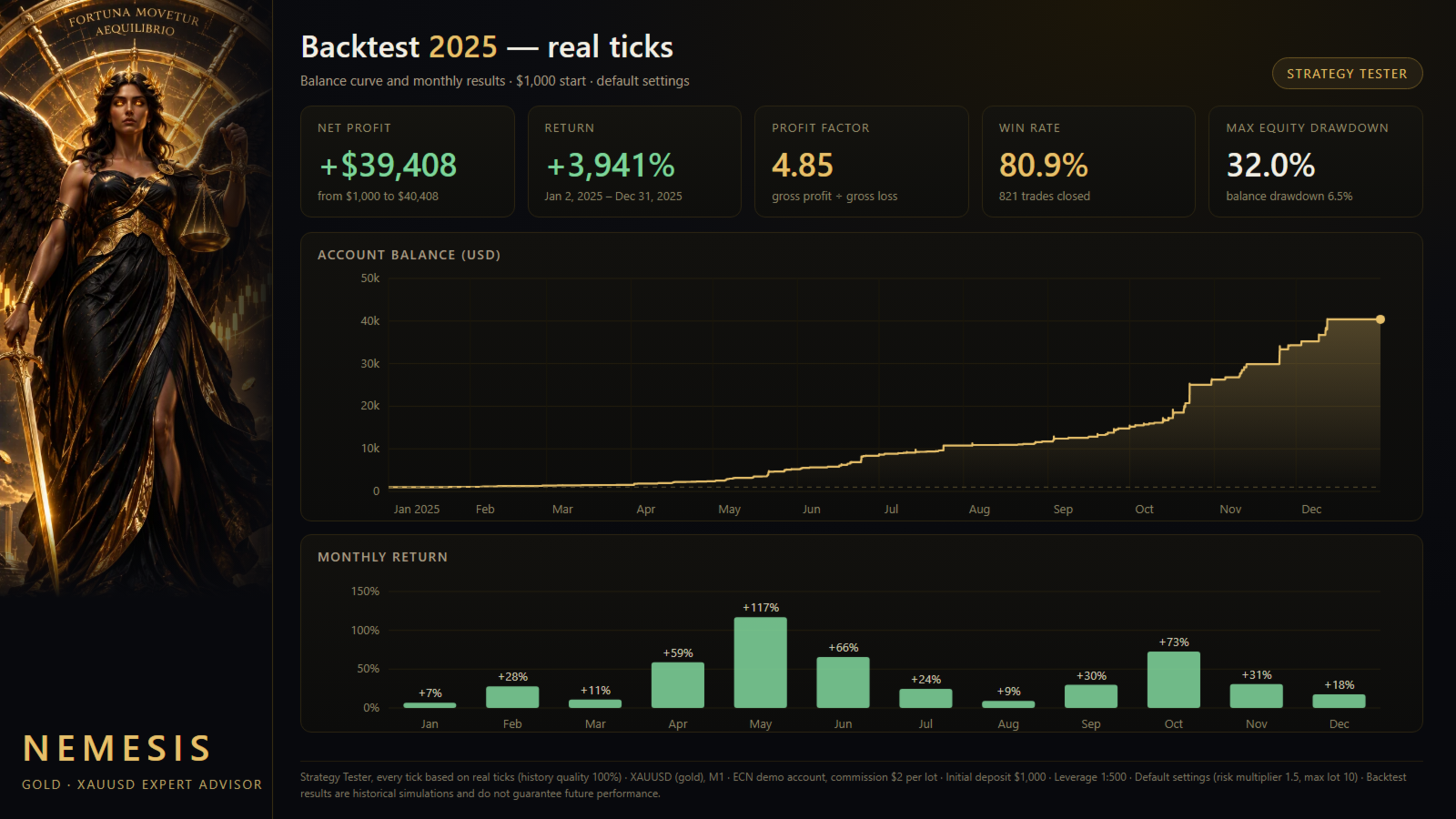
2025 and 2026 (to September): much higher, with 32 and 18 percent drawdown, mostly thanks to reinvestment during a very strong gold rally.
Typical win rate per position: 75 to 85 percent. Across 28 rolling 12-month windows from 2019 to 2026 the worst drawdown was about 63 percent. Expect real drawdowns of this size. Results are strongly tied to gold's long uptrend and may be much weaker in a different market regime. Live results will differ because of spreads, slippage and swaps.
RISK WARNING
Grid and averaging systems without a stop loss can suffer very large drawdowns. Past performance, and especially backtests, do not guarantee future results. This is not financial advice. Trade only with money you can afford to lose.
FAQ
Can I use it on other symbols? No, it is built for gold only.
Does it work on a netting account? No, use a hedging account.
Does it use martingale? Lot size does not increase from one level to the next, but it does average down without a stop loss, so treat it as a high-risk system.
Why no trades today? Check the dashboard: it shows whether the day is blocked (FOMC, first Friday, year-end pause) or when the next window opens.
Can I run it on several accounts? Yes, one chart per account.
Questions are welcome in the comments.