RangeStrike MT5
- Uzmanlar
- Sürüm: 1.159
- Etkinleştirmeler: 5

Range Detection • Dynamic Reversal Entry • Alternating Reversal Engine
RangeStrike MT5 is an automated trading system created to identify meaningful price expansions, wait for a controlled reversal and then manage the entire trading cycle through a dynamic sequence of alternating positions.
Instead of entering the market immediately after a conventional indicator signal, RangeStrike lets the market move first.
The EA observes price structure, detects when the market has traveled a significant distance and prepares a pending order behind the movement. If price continues in the same direction, the pending order follows it. When the market reverses, the pending order stops moving and waits to be triggered.
From that moment, the most distinctive feature of RangeStrike begins:
The heart of RangeStrike: Alternating Reversal Engine
After the first position is activated, the EA continuously monitors the distance between the current market price and the latest position opened.
Whenever price moves the configured distance against the latest position, RangeStrike opens a new position in the opposite direction, using the configured lot multiplier.
A theoretical sequence may look like this:
BUY 0.01
↓ Price moves against the BUY
SELL 0.02
↑ Price reverses upward
BUY 0.04
↓ Price reverses downward again
SELL 0.08
↑ Price reverses again
BUY 0.16
And the sequence can continue:
BUY → SELL → BUY → SELL → BUY...
Each new position is based on the most recent market reversal, not on a fixed grid placed in advance.
The objective is to progressively increase the weight of the newest position so that, when the market eventually stops oscillating and develops a stronger directional movement, the latest position has greater influence on the total basket result.
How the initial RangeStrike entry works
By default, RangeStrike analyzes the 10 most recent candles, including the current candle.
The EA identifies:
- the lowest low;
- the highest high;
- the distance between those extremes;
- and which extreme occurred first.
When the distance reaches the configured range — 1,000 points by default — the EA recognizes that a significant movement has occurred.
If the lowest point occurred first and the market traveled upward, RangeStrike prepares a Sell Stop below the market.
If the highest point occurred first and the market traveled downward, RangeStrike prepares a Buy Stop above the market.
The default distance between the market and the pending order is 500 points.
Dynamic trailing pending order
The initial pending order is not static.
During an upward movement:
the Sell Stop moves upward behind price.
During a downward movement:
the Buy Stop moves downward behind price.
As long as the market continues moving in the same direction, the pending order follows.
When price begins to reverse, the order does not move away from the market anymore.
It remains in place waiting for price to reach it.
This allows RangeStrike to attempt an entry after the expansion begins to reverse, rather than entering directly into the original impulse.
The “back-and-forth” trading cycleOnce a market position exists, RangeStrike no longer uses the initial candle-range logic.
The system now manages the latest position.
For example, with an opposite-order distance of 1,000 points:
First position
BUY 0.01
If price falls 1,000 points:
First reversal
SELL 0.02
If price rises 1,000 points from the SELL entry:
Second reversal
BUY 0.04
If price falls another 1,000 points:
Third reversal
SELL 0.08
If price rises again:
Fourth reversal
BUY 0.16
This alternating mechanism continues automatically according to the configured parameters.
RangeStrike does not need to predict which direction will ultimately win.
It reacts to the actual movement of the market.
Basket recovery and closing systemWhen several positions are open, RangeStrike treats them as one trading basket.
The EA continuously calculates the combined floating result.
When the basket recovers the accumulated loss and returns from negative territory to breakeven or profit, RangeStrike records the market price.
From that point, the EA waits for an additional favorable movement.
When the configured number of additional points is reached and the basket remains profitable, all positions are closed together.
Therefore, the trading cycle can be summarized as:
Expansion → Reversal Entry → Alternating Reversals → Breakout/Directional Move → Basket Recovery → Close
First-position profit targetIf the first trade moves immediately in the correct direction and no recovery position is required, RangeStrike can close that trade using an independent profit target.
This allows successful initial trades to finish without unnecessarily starting an alternating recovery sequence.
Adaptive margin protectionRangeStrike includes an internal margin-protection system.
Before starting a new cycle, the EA can simulate several possible stages of the alternating sequence.
If the configured initial volume would create excessive projected margin pressure, RangeStrike can automatically reduce the initial lot size.
If even the minimum volume allowed by the broker would not provide sufficient projected margin safety, the EA can wait instead of starting a cycle that the account may not be able to support.
The system also checks real margin conditions before sending subsequent market orders.
Broker-aware executionRangeStrike automatically considers important symbol and broker specifications, including:
- minimum and maximum lot size;
- volume step;
- pending-order restrictions;
- Stop and Freeze levels;
- execution and filling policies;
- available margin.
This helps the EA adapt to different MT5 trading environments.
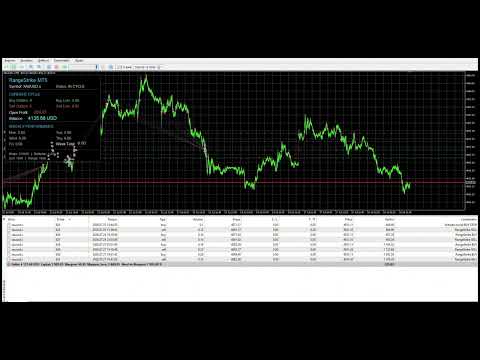
On-chart information panelRangeStrike displays useful information directly on the chart:
- current symbol;
- number of BUY positions;
- total BUY volume;
- number of SELL positions;
- total SELL volume;
- current floating profit/loss;
- closed profit for the current day.
Initial lot size
Starting volume of the trading cycle.
Distance between opposite orders
Distance the market must travel against the latest position before the opposite position is opened.
Lot multiplier
Controls the volume increase of each new alternating position.
Basket TP after breakeven
Additional price movement required after the basket recovers its previous loss.
TP for the first standalone order
Independent target for the first position when no recovery sequence has started.
Number of candles to analyze
Number of candles used to detect the initial price expansion.
Required range
Minimum distance between the lowest low and highest high.
Initial STOP distance
Distance between current price and the first pending order.
Automatic margin protection
Allows RangeStrike to adapt the initial volume to available account margin.
RangeStrike is designed primarily for MT5 Hedging accounts, because its alternating mechanism requires BUY and SELL positions to coexist on the same symbol.
The system may use increasing position volumes during an alternating recovery sequence.
This can create significant exposure and drawdown during prolonged, volatile or unfavorable market conditions.
Margin protection can help control risk, but it cannot eliminate the possibility of losses, drawdown or Stop Out.
Before live trading, users should perform backtests and forward tests using the actual symbol specifications, leverage, spread and trading conditions of their broker.
Recommended Timeframes
M5 and M15 are the recommended timeframes for RangeStrike.
In our testing, the EA showed its best overall behavior on these periods, combining good sensitivity to price expansion with sufficient market structure for the alternating reversal system.
RangeStrike uses the candles from the current chart timeframe for its initial range detection. Therefore, the selected timeframe directly affects how the EA interprets market movement.
With the default 10-candle setting:
M5 = approximately 50 minutes of market structure
M15 = approximately 150 minutes of market structure
Very short timeframes may increase sensitivity to market noise, while higher timeframes may produce fewer signals and much wider price movements.
For this reason, M5 and M15 are recommended as the primary starting timeframes, although users are encouraged to perform their own backtests on other periods.
Past performance does not guarantee future results.