ZAAD Moving Average
- Эксперты
- Abd Al Mouhemen Mo Haj Madoun
- Версия: 205.0
- Активации: 5
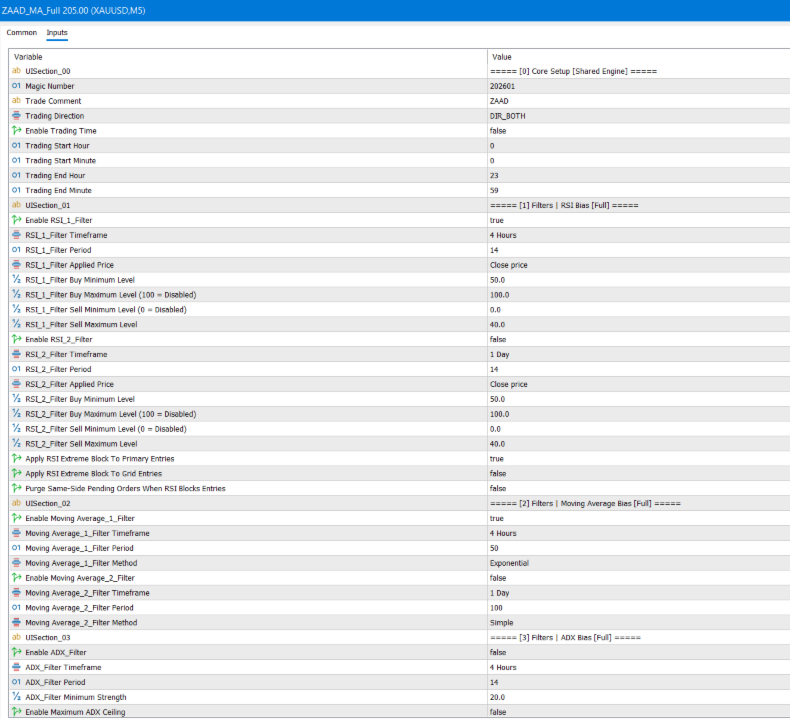
The Moving Average strategy inside the ZAAD expert is designed to give traders a structured way to trade direction, trend continuation, and momentum shifts using one of the most widely understood tools in technical analysis: the moving average. Instead of treating the moving average as a simple line on the chart, ZAAD uses it as a decision framework. It helps define whether the market is in a bullish or bearish state, whether price is aligned with momentum, and whether a new entry is taking place in a location that makes sense rather than in random market noise.
At its core, the idea is simple. A moving average smooths price over a chosen number of candles. This smoothing removes part of the short-term noise and gives a clearer picture of the dominant path of the market. If price is above the moving average, that often suggests upward directional strength. If price is below it, that often suggests downward directional strength. But inside ZAAD, the moving average strategy becomes more useful because it is not working alone. It operates inside a larger framework that includes execution modes, pending-order logic, grid expansion, protection systems, lot sizing logic, and optional filters such as ADX and Stochastic. This means the strategy is not only about detecting direction, but also about deciding how the trade should be placed, how additional entries behave later, and how risk stays controlled if market conditions change.
One of the strengths of using the Moving Average strategy through ZAAD is that it transforms a very familiar indicator into a more disciplined trading engine. Many traders use moving averages manually in a loose way, for example by saying “price is above the MA, so maybe I should buy.” ZAAD makes this much more systematic. The expert applies a defined set of rules to decide when a signal is valid, how that signal interacts with the selected filters, whether the first entry should happen at market or through a pending order, and whether future grid activity is still allowed under the active conditions. This gives the trader consistency. Instead of interpreting the same moving average differently every day, the expert applies the same logic each time.
In practical trading terms, the Moving Average strategy is especially useful in directional markets. When the market is trending, moving averages can act as a guide for trend bias and dynamic support or resistance. For example, in a bullish market, price may repeatedly pull back toward the moving average and then continue higher. In a bearish market, price may rise toward the moving average and then rotate back downward. ZAAD can use this structure to help identify whether the market is still behaving in a way that supports the chosen direction. This is important because a trend strategy performs best when it enters in harmony with price flow, not when it blindly enters after a move is already exhausted.
The trader also benefits from flexibility. Different moving average settings can completely change the personality of the strategy. A shorter moving average reacts more quickly to price and can produce faster entries, but it is also more sensitive to noise. A longer moving average reacts more slowly and usually gives fewer signals, but those signals may reflect a broader trend structure. Likewise, the moving average method matters. An exponential moving average often reacts faster to newer price data, while a simple moving average can appear smoother and less reactive. This allows the trader to adapt the strategy to different market styles, symbols, and timeframes.
Another important advantage of the Moving Average strategy inside ZAAD is that it can work well with confirmation filters. For example, the trader may allow entries only when ADX confirms that the market has enough strength, or when Stochastic does not show an already overstretched condition. In that case, the moving average gives the directional framework, while the filters help avoid weak or late entries. This is especially useful because many losing trend trades happen not because the trend idea was wrong, but because the entry came too late, too stretched, or in a weak environment. ZAAD helps reduce that problem by letting the strategy and the filters work together instead of relying on one tool only.
The execution side also matters. A Moving Average signal in ZAAD is not limited to one fixed entry style. Depending on the chosen execution mode, the first trade can be placed at market, as a pending order, or as a combined market-and-pending structure. This gives the trader more control over aggressiveness. If the trader wants immediate participation, market execution may be preferred. If the trader wants better price placement and more patience, pending execution can be more appropriate. This makes the strategy more adaptable to different personalities and trading plans.
From a portfolio perspective, the Moving Average strategy is also valuable because it is easy to understand, easy to explain, and easy to test. Traders often trust strategies more when they can clearly understand why entries happen. With a moving average, the logic is intuitive: trend location, alignment, continuation, and structure. That clarity is important, especially when the strategy is being used inside a more advanced framework like ZAAD. A trader does not need to feel lost inside a black box. The moving average becomes a visible anchor that explains why the expert is behaving in a certain way.
In summary, the Moving Average strategy in ZAAD is more than a simple indicator trigger. It is a trend-structured entry system embedded inside a broader professional framework. It helps define directional bias, supports continuation-style trading, works well with confirmation filters, and integrates naturally with pending entries, grid logic, and protection tools. For traders who want a strategy that is simple in concept but stronger in execution, the Moving Average strategy can be one of the most practical and stable components of the ZAAD framework.