HCS RiskGauge
- 유틸리티
- 버전: 1.0
- 활성화: 10

HCS RiskGauge is a read-only daily account risk monitor for MetaTrader 5.
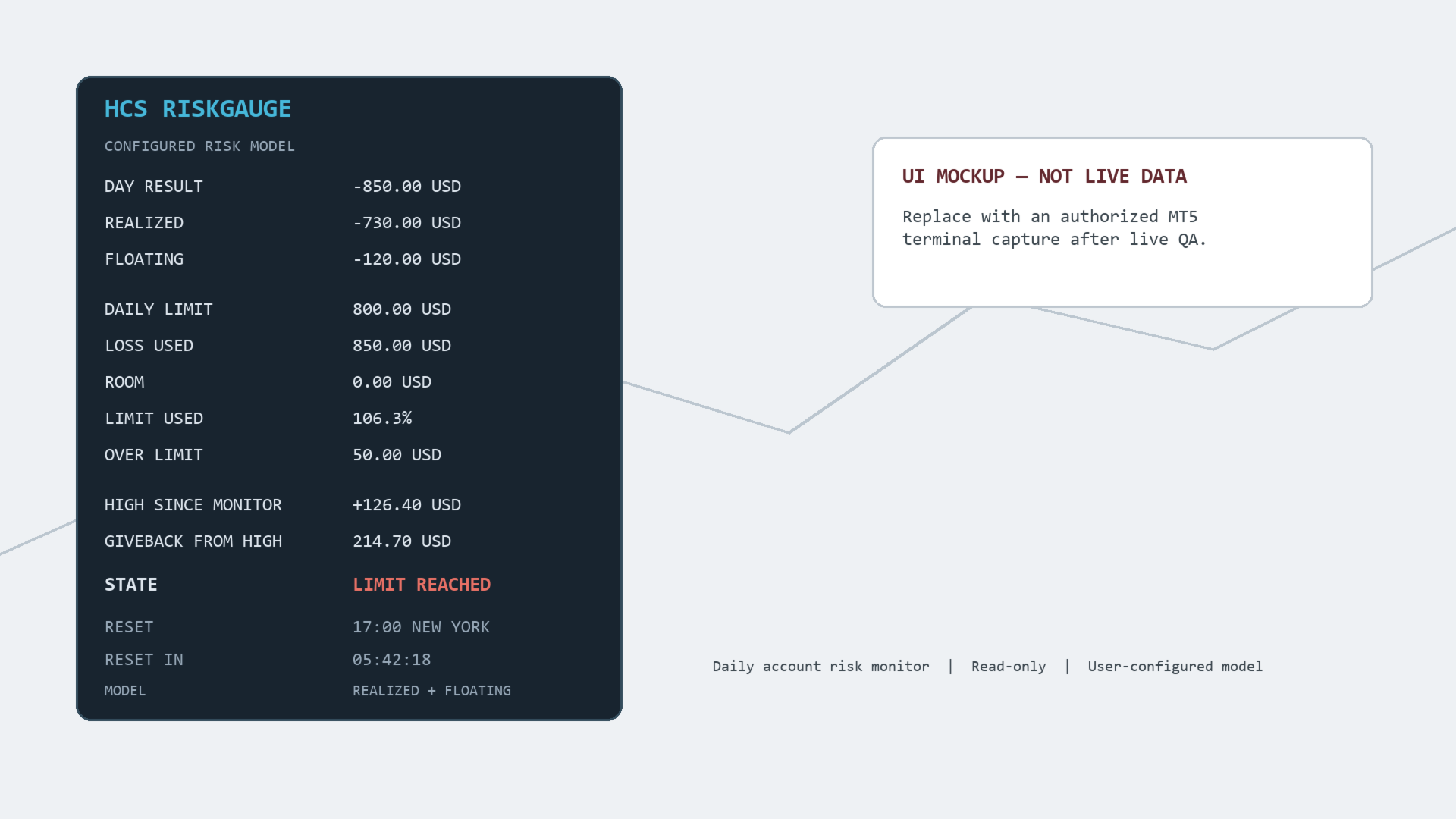
RiskGauge shows where the current MT5 account stands relative to a daily loss boundary you configure. Its compact on-chart panel keeps the current risk window visible while you trade.
The panel displays:
• Day Result
• Realized P/L
• Floating P/L
• Daily Loss Limit
• Loss Used
• Remaining Room
• Limit Used percentage
• Over Limit amount
• High Since Monitor
• Giveback From High
• Current State
• Reset reference and countdown
• Selected risk calculation model
CONFIGURE YOUR RISK MODEL
Choose between:
REALIZED ONLY
or
REALIZED + FLOATING
Set a positive daily loss boundary in your account currency and choose when your monitoring day resets.
Supported reset references:
• MT5 Server Time
• UTC
• Local Computer Time
• New York
• London
New York and London use built-in daylight-saving-time rules without requiring a network connection.
ACCOUNT-WIDE MONITORING
RiskGauge monitors the full signed-in MT5 account from a single chart.
Realized trade P/L is reconstructed from MT5 deal history for the current configured risk window. Current floating P/L is displayed separately and can optionally be included in Day Result.
RiskGauge then calculates how much of the configured loss boundary has been used, how much room remains, the percentage used, and any amount beyond the configured boundary.
DISPLAY STATES
RiskGauge provides textual reference states:
NORMAL
CAUTION
NEAR LIMIT
LIMIT REACHED
These states describe the account relative to the user-configured model.
They are informational only and do not trigger protective action.
BROKERAGE AND PROP-FIRM AGNOSTIC
Users configure the reset boundary, daily loss limit, and calculation model to reflect their own brokerage, prop-firm, evaluation, or personal risk framework.
HCS does not represent that any configuration reproduces a brokerage or prop firm's official account calculations. Users should configure RiskGauge according to the rules applicable to their own account.
FEATURES
• Account-wide fixed daily-loss boundary in account currency
• Current-window realized trade P/L from MT5 deal history
• Current whole-position floating P/L
• Realized-only or realized-plus-floating calculation model
• Remaining Room
• Loss Used
• Limit Used percentage
• Over Limit amount
• High Since Monitor
• Giveback From High
• Textual risk states
• Server, UTC, Local, New York, and London reset references
• Automatic reset countdown
• Timer-based reset without reliance on incoming price ticks
• Mid-window history reconstruction
• Restart-safe monitor high
• Compact configurable chart panel
READ-ONLY BY DESIGN
RiskGauge observes only.
It does not:
• Place trades
• Close trades
• Modify trades
• Block trades
• Change Algo Trading
• Generate entry signals
• Enforce brokerage or prop-firm rules
INPUTS
• Daily Loss Limit
• Risk Calculation Model
• Reset Reference
• Reset Hour
• Reset Minute
• Caution Threshold
• Near Limit Threshold
• Panel Corner
• X/Y Position
• Font Size
IMPORTANT CALCULATION NOTES
Realized P/L includes BUY/SELL deal profit, commission, swap, and fee fields recorded by MT5.
Separate non-trade cash flows, credits, corrections, bonuses, and reversals are excluded.
Floating P/L represents the current whole-position value, including positions that may have been opened before the configured reset.
Historical floating values cannot be reconstructed before RiskGauge begins monitoring, so High Since Monitor is explicitly scoped to the current monitoring period.
INSTALLATION
Install HCS RiskGauge from MQL5 Market and attach it to one chart.
Configure the daily loss limit, calculation model, and reset reference appropriate for the account.
Because RiskGauge monitors the signed-in account rather than an individual symbol, only one instance is required per MT5 account.
No WebRequest, DLL, telemetry, external service, or network dependency is used.
HCS RiskGauge is an informational risk-monitoring utility and is not a trading recommendation or guarantee of compliance with any brokerage, evaluation, or prop-firm rules.