I've been trading XAUUSD for 12 years. During that time, I've tried more gold indicators than I can count — free ones, paid ones, custom-built ones.
Most of them share the same fundamental problems. And those problems cost you money.
Today I'm going to break down the 5 biggest mistakes I see in gold indicators on MQL5 Market — and explain how I designed KURAMA GOLD SIGNAL PRO (KGS) to avoid every single one of them.
Problem #1: Too Many Signals, No Quality Filter
This is the most common issue. Open the chart, apply the indicator, and within an hour you have 10+ arrows pointing in every direction. 
It feels like more signals = more opportunities. But in reality, more signals = more bad trades.
Gold is volatile. On any given M15 chart, you can find dozens of places where price touches a moving average, breaks a support level, or forms a candlestick pattern. If your indicator fires a signal at every one of them, most of those entries will fail.
The problem isn't detecting setups. That's easy. The problem is knowing which setups to skip.
How KGS solves this:
Every signal runs through 7 independent filters before it appears on your chart. RSI, MA angle, trend direction, ATR volatility, H4 timeframe confirmation, session timing, and MA convergence — all checked automatically. Signals that don't pass get blocked. You never see them.
On top of that, every signal that does pass gets a Quality Score:
- ★★★ = All conditions perfect
- ★★ = Conditions good, normal entry
- ★ = Conditions marginal, consider skipping
Your job is simple: only trade ★★ and ★★★. The indicator already filtered out the garbage.
Problem #2: No Session Awareness
Gold doesn't move the same way at 3 AM and 3 PM.
During the Asian session, XAUUSD typically trades in a $5-$10 range with thin liquidity. Spreads widen. Fake moves happen. Yet most indicators will happily fire buy and sell signals during these dead hours.
Then London opens, volatility explodes, and the real moves begin. But by then, you're already stuck in a losing position from an Asian session signal.
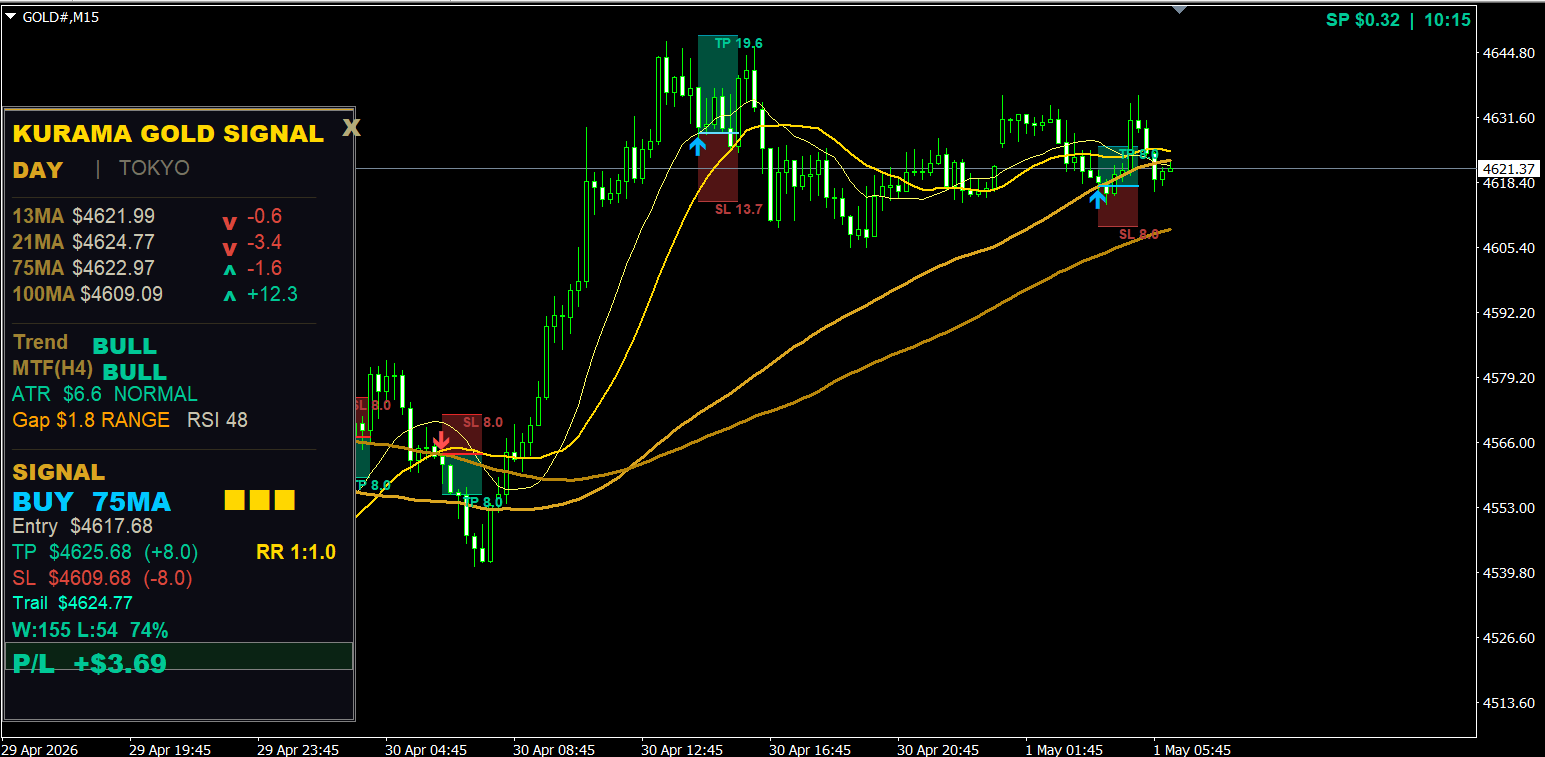
How KGS solves this:
KGS has a built-in session filter. It knows whether the current bar falls in Asian, London, or New York hours. You can choose which sessions to allow signals in.
By default, London and New York sessions are active — because that's when gold actually moves with conviction. Asian session signals are filtered out.
The info panel on your chart always shows the current session, so you know at a glance whether it's a good time to trade.
Problem #3: Fixed Stop Loss That Ignores Volatility
Many indicators show a fixed pip stop loss. "SL = 50 pips" or "SL = $5 from entry."
This is dangerous in gold.
Gold's volatility changes dramatically throughout the day and week. During quiet Asian hours, a $5 stop might be too wide. During NFP or FOMC, a $5 stop gets hit in seconds — it's way too tight.
A fixed stop loss doesn't adapt. It either gives back too much profit or gets stopped out before the trade has a chance to work.
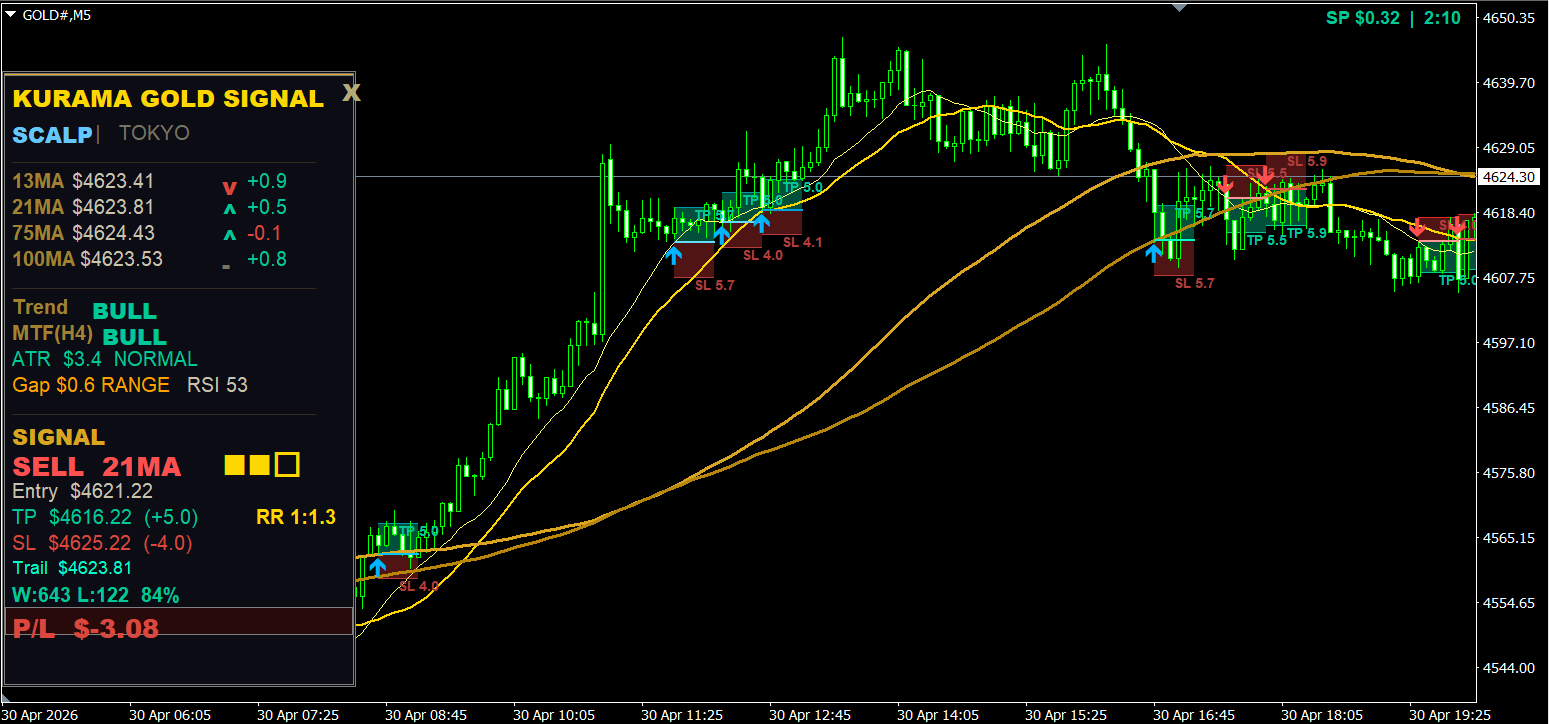
How KGS solves this:
KGS calculates TP and SL dynamically using ATR (Average True Range). When volatility is high, stops are wider to avoid getting stopped out by noise. When volatility is low, stops are tighter to protect profits.
This is displayed visually — green zone for TP, red zone for SL, with the exact pip value shown inside each zone. You see instantly how much you're risking and how much you're targeting.
No guessing. No fixed numbers that ignore what the market is actually doing.
Problem #4: No Trend Direction Confirmation
Here's a scenario that happens every day:
Price dips to a moving average. The indicator fires a BUY signal. You enter. Price bounces 2 pips, then crashes through the MA and keeps falling.
What went wrong? The trend was bearish. The MA touch wasn't a pullback — it was a brief pause in a downtrend before continuation.
Most indicators detect the pattern (MA touch, support bounce, etc.) but don't check whether the overall trend supports that direction.
How KGS solves this:
KGS uses EMA alignment to determine the trend. If EMAs are bearish (fast below slow), buy signals are blocked. If EMAs are bullish (fast above slow), sell signals are blocked.
Additionally, KGS checks the H4 timeframe for higher-level trend confirmation. Even if the M15 chart looks bullish, if H4 is strongly bearish, the signal quality gets downgraded.
This prevents the classic trap of buying into a bear trend just because price touched a moving average.
Problem #5: No TP/SL Display — "Just Follow the Arrows"
This one drives me crazy.
Some indicators give you a beautiful arrow signal — BUY here! — but then leave you completely on your own for the exit. Where's your target? Where's your stop? You have to figure it out yourself.
That defeats the entire purpose of using an indicator.
Entry is only half the trade. Without a predefined exit plan, you'll either hold too long and give back profits, or panic-exit too early and miss the move.
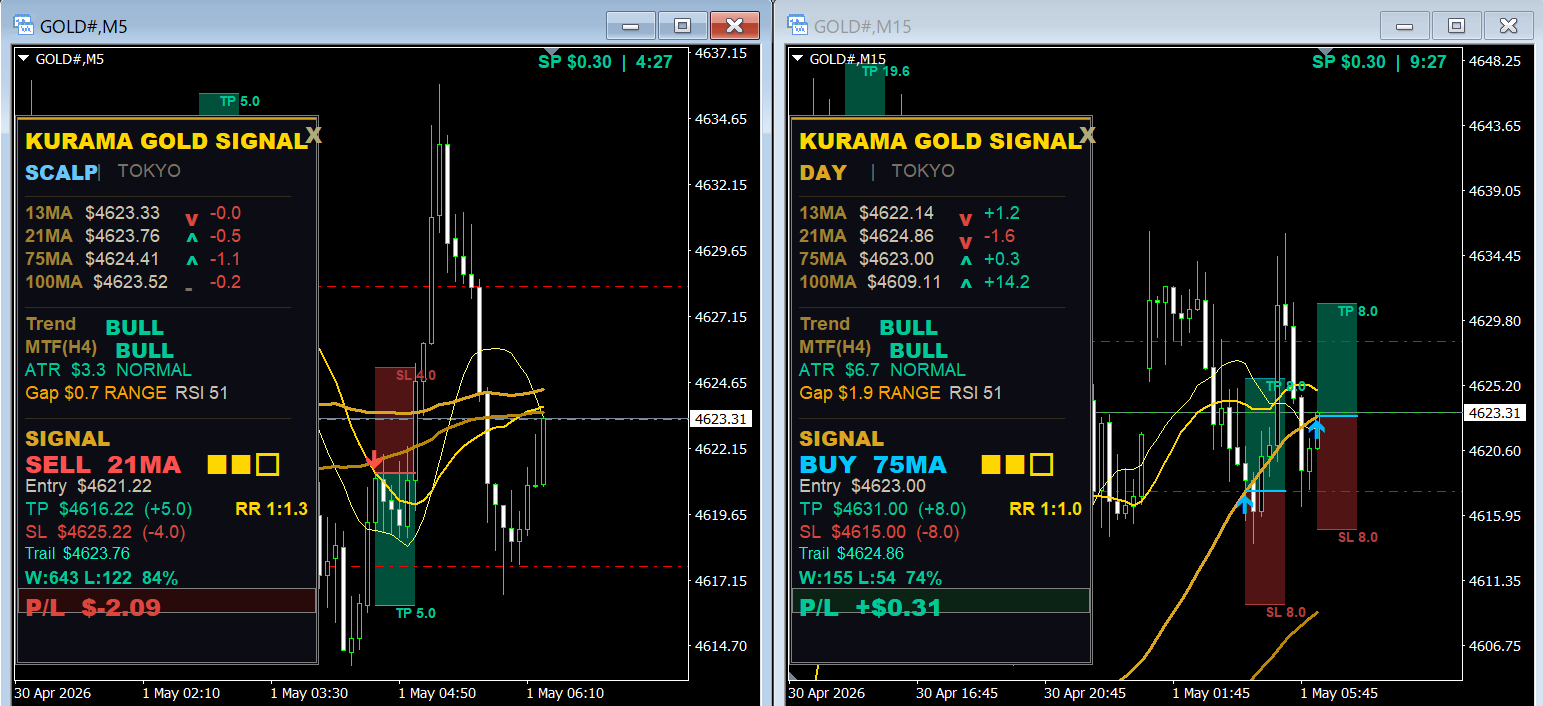
How KGS solves this:
Every KGS signal comes with automatic TP and SL zones displayed directly on the chart. Green zone = take profit target. Red zone = stop loss level. Pip values are shown inside each zone.
You see the entry arrow, and immediately know:
- Exactly where to place your take profit
- Exactly where to place your stop loss
- The risk-reward ratio of the trade
No calculation needed. No second-guessing. Everything is visual, immediate, and ready to execute.
The Real Difference: A System, Not Just Signals
Most gold indicators are signal generators. They detect a pattern and fire an arrow. That's it.
KGS is a trading system compressed into an indicator. It doesn't just tell you where to enter — it tells you:
- Whether you should enter (quality score)
- When to enter (session filter)
- Which direction to enter (trend filter)
- Where to exit (auto TP/SL)
- How confident to be (★ to ★★★)
Is it perfect? No. Nothing is. Markets are unpredictable and no indicator can guarantee profits.
But it eliminates the 5 biggest problems that cause most gold traders to lose money with indicators. And it does it automatically, every tick, without emotion.
Try It Yourself
Available on MQL5 Market (buy or rent monthly):
MT4 version: https://www.mql5.com/en/market/product/170617
MT5 version: https://www.mql5.com/en/market/product/170916
Start with a 1-month rental. Apply it to XAUUSD M15. Watch the signals, check the quality scores, compare ★★★ signals versus ★ signals.
If it improves your trading, keep it. If not, you've only risked one month.
Questions? Message me directly through MQL5.