
Trend trading is one of the most straightforward approaches to market analysis. Instead of trying to predict every price reversal, traders identify the prevailing market direction and look for opportunities to trade in that direction.
The idea sounds simple: look for buying opportunities when the market is rising and selling opportunities when it is falling. In practice, however, several questions arise. How can you identify a genuine trend? Should you enter after a strong price move? What should you do when the market temporarily moves against your position?
Let's look at the basic principles of trend trading in simple terms and explore how this approach can be automated with a trading robot.
What Is a Trend?
A trend is a directional price movement that persists over a period of time. Traders generally distinguish between three market conditions.
- Uptrend. Price forms higher highs and higher lows. Buyers are currently driving the movement, so traders look for potential buying opportunities.
- Downtrend. Highs and lows gradually move lower. Traders focus on possible selling opportunities.
- Sideways market. Price moves within a range without a clear direction. Trend-following signals may be less effective in these conditions.
A trend cannot be defined by a single candle. Even after a strong rise, the market may enter a correction. A decline may also turn into a recovery. The market direction should therefore be assessed using several pieces of evidence rather than one isolated signal.
How Can You Identify the Market Direction?
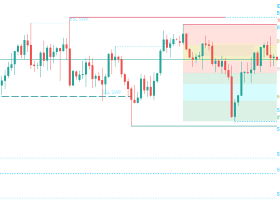
You do not need dozens of indicators to get started. Begin with a regular chart and examine how successive highs and lows are developing.
If both highs and lows are moving upward, the market may be in an uptrend. If they are gradually moving lower, a downtrend may be developing. If price repeatedly returns to the same area, the market may be moving sideways.
Moving averages can provide additional context. For example, the relationship between price and a moving average, together with the direction of the line, can help assess the broader movement. However, no indicator can predict the market with complete accuracy.
It can also be useful to examine multiple timeframes. A higher timeframe helps you understand the broader direction, while a lower timeframe can help identify a more precise entry. Signals across different timeframes may conflict, so the rules for combining them should be defined in advance.
When Should You Enter a Trade?
One common beginner mistake is entering a trade simply because the price has already risen or fallen sharply. By the time the decision is made, the movement may be close to a local turning point.
Many trend-following strategies look for entries after a pullback. Price moves in a certain direction, temporarily corrects, and then shows signs that the original movement may continue. The idea is to avoid buying at the top or selling at the bottom without a clear plan.
Before entering a position, ask yourself a few questions:
- What direction does the selected timeframe indicate?
- Is there a specific entry signal, or am I simply assuming that price will continue?
- Where will the trade be closed if the market scenario fails?
- Is the position size appropriate for my capital and the distance to the Stop Loss?
- Are the spread and other trading costs reasonable?
If you cannot answer these questions, there is no need to rush into a trade. Missing an opportunity is a normal part of trading.
Why Should You Pay Attention to Pullbacks?
Even a strong trend does not mean that price will move in only one direction. Corrections, profit-taking, and short-term fluctuations are a normal part of the market.
A pullback does not automatically mean the trend has ended. However, it is equally dangerous to assume that every pullback is temporary. Sometimes it is the beginning of a reversal. That is why a strategy should define which conditions support continuation and which invalidate the original trading idea.
Trend traders should be especially careful about increasing position size simply because the market has moved against an existing trade. Without clear limits, this approach can quickly increase the overall risk to the account.
How Can You Manage Risk in Trend Trading?
Every strategy needs risk-management rules. Correctly identifying the market direction does not guarantee that a trade will be profitable.
- Position size. Trade volume should reflect account size and the amount you are prepared to lose.
- Stop Loss. Define in advance when the trading idea is no longer valid. Remember that a stop order does not always guarantee execution at the specified price.
- Number of open positions. Several positions in the same direction can increase total exposure, even when each position appears small on its own.
- Drawdown. Consider not only closed results but also the potential temporary loss on open positions.
Do not judge a strategy only by its percentage of winning trades. Loss size, trading costs, drawdown, and performance across different market conditions also matter.
Can Trend Trading Be Automated?
Yes. If the entry and exit conditions can be described clearly, they can be translated into an algorithm and implemented as an Expert Advisor for MetaTrader. This approach helps execute predefined rules without having to monitor every market movement manually.
Automation does not make a strategy error-free. A robot may follow its rules consistently, but those rules still need to be tested. Results depend on the algorithm, its settings, trading costs, and market conditions.
VR Proton: An Automated System for Trend Trading
VR Proton is an automated trading system for MetaTrader 4 and MetaTrader 5. Its entry logic is trend-based, while trade management is handled automatically according to predefined rules.
The robot manages more than the initial position. Depending on how the market develops, it can manage a series of trades, add positions when price moves against the initial direction, use automatic breakeven protection and trailing stops, and calculate a closing level for the series.
One detail is important: trend-based entry logic does not mean that every subsequent action always follows the current price direction. When the market moves unfavourably, the algorithm may use averaging. This introduces additional risks and makes careful configuration and drawdown monitoring essential.
Before using the system, study its settings and test it in the Strategy Tester and on a demo account. Historical test results do not guarantee similar performance in live trading.
Learn more on the MQL5 Market page for VR Proton on MetaTrader 5 and the VR Proton page for MetaTrader 4.
How to Start Learning Trend Trading
You do not need to build a complex strategy with numerous indicators right away. Start with one instrument and a regular chart. Mark the successive highs and lows and try to identify areas of upward, downward, and sideways movement.
Next, write down simple entry and exit rules and check how they performed on historical data. Keep track not only of the results but also of the reasons behind each trade. This helps you understand where a strategy has a clear rationale and where a decision was driven by emotion.
Once the rules are clear, you can begin exploring automation: study how Expert Advisors work, learn to use the Strategy Tester, and gradually move into programming for MetaTrader.
More From the Author
Visit my MQL5 profile for more articles about trading strategies, MetaTrader, and automated trading.
Add me as a friend on MQL5 to follow my activity and stay updated on new publications about trading robots and strategy development.
Tags: trend trading, Forex trading, trading strategy, technical analysis, MetaTrader, trading robot, Expert Advisor, VR Proton, risk management, MQL5.