
Argo Navis Momentum is not a guaranteed winner. It has losing trades, losing days and quiet weeks. I would rather you hear that from me now than find out on your second Monday.
Most disappointment with an EA does not come from the EA itself. It comes from judging it too early, against the wrong numbers, or after changing the settings halfway through. This post is about how to give Argo Navis a fair test, and how to tell a normal bad week from a real problem.
Three Kinds of Week
Argo Navis is a breakout system. It earns when gold leaves a range and keeps going. That makes its weeks fall roughly into three types.
| Type of week | What gold does | What you usually see |
|---|---|---|
| Trending | Breaks a level and keeps running | Several winners, some reaching full take profit |
| Choppy | Breaks, snaps back, breaks the other way | Small losses and break-even closes |
| Quiet | Stays inside a narrow range | Very few trades, sometimes none for a day or two |
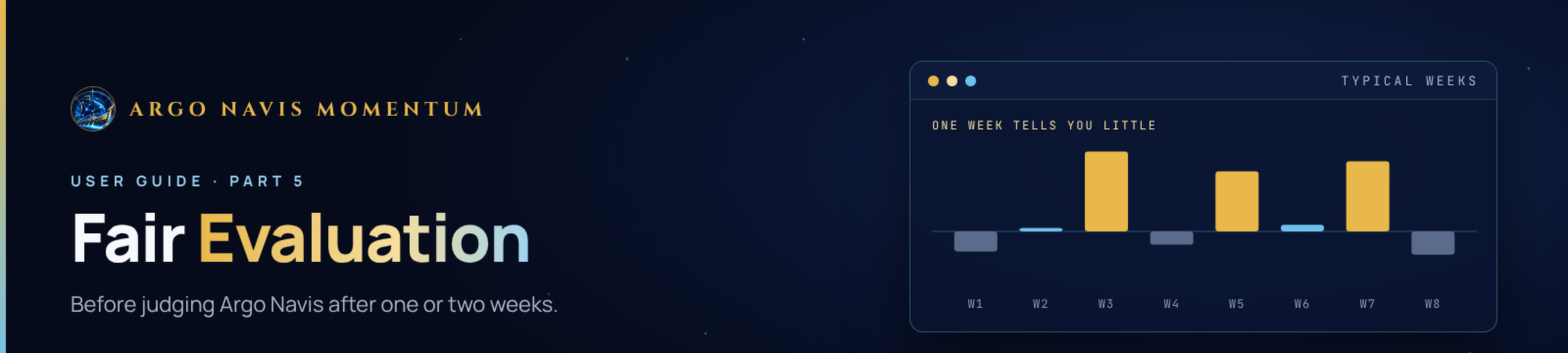
All three are normal. You cannot choose which one comes next, and one or two weeks can easily be all choppy or all quiet. The profit of a breakout system comes mostly from the trending weeks, so it needs enough time for those weeks to show up.
That is why one or two weeks tells you very little. A fair first look is two to three months.
Reading the Backtest Honestly
Backtests are useful, but only if you read them for what they are. Here is how I would read any Argo Navis backtest, including mine.
The settings were developed on past data. Every EA is built and tuned by looking at history. Results on new data, including your live account, will very likely be lower than the backtest. That is true for every EA on the Market, and I would rather say it plainly.
Tick modeling changes the result. Breakout entries and tight trailing stops are sensitive to how the tester builds price movement inside each bar. When I compared "1 minute OHLC" with "Every tick based on real ticks", some strategies came out noticeably weaker on real ticks. If you test it yourself, use Every tick based on real ticks, and expect lower numbers than a faster mode would show.
Ignore huge auto-lot balances. A % risk backtest over a year or two keeps compounding. The lot grows with the balance, with no limit on liquidity or slippage, until the final balance looks unreal. Judge the system on a fixed-lot test: the profit factor, the drawdown and the shape of the curve.
Your broker is not the tester. The tester does not know your broker's real slippage on a fast break. Spread, commission and execution all shift the result (see Part 2).
So use the backtest to understand how the system behaves: how often it trades, how long the flat periods last, how deep the drawdowns go. Do not use it as a promise of what next month will bring.
Live Results, Backtest and Signal
It is natural to compare your account with the backtest or with my live signal. Just compare the right things.
- Compare behaviour, not exact numbers. Your account will not match the signal trade for trade. Different balance, risk setting, broker, server and start date all change which orders trigger and how they fill.
- Compare over the same period. Your first two weeks against the signal's best quarter is not a fair comparison.
- Compare at the same risk. If the signal runs 1% and you run 3%, your swings will be roughly three times larger, in both directions.
Live signal: Argo Navis Momentum live signal. It may use a different balance or risk setting from yours.
Normal Drawdown or a Real Problem?
When results look bad, the first question is whether the strategy is having a normal bad stretch, or whether something is actually wrong. These signs usually mean normal drawdown:
- Losses are within each trade's planned stop loss.
- Many trades close at break-even or a small profit after a failed break.
- The signal or other users had a similar stretch over the same dates.
- Gold was choppy or range-bound during that period.
These signs usually point to a setup or execution problem:
- Losses are regularly larger than the planned stop. That points to slippage or a broker issue.
- Entries are regularly far from the pending order price.
- The Experts tab shows the same error every day.
- Trades appear that the signal never took, or the signal trades and you do not.
- The EA is running on more than one chart, or the account is netting instead of hedging.
If it looks like the second list, go through Part 2 first, then send me the details. If it looks like the first list, the most useful thing you can do is usually nothing.
Give the System a Fair Evaluation
- Use a lot size you are comfortable losing on. If a normal losing week makes you want to switch the EA off, the risk is too high.
- Do not raise risk to win back a loss. That turns a normal drawdown into a deep one.
- Do not switch strategies on and off after every bad week. It usually turns off the ones that are about to recover, and your results stop matching any test.
- Change one thing at a time, and rarely. If you change settings every week, you never learn what the system itself does.
- Keep a simple log. Note the date, the setting changes and anything unusual. It makes any later review much easier.
- Judge it over months, on the full set of trades, not on the last few.
If, after a fair period at a sensible risk, Argo Navis does not suit you, that is a perfectly valid conclusion. I would just like it to be based on a fair test.
More in This Series
- Part 1 – Input Settings Explained
- Part 2 – Why Broker Execution Matters
- Part 3 – How Argo Navis Trades
- Part 4 – How Argo Navis Protects Every Trade
Get Argo Navis Momentum
Argo Navis Momentum is available on the MQL5 Market for MetaTrader 5. You can download the free demo and run it in the Strategy Tester before you buy.
Product page: Argo Navis Momentum on MQL5 Market
After purchase, send me a private message on MQL5 and I will help you with setup.
Argo Navis Momentum can lose money. Trading gold with leverage carries a high level of risk, and past results do not guarantee future results. Only trade money you can afford to lose.