How Argo Navis Momentum Trades: Ceiling, Floor and 14 Strategies

The first two posts were about settings and brokers. This one answers the question I get most often before people buy: what does Argo Navis Momentum actually do?
The short answer: it finds the levels gold has been unable to break, places stop orders just before them on both sides, and trades whichever side breaks first. It does this with 14 strategies watching different timeframes, from H1 up to D1. The rest of this post explains each part.
The Ceiling and the Floor
Gold does not move in a straight line. Most of the time it moves between two prices: one it keeps failing to break above, and one it keeps failing to break below.
- The ceiling is a recent swing high. Price pushed up to it, failed to go higher, and turned down.
- The floor is a recent swing low. Price pushed down to it, failed to go lower, and turned up.
These levels matter because many traders see them too. Stops from short sellers sit just above the ceiling. Stops from buyers sit just below the floor. When price finally breaks through, those stops are triggered, new breakout traders join, and the move often accelerates. That burst of momentum is what Argo Navis is built to catch.
A swing high or low is only a level if price respected it. Each strategy uses fixed rules to decide what counts as a swing: how many bars on each side must be lower (for a high) or higher (for a low), how far back to search, and how far the level must be from the current price. Weak or overlapping levels are ignored.
How the Orders Are Placed
Argo Navis does not try to predict which side will break. It prepares for both.
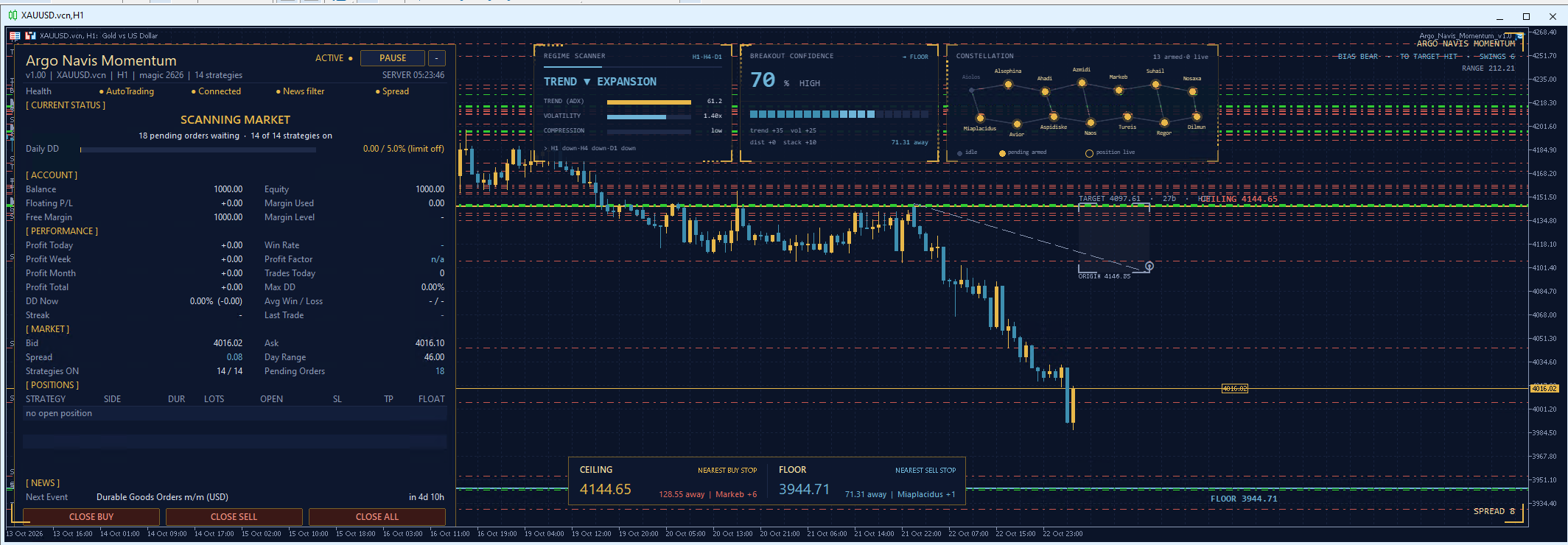
- Buy Stop near the ceiling. If price breaks up, this order fills and the trade rides the move higher.
- Sell Stop near the floor. If price breaks down, this order fills and the trade rides the move lower.
- Stop loss and take profit attached. Both are set the moment the order is placed. There is never an open position without a stop.
- Orders that do not trigger are removed. Each pending order has a lifetime. If the level does not break in time, or a newer level replaces it, the old order is deleted. A pending order that never fills costs nothing.
Why the orders sit slightly before the level
The orders are not placed exactly on the high or the low. They sit a small distance in front of it.
The reason is how breakouts fill. When price reaches a well-watched level, it often jumps through it in one burst. An order placed exactly on the level tends to fill late, after price has already moved. An order placed a little earlier catches the start of the move instead. I tested both versions on the same data, and the small offset gave clearly better results across the strategies.
The trade-off is that some orders fill on a touch of the level that does not turn into a real break. Those trades are what break-even and the stop loss are for.
14 Strategies, 4 Timeframes
One level on one timeframe is close to a coin flip. Some breaks run, some fail. So instead of one strategy, Argo Navis runs 14, each named after a star in the Argo Navis constellation.
Every strategy uses the same ceiling-and-floor idea, but each has its own swing timeframe, its own rules for what counts as a level, and its own stop loss, take profit, break-even and trailing settings.
| Swing timeframe | Strategies | What they catch |
|---|---|---|
| H1 | Naos, Tureis, Suhail, Markeb, Azmidi, Regor | Breaks of the session high or low |
| H2 | Alsephina, Nosaxa, Dilmun | Breaks of the levels built over several sessions |
| H4 | Avior, Ahadi | Larger swings that hold for one or two days |
| D1 | Miaplacidus, Aspidiske, Aiolos | Breaks of previous days' highs and lows |
Why so many timeframes
Gold behaves differently at each scale, and on any given day only some timeframes are moving.
- In a quiet Asian session, H1 and H2 levels may never break. The D1 strategies can still catch the break of yesterday's high when London opens.
- On a fast news-driven day, the short-timeframe strategies trigger first. The H4 and D1 strategies join later if the move keeps going.
- In a choppy week, short-timeframe breaks often fail, while a clean D1 break can still pay for several small losses.
No single timeframe works every week. Spreading the work across four timeframes smooths out the quiet periods of each one. That is also why I recommend keeping all 14 strategies on.
When strategies agree
Sometimes several strategies find levels at almost the same price. When three or more orders stack near one level, the CEILING or FLOOR label on the chart turns red. A break there triggers several trades at once. That is more profit if the break runs, and more loss if it fails. It is one reason I suggest a modest risk per trade, and why Max open positions exists.
A Breakout, Step by Step
Here is what one trade looks like from start to finish.
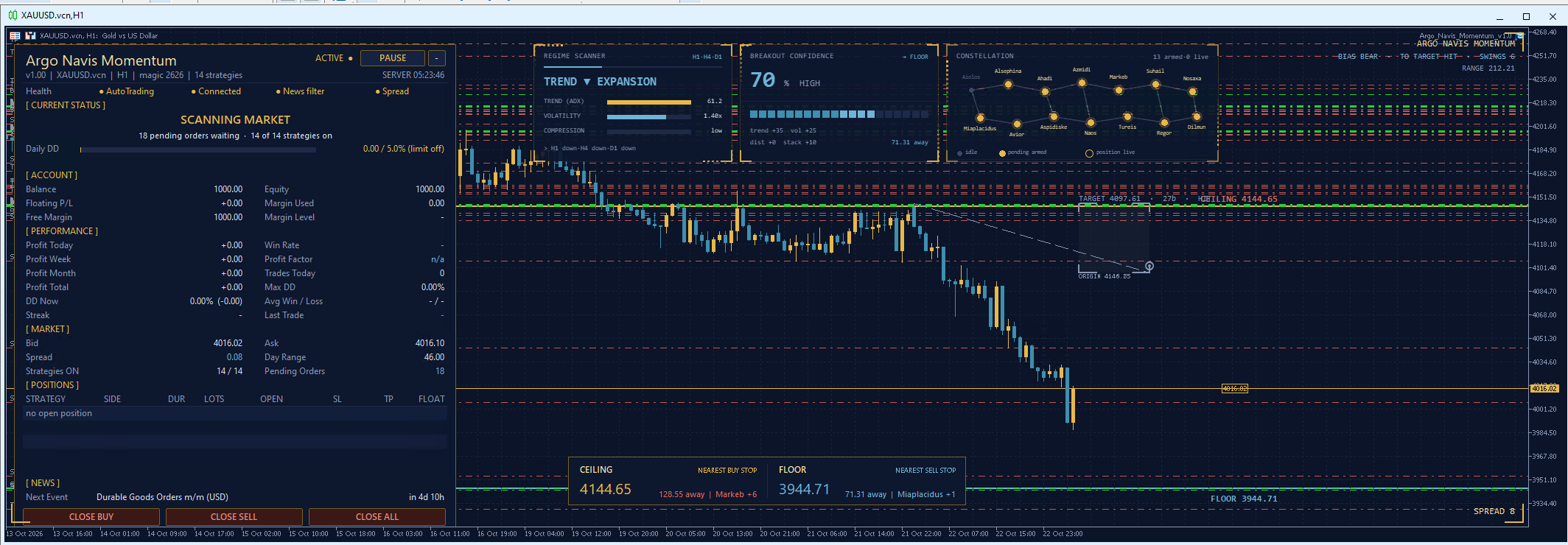
- The level forms. Gold makes a swing high and pulls back. One of the strategies marks it as a ceiling.
- The order goes in. A Buy Stop is placed just under the ceiling, with its stop loss and take profit already attached. On the other side, a Sell Stop waits near the floor.
- Price breaks. Gold pushes through the ceiling and the Buy Stop fills. The target box on the chart shows the take-profit zone.
- Break-even. Once the trade is far enough in profit, the stop loss moves to the entry price plus a small lock. From here the trade can no longer become a full loss.
- Trailing. As gold keeps rising, the stop follows behind it at the gap set for that strategy.
- Exit. The trade closes at the take profit, or where the trailing stop catches the pullback. The target box dims and shows HIT if the target was reached.
- Clean up. The unused Sell Stop on the other side expires or is replaced when new levels form.
Not every trade gets this far. Some break, fail, and return to hit the stop loss before break-even. Some reach break-even and close with a small profit. A few run all the way. The system depends on the runners paying for the failures.
When the EA Stays Out
A breakout system makes money by trading the right moments, and by staying out of the wrong ones. Argo Navis places no new orders when:
- High-impact USD news is close. Pending orders are removed before the release, and open positions can be closed (Part 1 explains the settings).
- The weekend is near. No new entries in the last hours before the Friday close or the first hours after the Monday open.
- The spread is too wide. If the spread is large compared with the distance to the level, the entry is skipped.
- The market is closed. No order requests are sent outside the broker's trading session.
- A risk limit is reached. The daily loss limit, Prop Firm limits or Max open positions can all stop new entries.
- There is no clean level. If no strategy finds a valid ceiling or floor, nothing is placed.
So there will be hours, and sometimes days, with no trades. That is the EA doing its job, not a fault.
What This Means for You
Understanding how the EA trades makes its results easier to read:
- Trending weeks are the good weeks. Clean breaks that keep going are where most of the profit comes from.
- Choppy weeks are the hard weeks. Breaks that fail and reverse produce small losses and break-even trades. They are part of the system, not a sign it has stopped working.
- Quiet weeks have few trades. If gold barely moves, few orders trigger.
- No martingale, no grid. Every order stands alone with its own stop. Losses are never doubled up to recover.
Judge Argo Navis over months, not days, and keep the risk at a level where a losing week is uncomfortable but not damaging.
More in This Series
Get Argo Navis Momentum
Argo Navis Momentum is available on the MQL5 Market for MetaTrader 5. You can download the free demo and run it in the Strategy Tester before you buy.
Product page: Argo Navis Momentum on MQL5 Market
After purchase, send me a private message on MQL5 and I will help you with setup.
Argo Navis Momentum can lose money. Trading gold with leverage carries a high level of risk, and past results do not guarantee future results. Only trade money you can afford to lose.