Don’t Chase the Move: Why Strong Momentum Candles Can Produce Bad Entries

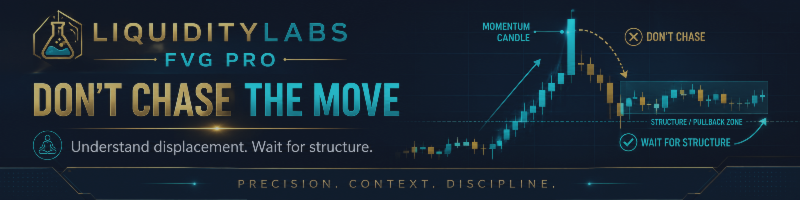
One of the hardest moments for many traders occurs immediately after the market makes a powerful move.
A large bullish candle appears.
Price accelerates through several recent levels.
Momentum looks obvious.
Suddenly the trade feels easy.
The problem is that the easiest-looking moment on the chart can also be one of the worst moments to enter.
By the time a move looks obvious, much of that move may already have occurred.
This creates a common trading mistake:
Chasing displacement instead of understanding it.
The objective of this article is not to argue that strong momentum is bad.
Strong momentum can provide extremely useful information.
The important distinction is between recognizing strength and entering after strength has already become extended.
Those are not the same thing.
What Is Displacement?
Displacement is a meaningful expansion in price.
Instead of moving slowly through overlapping candles, the market begins travelling with greater urgency.
Candles may expand.
Overlapping price action may decrease.
Previous levels may be crossed quickly.
The market may cover a relatively large distance in a short period.
This behaviour can suggest that one side of the market has temporarily gained greater control.
That makes displacement valuable information.
But information about direction does not automatically provide good entry location.
A trader can correctly identify bullish strength and still buy at a poor price.
Likewise, a trader can correctly identify aggressive selling and still enter short after most of the immediate downward expansion has already occurred.
This is why direction and entry should be evaluated separately.
The Psychological Problem With Large Candles
Large candles create urgency.
Imagine watching price move slowly for twenty minutes.
Nothing appears particularly interesting.
Then suddenly a large bullish candle forms and price rapidly moves higher.
The trader who was previously patient now begins thinking:
“It’s going without me.”
That thought changes the decision-making process.
Instead of asking whether the current price provides an attractive trade location, the trader becomes focused on avoiding the emotional pain of missing the move.
This is classic fear of missing out.
The entry is no longer based primarily on market structure.
It is based on urgency.
And urgency often appears after price has already travelled significantly.
Strong Direction Does Not Mean Good Location
This is one of the most important concepts in technical trading.
You can be correct about direction and still have a poor trade.
Suppose price aggressively rises.
You correctly identify bullish momentum.
You buy near the top of the expansion.
Price then pulls back normally before continuing higher.
Your directional idea was correct.
But your entry location exposed you to unnecessary adverse movement.
Depending on your stop placement and position sizing, that normal pullback may remove you from the trade before the broader bullish move resumes.
The problem was not necessarily the analysis.
The problem was the execution.
This is why experienced chart reading should separate these two questions:
Where does price appear to want to go?
and
Where would I actually want to participate?
They are different questions.
Every Expansion Creates Distance
When price accelerates, it begins moving away from previous areas of interaction.
That distance matters.
The farther price moves without meaningful retracement or consolidation, the more carefully a trader should evaluate whether the current location still provides reasonable risk.
This does not mean that extended markets must reverse.
Strong markets can continue moving much farther than expected.
The mistake is assuming that continuation alone makes the current entry attractive.
Imagine buying after price has already travelled significantly.
Your logical invalidation point may remain much lower near the structure that actually supported the move.
Now you face an uncomfortable choice.
You can place the stop where the structure makes sense, creating a large risk distance.
Or you can place a very tight stop near the late entry, where normal market noise may remove the position.
Neither problem existed to the same degree before price became extended.
Pullbacks Are Not Automatically Weakness
Traders who chase momentum often interpret the first pullback as danger.
They enter after a large bullish move.
Then a bearish candle appears.
Because the entry occurred near the top, even a normal retracement immediately creates discomfort.
The trader begins thinking the market has reversed.
But trending markets rarely travel in perfectly straight lines.
Expansion is commonly followed by some combination of:
-
retracement,
-
consolidation,
-
profit-taking,
-
two-sided trading,
-
liquidity rebalancing,
-
or temporary hesitation.
A pullback by itself does not automatically mean the original directional move has failed.
The more useful question is:
What happens to structure during the pullback?
A market can retrace while still maintaining the broader directional condition.
That is fundamentally different from a market that begins breaking the structure supporting the original move.
Pullback Versus Reversal
This distinction deserves particular attention.
Suppose price has been advancing.
A pullback occurs.
If the market continues respecting important structural areas and buyers eventually regain control, the retracement may simply be part of the trend.
A more meaningful reversal requires stronger evidence that control has actually changed.
That could involve broader structural deterioration, failed continuation, sustained acceptance in the opposite direction, or other contextual evidence.
The key principle is simple:
Do not label every move against your position a reversal.
Likewise:
Do not label every pullback a buying opportunity simply because the market was previously rising.
Observe what price actually does.
Why Waiting Can Improve the Information Available
Waiting after a large expansion does not guarantee a better trade.
It does something else:
It gives the market an opportunity to reveal more information.
After displacement, price may continue immediately.
It may retrace.
It may consolidate.
It may completely reverse.
Waiting allows those possibilities to begin separating themselves.
Instead of entering because one large candle looks convincing, the trader can observe whether the market maintains control after the excitement of the initial expansion.
This is one of the reasons patience is not simply psychological discipline.
Patience can be an analytical tool.
Time allows additional market information to develop.
The Market Does Not Care That You Missed the First Move
Another damaging belief is that missing the initial impulse means the opportunity is gone forever.
Sometimes it is.
And that is fine.
Not every market movement must become your trade.
There will always be another setup.
Trying to participate in every major candle often causes traders to enter precisely when risk has become difficult to define.
A missed trade costs nothing.
A poor trade can.
That does not mean traders should become excessively hesitant.
It means execution should remain connected to a plan rather than to emotional urgency.
Fair Value Gaps and Strong Displacement
Strong displacement can sometimes create visible price imbalance, including structures traders identify as Fair Value Gaps.
This is where another common mistake appears.
A trader sees aggressive movement and an imbalance form, then immediately treats both as proof that price must continue.
An FVG describes something about how price travelled through an area.
It does not guarantee that entering at the most extended point of that movement is appropriate.
In fact, the existence of imbalance can sometimes encourage a more patient question:
If this move remains structurally valid, is there a better area from which to evaluate participation?
That is a very different mindset from chasing the final candle.
Structure Before Emotion
A useful exercise after a large move is to temporarily ignore the size of the latest candle.
Instead, examine the chart structurally.
Ask:
Where did the expansion begin?
What market structure existed before the move?
Which areas were broken during the expansion?
Has price become unusually extended from recent interaction?
If a pullback occurs, where would the original directional thesis actually become questionable?
Would entering now produce logical risk, or am I entering because the candle looks exciting?
These questions help transform a reactive decision into an analytical one.
Momentum Can Still Continue
It is important not to misunderstand the lesson.
“Do not chase” does not mean:
“Fade every strong candle.”
That can be equally dangerous.
Strong markets can continue producing strong moves.
Trying to predict the top of every bullish expansion or the bottom of every bearish expansion can create repeated losses.
The objective is not to fight momentum.
It is to recognize when the current price location no longer provides a trade you are comfortable defining.
Sometimes the correct decision is to participate.
Sometimes the correct decision is to wait.
Sometimes the correct decision is to let the entire move go.
All three can be valid.
A Simple Post-Displacement Framework
After a strong market move, consider breaking your analysis into stages.
1. Recognize the Expansion
A meaningful directional move has occurred.
Do not immediately convert that observation into an entry.
2. Evaluate Location
Ask how far price has travelled relative to the structure that produced the move.
3. Observe the Response
Does momentum continue?
Does price consolidate?
Does the market begin retracing?
4. Monitor Structure
Determine whether the underlying directional thesis remains intact or whether actual evidence of control transfer is appearing.
5. Evaluate Risk
Can an entry be defined with logical invalidation?
If not, the move may simply be too extended for your preferred execution.
6. Accept Missing the Trade
If price never offers a location that fits your plan, let it go.
Trading discipline includes knowing when not to participate.
Where LiquidityLabs FVG PRO Fits
One objective behind LiquidityLabs FVG PRO for MetaTrader 5 is to help traders organize areas of imbalance and developing market context without forcing every detected structure into an automatic entry.
A tool should support decision-making, not replace it.
The proprietary internal confirmation process, calculations, thresholds and timeframe architecture used by FVG PRO are intentionally not disclosed.
The educational principle, however, applies regardless of which indicator or trading method you use:
A powerful market move can tell you something important about direction while still offering a poor immediate entry location.
Learning to recognize that difference can help reduce emotional chasing.
Final Thoughts
Large candles are visually persuasive.
They make direction appear obvious.
They create urgency.
They make traders feel that waiting means losing an opportunity.
But the market does not reward entries simply because they were made quickly.
Good execution requires more than recognizing momentum.
It requires understanding where price is, what structure is supporting the move, what would invalidate the idea, and whether the current location offers reasonable risk.
The next time an explosive candle appears, resist the instinct to immediately follow it.
Ask:
Am I entering because the setup is good—or because I am afraid the move will leave without me?
That single question can expose a surprising number of poor entries.
Recognize the displacement.
Respect the momentum.
Read the structure.
Then decide whether the market has actually offered you a trade.
You do not need to catch every move. You need to avoid letting the move make the decision for you.
LiquidityLabs FVG PRO for MetaTrader 5:
https://www.mql5.com/en/market/product/189564
Trading-risk disclaimer: Trading Forex, CFDs, cryptocurrencies and other leveraged instruments involves substantial risk and may not be suitable for every trader. Momentum, price-action structures, Fair Value Gaps and technical indicators cannot guarantee future price behaviour or profitable results. Always evaluate trades independently and use appropriate risk management.