MT5 Trade Copier: Managing Multiple Receivers with Different Risk Profiles from One Sender

Product link:
https://www.mql5.com/en/ market/product/191385
One of the most powerful applications of an MT5 Trade Copier is the ability to distribute a single stream of trading signals to multiple Receiver accounts while allowing each account to operate with its own risk profile.
A conservative account, a balanced account, and a more aggressive account can all follow the same Sender. However, they do not need to use the same lot size, filters, drawdown limits, or trading conditions.
This separation between the trading signal and the execution rules makes multi-account copy trading much more flexible. The Sender broadcasts the trade, while each Receiver applies its own configuration before executing the copied order.
With COPYLATOR – MT5 Trade Copier, this architecture can be used for personal accounts, multiple investment accounts, signal distribution, portfolio management, and other multi-account environments where different accounts require different trading parameters.
1. The Core Concept: One Sender, Multiple Risk Profiles
Imagine one Sender account generating a Buy trade on EURUSD.
Three Receiver accounts can receive that same signal:
- Receiver A: Conservative risk profile
- Receiver B: Balanced risk profile
- Receiver C: Higher-risk profile
The Sender does not need to create three different versions of the trade. It broadcasts the original trade, and each Receiver determines how that trade should be handled according to its own settings.
This means the same signal can result in different position sizes, different filtering decisions, and different risk controls across the Receiver accounts.
2. Why Different Risk Profiles Matter
Different trading accounts often have different objectives and constraints. Applying identical settings to every account can therefore create unnecessary exposure or fail to use the available flexibility of the copier.
For example, one account may be intended for relatively conservative capital preservation, while another may be designed for more aggressive growth. A third account may be used primarily for testing.
The important point is that the copier does not determine the appropriate risk level for the account. The account owner or manager must define that profile and configure the Receiver accordingly.
A useful way to think about the architecture is:
SENDER | |---- Trade Signal | +---- RECEIVER A → Conservative Rules | +---- RECEIVER B → Balanced Rules | +---- RECEIVER C → Aggressive Rules
The signal is shared, but the execution environment can be different.
3. Lot Sizing: The First Layer of Differentiation
Position sizing is usually the first and most visible difference between Receiver accounts.
COPYLATOR provides several methods for controlling copied volume, including fixed lot sizing, lot multipliers, balance-ratio scaling, and maximum lot caps.
Balance-Ratio Scaling
Balance-ratio scaling adjusts the copied volume according to the relationship between account balances.
For example, if a Receiver has substantially less balance than the Sender, its copied position can be scaled down rather than simply reproducing the Sender's raw volume.
This is useful when several accounts have different sizes but the manager wants position sizing to remain proportional.
However, balance-ratio scaling should not be interpreted as a guarantee of identical monetary risk. Differences in leverage, contract specifications, symbol conditions, Stop Loss distance, margin requirements, and broker execution can still produce different outcomes.
Lot Multiplier
A lot multiplier applies a configured factor to the copied volume.
For example:
- 0.5 multiplier → approximately half of the calculated source volume
- 1.0 multiplier → approximately the calculated source volume
- 1.5 multiplier → approximately one and a half times the calculated source volume
This can be useful when Receiver accounts have different risk tolerances.
Fixed Lot Size
Fixed lot sizing replaces the calculated Sender volume with a predefined lot size.
This approach can be useful when the Receiver's position size is intentionally defined in absolute volume rather than according to account balance.
The disadvantage is that a fixed lot may become inappropriate as the account balance changes, so it should be reviewed periodically.
Maximum Lot Cap
The maximum lot cap provides an additional volume limit.
Even if balance scaling or a multiplier produces a large calculated volume, the maximum lot setting can prevent the copied position from exceeding the configured limit.
This is particularly useful when multiple Receivers have different risk profiles because each Receiver can have its own maximum permitted lot size.
4. Filters: The Second Layer of Differentiation
Lot sizing determines how large a copied trade can be. Filters determine which trades a Receiver is willing to copy.
This creates another important level of customization.
Spread Filter
A Receiver can use a maximum spread condition so that trades are not copied when the current spread exceeds the configured threshold.
This can be useful when the Receiver broker has different spread conditions from the Sender, especially around volatile market periods or major economic announcements.
The spread condition belongs to the Receiver's trading environment. Therefore, a trade accepted by one Receiver may be rejected by another if their spread conditions are different.
Direction Filters
Receivers can also be configured to accept only certain trade directions.
For example:
- Receiver A → Buy trades only
- Receiver B → Sell trades only
- Receiver C → Both directions
This allows different accounts to use the same Sender while applying different directional restrictions.
Day and Time Filters
Trading schedules can also differ between Receivers.
One account may operate during selected trading hours while another may remain active across a broader schedule.
This is particularly useful when accounts have different execution requirements or when a manager wants to restrict certain Receivers during periods of lower liquidity or higher transaction costs.
5. Drawdown Protection: The Final Risk Layer
Position sizing and filters control individual trades, but drawdown protection provides an additional account-level safety mechanism.
Each Receiver can have its own daily and total drawdown configuration.
For example:
- Conservative Receiver → 2% daily / 5% total
- Balanced Receiver → 5% daily / 15% total
- Higher-risk Receiver → 10% daily / 25% total
These numbers are configuration examples rather than universal recommendations. Appropriate limits depend on the account's objectives, strategy, broker conditions, and risk tolerance.
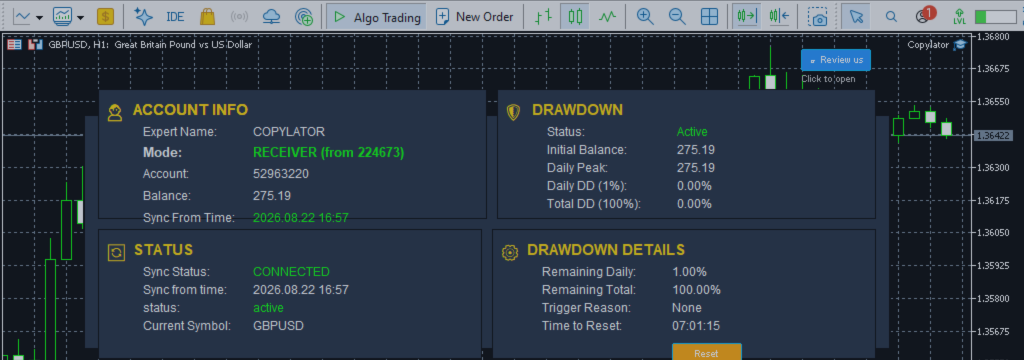
When a configured drawdown limit is exceeded, COPYLATOR can block new copying. Depending on the configuration, it can also close positions opened by COPYLATOR and delete COPYLATOR pending orders.
This means the Receiver can have a different stopping point from the other accounts even though all accounts receive signals from the same Sender.
6. Understanding the Drawdown Reset Mechanism
Drawdown protection should be understood carefully because daily and total drawdown operate differently.
The automatic daily reset clears the daily drawdown state at the configured broker-server time. It does not automatically replace the total drawdown baseline.
A manual reset on the Receiver can establish a new baseline by setting the current balance as the new initial balance.
Therefore, the reset configuration should be considered part of the Receiver's risk profile rather than treated as a simple on/off feature.
7. Practical Multi-Receiver Configuration Example
Consider one Sender account distributing trades to three Receivers.
Receiver A – Conservative Profile
- Balance-ratio scaling
- Lot multiplier: 0.5
- Maximum lot: 0.10
- Maximum spread: 1.5 pips
- Restricted trading schedule
- Daily drawdown: 2%
- Total drawdown: 5%
- Buy-only configuration
Receiver B – Balanced Profile
- Balance-ratio scaling
- Lot multiplier: 1.0
- Maximum lot: 0.50
- Maximum spread: 2.5 pips
- Broader trading schedule
- Daily drawdown: 5%
- Total drawdown: 15%
- Buy and Sell enabled
Receiver C – Higher-Risk Profile
- Balance-ratio scaling
- Lot multiplier: 1.5
- Maximum lot: 2.0
- Maximum spread: 4.0 pips
- Broader trading schedule
- Daily drawdown: 10%
- Total drawdown: 25%
- Buy and Sell enabled
All three accounts can receive the same Sender signal, while their execution parameters remain independent.
8. The Receiver Should Be Configured for Its Own Broker
Different Receiver accounts may be held with different brokers. This introduces additional considerations beyond lot size and drawdown.
Symbol names may differ between brokers. For example, one broker may use XAUUSD while another uses a broker-specific suffix or alternative symbol name.
COPYLATOR includes automatic symbol mapping and also allows manual mapping when necessary.
Each Receiver should therefore be tested using the actual symbols, spreads, contract specifications, volume steps, and trading conditions available on its broker.
9. Hedging and Netting Accounts
Receiver account type can also affect how copied positions are handled.
On Hedging accounts, multiple positions for the same symbol can exist independently, allowing ticket-based synchronization and more granular position management.
Netting accounts maintain one net position per symbol. As a result, some operations such as position reversal and pending-order replication may behave differently and can be adjusted or limited according to the account structure.
For this reason, multiple Receivers should not be assumed to behave identically simply because they receive the same signal.
10. Partial Close and Volume Changes
Different Receivers may also have different position sizes, which makes partial-close synchronization particularly important.
If the Sender partially closes a position, the Receiver needs to reduce the corresponding copied volume while keeping the remaining position open when supported by the account structure and broker's volume rules.
Because Receivers can use different lot-sizing configurations, their absolute remaining volumes may differ even when the same proportional trade action is copied.
11. Real-Time SL/TP Synchronization
Risk profiles should not be considered only at the moment a trade is opened.
Stop Loss and Take Profit modifications can occur after the original trade has already been copied.
COPYLATOR can synchronize supported SL/TP changes in real time, including adding stops to trades that were originally opened without them.
This is important in a multi-Receiver environment because every account can have different volume and risk settings while still following changes to the Sender's trade management.
12. Multi-Sender and Multi-Receiver Architecture
A single Receiver can also participate in a more complex environment where multiple Senders are involved.
When multiple strategies are combined, additional attention should be paid to symbol overlap, direction conflicts, total exposure, comments, and drawdown.
For a simple one-Sender/multiple-Receiver setup, however, the architecture remains straightforward:
             SENDER
                |
       +--------+--------+
       |        |        |
       v        v        v
 RECEIVER A  RECEIVER B  RECEIVER C
 Conservative  Balanced  Higher Risk
Each Receiver can have its own configuration while remaining connected to the same source account.
13. Custom Comments and Trade Identification
When multiple Receivers are managed simultaneously, identifying copied trades becomes increasingly important.
COPYLATOR supports custom comment prefixes that can help distinguish copied trades and associate them with a particular strategy or configuration.
This can simplify monitoring, reporting, and troubleshooting when several accounts are running simultaneously.
14. Notifications and Monitoring
Multiple Receiver accounts should be monitored independently.
Notifications can help identify important events such as trade openings and closings, drawdown triggers, and errors.
A centralized monitoring process makes it easier to determine whether an issue is specific to one Receiver or affects the entire copying environment.
15. Common Mistakes to Avoid
Using Identical Settings on Every Receiver
If every account has exactly the same lot size, filters, and drawdown limits, the purpose of maintaining different risk profiles is largely lost.
Ignoring Account Balance Differences
The same lot size can represent very different exposure on accounts with different balances. Position sizing should therefore be reviewed relative to each account's capital.
Forgetting the Maximum Lot Cap
Scaling mechanisms can produce larger volumes as account balances or Sender volumes change. A maximum lot cap provides an additional volume boundary.
Using Aggressive Settings on a Conservative Account
A Receiver's configuration should match its intended purpose. A low-risk account should not accidentally inherit aggressive multiplier or drawdown settings.
Testing Only One Receiver
Every Receiver should be tested independently. A configuration that works correctly on one account does not automatically prove that all other accounts have correct symbols, volume rules, filters, and permissions.
Ignoring Symbol Differences
Different brokers may use different symbol names or specifications. Automatic mapping should be verified, and manual mapping should be configured when required.
16. A Better Configuration Workflow
A structured workflow can reduce configuration mistakes:
- Define the purpose of each Receiver account.
- Determine the desired position-sizing method.
- Set the appropriate multiplier, fixed lot, or balance-ratio configuration.
- Define a maximum lot cap.
- Configure spread and direction filters if required.
- Configure trading-day and time restrictions where appropriate.
- Set daily and total drawdown limits.
- Verify symbol mapping on every Receiver.
- Check Hedging or Netting account type.
- Run each Receiver on a demo account before live deployment.
- Monitor actual copied volume and execution results.
- Review the configuration periodically as account balances and trading conditions change.
17. The Most Important Principle: Separate Signal From Risk
The fundamental advantage of this architecture is that the trading signal does not have to determine the final risk level for every account.
The Sender provides the signal.
The Receiver applies its own execution and risk rules.
This separation allows one strategy to be distributed across multiple accounts without forcing every account to operate with identical parameters.
However, automation does not eliminate the need for risk management. Incorrect Receiver settings can still produce excessive volume, unsuitable exposure, or unexpected trading behavior.
18. Final Checklist
- Each Receiver has a clearly defined purpose.
- Each Receiver has an appropriate lot-sizing method.
- Maximum lot limits have been configured.
- Spread conditions have been considered.
- Direction filters have been reviewed.
- Trading schedules have been checked.
- Daily drawdown limits are appropriate for each account.
- Total drawdown limits are configured independently.
- Symbol mappings have been verified.
- Hedging/Netting differences have been considered.
- SL/TP synchronization has been tested.
- Partial-close behavior has been tested.
- All Receivers have been tested independently.
- All MT5 terminals remain connected and running during live copying.
Conclusion
Managing multiple Receivers with different risk profiles is one of the most useful applications of an advanced MT5 Trade Copier.
A single Sender can distribute the same trading activity to multiple accounts while each Receiver applies its own position sizing, filters, drawdown protection, symbol mapping, and execution rules.
The key is a layered approach:
- Lot sizing controls position volume.
- Filters control which trades are accepted.
- Maximum lot caps limit position size.
- Drawdown protection provides account-level loss controls.
- Symbol mapping adapts copying to different broker symbols.
- SL/TP synchronization keeps supported trade-management changes aligned.
- Monitoring and testing help verify that every Receiver behaves as intended.
The Sender can broadcast one strategy, while each Receiver expresses that strategy through its own defined risk framework. With careful configuration and independent testing, this architecture can provide a practical foundation for managing multiple MT5 accounts from a single trading source.
Product link:
https://www.mql5.com/en/ market/product/191385