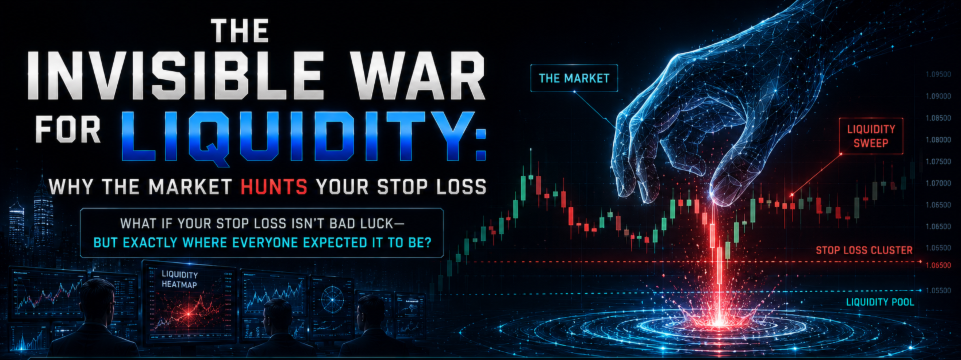
The Invisible War for Liquidity: Why the Market Hunts Your Stop Loss

The Invisible War for Liquidity: Why the Market Hunts Your Stop Loss
What if your stop loss was not bad luck, but exactly where everyone expected it to be. This is not a conspiracy theory article, and it deserves to be treated as neither pure paranoia nor pure coincidence. What actually explains the frustratingly common experience of a stop being touched right before the market reverses in the originally intended direction is genuine, well understood market microstructure mechanics, not a shadowy campaign targeting any individual trader personally.
Part One: Why Liquidity Is the Actual Fuel Markets Run On
Any large order needs a counterparty willing and able to fill it, and large participants specifically seek out areas of concentrated liquidity to execute efficiently without moving price excessively against their own position in the process. A resting stop order is, from a pure market mechanics perspective, exactly the kind of fillable liquidity large participants need, since a triggered stop order converts instantly into a market order, providing genuine, immediate counterparty liquidity the moment price reaches it. Liquidity pools are simply concentrations of exactly this resting order flow, and large orders are naturally drawn toward wherever that concentration genuinely exists.
Part Two: Where Stop Clusters Actually Form, and Why
Stop concentration is not mysterious once you understand where it comes from. Round, psychologically clean numbers attract a disproportionate share of stop placements simply because many independent traders find them visually convenient. Levels just beyond an obvious swing high or low attract stops because this exact placement is widely taught as standard technique, meaning many independent traders, following similar conventional guidance, arrive at very similar price levels without ever communicating with each other. Fixed distance stops derived from commonly used indicator settings produce a similar clustering effect, since many retail traders using comparable default settings land on comparable stop distances from comparable entries. None of this requires coordination. It simply requires enough independent traders following similar conventional heuristics to produce a large, statistically predictable concentration of orders sitting at very similar levels.
Part Three: Why Apparent Manipulation Is Often Just Market Mechanics
This distinction deserves careful, honest treatment rather than either dismissal or exaggeration. A large participant executing a legitimate order by seeking out a natural concentration of available liquidity is not manipulation, it is simply how large orders are executed efficiently in any liquid market, and this activity will mechanically coincide with clustered stop levels precisely because that is where the liquidity naturally concentrates, not because of any scheme targeting retail traders specifically. Genuinely illegal manipulation, such as spoofing, placing orders with no real intent to execute them purely to mislead other participants about actual supply and demand, is a real, separately regulated and prosecuted practice, but it is a fundamentally different phenomenon from the ordinary mechanical dynamic described above, and conflating the two obscures a genuinely useful, demystifying explanation with an unfounded and unproductive narrative of universal conspiracy.
Much of what feels, in the moment, like a stop being deliberately hunted is, more precisely, a large legitimate order finding exactly the liquidity concentration it needed, briefly touching that level to access it, and then continuing because there was never enough opposing conviction actually driving through that price to sustain movement beyond it, only enough activity to access the available liquidity sitting there.
Part Four: How to Place Stops More Robustly Against This Dynamic
- Avoid sitting exactly at the most obvious, textbook location. A stop placed precisely at a round number or precisely at the visible swing point itself sits in the single most crowded, most statistically predictable location available. A deliberate buffer beyond the obvious level, rather than directly at it, reduces vulnerability to a purely mechanical liquidity grab that reverses immediately after briefly touching the crowded, obvious point.
- Use volatility adaptive stop distances rather than a fixed, round number distance. A stop distance that scales with genuine current volatility is naturally less likely to coincide with the crowd's fixed, conventionally clean distances. This is precisely the principle behind the ATR based dynamic stop calculation inside ICONIC BTC AI+ and ICONIC GOLD AI+, where protective distance is derived from real, current market conditions rather than a fixed, psychologically convenient number shared by a large portion of other market participants.
- Pair adaptive distance with a sensible absolute cap. Both systems combine ATR adaptive calculation with an absolute point cap as a final safety boundary, ensuring the stop remains genuinely responsive to real conditions without ever becoming unreasonably wide during an extreme, temporary spike, a different purpose from crowd avoidance but a complementary discipline worth pairing with it.
- Accept that some stop outs reflect genuine, sustained moves rather than a liquidity grab. The goal is not eliminating every stop out entirely, which is neither realistic nor desirable, it is specifically avoiding the statistically predictable vulnerability of sitting exactly where a large, independently arrived at crowd of other traders also happens to sit.
Frequently Asked Questions
Is stop hunting a real phenomenon or just bad luck? It is best understood as genuine market microstructure mechanics rather than either pure coincidence or a deliberate scheme against any individual trader. Stops cluster at predictable levels because many independent traders use similar conventional placement heuristics, and large orders naturally seek out exactly this kind of concentrated liquidity to execute efficiently.
Is this the same thing as illegal market manipulation? No. Legitimate large orders seeking natural liquidity concentrations are normal market functioning. Genuinely illegal manipulation, such as spoofing with orders that were never intended to execute, is a separate, regulated practice and a fundamentally different phenomenon from ordinary liquidity seeking behavior.
Why do stops placed at round numbers get hit so often? Because a disproportionate number of independent traders place stops at psychologically clean, round levels, creating a large, predictable concentration of liquidity that naturally attracts large orders seeking exactly that kind of fillable liquidity.
How can a trader place stops more robustly against this dynamic? By avoiding the most obvious, textbook exact placement, using volatility adaptive rather than fixed round number distances, and accepting that avoiding every possible stop out entirely is neither realistic nor the actual goal.
Understanding the Mechanics Beats Fearing a Conspiracy
The market does not know or care about any individual trader's specific stop loss. It simply moves toward wherever concentrated liquidity genuinely exists, and understanding exactly why that liquidity concentrates where it does is far more useful than either dismissing the pattern as coincidence or exaggerating it into a deliberate personal vendetta. Genuine robustness comes from placing stops based on real, current volatility rather than the same conventional, crowded heuristics a large share of the market happens to share.
Explore systems built around exactly this principle, adaptive, volatility based stop calculation rather than fixed, crowded conventions, including ICONIC BTC AI+ and ICONIC GOLD AI+, at iconicfx.tech.
Risk Disclaimer. Trading foreign exchange, cryptocurrencies, commodities and other leveraged financial instruments carries a high level of risk and may not be suitable for all investors. The high degree of leverage can work against you as well as for you. Past performance is not indicative of future results. Automated trading systems, indicators and Expert Advisors do not guarantee profits and can produce losses. ICONIC.FX provides software tools only and does not provide investment advice, portfolio management or financial recommendations. You are solely responsible for your own trading decisions. Seek advice from an independent licensed financial advisor if you have any doubts.



![[iVISTscalp5]: EURUSD. Forecast First. Market Reaction Afterwards//October 12-16, 2026](https://c.mql5.com/6/1038/splash-preview-777972.png "[iVISTscalp5]: EURUSD. Forecast First. Market Reaction Afterwards//October 12-16, 2026")