Edge Decay: Why Even a Genuinely Real Trading Edge Fades, and What Actually Slows It Down

Edge Decay: Why Even a Genuinely Real Trading Edge Fades, and What Actually Slows It Down
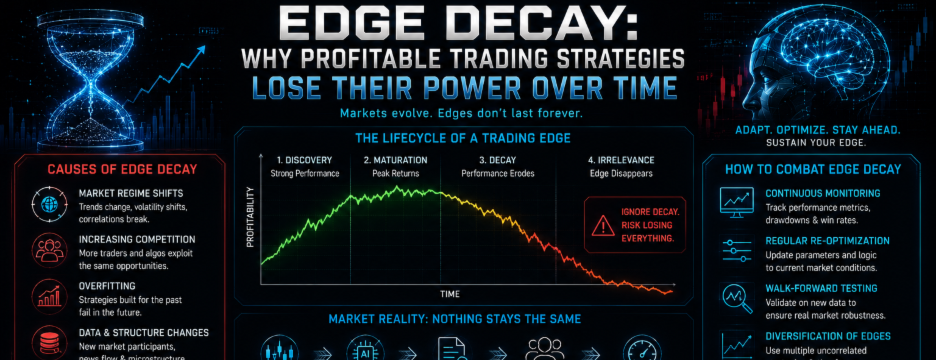
Here is a distinction almost nobody makes clearly, and it matters enormously. A strategy that never had a real edge to begin with, one that simply memorized historical noise, is not decaying when it fails live. It was never functioning in the first place, and its failure is simply the illusion finally becoming visible. Edge decay is a different and, in some ways, more unsettling phenomenon entirely. It describes a strategy with a genuinely real, properly validated edge, one that performed exactly as expected out of sample for a meaningful period, gradually losing its effectiveness over months or years as the world around it changes.
This article explains what causes genuine edge decay, why rising competition and market evolution are among the most under discussed reasons a real edge erodes, and how disciplined optimization and monitoring, done correctly rather than reflexively, actually help extend the useful life of a genuinely sound strategy.
What Edge Decay Actually Is, and Why It Differs From a Fake Edge Being Exposed
Overfitting produces a strategy that looked profitable in a backtest but never contained a genuine, repeatable pattern at all, an elaborate coincidence dressed up as intelligence. When such a strategy fails live, nothing has decayed, the illusion has simply been revealed. Edge decay describes something categorically different, a strategy that demonstrated genuine, validated performance on data it never touched during its own design, and then, having proven itself real, gradually loses effectiveness as external conditions shift around it. Both situations eventually produce the same visible symptom, declining live performance, but they demand entirely different diagnoses and entirely different responses, which is precisely why understanding the distinction matters before deciding what to do about a losing streak.
The Core Causes Behind a Genuine Edge Losing Its Effectiveness
- Crowding and competitive erosion. A genuinely profitable pattern that becomes known, or independently discovered, by enough market participants tends to erode simply through the collective act of being exploited, a well documented phenomenon broadly referred to as alpha decay in quantitative finance.
- Structural market evolution. New participants, new instruments, evolving regulation and shifting liquidity provision genuinely change the underlying mechanics of a market over time, altering the statistical relationships an edge originally relied upon.
- Changing cost structures. Spreads, execution costs and typical slippage patterns shift as market infrastructure evolves, meaning a strategy with genuinely thin original margins can see its real world profitability erode even if the underlying pattern itself has not fundamentally changed.
- Technology diffusion. An edge that once required genuinely sophisticated tooling can become commoditized as similar capability becomes widely accessible, gradually narrowing the advantage that once separated an early adopter from the broader market.
Market Evolution and Rising Competition: The Silent Erosion Nobody Discusses Enough
Of all the causes listed above, competitive erosion deserves the deepest attention, because retail traders rarely think about it at all. The assumption is understandable and almost always wrong, that an individual trader's position size is too small to meaningfully affect a market, so competition seems irrelevant to a small account. This misses the actual mechanism. Edge erosion through competition does not require any single participant to move the market. It requires enough independent participants collectively exploiting the same genuine pattern that the market's own statistical behavior around that pattern gradually shifts in response to being consistently exploited.
This is precisely why a pattern that worked cleanly when relatively few traders understood it can quietly weaken as awareness spreads, not because the pattern was ever fake, but because the market itself adapts to being systematically exploited by a growing population of participants doing essentially the same thing. This is one of the most under appreciated forms of edge decay specifically because it produces no dramatic headline, no regulatory announcement, no obvious single cause a trader can point to. It simply accumulates quietly in the background.
How Disciplined Optimization and Monitoring Genuinely Help, Done Correctly
Here is where real nuance matters. Reflexively re optimizing a strategy every time performance dips is precisely the behavior that risks curve fitting a system to recent noise rather than genuinely responding to real decay. The correct discipline is monitoring first, intervention only when monitoring provides genuine evidence, not the reverse.
Track rolling performance windows, not only cumulative statistics. A strategy's all time performance figures can mask a meaningful recent decline. Comparing a defined recent window, such as trailing performance over the last several months, against the equivalent historical baseline the strategy was originally validated on, reveals genuine drift far more clearly than an all time average ever could.
Distinguish a normal losing streak from genuine statistical drift. Every valid strategy experiences losing periods as an expected part of its probability distribution. Genuine edge decay reveals itself through a sustained, meaningful divergence from expected statistics over an extended window, not a handful of losing trades that any properly functioning system will naturally produce from time to time.
Recalibrate against genuinely new, out of sample evidence, never against the same historical window repeatedly. When monitoring does reveal genuine drift, the correct response is validating any adjustment against fresh, previously unseen data, exactly the walk forward discipline that separates responsible recalibration from the same curve fitting trap that created a fake edge in the first place.
Built In Defense: Systems Engineered to Notice Their Own Decay
The strongest practical defense against edge decay is not vigilant manual monitoring alone. It is architecture that continuously monitors and recalibrates itself against live evidence as a built in structural property, complementing rather than replacing a trader's own oversight. ICONIC TITAN AI embodies this directly, its neural ensemble continuously retrained through an ongoing walk forward backfill process that feeds live hit rate statistics back into the model, meaning its own calibration is perpetually checked against fresh, genuinely unseen results rather than trusted indefinitely from a single point of validation performed once.
Inside ICONIC KYBERNETIC AI+, the self calibrating confidence gate built on Adaptive Conformal Inference continuously regulates its own threshold against a stated, numeric error rate target, functioning as a genuine, automatic decay detection mechanism, if the system's realized accuracy begins drifting from its target, the gate itself adjusts in response rather than requiring an external audit to notice the shift months later. Its regime filter performs a related function, continuously tracking real, updated profitability statistics for specific market conditions rather than trusting a single historical assessment indefinitely.
ICONIC BTC AI+ and ICONIC GOLD AI+ address the same underlying problem through differentiable plasticity, continuously rewiring the strength of their own internal neural connections in response to live feedback, a structural mechanism for ongoing adaptation rather than a single calibration left to quietly decay unattended over months or years.
Frequently Asked Questions About Edge Decay
What is the difference between edge decay and overfitting? Overfitting produces a strategy that never contained a genuine edge, an illusion created by fitting historical noise. Edge decay describes a genuinely real, properly validated edge that gradually loses effectiveness over time due to external forces such as market evolution and rising competition.
Why does competition erode a genuinely profitable trading pattern? When enough independent participants discover and exploit the same real pattern, their collective activity gradually changes the market's own statistical behavior around that pattern, a well documented phenomenon known as alpha decay, even though no single participant's position size individually moves the market.
How can a trader tell a normal losing streak apart from genuine edge decay? By comparing rolling recent performance windows against the strategy's original validated baseline over a meaningful timeframe, rather than relying on all time cumulative statistics that can mask a genuine recent decline, or reacting to a handful of losses that any valid strategy will naturally produce occasionally.
Is frequent re optimization a good defense against edge decay? Only when grounded in genuine, out of sample evidence of real drift. Reflexive re optimization based purely on a recent rough patch risks recreating the exact curve fitting trap that produces a fake edge in the first place, rather than addressing genuine decay.
Can a trading system defend against its own edge decay automatically? Yes, through architecture built to continuously monitor and recalibrate itself against live evidence, such as self calibrating confidence gates, ongoing walk forward retraining, and continuously updated regime specific statistics, rather than relying solely on a human noticing decline after the fact.
No Edge Lasts Forever. Build for the Decay, Not Just the Discovery
Finding a genuine trading edge is only the beginning of the real work. Every edge, however real and however properly validated, exists inside a market that keeps evolving and a competitive landscape that keeps growing, and pretending otherwise is its own quiet form of denial. The traders and systems that endure are not the ones who found a permanent, unchanging edge. They are the ones built to notice erosion honestly and respond to genuine evidence, rather than either ignoring a real decline or reflexively chasing every recent fluctuation.
Explore systems engineered with exactly this ongoing self awareness, from the continuously retrained signal engine of ICONIC TITAN AI, through the self calibrating architecture of ICONIC KYBERNETIC AI+, to the continuously adaptive neural cores of ICONIC BTC AI+ and ICONIC GOLD AI+, at iconicfx.tech.
Risk Disclaimer. Trading foreign exchange, cryptocurrencies, commodities and other leveraged financial instruments carries a high level of risk and may not be suitable for all investors. The high degree of leverage can work against you as well as for you. Past performance is not indicative of future results. Automated trading systems, indicators and Expert Advisors do not guarantee profits and can produce losses. ICONIC.FX provides software tools only and does not provide investment advice, portfolio management or financial recommendations. You are solely responsible for your own trading decisions. Seek advice from an independent licensed financial advisor if you have any doubts.


