The Complete Guide to ICT Power of Three (PO3) & AMD Framework

The ICT Power of Three (PO3): The Ultimate Guide to Accumulation, Manipulation, and Distribution
There is a distinct reason why most retail traders can look at a price chart, correctly identify the overall trend, and still consistently lose money. They see the movement of price, but they are entirely blind to the narrative behind it.
They buy breakouts just as they reverse. They place their stop-losses in the exact locations where the market is programmed to seek liquidity. They treat every hour of the trading day as if it holds the same opportunity, completely ignoring the fundamental relationship between time and price.
If you have ever felt like the market is actively hunting your stop-loss before moving in your original direction, you are not experiencing bad luck. You are experiencing the algorithm.
To trade alongside institutional order flow, you must stop looking at the market as a series of random fluctuations and start viewing it as a highly structured delivery mechanism. This mechanism is governed by a framework known as the Power of Three (PO3), or Accumulation, Manipulation, and Distribution (AMD).
This comprehensive guide will break down the complete institutional logic behind PO3. You will learn how to read the true daily narrative, how to identify the trap of the Judas Swing, and how to position yourself for the true distribution of price.
Why This Framework Matters
After more than 20 years of studying and participating in financial markets across Forex, Commodities, Indices, and Cryptocurrency markets, one recurring observation became impossible to ignore:
Price repeatedly delivered itself through a recognizable sequence of accumulation, manipulation, and distribution.
While most traders focused on indicators, patterns, and predictions, the underlying market narrative remained largely misunderstood.
Over the years, extensive chart study revealed that institutional delivery follows a structured process built around liquidity, time, and market participation. The Power of Three (PO3) framework became one of the most practical ways to explain that process.
The purpose of this article is not to promote a trading tool or sell a trading strategy.
Its purpose is to help traders understand how market delivery works, how liquidity is engineered, and why the relationship between time, price, and liquidity is often more important than the indicators traders place on their charts.
The Power of Three AMD Protocol was later developed as a way to visualize this framework in a structured and objective manner.
TABLE OF CONTENTS
1. What Is Power of Three (PO3)?
2. Understanding AMD
3. Why Most Traders Fail to Recognize PO3
4. The True Daily Narrative
5. Accumulation Phase (ACN)
6. Manipulation Phase (MPN)
7. Distribution Phase (DBN)
8. Multi-Asset Applications
9. Advanced PO3 & Fractal Delivery
10. Chart Study Library
11. Indicator Application
12. Real Trading Workflow
13. Common Mistakes
14. Frequently Asked Questions
15. Conclusion
16. About the Author
17. Additional Resources
18. Disclaimer
SECTION A — THE MARKET THEORY
What Is the Power of Three (PO3)?
The Power of Three (PO3) is a core concept within the Inner Circle Trader (ICT) methodology. At its foundation, PO3 is the structural life cycle of a price movement. It is the sequence through which the interbank delivery algorithm engineers liquidity, pairs institutional orders, and delivers price to its intended targets.
It is critical to understand that PO3 is not merely a chart pattern. It is not a retail "flag" or "head and shoulders" formation. PO3 is a macroeconomic blueprint of market manipulation and delivery.
The Institutional Logic
Financial markets do not move because of retail buying and selling pressure. The volume required to move currencies, indices, or commodities is vast. Institutions, central banks, and large market makers operate with positions so large that they cannot simply click "buy" or "sell" at market price. If they did, they would suffer massive slippage, ruining their average entry price.
To fill massive orders, smart money requires a counter-party. To buy heavily, they need an abundance of sellers. To sell heavily, they need an abundance of buyers.
How do they find these buyers and sellers? They create them. The Power of Three is the three-step process used to engineer this liquidity.
Understanding AMD: Accumulation, Manipulation, Distribution
The PO3 framework is executed through three distinct phases: Accumulation, Manipulation, and Distribution (AMD).
1. Accumulation (ACN)
Accumulation is the building phase. During this period, price typically consolidates within a defined range. To the untrained eye, the market is simply moving sideways. However, beneath the surface, a highly orchestrated event is occurring: the engineering of retail liquidity.
As price bounces between a defined support and resistance level, retail traders begin to interact with the range. They place buy orders at support and sell orders at resistance. More importantly, breakout traders place buy-stops above the range and sell-stops below it.
During the Accumulation phase, the algorithm is deliberately building a concentrated pool of liquidity (stop-losses and pending orders) on both sides of the market.
2. Manipulation (MPN)
Manipulation is the trap. Once sufficient liquidity has been accumulated, the algorithm will aggressively drive price out of the range. This artificial move is designed to accomplish two things:
-
Trigger Stop-Losses: It hunts the stops of the traders who correctly anticipated the true trend but placed their stops too close to the accumulation range.
-
Induce the Wrong Side: It triggers the pending breakout orders of retail traders, trapping them in false positions.
This sudden, aggressive move in the opposite direction of the true daily trend is known as the Judas Swing. It is an artificial run on liquidity. For institutions to distribute a massive long position, they use the manipulation phase to drive price down, triggering retail sell-stops. Institutions buy these sell-stops at a discount.
3. Distribution (DBN)
Distribution is the true delivery of price. Once the manipulation has cleared the engineered liquidity and institutional orders have been paired, the market rapidly reverses and begins its true directional expansion.
This phase is characterized by energetic price action, displacement, and the creation of Fair Value Gaps (FVGs). The distribution phase will not stop until it reaches a higher-timeframe liquidity objective—usually a previous major high or low, or a significant imbalance in price.
Professional Chart Analysis: EURUSD Bearish PO3
The Narrative Setup: The chart above illustrates a pristine Bearish Power of Three delivery.
Accumulation Phase: Notice the gray box on the left. Price consolidates tightly during the pre-London hours. Retail traders are boxing this range, placing buy-stops above and sell-stops below.
Manipulation Phase: As the London Killzone opens, price suddenly spikes upward out of the accumulation box. This is the classic Judas Swing. Why did it occur? The algorithm needed to trigger buy-side liquidity (breakout longs and short-sellers' stop-losses) to engineer a massive pool of buyers. Smart money pairs their massive sell orders with these engineered buy orders.
Distribution Phase: Once the liquidity is swept and institutional shorts are positioned at a premium, the trap closes. Price aggressively displaces downward, forming the massive bearish expansion.
What Traders Should Have Anticipated: An experienced ICT trader noting a bearish daily bias would ignore the initial spike up during London, recognize it as a hunt for premium liquidity, and wait for the aggressive reversal to enter short toward the downside targets.
Figure 1: EURUSD Bearish PO3 Example
A textbook Accumulation → Manipulation → Distribution sequence.
The London session performs the manipulation by sweeping buy-side liquidity above the accumulation range before New York distributes price lower toward external liquidity.

Why Most Traders Fail to Recognize PO3
Traders consistently fall victim to the AMD cycle for several distinct reasons:
-
Ignoring Time: Retail indicators are time-blind. The algorithm, however, operates strictly on time-based macros. Accumulation, Manipulation, and Distribution are highly correlated with specific session timings.
-
Chasing the Judas Swing: When the manipulation phase occurs, it looks extremely convincing. It is often accompanied by a sudden influx of volume or a minor news event. Retail traders see the large candle, assume it is a breakout, and jump in—exactly when smart money is preparing to reverse the market.
-
Misunderstanding Liquidity: Most traders view support and resistance as concrete walls that will stop price. Institutional traders view support and resistance as pools of liquidity to be aggressively targeted and swept.
The True Daily Narrative: Time and Price
To trade the Power of Three successfully, you must master the concept of the True Daily Narrative. You cannot simply look at a 15-minute chart in isolation. You must anchor your analysis to specific time-based reference points.
The Daily Open and NY Midnight Open
In the ICT methodology, the opening price at 00:00 EST (New York Midnight) is the most critical reference point of the trading day. It serves as the baseline for institutional premium and discount pricing for the intraday cycle.
-
If the higher-timeframe narrative is Bullish, the algorithm will seek to accumulate and manipulate below the NY Midnight Open price. Institutions want to buy at a deep discount relative to the true daily opening price.
-
If the higher-timeframe narrative is Bearish, the algorithm will seek to accumulate and manipulate above the NY Midnight Open price. Institutions want to sell at a premium relative to the day's open.
Deep Dive: The Manipulation Phase (MPN)
The Manipulation phase is the most critical element of the PO3 cycle. If you can correctly identify the manipulation, you hold the key to institutional entries.
The Mechanics of the Judas Swing: The Judas Swing is a false expansion. If the daily bias is bearish, the manipulation phase will feature heavy, aggressive bullish candles. This terrifies early shorts into closing their positions and excites breakout buyers into entering longs.
Where Does Manipulation End? The manipulation phase does not stop arbitrarily. It is mathematically programmed to reach specific institutional points of interest (POIs):
-
External Liquidity: Sweeping the highs or lows of the previous day (PDH/PDL), the previous session, or the accumulation range itself.
-
Internal Liquidity: Reaching into a higher-timeframe Fair Value Gap (FVG) or an institutional Order Block (OB).
Deep Dive: The Distribution Phase (DBN)
The Distribution phase is the reward for patience. This is the stage where price moves efficiently toward its target.
Figure 2: XAUUSD Distribution Phase Example
Gold forms a premium-priced manipulation, rejects a bearish Fair Value Gap, confirms a Change in the State of Delivery (CISD), and distributes aggressively toward the Previous Day Low (PDL).

Professional Chart Analysis: XAUUSD Bearish Distribution & Entry
The Narrative Setup: This Gold (XAUUSD) chart highlights exactly how a trader engages with the Distribution phase after the Manipulation has occurred.
Manipulation (The High): Price opens and aggressively pushes upward to create the High of the Day. This is the manipulation phase, pushing into a deep premium to hunt buy-side liquidity.
The Structural Shift (CISD): Following the high, price displaces downward rapidly. This Change in the State of Delivery (CISD) confirms the manipulation is over and the distribution has begun.
Smart Money Entry (-FVG): Distribution rarely happens in a straight line. As marked on the chart, price offers a "Pullback / Retracement" into a newly formed Bearish Fair Value Gap (-FVG). This is the institutional optimal trade entry.
Liquidity Targeted: The distribution phase completely rejects the premium zone and drives relentlessly downward to sweep the Previous Day Low (PDL) marked at the bottom of the chart.
Characteristics of Distribution:
-
Displacement: Price does not move sluggishly. It displaces violently, leaving behind Fair Value Gaps (as seen in the Gold chart above) because smart money is pricing the asset aggressively in one direction.
-
The Draw on Liquidity: Distribution is magnetic. It is drawn toward the opposing side's liquidity pool. If accumulation was swept at the top (buy-stops taken), the distribution will not stop until it sweeps the bottom (sell-stops taken).
Multi-Asset Nuances: How PO3 Adapts
While the AMD framework is universal, its time-based delivery sequence varies depending on the asset class.
Indices (NAS100, US30, SPX)
Equities and indices march to the beat of the New York session. While London can provide manipulation, indices frequently accumulate during the pre-market (07:00 - 08:30 EST). Manipulation is violently injected right at the 08:30 EST news embargo or the 09:30 EST Equities Open. Distribution typically unfolds from 09:30 to 11:30 EST.
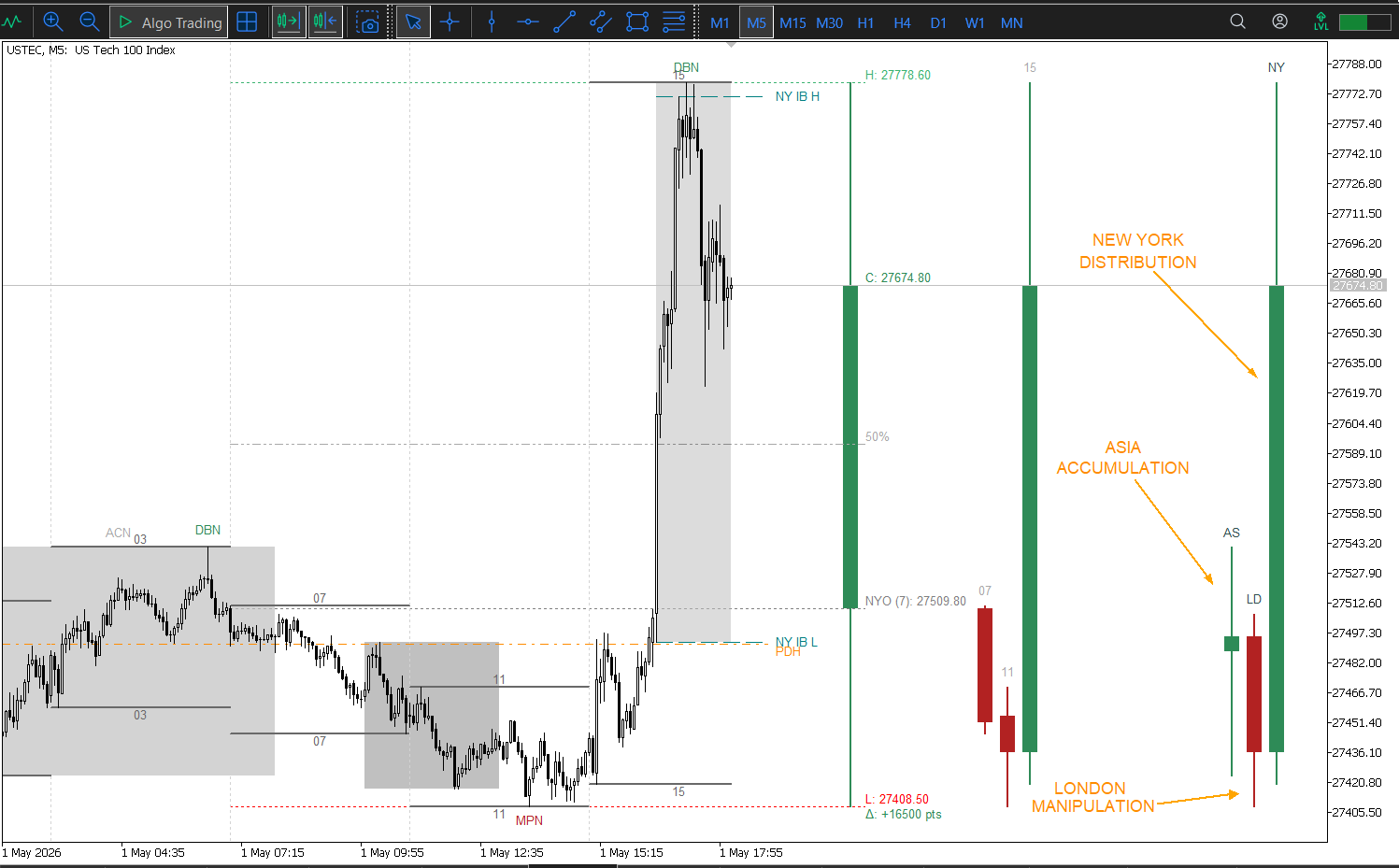
Professional Chart Analysis: USTEC (NASDAQ) Bullish PO3 Timing
The Narrative Setup: This chart beautifully visualizes how specific sessions own specific phases of the PO3 cycle on Index futures. Look at the synthetic macro candles drawn on the right side.
Asia Accumulation: The Asian session creates the initial tight consolidation, building liquidity on both sides without displaying a clear trend.
London Manipulation: The London session violently drives price down below the Asian range, forming the Low of the Day. This is the Judas Swing engineering sell-side liquidity.
New York Distribution: The New York open acts as the catalyst for the massive true expansion. NY inherits the low created by London and distributes price aggressively higher, breaking all previous structures.
Session Sequencing: This is the textbook "London Low, New York Continuation" model. Traders expecting a bullish day should never buy the Asian range; they wait for London to sweep the lows before positioning for the New York rally.
Figure 3: USTEC Session-Based PO3
A classic Index delivery model where Asia creates accumulation, London engineers manipulation, and New York performs the primary distribution phase.
Forex (EURUSD, GBPUSD)
Forex pairs are heavily influenced by the London session. The classic PO3 profile for a major currency pair features accumulation during Asia, manipulation (Judas Swing) at the London Open (02:00 - 05:00 EST), and distribution carrying through the New York session.
Crypto (BTCUSD)
Cryptocurrency trades 24/7, making traditional session times less rigid. However, the algorithm still anchors to the NY Midnight Open and the New York 09:30 EST open. Weekend price action often serves as a macro Accumulation phase, with early Monday providing the Manipulation, leading to mid-week Distribution.
Advanced PO3: The Fractal Nature of Delivery
The most vital concept to grasp is that PO3 is fractal. It exists simultaneously on multiple timeframes.
A Daily candle is simply a PO3 cycle. The wick at the bottom is the manipulation; the body is the distribution.
However, within the Daily Manipulation phase, if you drop to a 15-minute chart, you will find a nested, smaller-scale Accumulation, Manipulation, and Distribution cycle.
To achieve high-probability trading, you must align the timeframes:
-
Weekly PO3: Determines the macro draw on liquidity.
-
Daily PO3: Determines the directional bias for the specific day.
-
Session PO3 (Intraday): Provides the specific entry mechanism (AMD) aligned with the Daily and Weekly bias.
When you understand the theory of market delivery, you no longer fear the Judas Swing—you hunt it.
Chart Study Library: Real-World PO3 Examples
This section summarizes the real-world examples discussed throughout the article and highlights how the Power of Three framework manifests across different asset classes.
Example 1 — EURUSD
Daily Bias
Bearish
Liquidity Target
Previous Session Low
Accumulation (ACN)
Asian Session Consolidation
Manipulation (MPN)
London Buy-Side Liquidity Sweep
Distribution (DBN)
New York Selloff
Trade Narrative
London raided liquidity above the Asian range, trapped breakout buyers, and distributed price lower toward external sell-side liquidity.Example 2 — XAUUSD
Daily Bias
Bearish
Liquidity Target
Previous Day Low (PDL)
Accumulation (ACN)
Early Session Range
Manipulation (MPN)
Premium Liquidity Raid
Distribution (DBN)
CISD Confirmation + Bearish Expansion
Trade Narrative
Gold expanded into premium pricing, swept liquidity, rejected from a bearish FVG, confirmed a CISD, and distributed lower toward the PDL.
Example 3 — USTEC
Daily Bias
Bullish
Liquidity Target
Buy-Side External Liquidity
Accumulation (ACN)
Asian Session
Manipulation (MPN)
London Sell-Side Liquidity Sweep
Distribution (DBN)
New York Rally
Trade Narrative
Asia created balance, London engineered the low of the day, and New York delivered the primary bullish expansion.
Example 4 — BTCUSD
Daily Bias
Bearish
Liquidity Target
Previous Day Low
Accumulation (ACN)
Range Formation
Manipulation (MPN)
PDH Sweep
Distribution (DBN)
Discount Delivery
Trade Narrative
Bitcoin swept PDH, entered premium territory, and then transitioned into distribution as liquidity shifted toward the downside objective.
SECTION B — INDICATOR APPLICATION
(Note: The following section introduces a comprehensive technical tool designed to visualize the concepts taught in Section A. The framework always supersedes the tool; the tool simply provides operational efficiency.)
Visualizing the Framework: How the PO3 & AMD Indicator Solves the Problem
Understanding the theory of Accumulation, Manipulation, and Distribution is intellectually satisfying, but executing it in real-time is operationally demanding. A trader must simultaneously track the NY Midnight Open, monitor fractal AMD cycles across the Daily, H4, and 15-minute charts, map out dynamic Killzones, and identify liquidity pools—all while managing the psychological pressure of a live market.
The PO3 & AMD Master Toolkit was developed specifically to eliminate this cognitive overload. It acts as an execution-assistance overlay, mathematically defining and visualizing the institutional delivery sequence directly on your chart.
Here is how the indicator translates pure theory into actionable visual data.
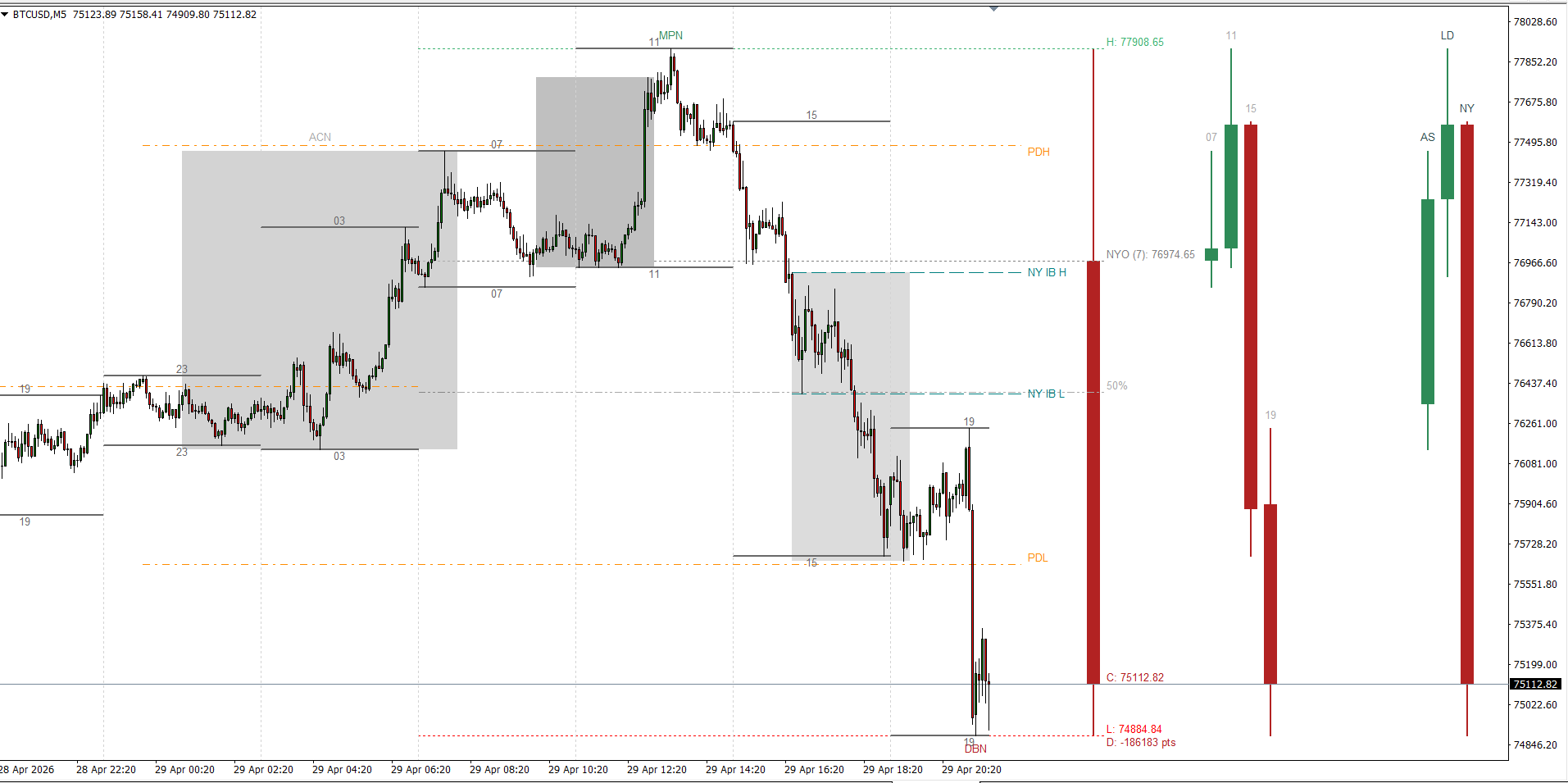
Figure 4: BTCUSD PO3 AMD Protocol Visualization
The indicator automatically identifies accumulation zones, manipulation events, distribution phases, equilibrium levels, and liquidity targets while maintaining alignment with the broader daily narrative.
Professional Chart Analysis: BTCUSD via the PO3 Indicator
What the Indicator Reveals: This chart shows the power of having the complete PO3 framework automated.
Automated Phase Mapping: The indicator automatically boxes the Accumulation (ACN) zone and identifies the precise moment of Manipulation (MPN).
Liquidity Tracking: Notice the orange dashed lines labeled "PDH" (Previous Day High) and "PDL" (Previous Day Low). The indicator visually proves that the MPN phase spiked exactly to sweep the PDH before reversing.
Equilibrium & Context: The indicator automatically draws the 50% Equilibrium line of the structural range. As price drops into the massive Distribution (DBN) phase, the trader can clearly see they are exiting the premium zone and driving toward the discount liquidity (PDL).
Macro Projections: On the far right, the indicator plots the synthetic Daily and Weekly candles, allowing the intraday trader to see exactly how their 5-minute structure aligns with the macro open, high, low, and close.
1. Fractal PO3 Projections (Daily, Weekly, H4)
Instead of forcing you to switch between timeframes to understand the macro narrative, the indicator automatically plots the Open, High, Low, and Close (OHLC) projections of the Daily, Weekly, and H4 Power of Three cycles onto your lower timeframe execution charts.
-
Application: You instantly see where the current 5-minute candle sits relative to the Daily Open and NY Midnight Open.
2. Algorithmic AMD Labels
The indicator programmatically identifies the structural characteristics of the phases and labels them directly on the chart (ACN, MPN, DBN).
-
Application: It highlights tight, range-bound price action as ACN. When price breaks out of this box, it maps the MPN phase. Once a structural shift occurs, it confirms the DBN phase, removing the guesswork.
3. Automated Killzone Mapping
Time is the master of price. The indicator draws precise, shaded time-boxes for the Asian, London, and New York Killzones based on EST.
-
Application: It prevents you from entering setups in "dead zones" and forces you to hunt for the Manipulation phase exactly when institutional volume is scheduled to enter the market.
4. Smart Sweep Alerts & Liquidity Levels
The indicator automatically tracks external liquidity pools (Previous Day High/Low, Asian Session High/Low) and maps them as dynamic lines.
-
Application: The "Smart Sweep" module generates real-time alerts when price raids these specific liquidity levels during an active Killzone. This signals that the Manipulation phase may be terminating.
Real Trading Workflow: Executing PO3
To utilize the indicator effectively, follow this strict, step-by-step workflow. The tool provides the data; you provide the logic.
Step 1 — Identify the Higher Timeframe Context
Open your chart and look at the Weekly and Daily PO3 Projections provided by the indicator. Identify your bias. If the Daily PO3 indicates a bullish expansion toward a higher timeframe liquidity pool, your rule for the day is simple: Only look for long setups.
Step 2 — Locate Accumulation (ACN)
Wait for the indicator to map the ACN phase, typically during the Asian Killzone box. Note the high and the low of this ACN box. These are your engineered liquidity targets. Do not execute trades inside this box.
Step 3 — Wait for Manipulation (MPN) & The Smart Sweep Alert
As the London or New York Killzone opens, wait for price to aggressively break below the ACN box (since your bias is bullish). Watch for price to drop below the NY Midnight Open line drawn by the indicator. When price sweeps the ACN low, wait for the Smart Sweep Alert to trigger. You are now in the Judas Swing.
Step 4 — Confirm the Structure Shift
Do not catch the falling knife. Allow the Manipulation phase to do its job. Wait for price to violently reverse and break above the most recent swing high created during the drop. This Market Structure Shift (MSS) confirms the transition to Distribution.
Step 5 — Enter the Distribution (DBN) Phase
Once the structure shifts, the indicator will project the DBN phase. Enter on a pullback into a Fair Value Gap within the newly formed discount zone. Target the opposing liquidity pool—the buy-stops resting above the ACN box.
15 Common Mistakes Traders Make with PO3 and AMD
Even with a deep understanding of the theory and visual aids, traders often sabotage themselves. Avoid these critical errors:
-
Ignoring the Higher Timeframe Bias: Trading an intraday manipulation setup that goes against the weekly institutional order flow.
-
Trading Outside Killzones: Trying to force setups during the pre-Asian dead zone or the NY afternoon chop.
-
Entering Before the Sweep: Anticipating the manipulation before the liquidity pool has actually been raided.
-
Chasing the Judas Swing: Mistaking the aggressive manipulation candle for a true breakout and entering in the wrong direction.
-
Forgetting NY Midnight Open: Trading without knowing where the current price sits relative to the true daily open.
-
Trading Every Session: Feeling obligated to trade London and New York every day, rather than waiting for a clear accumulation profile.
-
Moving Stop-Losses to Breakeven Too Early: Choking the trade before the distribution phase has fully displaced.
-
Targeting Arbitrary RR Ratios: Using a fixed 1:3 risk-to-reward instead of targeting the actual logical liquidity pools (e.g., Asian High).
-
Confusing a Retracement with Manipulation: A standard pullback in a trend is not a Judas Swing; manipulation specifically targets concentrated stop-loss pools.
-
Ignoring High-Impact News: Failing to realize that 08:30 AM CPI or NFP is the exact catalyst the algorithm uses for the manipulation phase.
-
Overleveraging the Sweep: Entering with massive size exactly at the liquidity level without waiting for a structural shift confirmation.
-
Blindly Trusting Labels: Taking a trade just because the indicator prints "DBN" without aligning it with the daily narrative.
-
Trading Illiquid Pairs: Trying to apply strict time-based PO3 logic to minor or exotic forex pairs that lack clean institutional algorithms.
-
Impatience During Accumulation: Taking low-probability trades inside the ACN box out of boredom.
-
Neglecting Internal Liquidity: Forgetting that after a major external sweep, price will seek internal liquidity (FVGs) before continuing.
Frequently Asked Questions (FAQs)
1. What does PO3 stand for?
Ans: PO3 stands for Power of Three. It refers to the daily algorithmic sequence of Accumulation, Manipulation, and Distribution (AMD) used by institutions to deliver price.
2. What is the difference between PO3 and AMD?
Ans: They are essentially the same concept. PO3 is the overarching structural logic. AMD is the specific phase-by-phase breakdown of that structural logic.
3. What is a Judas Swing?
Ans: The Judas Swing is a false price movement designed to trick retail traders into entering the wrong direction and to trigger stop-losses before the true directional move begins.
4. Why is the NY Midnight Open so important?
Ans: Institutions use 00:00 EST as the reset point for the daily algorithmic cycle. It acts as the ultimate zero-line to determine if price is currently in a premium (expensive) or discount (cheap) state for the day.
5. Does PO3 work on all asset classes?
Ans: Yes, but the timing varies. Forex aligns heavily with London, Indices with New York, and Gold/Crypto have their own unique algorithmic timings.
6. Can PO3 be used on lower timeframes like the 1-minute chart?
Ans: Yes, PO3 is fractal. However, a 1-minute AMD cycle is only high-probability if it aligns with a higher-timeframe point of interest (POI).
7. How long does the Accumulation phase usually last?
Ans: It varies, but the most prominent accumulation typically spans the Asian session (4-6 hours) or the pre-New York lunch hour (1-2 hours).
8. Do I buy the sweep of liquidity?
Ans: Advanced traders can use limit orders at external liquidity, but the safer approach is to wait for the sweep, let price reverse, and enter on the subsequent Market Structure Shift.
9. What if the day doesn't have an Accumulation phase?
Ans: If there is no clear accumulation, the probability of a clean manipulation/distribution cycle drops significantly. It is better to sit out and wait for a clear profile.
10. How does the indicator know when ACN is happening?
Ans: The indicator uses complex volatility and range-bound metrics combined with specific time-windows to identify periods of price consolidation.
11. Does the PO3 indicator repaint?
Ans: A high-quality PO3 indicator uses static historical data (like daily open lines and time-boxes) and real-time break-of-structure logic. It should not retroactively repaint past phases.
12. Can I use the PO3 strategy for prop firm challenges?
Ans: Yes. Because PO3 focuses on high-probability setups during specific times of the day, it is excellent for managing risk and avoiding overtrading.
13. What is the difference between Internal and External Liquidity?
Ans: External liquidity rests above old highs and below old lows (stop-losses). Internal liquidity exists within the price range, usually in the form of Fair Value Gaps (imbalances).
14. What time zone should I use for Killzones?
Ans: All ICT and Smart Money Concepts timing is strictly based on New York local time (EST/EDT).
15. Where should my stop-loss go during the Distribution phase?
Ans: Your stop-loss should be placed safely below the low of the Manipulation phase (the Judas Swing wick). Once distribution displaces, that low should be protected by the algorithm.
Conclusion
Understanding the Power of Three (PO3) and the Accumulation, Manipulation, and Distribution (AMD) framework is the bridge between retail confusion and institutional clarity. By shifting your focus away from lagging patterns and toward the relationship between time, price, and liquidity, you align yourself with the interbank delivery algorithm.
You must remember that the market is not random. The consolidation you find boring is precisely engineered accumulation. The sudden breakout that hits your stop-loss is calculated manipulation. The trend you missed because you were stopped out is the true distribution.
Elevate Your Execution
The concepts outlined in this guide provide you with the master blueprint for market delivery. However, seeing the matrix in real-time requires immense focus and discipline.
For traders who understand the logic but struggle with the daily, multi-timeframe execution, the PO3 & AMD Master Toolkit provides the ultimate visual advantage. It is designed for dedicated ICT and SMC practitioners who want to remove the cognitive fatigue of chart markups, and it is not for traders looking for a blind "buy/sell" signal machine without doing the analytical work.
Stop trading the random movements of price. Start trading the narrative.
About the Author
Ravi Gurung is a financial market practitioner with more than two decades of market experience across Forex, Commodities, Indices, and Cryptocurrency markets.
His work focuses on market structure, liquidity engineering, institutional order flow, and algorithmic market delivery models. Through extensive chart study and practical market observation, he developed the Power of Three AMD Protocol to help traders visualize the relationship between accumulation, manipulation, and distribution across multiple timeframes.
He is the founder of AlgoPulse Quant Lab, where he develops professional-grade indicators, trading tools, and educational resources designed for discretionary and systematic traders.
Further Study & Practical Application
Understanding the Power of Three (PO3) and the Accumulation, Manipulation, and Distribution (AMD) framework is only the beginning.
Like any market model, the real value comes from observing it repeatedly across different asset classes, sessions, and market conditions.
If you are studying PO3 in greater depth, consider reviewing the chart examples presented throughout this article and applying the framework to your own analysis of Forex, Gold, Indices, and Cryptocurrency markets.
For traders who prefer a structured visual approach, the Power of Three AMD Protocol was developed to help map accumulation, manipulation, distribution, liquidity levels, session narratives, and higher-timeframe PO3 structures directly on the chart.
Regardless of the tools you choose to use, the objective remains the same:
Understand the narrative before seeking the trade.
Master the framework first. The execution becomes significantly easier afterward.
Additional Resources
• CRT Ghost Candle HTF Fractal
Disclaimer
The information presented in this article and any accompanying tools, indicators, examples, charts, or illustrations is provided solely for educational and analytical purposes.
Nothing contained herein should be interpreted as financial advice, investment advice, trading advice, or a recommendation to buy or sell any financial instrument.
All trading and investing activities involve substantial risk, and past performance does not guarantee future results. Market conditions can change rapidly, and no methodology, strategy, or indicator can guarantee profits or eliminate risk.
Readers are solely responsible for their own trading and investment decisions and should conduct independent research and apply appropriate risk management before participating in financial markets.