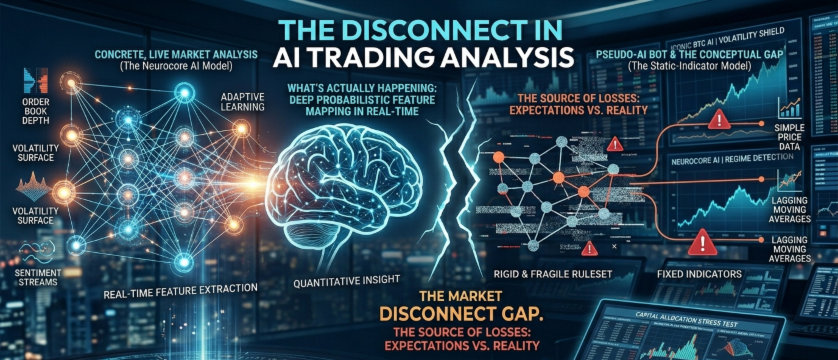

What AI Analysis Actually Does in Financial Markets
Most discussions of artificial intelligence in trading start in the wrong place. They open with capabilities. With impressive vocabulary. With carefully assembled lists of what machine learning can theoretically accomplish. What they consistently skip is the more useful question: what is actually happening inside these systems when they analyze a market, and how much of what gets sold under the AI label has anything to do with that?
The gap between those two things is where most traders lose money.
Not through fraud, necessarily. Through a more mundane problem: buying a product based on a description of technology that the product does not actually contain, then making allocation decisions based on results that were never going to hold up under real market conditions.
Understanding AI analysis at a concrete level, not a conceptual one, changes how you evaluate everything in this space.
What the System Is Actually Processing
When an AI system claims to analyze a market, the first question worth asking is: what data is going into it? The answer tells you more about what the system can and cannot do than any number of performance claims.
There are meaningful differences between the data types available to algorithmic systems, and those differences are not academic. A system trained on closing prices and derived indicators is working with a heavily processed, time delayed representation of market activity. By the time a daily close is computed and fed into a model, a significant amount of information about what actually happened during that session, who was buying, who was selling, how the order book behaved during the major moves, has already been compressed out of existence.
Order flow and microstructure data sits at the other end of that spectrum. It is the raw, unprocessed record of what is actually occurring in the market: every transaction, the depth of the order book at each price level, the ratio of aggressive to passive order placement, the size distribution of trades hitting the book. This data is considerably harder to work with. It requires processing infrastructure that most retail development environments cannot handle. But it carries a qualitatively different type of information because it reflects actual participant behavior rather than the aggregated price residue of that behavior.
The distinction matters because markets move before they show up on charts. Institutional positioning, by definition, precedes the price movement it eventually causes. If your analytical system only processes price, it will always be reacting to movements that have already happened. A system processing order flow can, in principle, identify the statistical signatures of accumulation before it becomes a directional move.
That is a real capability. It is also a technically demanding one to implement correctly, which is why most products claiming to do it do not actually do it.
Where AI Genuinely Changes the Analytical Picture
There are specific domains where machine learning outperforms human analysis not marginally but structurally. No amount of effort or expertise closes these gaps because they are rooted in properties of human cognition that cannot be overridden through discipline alone.
Processing consistency is one. A trained model evaluating the same inputs will produce the same output every time. A human analyst evaluating the same chart at 9am Monday versus 11pm Friday after a difficult week will not. This sounds like a small thing until you recognize how much of discretionary trading underperformance traces back not to flawed strategy logic but to inconsistent application of that logic under varying emotional and physiological states.
Dimensionality is another. The human mind can hold perhaps four or five variables in working memory simultaneously and reason about their interactions with any accuracy. A neural network processing financial data operates across hundreds of input dimensions, learning their joint statistical properties including relationships that only manifest under specific conditional combinations. An analyst watching RSI, volume, and a trend line is making decisions from a three dimensional slice of a market generating information across far more dimensions than that. The model does not get tired. It does not simplify because simplification is cognitively necessary. It processes the full dimensionality of the data it was given.
Speed matters in specific contexts. Not because faster is always better, but because certain analytical tasks, particularly those involving real time microstructure evaluation, require processing new information at speeds where human analysis is simply not a viable option. The question is not whether a human analyst could eventually reach the same conclusion. It is whether they could reach it before the market has already moved past the point where that conclusion is actionable.
The Limitation Nobody Explains Clearly Enough
Here is the problem that makes AI analysis in trading genuinely difficult and that is almost universally undersold in product marketing.
Financial markets are not stationary. The statistical relationships between variables that exist today may not exist in six months, because the market is composed of adaptive participants who observe patterns and adjust their behavior in response to them. A model trained on historical data learns the structure of a market that no longer fully exists by the time the model is deployed.
This is not a flaw that better training data or more sophisticated architecture eliminates. It is a structural feature of the problem. Markets are a reflexive system: the act of analysis and the trading that follows from it is itself a market input that changes the thing being analyzed.
What this means practically is that any AI analytical system requires ongoing monitoring, validation against out of sample performance, and willingness to retrain or pause when the model's performance metrics suggest its learned representation no longer fits current conditions. This is continuous engineering work, not a one time development effort. Products that were trained once, released, and are never updated are deteriorating from the moment of deployment. The question is only how quickly.
A related issue is what the training data does not contain. Every model is trained on the market history that existed and survived. It has no representation of scenarios that have not yet occurred. Market events without historical precedent, including systemic liquidity crises, correlated flash crashes across asset classes, and structural changes to market microstructure from new regulatory frameworks, exist outside the model's learned distribution. This does not make AI analysis useless under stress conditions. It means the system's behavior under those conditions should be explicitly governed rather than left to the model to figure out on the fly.
The Infrastructure Gap
The vocabulary used to describe serious institutional AI analysis is identical to the vocabulary used to describe indicator scripts with renamed optimization outputs. Both say neural network. Both say deep learning. The difference is everything that is not visible in the product description.
Genuine machine learning applied to financial markets requires substantial computational resources for training, careful construction of training datasets that separate historical periods to prevent information leakage, rigorous out of sample testing that explicitly evaluates performance on data the model has never seen, and ongoing monitoring infrastructure that tracks whether live performance aligns with expected model behavior.
This work is expensive and slow and produces results that are inherently uncertain rather than the clean, confident performance projections that sell products. It also produces models that behave differently under different conditions, that have periods of underperformance, and that require human oversight to operate responsibly. None of those characteristics make for compelling marketing copy.
Most retail AI trading products skip this infrastructure entirely. The development cycle is: write indicator logic, optimize parameters against historical data, package with an AI themed description, release. The result passes a surface level inspection of the vocabulary while containing none of the substance. Knowing what the real infrastructure looks like makes the gap visible immediately.
Two Layers, Two Different Questions
At ICONIC.FX, the analytical architecture is built around a fundamental distinction between two questions that most systems try to answer with one model: where is the market likely to go, and is this an environment where acting on that answer is appropriate.
The execution layer addresses the first question. ICONIC BTC AI processes order flow and microstructure data for the Bitcoin market through trained deep learning layers to generate directional probability estimates. The model identifies statistical patterns in how the order book behaves before sustained directional moves, allowing the system to position before those moves are visible on price charts. Every signal that reaches execution has a defined risk attached to it before the order is placed. No position averaging. No logic that treats a losing trade as a reason to add size.
The governance layer addresses the second question. ICONIC NEUROCORE AI runs continuously as a risk supervision system, evaluating whether the current market environment falls within the statistical conditions under which the execution layer was designed to operate. When it detects volatility expansion, regime transitions, or liquidity dislocations that fall outside expected parameters, it compresses exposure, adjusts structural risk levels, or suspends execution entirely until conditions normalize. This layer does not try to predict where price will go. Its job is to know when the environment is hostile enough that not trading is the better answer.
The combination is what makes the system's risk profile honest. Directional analysis and risk governance are solved separately, by architectures designed for each specific problem, rather than compressed into a single model that is asked to do both.
Live performance across both layers is independently tracked through MQL5 Signals and publicly verifiable. The track record reflects real market conditions including drawdown periods, not selectively presented intervals.
On Evaluating AI Analysis Honestly
A serious AI analytical system should be able to answer specific questions about its architecture: what data it processes, how the model was trained, what it is optimized to predict or maximize, how performance is monitored after deployment, and what the behavior is under adverse conditions.
Vague answers to those questions, or answers that consist entirely of restating marketing claims in technical vocabulary, indicate that there is no specific answer to give. That is worth knowing before capital is committed.
The systems that hold up under that scrutiny are fewer than the marketing landscape suggests. They exist. Finding them requires asking the right questions and being willing to look past the equity curve screenshots to the architectural substance underneath.
ICONIC NEUROCORE AI+ is available on the MQL5 Marketplace for MetaTrader 5, supporting XAUUSD and BTCUSD.
Risk Disclosure: Trading in leveraged financial instruments involves significant risk of loss. Past performance does not guarantee future results. Capital is at risk. This content is informational and does not constitute financial advice.