
Trading attracts many promises.
Faster entries.
Perfect indicators.
Guaranteed signals.
Fully automated profits.
The next tool that finally solves the market.
At Pricewerk, we take a different position.
The purpose of a trading tool is not to promise certainty. The purpose is to create structure.
Markets are uncertain. Price can move against any setup. Backtests can fail in forward conditions. A good trading tool should not hide this reality. It should help the trader work with it more professionally.
This is why we build rule-based trading tools.
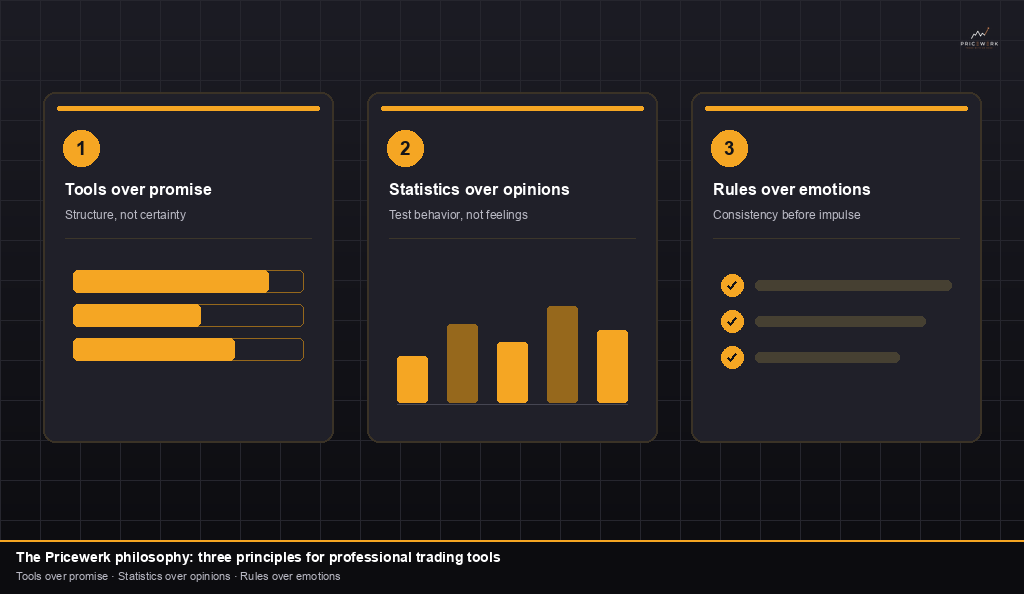
The philosophy is simple:
Tools over promise.
Statistics over opinions.
Rules over emotions.
These principles define how we think about indicators, Expert Advisors, utilities and trading workflows.
1. Tools Over Promise
A trading product should not be built around exaggerated claims.
A serious tool should answer practical questions:
- What market behavior does it analyze?
- Which conditions does it evaluate?
- Where is the setup valid?
- Where is the setup invalid?
- How is risk defined?
- Which market conditions should be avoided?
- How can the trader test the logic?
- What are the limitations?
A tool should support the trading process. It should not replace responsibility.
Our tools are designed to provide structure, not certainty. They are built to help traders identify, test and execute defined trading ideas more consistently.
This is different from marketing based on profit promises.
A serious trader does not need a tool that sounds impressive. A serious trader needs a tool that can be understood, tested and controlled.
2. Why Rule-Based Trading Matters
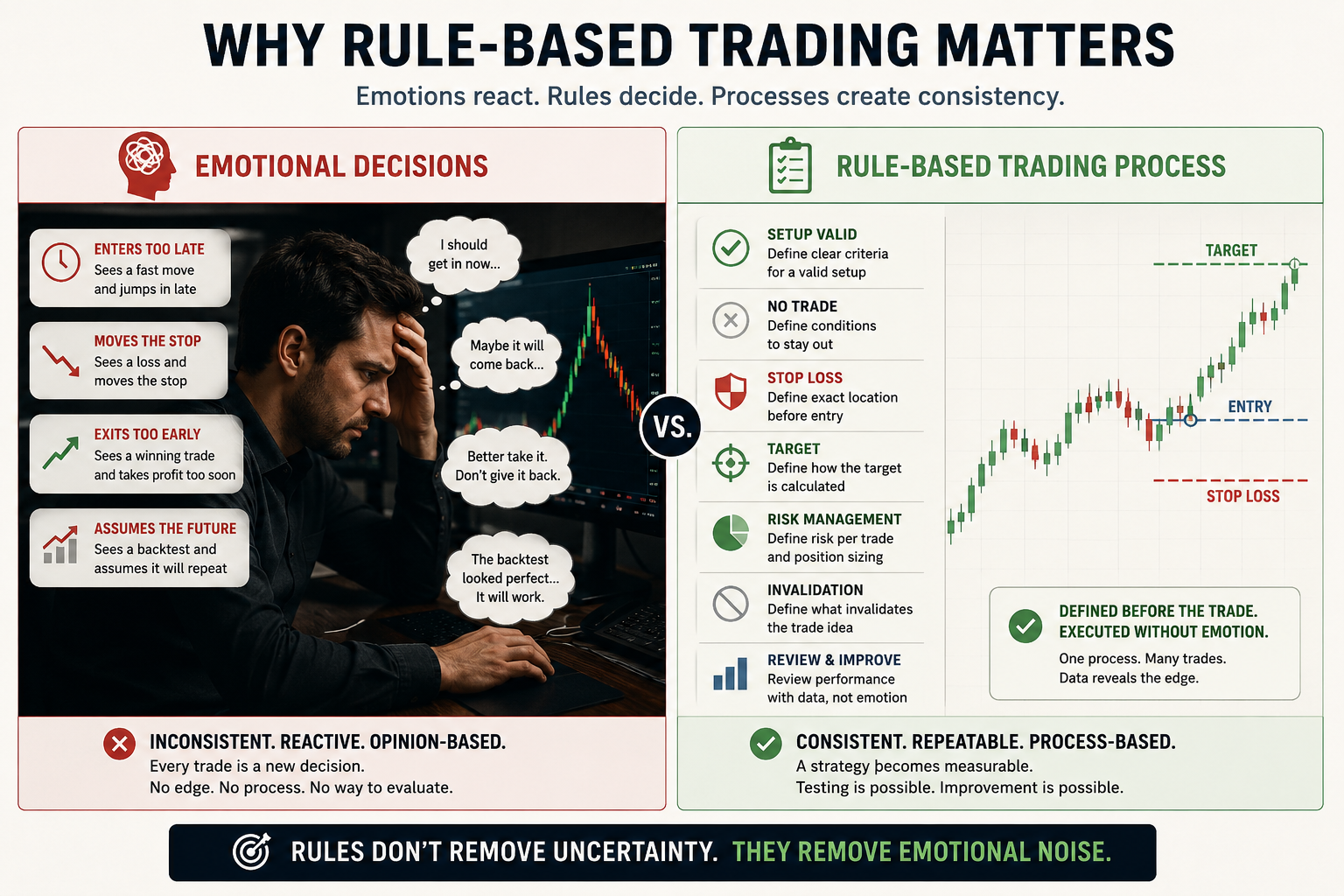
Trading decisions can easily become emotional.
A trader sees a fast move and enters too late.
A trader sees a loss and moves the stop.
A trader sees a winning trade and exits too early.
A trader sees a backtest and assumes the future will behave the same way.
Rule-based trading does not remove uncertainty, but it can reduce emotional decision-making.
A rule-based model defines:
- when a setup is valid
- when no trade should be taken
- where the stop loss belongs
- how the target is calculated
- how much risk is allowed
- when a trade is invalid
- how performance should be reviewed
Rules create consistency.
Consistency makes testing possible.
Without rules, every trade becomes a separate opinion. With rules, a strategy can be evaluated as a process.
3. Statistics Over Opinions
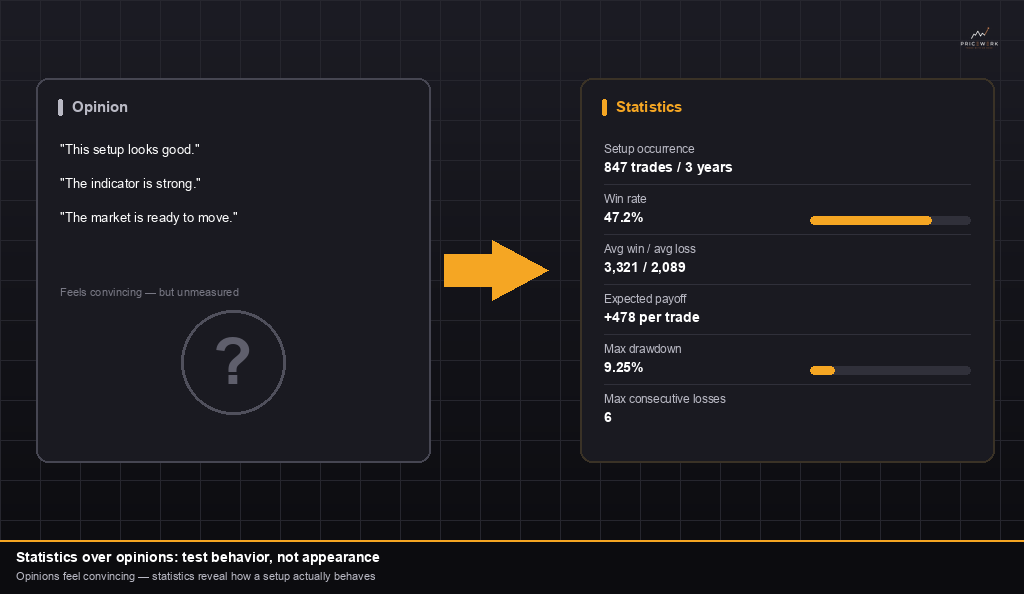
Many traders have strong opinions about the market.
They believe a pattern works.
They believe an indicator is strong.
They believe a setup is obvious.
They believe a market is ready to move.
But opinions are not enough.
A trading idea becomes more useful when it can be tested and reviewed statistically.
Important questions include:
- How often does the setup occur?
- What is the win rate?
- What is the average win?
- What is the average loss?
- What is the expected payoff?
- What is the maximum drawdown?
- How many consecutive losses occurred?
- Does performance depend on one short period?
- Does the strategy survive different market phases?
- Does it behave differently across symbols and timeframes?
Statistics do not guarantee future results. But they help traders understand behavior.
That is the point.
Our tools are built to support a more statistical way of thinking. The trader should not rely only on how a setup looks. The trader should review how the setup behaves.
4. Rules Over Emotions
Emotions are part of trading.
Fear, greed, impatience and revenge trading can affect decisions. Even experienced traders are not immune to them.
A good trading tool should reduce unnecessary emotional pressure.
For example, an Expert Advisor can execute a predefined setup without hesitation. An indicator can highlight a structure without forcing the trader to search manually. A utility can calculate risk and lot size more accurately than a trader under pressure.
This does not mean automation removes risk.
It means automation can help apply rules consistently.
We don't build tools around the idea that the trader should stop thinking. The opposite is true. The trader should think before the trade by defining the process, testing the rules and setting risk parameters.
Once the process is defined, the tool can help execute or visualize it more consistently.
5. Why Trading Tools Should Be Transparent
A trading tool should be understandable.
A trader should know what kind of market behavior the tool is designed to evaluate.
A Turtle Soup model is different from a VWAP continuation model.
A Golden Pocket pullback system is different from a breakout compression model.
A Smart Money indicator is different from a generic trend indicator.
Each tool should have a clear identity.
A transparent tool should explain:
- the basic concept
- the setup structure
- the risk logic
- the best market conditions
- the conditions that require caution
- the limits of the model
This is important because traders should not use tools blindly.
A tool becomes more valuable when the trader understands what it is designed to do and what it is not designed to do.
6. Why Risk Control Comes First
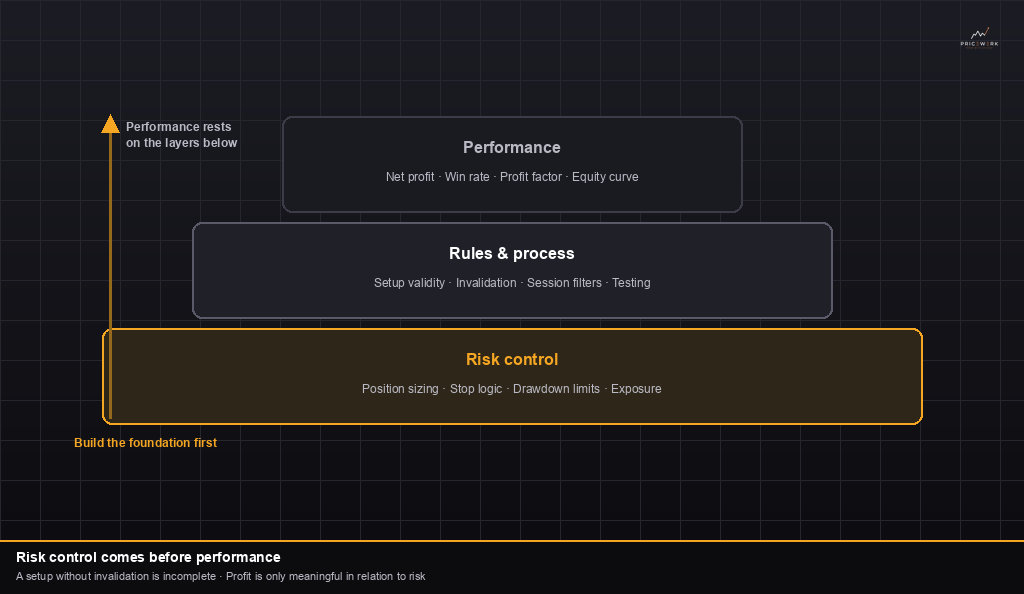
A trading strategy is not strong because it makes profit in one backtest.
A strategy becomes more useful when risk is defined and controlled.
Risk control includes:
- position sizing
- stop-loss logic
- maximum drawdown limits
- daily loss control
- maximum trades
- session filters
- spread filters
- exposure limits
- realistic testing
A tool that produces signals without risk logic can be dangerous.
Our tools are built around the idea that risk control comes before performance. A setup without invalidation is incomplete. A trade without position sizing is incomplete. An EA without exposure control is incomplete.
Profit is only meaningful when it is understood in relation to risk.
7. Why Backtesting Matters
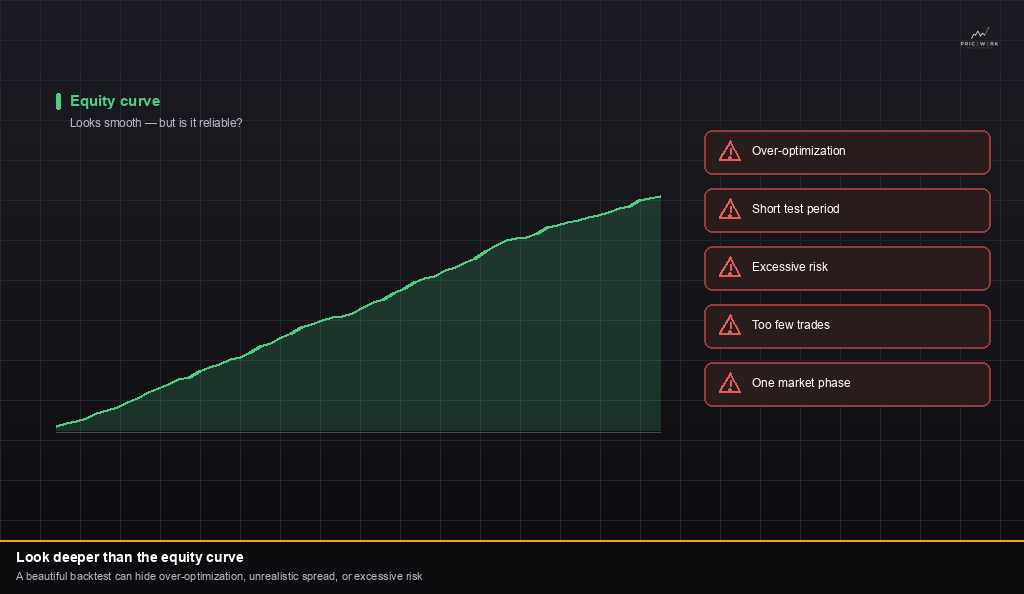
Backtesting is not a promise of future performance.
It is a research tool.
A useful backtest helps traders understand how a strategy behaved under historical conditions. It shows drawdown, trade frequency, losing streaks, profit factor, expected payoff and sensitivity to market phases.
However, a backtest must be interpreted carefully.
A beautiful equity curve can be misleading if it comes from:
- over-optimization
- unrealistic spread
- too short a test period
- poor data quality
- excessive risk
- one exceptional market phase
- too few trades
- curve-fitted parameters
We encourage traders to look deeper than the equity curve.
A good strategy should be evaluated by behavior, stability and risk profile, not by one attractive screenshot.
8. The Role of Expert Advisors
An Expert Advisor can execute rules automatically.
This is useful because automated execution can reduce hesitation, manual errors and inconsistent decision-making.
But an EA is not a guarantee of profit.
An EA simply follows its logic. If the logic is good, tested and risk-controlled, automation can be valuable. If the logic is weak or the risk settings are too aggressive, automation can apply bad decisions very efficiently.
This is why an EA should always be tested, configured and monitored.
A professional EA should provide:
- clear strategy logic
- defined risk settings
- stop-loss and take-profit structure
- spread filters
- session filters
- exposure limits
- drawdown protection
- transparent inputs
- realistic backtesting behavior
The value of an EA is not that it removes responsibility. The value is that it can apply a defined process consistently.
9. The Role of Indicators
An indicator should support analysis.
It should make structure easier to read, not make the chart more confusing.
A good indicator helps traders identify:
- relevant zones
- trend structure
- possible setup areas
- invalidation levels
- alerts
- statistics
- market context
But an indicator should not be treated as a guarantee.
A signal is not a command. A zone is not a prediction. A visual pattern is not a complete trade.
The trader still needs to evaluate risk, confirmation and context.
Our indicators are designed to support structured decision-making, not emotional chart chasing.
10. The Role of Utilities
Utilities are often underestimated.
A trading utility may not generate signals, but it can improve execution quality.
For example, a utility can help with:
- lot-size calculation
- order preparation
- semi-automated execution
- stop-loss and take-profit placement
- risk preview
- trade confirmation
- signal-to-order workflow
This can reduce mistakes.
A trader may identify a good setup but still place the wrong lot size, miscalculate stop distance or enter too late. A utility can help make the execution process more controlled.
This fits our philosophy:
Better tools. Better process. Less emotion.
11. Why No Tool Should Be Sold as Certainty
Markets are uncertain by nature.
No indicator can know the future.
No EA can guarantee profit.
No backtest can remove risk.
No strategy works in all market conditions.
A serious provider should acknowledge this.
We don't build around certainty claims. We build around process quality.
A tool should help the trader:
- see structure more clearly
- test ideas more systematically
- execute rules more consistently
- manage risk more consciously
- avoid emotional decisions
- understand limitations
That is a realistic and professional purpose.
12. The Pricewerk Standard
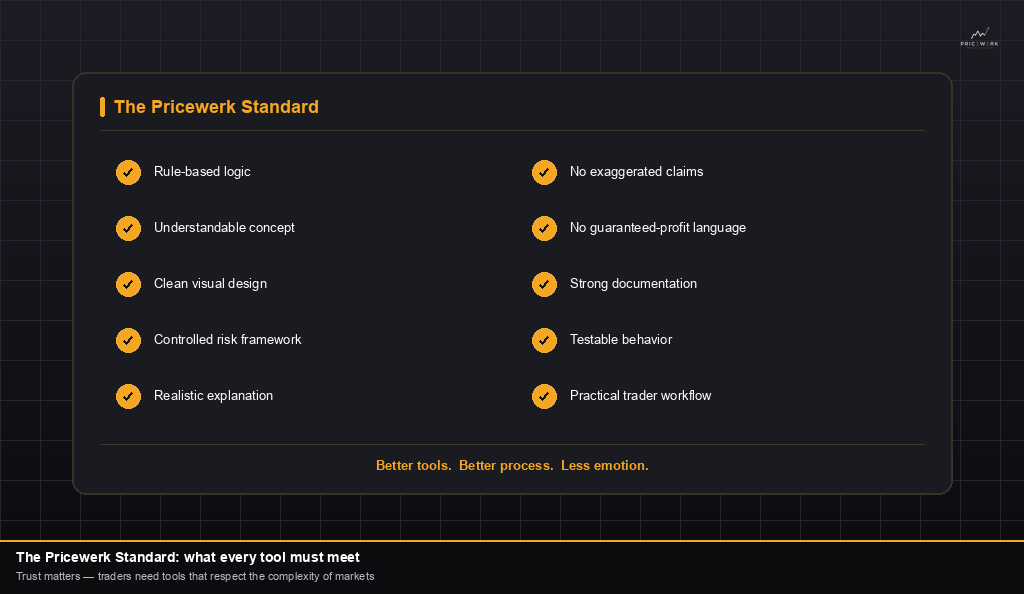
Our tools follow a clear standard:
- rule-based logic
- understandable concept
- clean visual design
- controlled risk framework
- realistic explanation
- no exaggerated claims
- no luxury or hype imagery
- no guaranteed-profit language
- strong documentation
- testable behavior
- practical trader workflow
This standard is important because trust matters.
Traders do not need more noise. They need tools that respect the complexity of markets.
13. Final Thoughts
We build rule-based trading tools because trading needs structure.
The market will always remain uncertain. But the trading process can be made more disciplined.
A good trading tool should not promise success. It should support better decisions.
That is the core idea behind Pricewerk:
Tools over promise.
Statistics over opinions.
Rules over emotions.
The goal is not to sell certainty.
The goal is to build tools that support a structured, risk-aware and repeatable trading process.
Risk Notice
Trading foreign exchange, CFDs and other leveraged products involves significant risk and may not be suitable for every trader. Trading tools, indicators, Expert Advisors, backtests and strategy examples do not guarantee future results. Always test trading tools carefully in a demo environment before considering live use. Use risk settings that match your personal risk tolerance.