
# Global Financial Outlook: Structural Reconfiguration and Strategic Sector Analysis
25 May 2026, 06:30

0
108
# Global Financial Outlook: Structural Reconfiguration and Strategic Sector Analysis
The global financial landscape is undergoing a phase of profound structural reconfiguration. Markets are no longer reacting solely to traditional interest rate cycles but to three dominant macroeconomic forces: **geopolitical fragmentation** (necessitating supply chain redesign), a **structurally higher inflation floor**, and the massive deployment of capital toward **Artificial Intelligence infrastructure**.
Below is a detailed analytical and institutional breakdown of global markets, their key sectors, and the regions reshaping the economic chessboard.

---
## 1. Macroeconomic Context and Regional Growth
For the current period, projections from the International Monetary Fund (IMF) and the World Bank indicate moderate but divergent global growth, ranging between **3.1% and 3.3%**. While advanced economies show signs of fatigue—particularly in Europe—emerging markets, led by the dynamism of South Asia, continue to serve as the primary engine of expansion.
As illustrated in growth projection maps, expansion is not uniform. The resilience of the United States contrasts with the stagnation of the Eurozone, while India consolidates its position as the world's fastest-growing major economy.
---
## 2. Foreign Exchange (Forex) Markets and Central Bank Dynamics
Currency markets directly reflect the decoupling of monetary policies among major economic powers:
* **U.S. Dollar (USD – Index: DXY):** Maintains its status as a global safe-haven currency and hegemonic reserve asset. Although the Federal Reserve (Fed) proceeds cautiously toward neutral rates, the U.S. fiscal risk premium keeps long-term bond yields elevated, underpinning the greenback's strength.
* **Euro (EUR):** Trades under pressure due to macroeconomic weakness across the Eurozone. The European Central Bank (ECB) faces a dilemma: maintain rates to anchor core inflation or ease policy to avert a technical recession in Europe's industrial core.
* **Japanese Yen (JPY):** Following the definitive exit from negative interest rates, the Bank of Japan (BoJ) continues a highly gradual process of monetary tightening, enabling the Yen to recover ground from multi-year lows.
* **Chinese Yuan (CNY / CNH):** Closely managed by the People's Bank of China (PBoC). Beijing aims to preserve currency stability to prevent capital outflows while deploying aggressive monetary stimulus to revitalize domestic consumption.
---
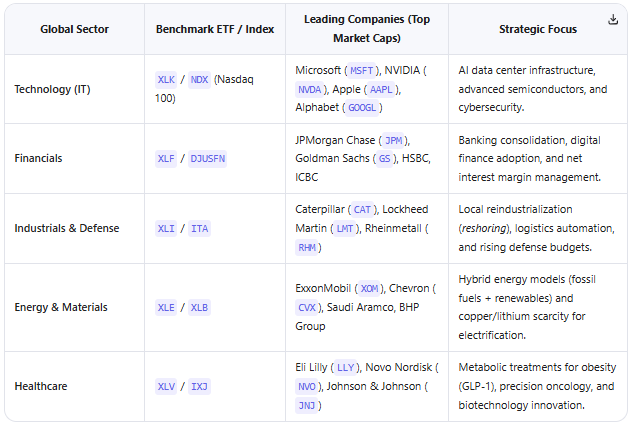
## 3. Global Sector Mapping: Tickers, Indices, and Leading Companies
Global equity market value remains heavily concentrated. The technology sector, alongside financials and industrials, accounts for more than half of the planet's total market capitalization.
This distribution underscores the dominant weight of Information Technology (21%) and Financial Services (17%)—sectors that dictate the trajectory of the world's major benchmark indices.
### Reference Sector Table
---
## 4. Fundamental Country Analysis by Region
### Americas
* **United States:** Remains the cornerstone of developed markets. Growth hovers around **2.1%**, supported by robust corporate investment in technology and a stabilized labor market—though closely monitored amid rising public debt accumulation.
* **Mexico:** Consolidated as a strategic *nearshoring* hub for the North American market. Despite currency volatility linked to political factors, foreign direct investment inflows remain resilient.
* **Brazil:** The region's commodities powerhouse. Balances a complex fiscal agenda with massive agricultural and energy exports that sustain its trade surplus.
### Europe
* **Germany:** Europe's industrial engine faces structural headwinds due to persistently high energy costs and weakening external demand for capital goods. Growth remains near flat, below 1%.
* **United Kingdom:** Exhibits a gradual recovery. The Bank of England operates cautiously amid labor market rigidity and sticky services inflation.
### Asia-Pacific
* **India:** Stands as the premier global growth story, expanding at rates exceeding **6%**. Physical and digital infrastructure development is attracting global capital seeking supply chain diversification alternatives.
* **China:** Navigating a phase of managed stabilization (growth ~**4.4%**). Policy focus has shifted decisively from real estate toward "high-value manufacturing"—including electric vehicles, battery technology, and semiconductor self-sufficiency.
* **Japan:** Experiencing a financial renaissance driven by corporate governance reforms, the return of moderate inflation, and the strategic repositioning of its technology corporations within the advanced hardware sector.

---
> *Disclaimer: This analysis is for informational purposes only and does not constitute financial advice. Market conditions are subject to rapid change; investors should conduct independent due diligence and consult qualified professionals before making investment decisions.*



![[iVISTscalp5]: EURUSD. Forecast First. Market Reaction Afterwards//October 12-16, 2026](https://c.mql5.com/6/1038/splash-preview-777972.png "[iVISTscalp5]: EURUSD. Forecast First. Market Reaction Afterwards//October 12-16, 2026")